Author: admin
-
Smart Chicken
The latest product from Berlin’s booming startup scene, a touch-sensitive smart chicken! An extremely low maintenance cockerel which operates on just the environmentally friendly pressure of one finger. No feed or batteries required and guaranteed free from electromagnetic emissions and all unpleasant odours.
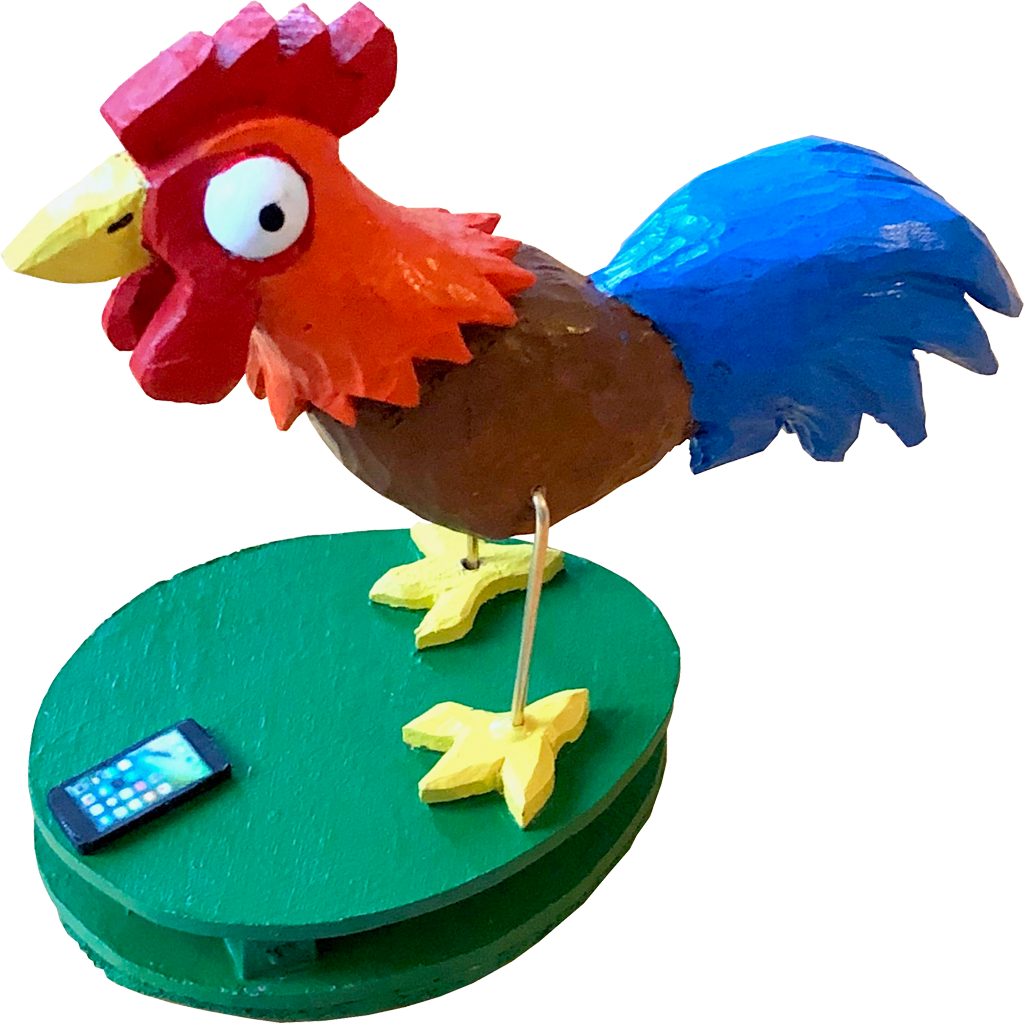
What does this cock a doodle do? Eternally patient it pecks away at its state of the art miniature smartphone. Dreadful anti-avian discrimination by the developers mean that every attempt with his beak is bleak. With feathers but no fingers this bird of little brain will forever be barred from crowing onto the Internet, which is probably no bad thing.
-
Goldesel
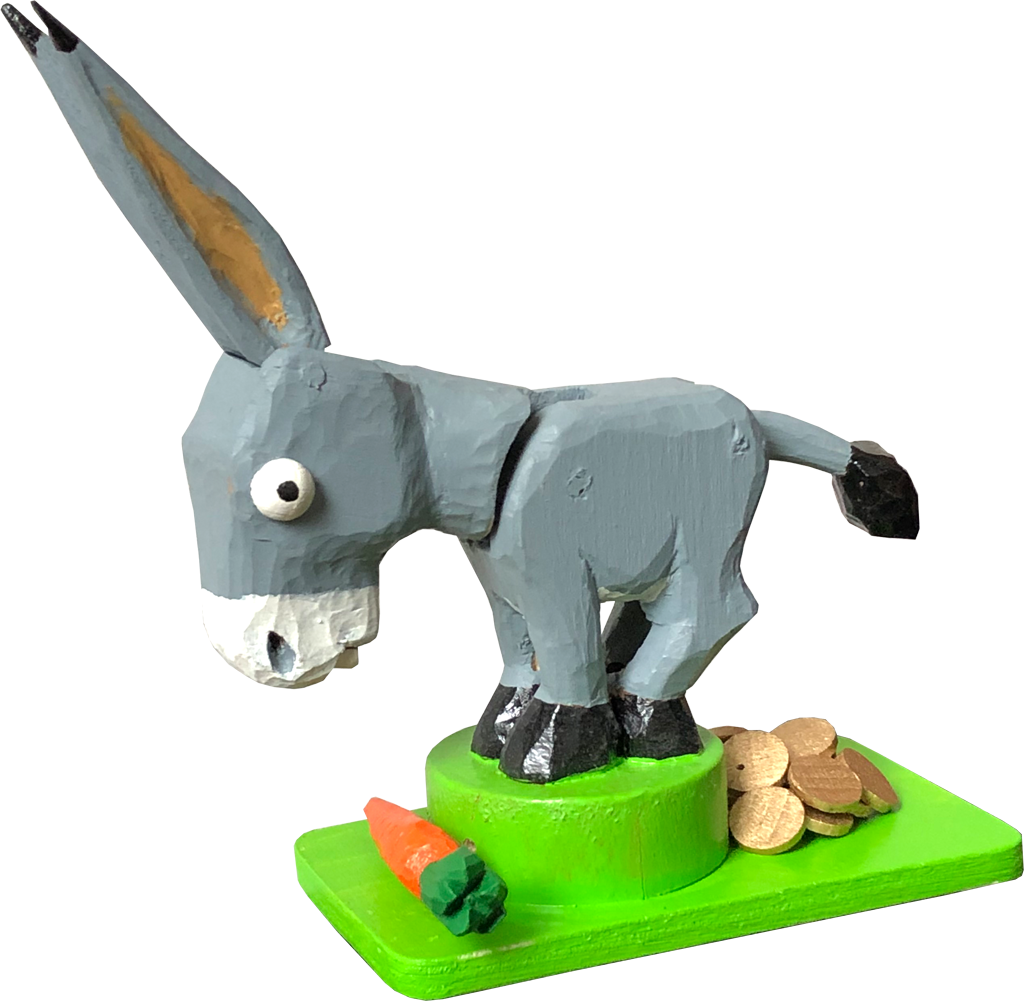
Goldesel plays a role in one of the European fairytales collected by the Brothers Grimm.
According to the fable, all you have to do is say “bricklebrit” and Goldesel’s droppings will turn to pure gold ducats!
This wooden version of that fabulous animal has its own magic. Touch its single carrot and Goldesel will lift its head in wonder and, delicately used, Goldesel will waggle one of its ears. That can’t compare with the 24 carats heaped at the other end, but if you can find the one special, magical ducat, Goldesel will respond by politely lifting his tail. Unfortunately, so far despite lifting its tail “bricklebrit” doesn’t seem to have the desired effect with my limewood version. Maybe it’s my pronunciation, but I haven’t given up hope yet.
-
Goldesel
Video on Youtube – https://www.youtube.com/watch?v=6_SsgYUONhw
Goldesel plays a role in one of the European fairytales collected by the Brothers Grimm. All you had to do was say the word “bricklebrit” and the magical donkey’s droppings turned to pure gold ducats!
This wooden version of that fabulous animal has its own magic. Touch its single carrot and Goldesel will lift its head in wonder and, delicately used, Goldesel will waggle one of its ears. That can’t compare with the 24 carats heaped at the other end, but if you can find the one special, magical ducat, Goldesel will respond by politely lifting his tail. Unfortunately, so far despite lifting its tail “bricklebrit” doesn’t seem to have the desired effect with my limewood version. Maybe it’s my pronunciation, but I haven’t given up hope yet. Maybe your version will work better?
How to make your Goldesel

Draw one ear, a head, a tail and the body with legs on some stiff card. Bigger heads look cute as they suggest a young animal. Use some pins to try out the movement and work out the best place for each hinge. When you are satisfied, trace the shapes onto wood of the right thickness. At this stage, I actually scroll cut 3 ear shapes, as it looked close enough to a carrot shape to be able to carve it.
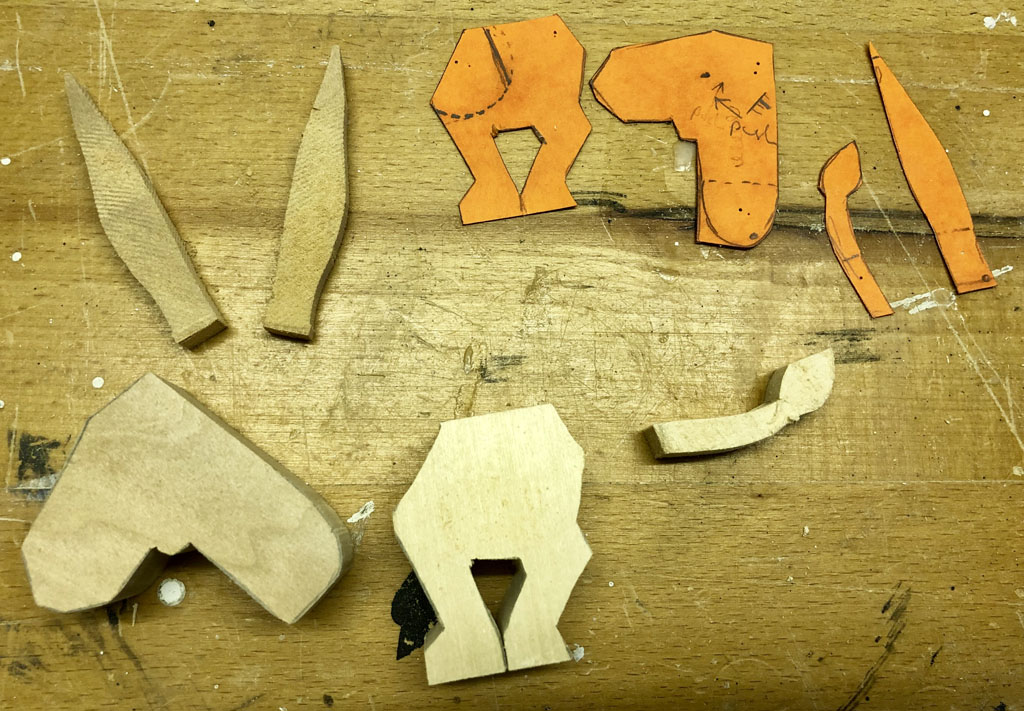
Drill two holes through the head for 3 mm dowel. For the hinge between the ears and the head drill the head so that the dowel is a tight fit. For the head to move freely on the dowel in the body, drill a second hole in the neck for a loose fit. Drill the holes where you had put the pins in the card when you checked the movement.
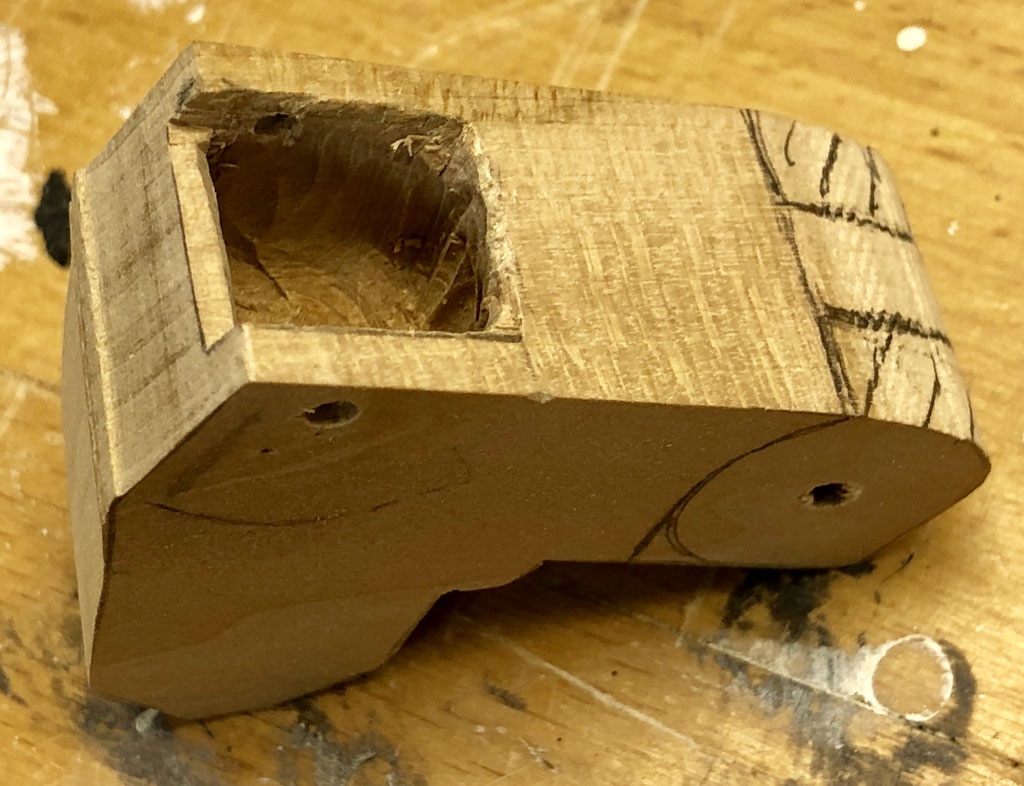
This clever donkey needs a hole chiselled in its head for the ears to move. For the neck hinge, mark the wood that needs cutting away using the cardboard templates to check what needs to be removed before sawing. To cut the arc shape, a sharp chisel is what’s required. Try fitting the ears to see that the hole is big enough for them to move freely.
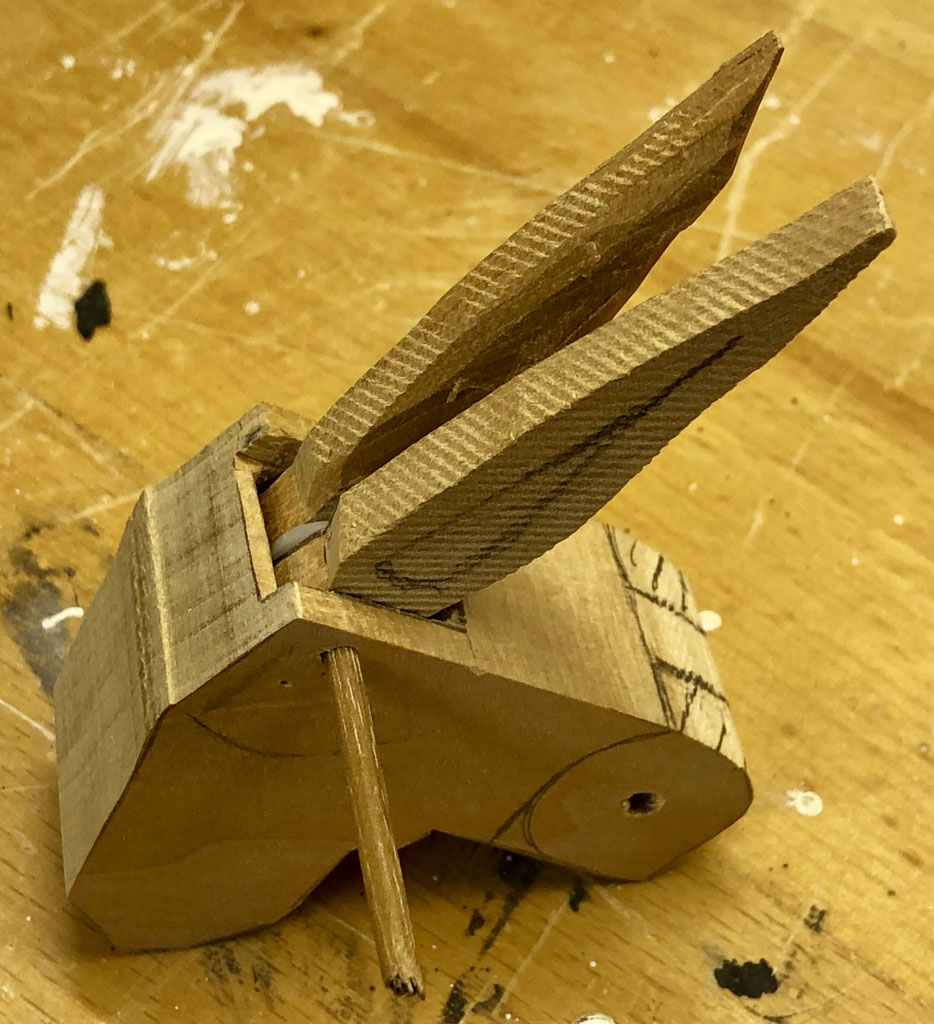
I left enough space for a small plastic washer between the ears to make sure that they can move separately. Roughly carved, head and ears look like this.
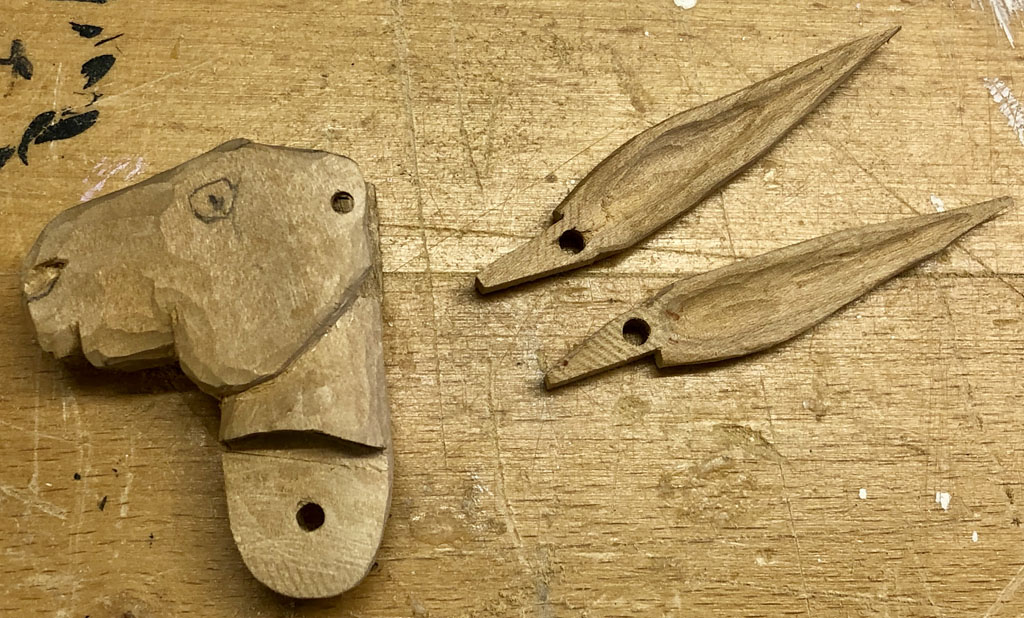
I used cord to waggle the ears and the tail. I tried cotton thread, but that caused too much friction. I tried fishing line, but that was too stiff when relying solely on gravity to pulle the ears down. I finally settled on thinner 1.5 kg nylon cord which is smooth and flexible enough for the job.
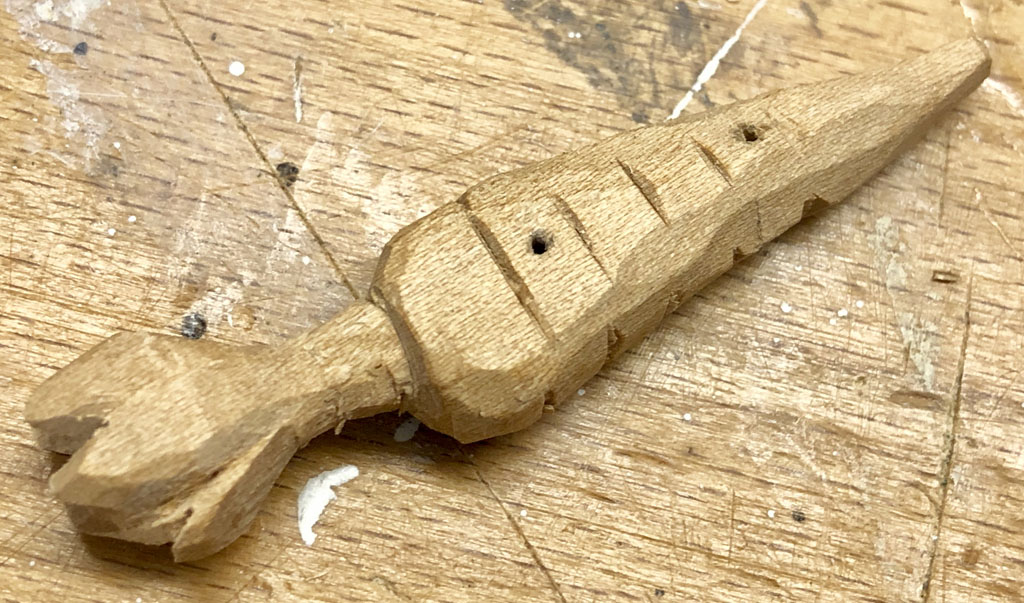
Here you can see how I drilled two holes along the neck, one for each ear. Note that routed like this, the cord which pulls the ears up will also pull the head up, when the ear has moved as far as it can.
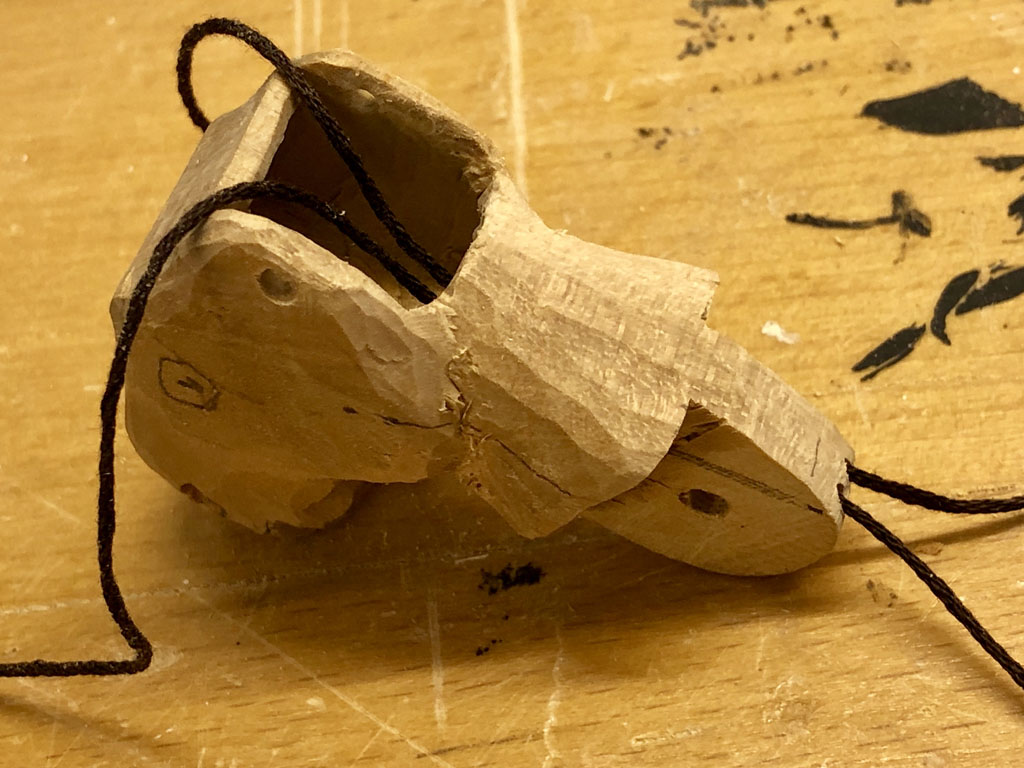
Here are the thinner, smoother nylon cords, ready to thread through the body.
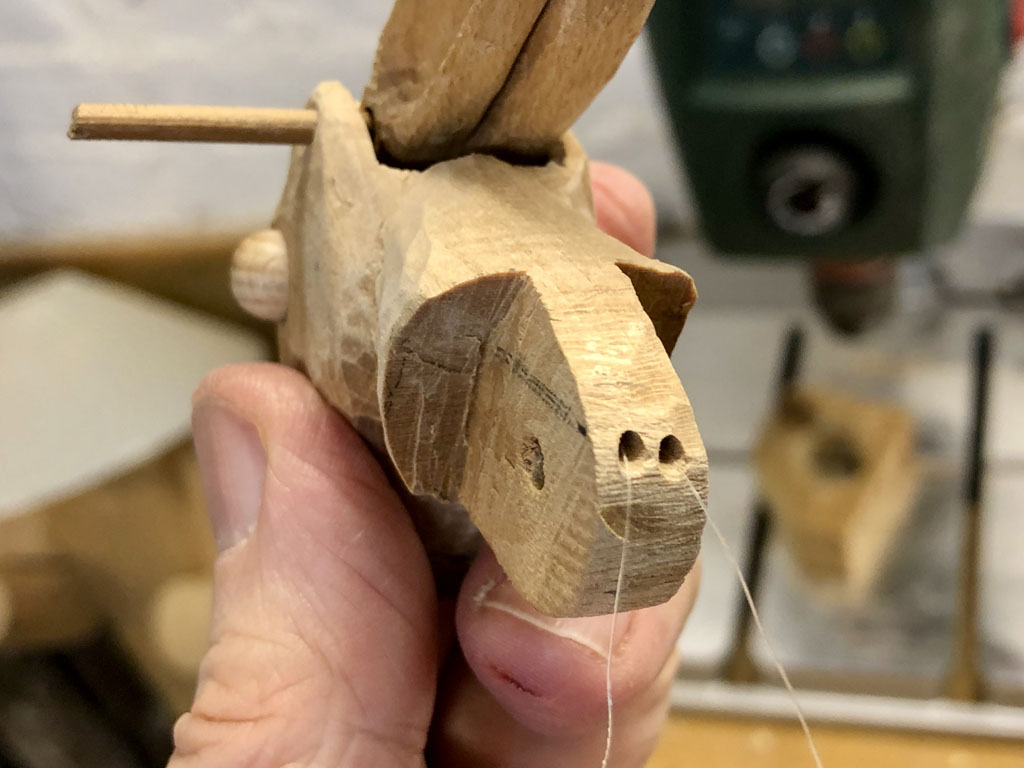
Now drill two holes in the body for a tight fit to hold the dowel to pivot the head and the tail. Note that it is best to drill the holes while the wood is still solid and the sides flat. That makes it easier to be precise and less likely that thin bits will break off. Then chisel out the space needed for the neck to rotate at the front and for the tail to rotate at the rear. Pencil markings on the outside show roughly how much space is needed for the movement.
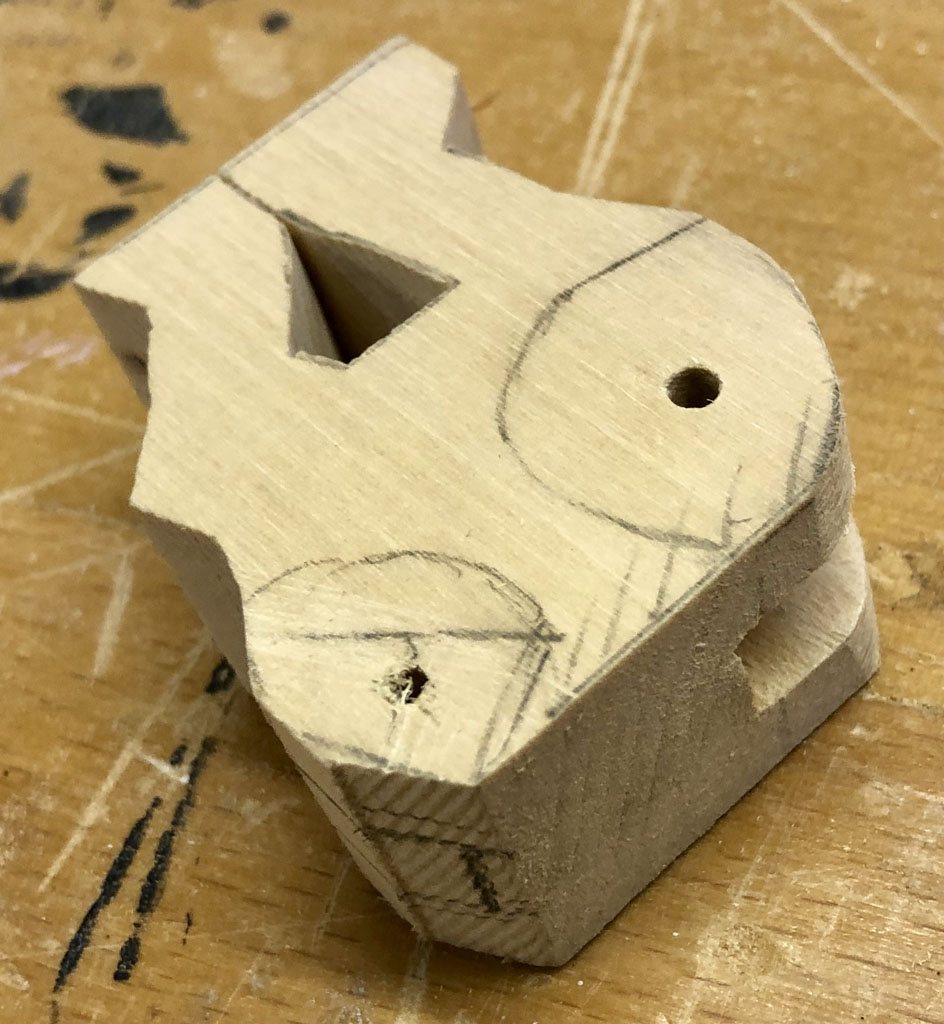
Once there is enough space for the neck to move freely, drill two holes through the body for the ear pulls. One hole is enough for the tail.
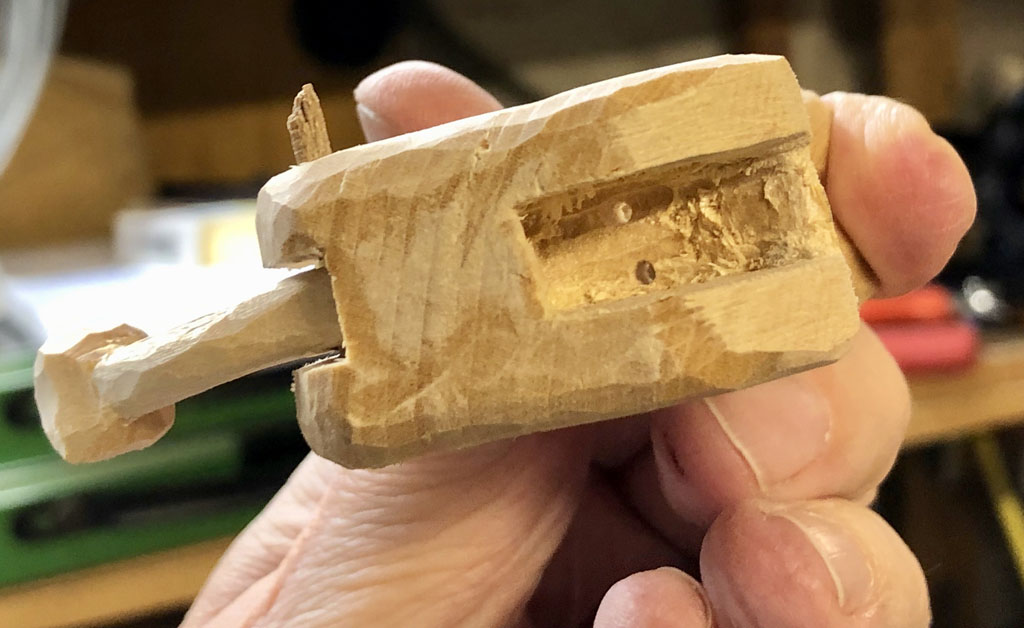
For the ear pulls, I fed the cords through the front hooves. For the tail pull there was enough space between the two rear hooves
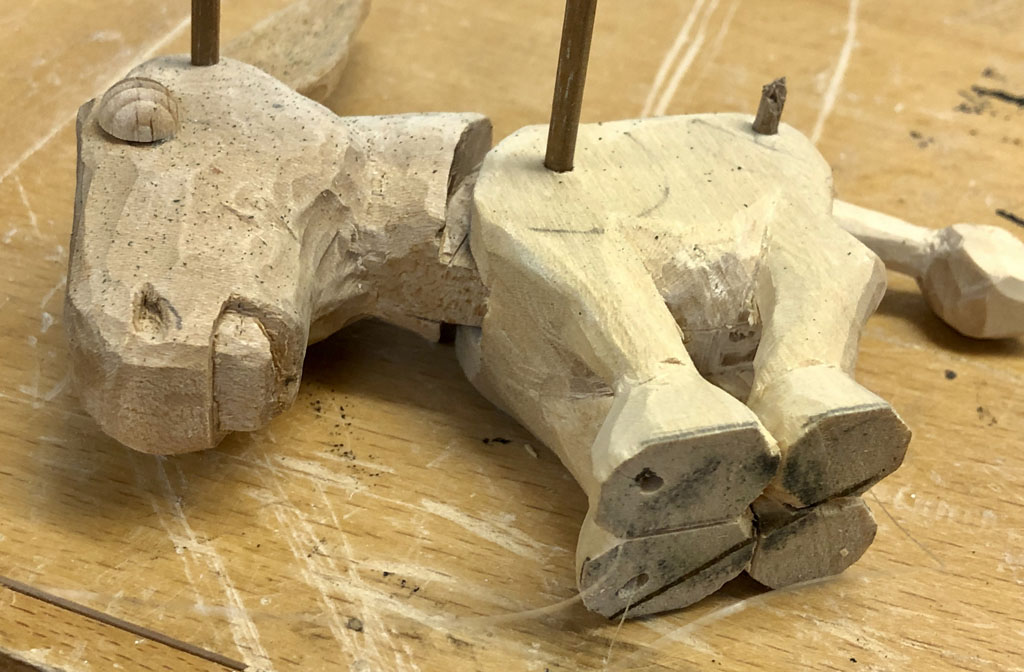
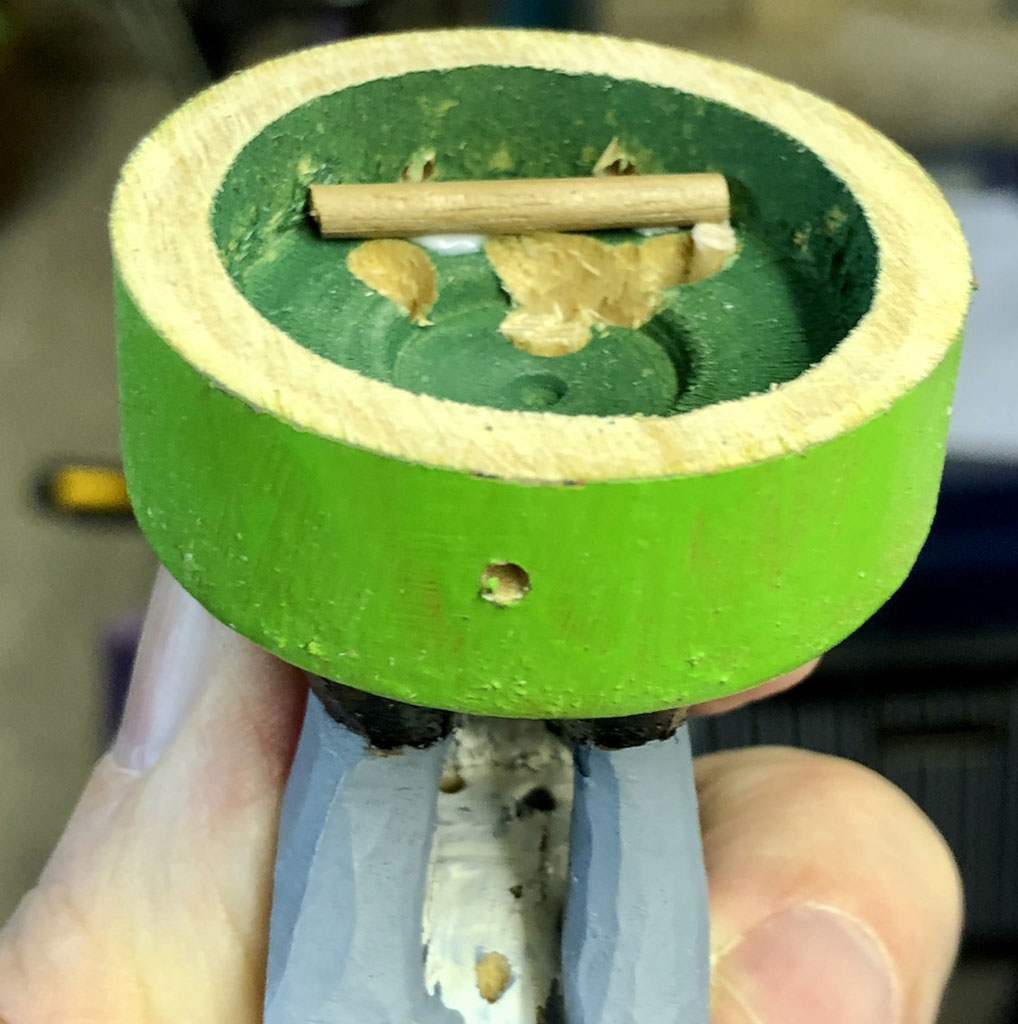
I recycled an old round wooden base for Goldesel to stand on, adding some smooth pieces of dowel to reduce the friction when the cord has to turn through 90 degrees. There are two holes at the front to connect the carrot to the two ear pulls and one hole at the rear to connect a coin to the tail pull.
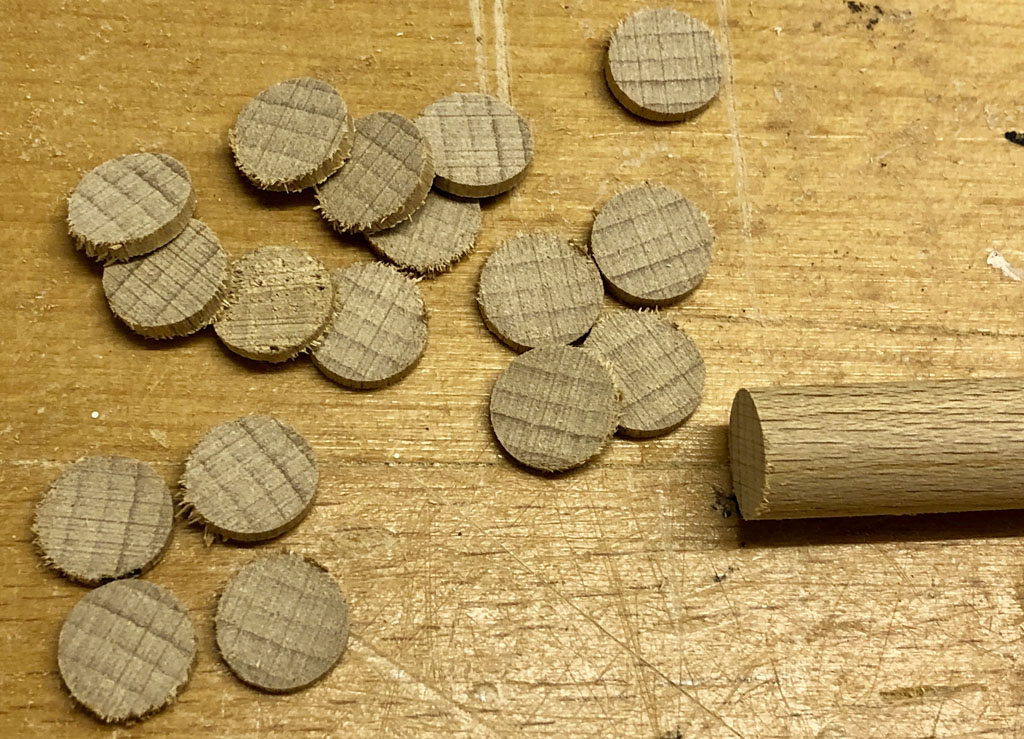
I’m afraid my gold ducats are only made from beechwood dowel with a lick of gold paint. Go for the real thing if you feel like it!
Carve a carrot and drill two holes in it, one for each ear pull.
 We need a base for the carrot and the ducats.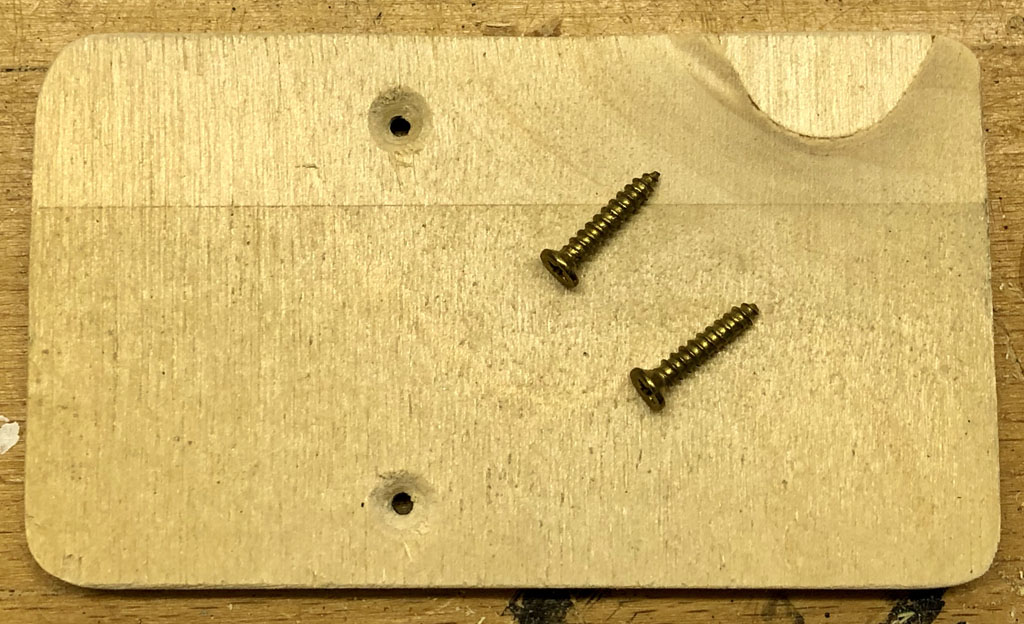
Now everything is ready to be assembled. Threading the fine cord can be quite testing and I found press-to-release tweezers quite handy to keep my frustration levels down.

Goldesel was an interesting experiment in using pull cords running inside a figure, like an inside out marionette. Unlike a thumb puppet it has no spring and relies on gravity to move ears, tail and head back to their starting positions. Before demonstrating, it is vital to practise your braying. The onomatopoeias for braying is “hee-haw” or “eeyore.” Curiously the National Geographic thinks that donkeys say “wee-snaw”. As a fan of Winnie the Poo, personally I go for eeyore.
-
One Smart Chicken
The latest product from Berlin’s booming startup scene, a touch-sensitive smart chicken! An extremely low maintenance cockerel which operates on just the environmentally friendly pressure of one finger. No feed or batteries required and guaranteed free from electromagnetic emissions and all unpleasant odours.
What does this cock a doodle do? Eternally patient it pecks away at its state of the art miniature smartphone. Dreadful anti-avian discrimination by the developers mean that every attempt with his beak is bleak. With feathers but no fingers this bird of little brain will forever be barred from crowing onto the Internet, which is probably no bad thing.
Design
I was inspired by a number of clothes peg automata, starting with a beautiful bird by the amazing Martin Lhotak (which you can see here https://www.youtube.com/watch?v=mkBWAJ83Yv0 ). It’s quite a simple mechanism where squeezing against a spring causes two parts to move relative to one another. Clothes pegs are fine if you want to clip your creation to something, but are not so good if you want it to stand on a surface. I went for an egg shape as it’s a chicken. In this case the chicken came first and then the eggs!
How to make it
Draw a chicken without any legs and then cut out that shape on a piece of card. Draw an egg, or pinch an egg from hyperspace if you are geometrically challenged like me. Cut it out on a piece of card. These are the templates to mark a piece of lime wood for the body and two pieces of thin plywood for the egg-shaped base.

Scroll cut the body

Scroll cut two egg shapes in thin plywood.
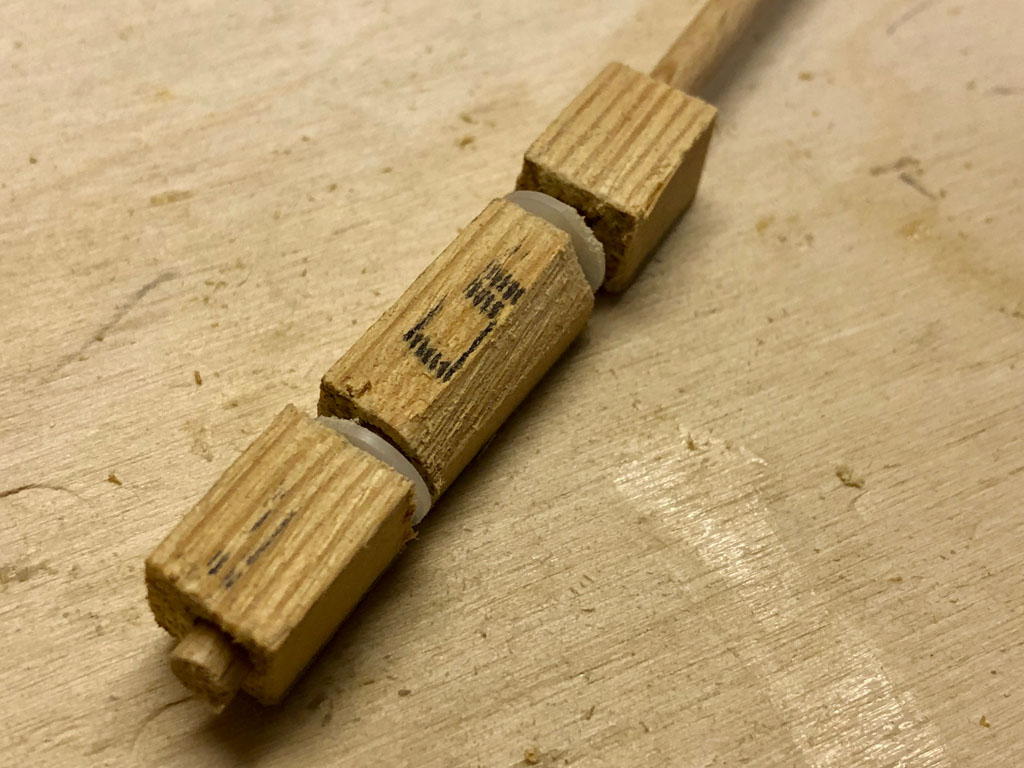
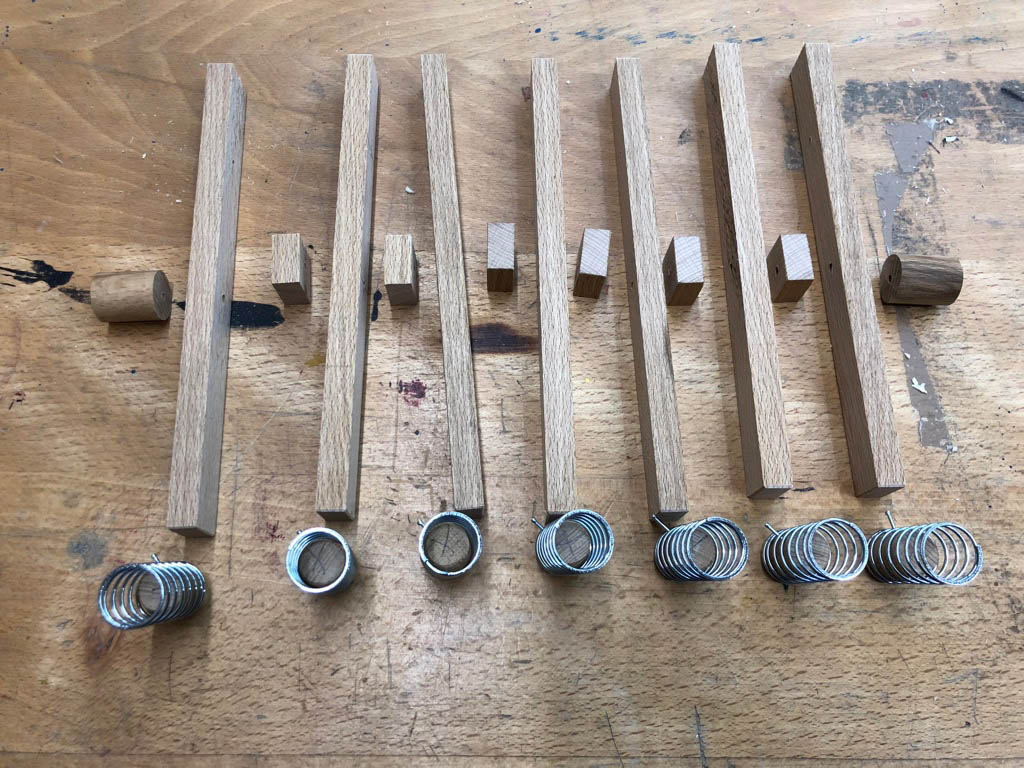
Make a wooden hinge to go towards the fat end of the eggs, located between the two eggs. This is three bits of roughly 10 mm x 10 mm strip with a hole drilled through the middle to take a piece of dowel. I added a couple of plastic washers which are probably not necessary as the rotation of the hinge is minimal and friction is not too important. You will however have to round the correct corners of all 3 pieces to allow enough rotation to get the cockerel pecking properly.
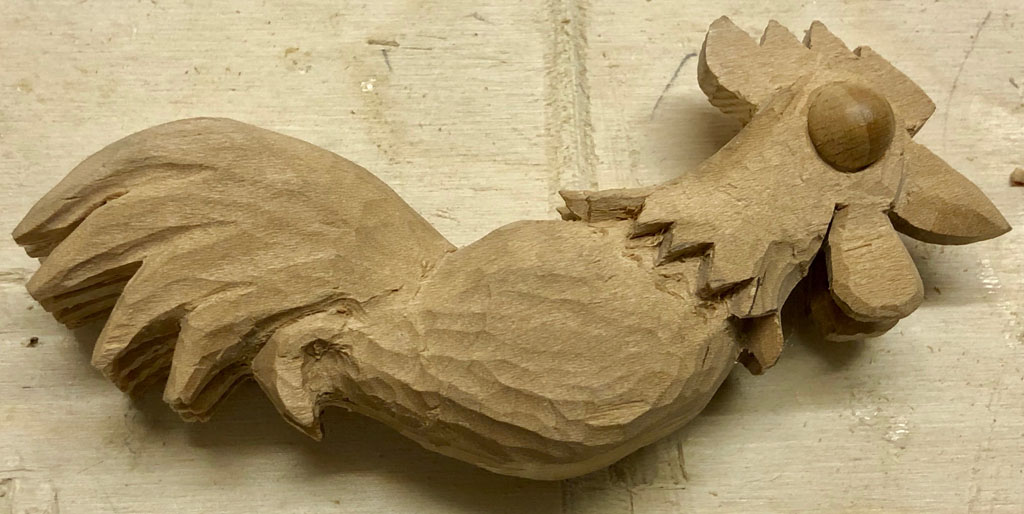
Carve the body to make it look like a cockerel. I glued on small ready-made hemispheres for the eyes for a nice popeye look.
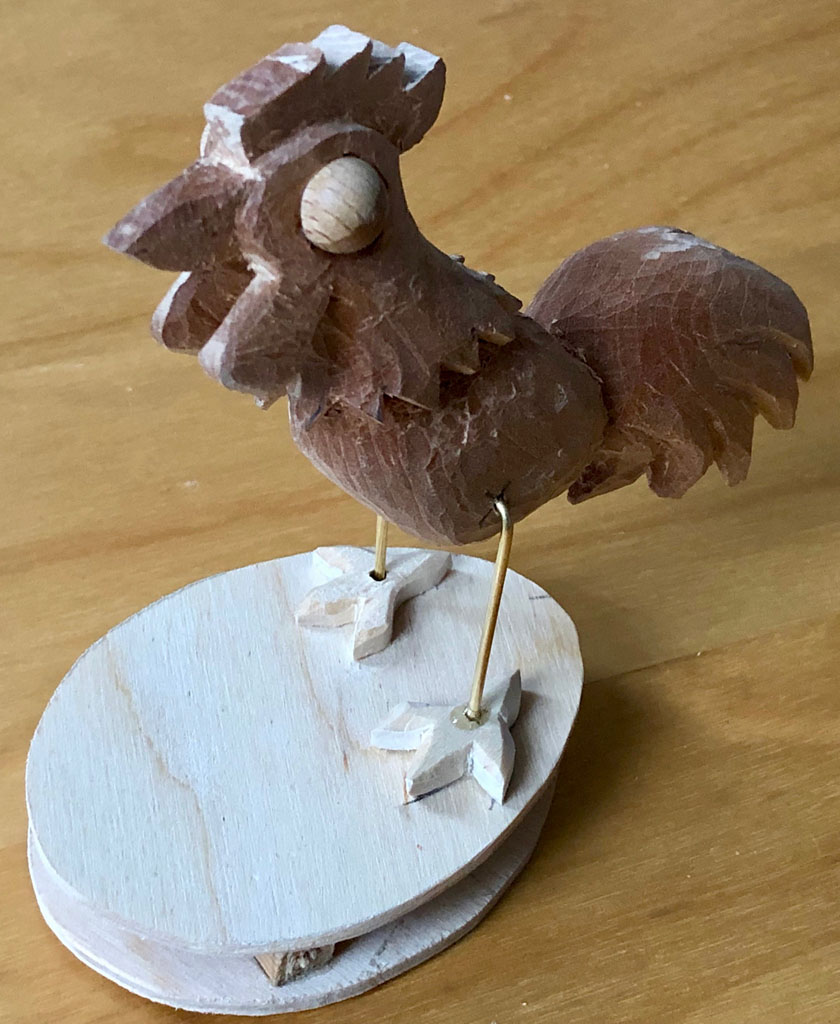
Make two feet. Note that the chicken’s left foot is a tight fit for its brass leg and its right foot allows its brass leg to move freely.
The holes in the side of the body are at the same height but the hole in the right side is about 5 mm further back. This offset means that when the right leg is pushed up relative to the left leg, it makes the body tilt forward and our cockerel starts pecking away. Between the two eggs, the right leg is fixed to the bottom egg.
A spiral spring between the eggs pushes them apart and keeps the chicken upright.
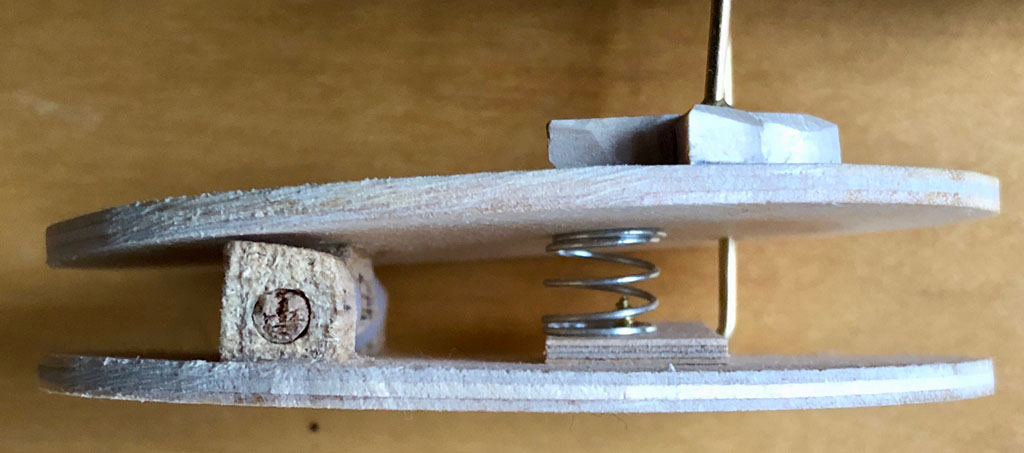
As you can see, the spring pushed the eggs a bit too far apart, so I glued in another piece of 10 mm x 10 mm (not shown) in front of the hinge to correct that.
A very small piece of plywood serves as the smartphone. As it was too small for me to paint, I printed out a small image of a phone and glued it on.
-
Magnificent Moggie the Circus Cat
Ladies And Gentlemen, Boys And Girls, Children Of All Ages!
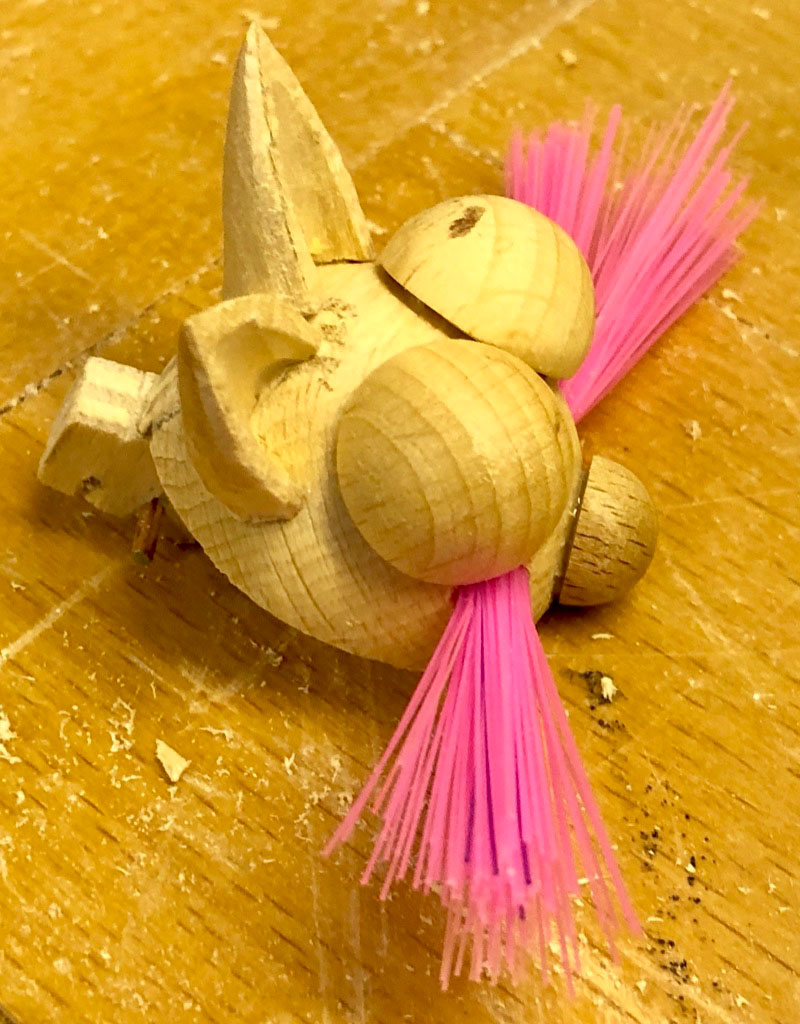
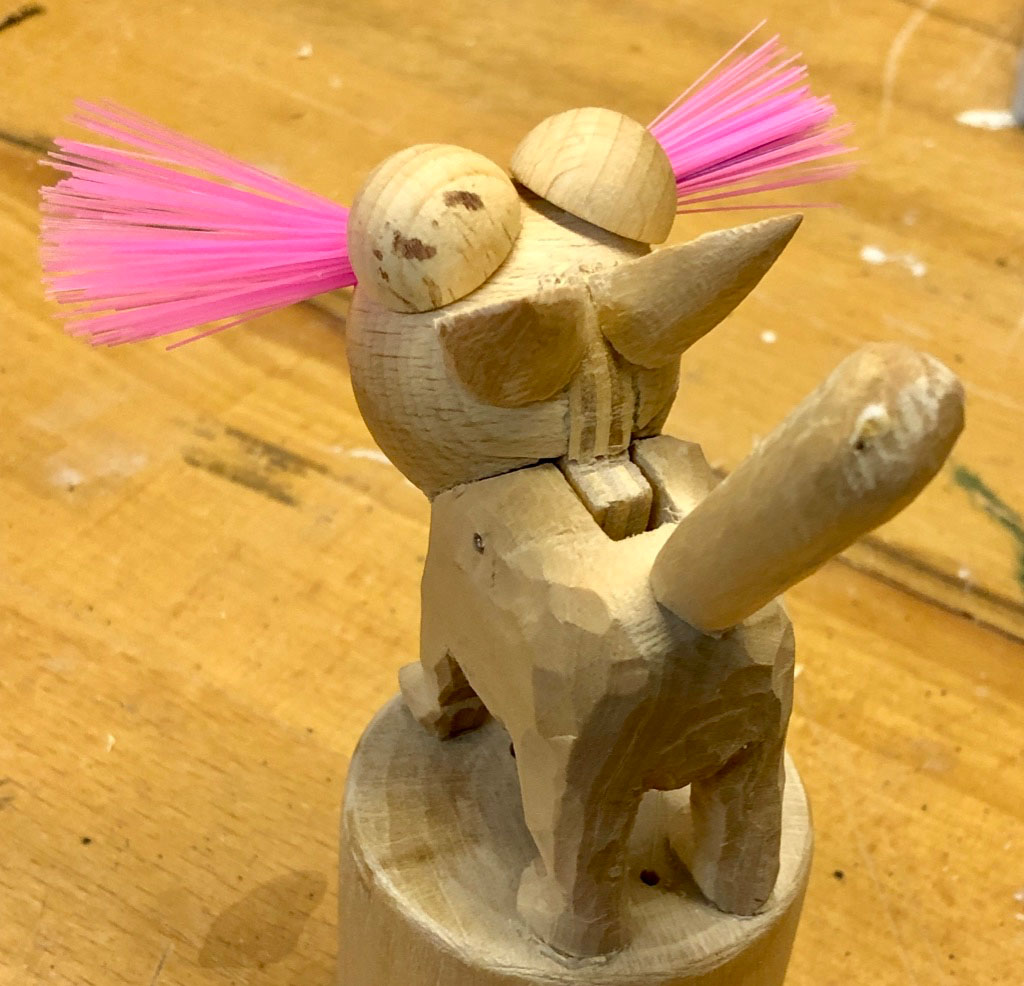
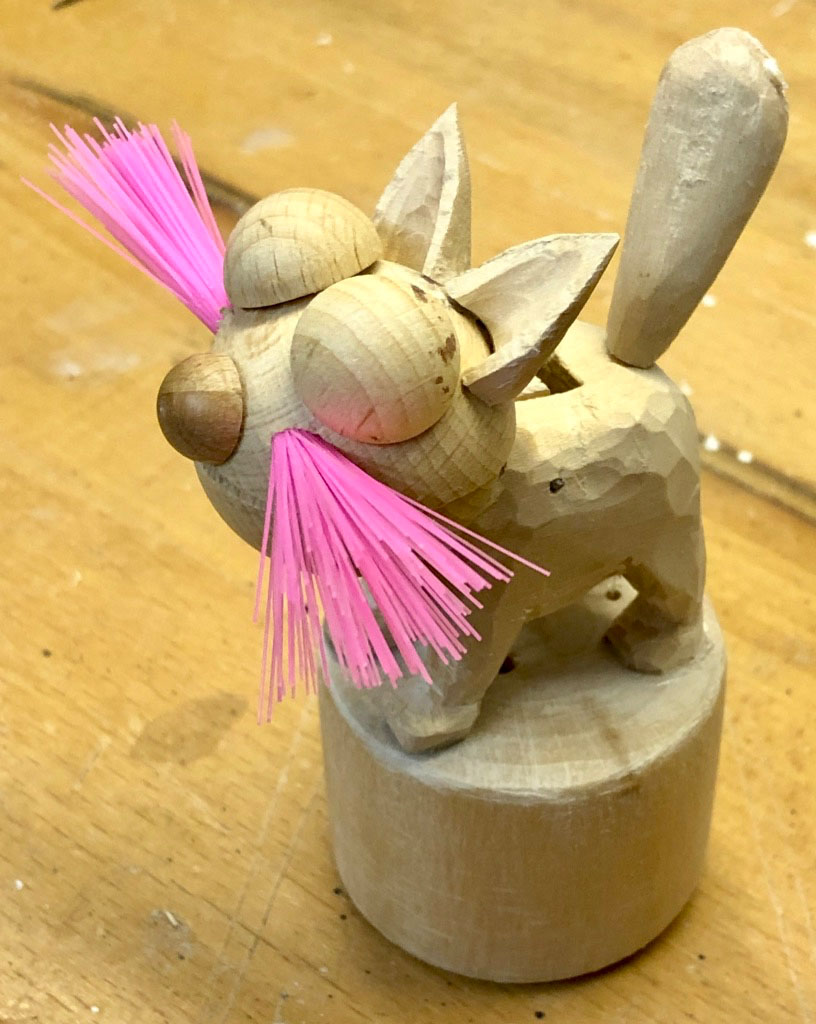
May I present to you a fantastically ferocious feline who can be persuaded to miaow on cue and can even wag her superior striped tail. Recently returned from an amazing tour with Kim’s Kabarett, she is eminently suitable for the smallest of lion tamers. I give you Magnificent Moggie the Circus Cat!
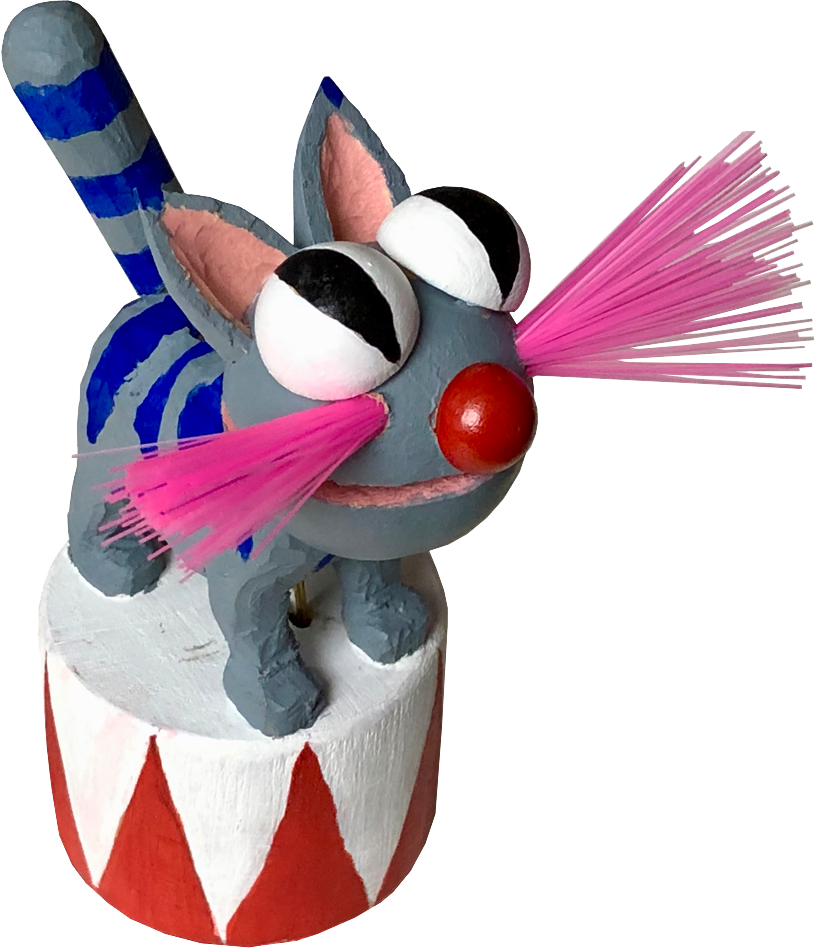
(Youtube link to the video is https://www.youtube.com/watch?v=eYXjcz8zUH4)
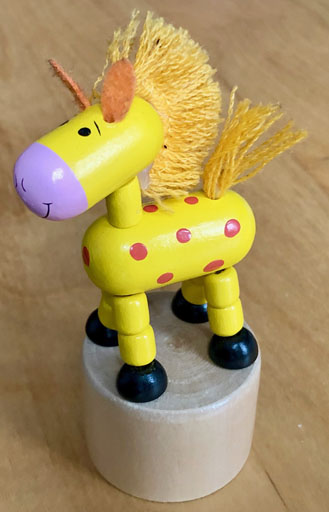 What was the brief?
Thumb push puppets are classic toys which come in hundreds of variations, but they all seem to share the idea of something collapsing when you push the base in. Horses like this one are quite popular, when you push the base, it first lowers its head and when you push harder it flops completely down. Wooden toys like this usually use turned parts to keep the price down.
I thought why not make a thumb puppet which does something else besides flopping and decided on a cat. To give a reason for the round base I thought she could be a circus cat, waiting for her tamer’s command. Push the front of the base and it opens its mouth, push the back and its tail moves (flops). So what makes a cat a cat? Those distinctive cat’s eyes with the vertical, ellipse-shaped slits? Whiskers? Big ears, a bushy tail and stripes? Well that was my recipe for cattiness.
Rough design
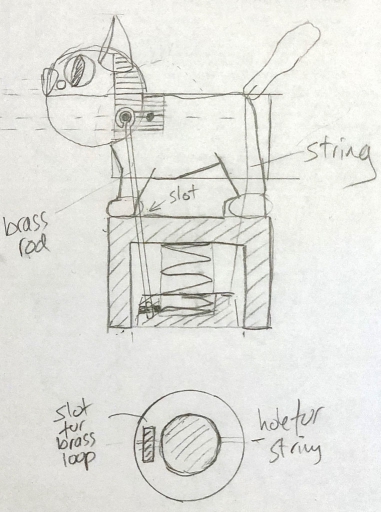
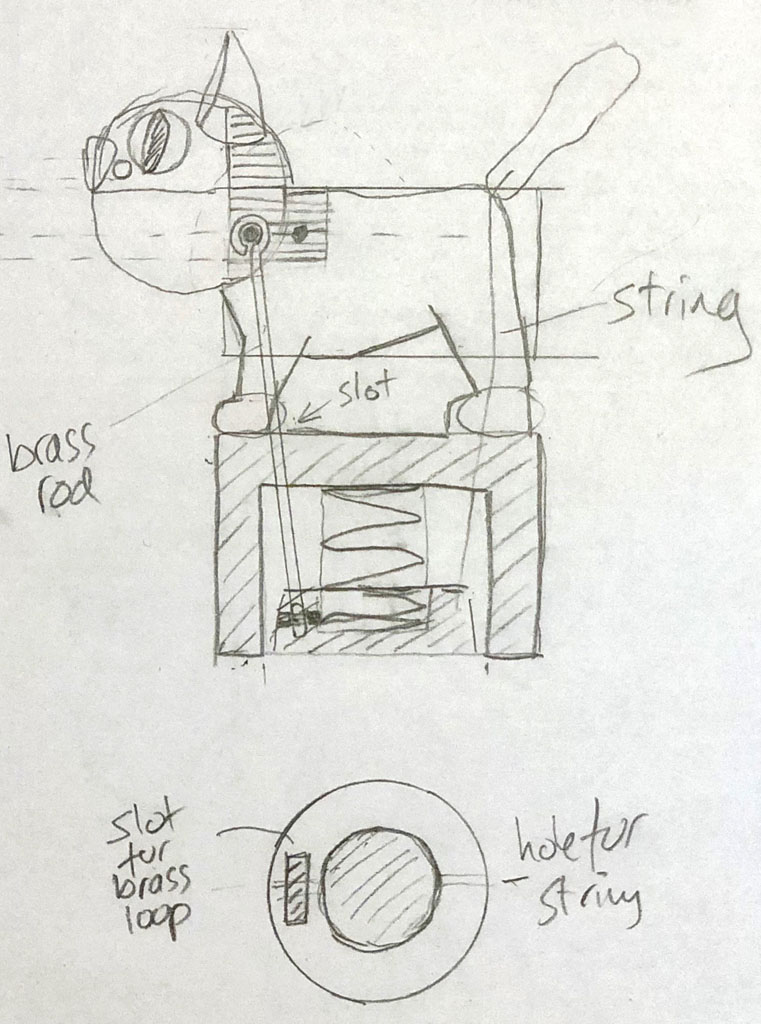
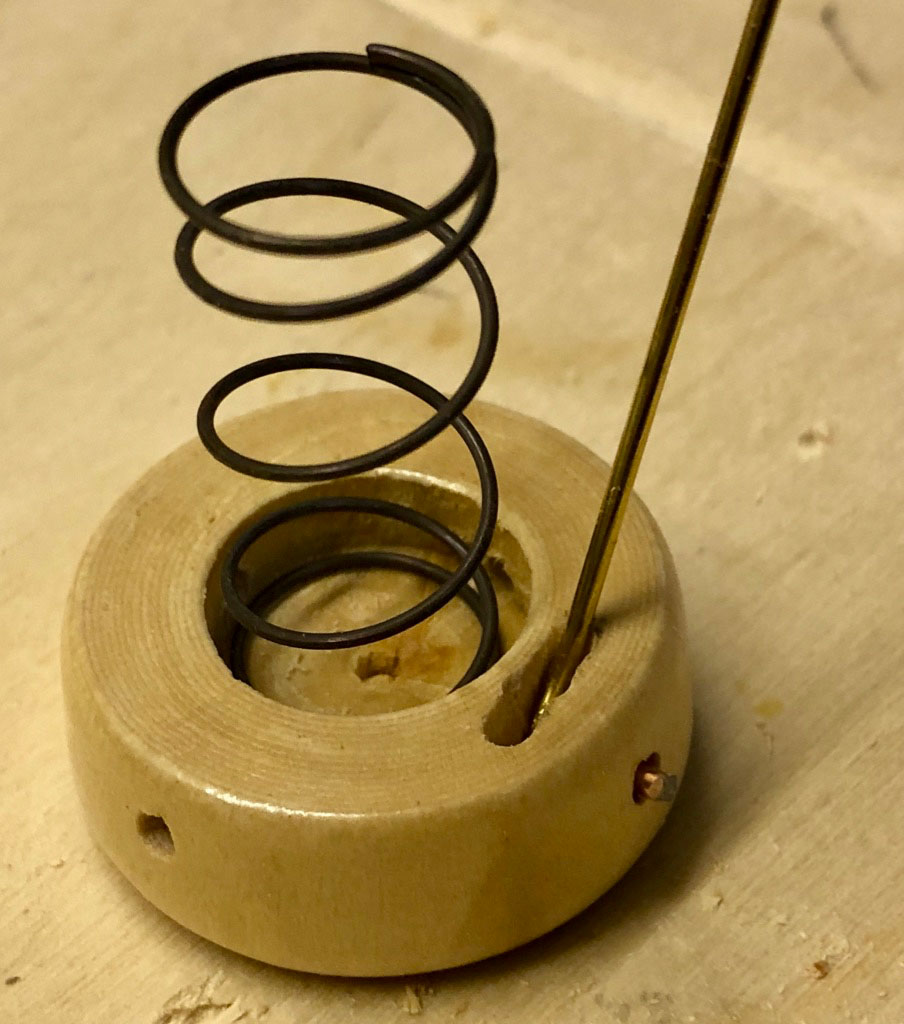
Pencil sketch of the Magnificent Moggie Here’s a rough sketch. The single spiral spring in the cylindrical base tries to expand, applying downward force
– keeping the tail proudly erect, via a piece of fishing line, which shouldn’t break with such a small fish
– keeping the cat’s mouth closed, via a slim brass rod
Press the base up and the tail will slacken and/or the cat’s mouth will open. The operator is responsible for the miaow.
I went for a spherical head and huge hemispherical eyes and a small nose made from beechwood. The body, tail and ears are made from carved lime wood as I won’t be charging anyone for my time to do that little bit of carving.
I reused an existing wooden base which had originally been turned.
Once the rough design was ready, this fairly simple toy only took a few hours over a weekend to make, with a bit of fiddling about for the final assembly.
Making the bits
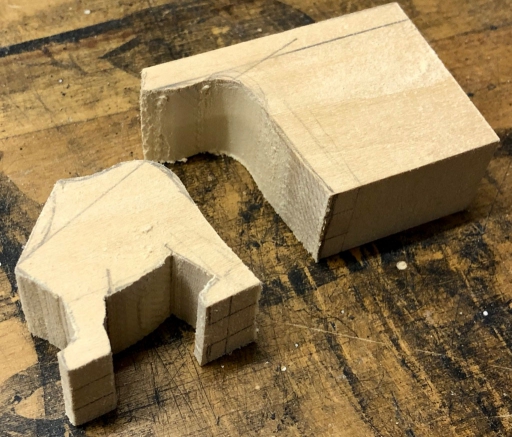
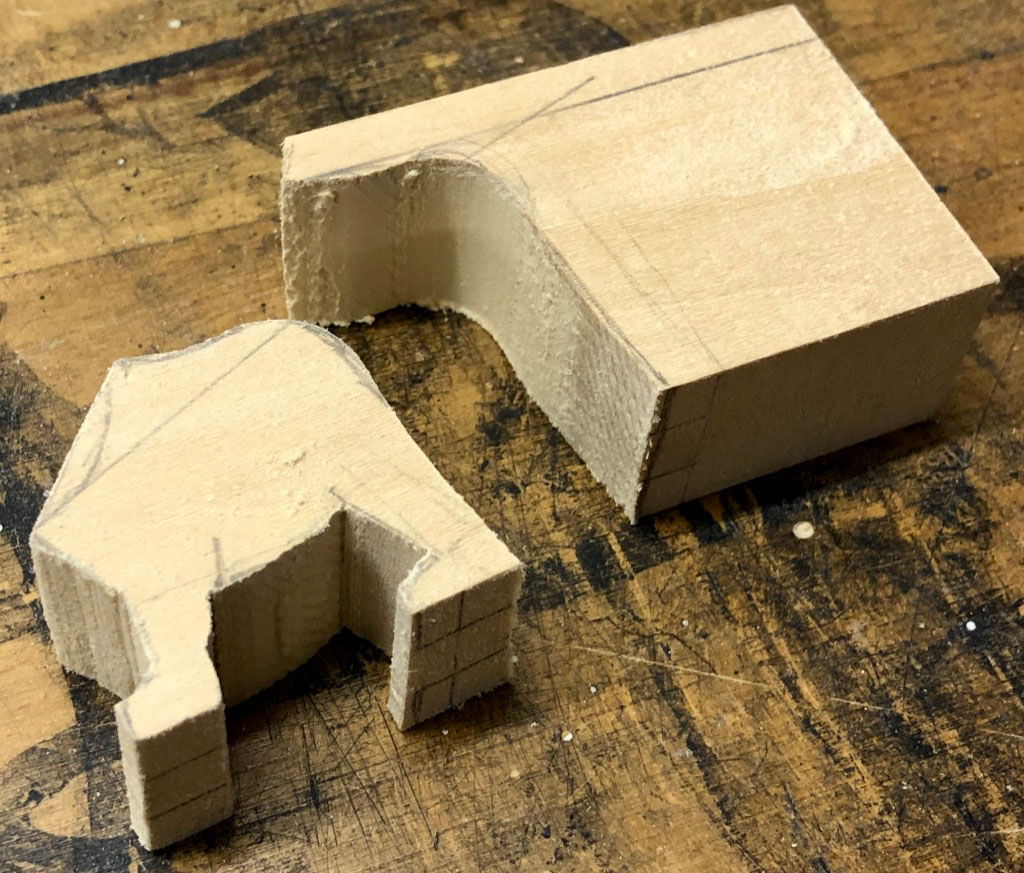
Scroll cut the body 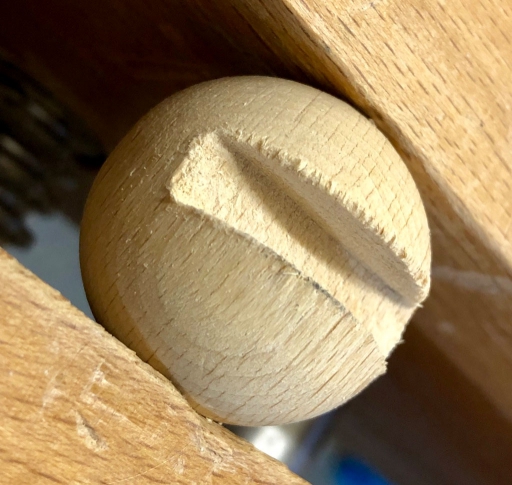
Cut the hinge slot 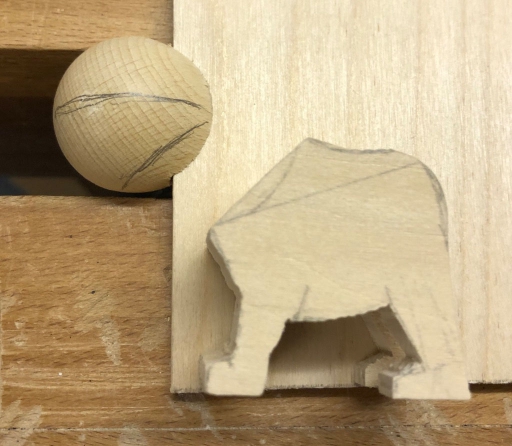
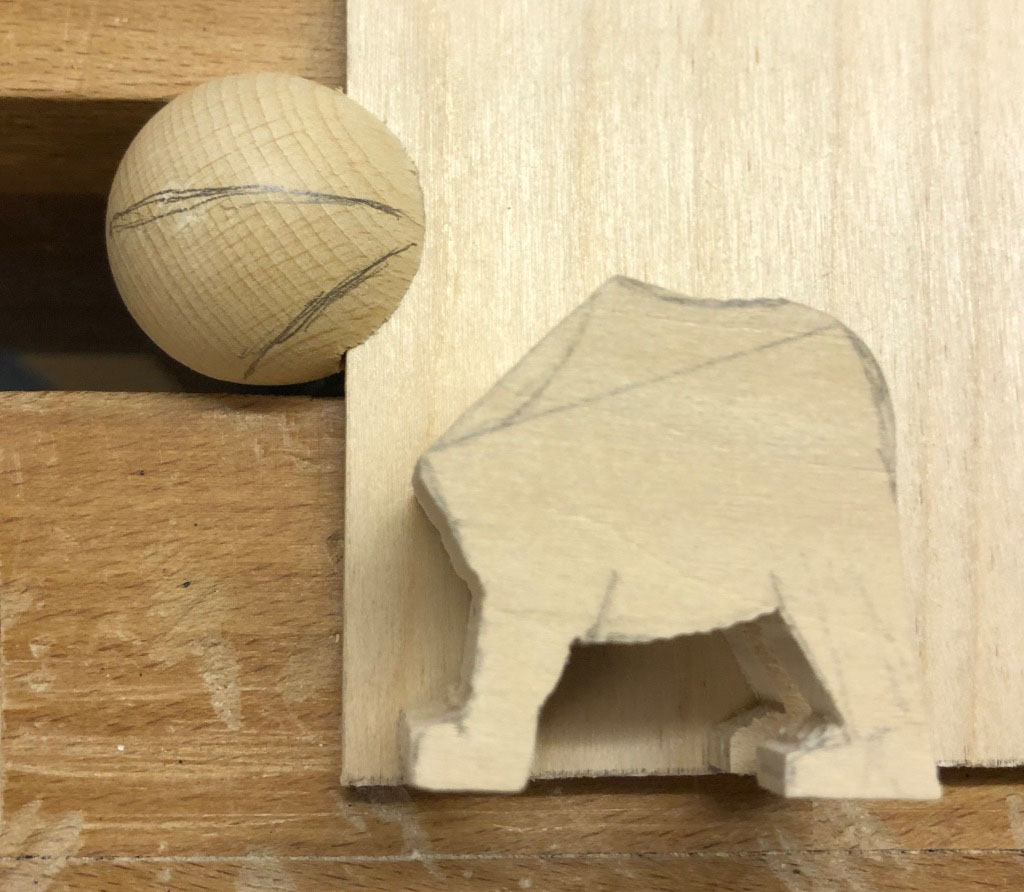
Slot the head onto the plywood for the hinge and mark neck and mouth 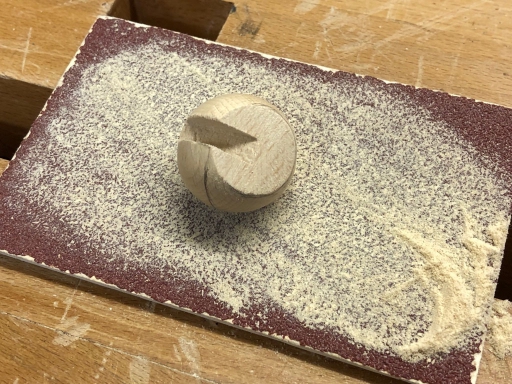
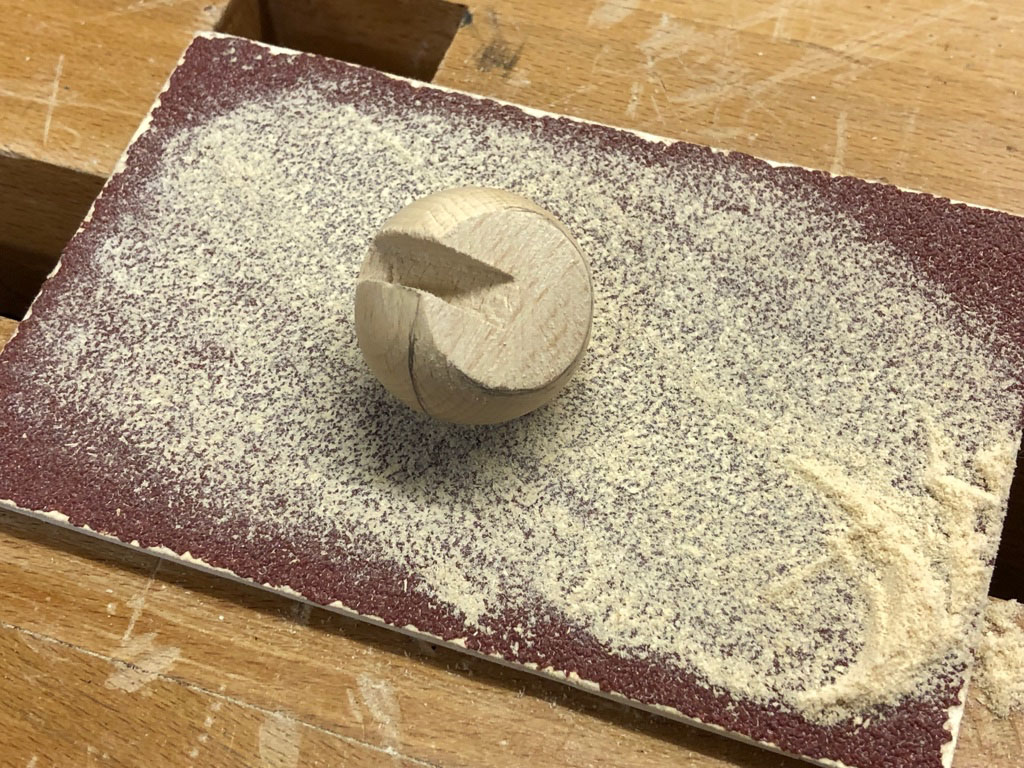
Sand the head flat where it is to be glued to the body 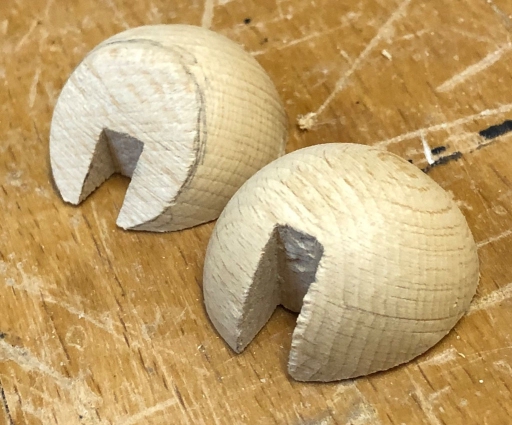
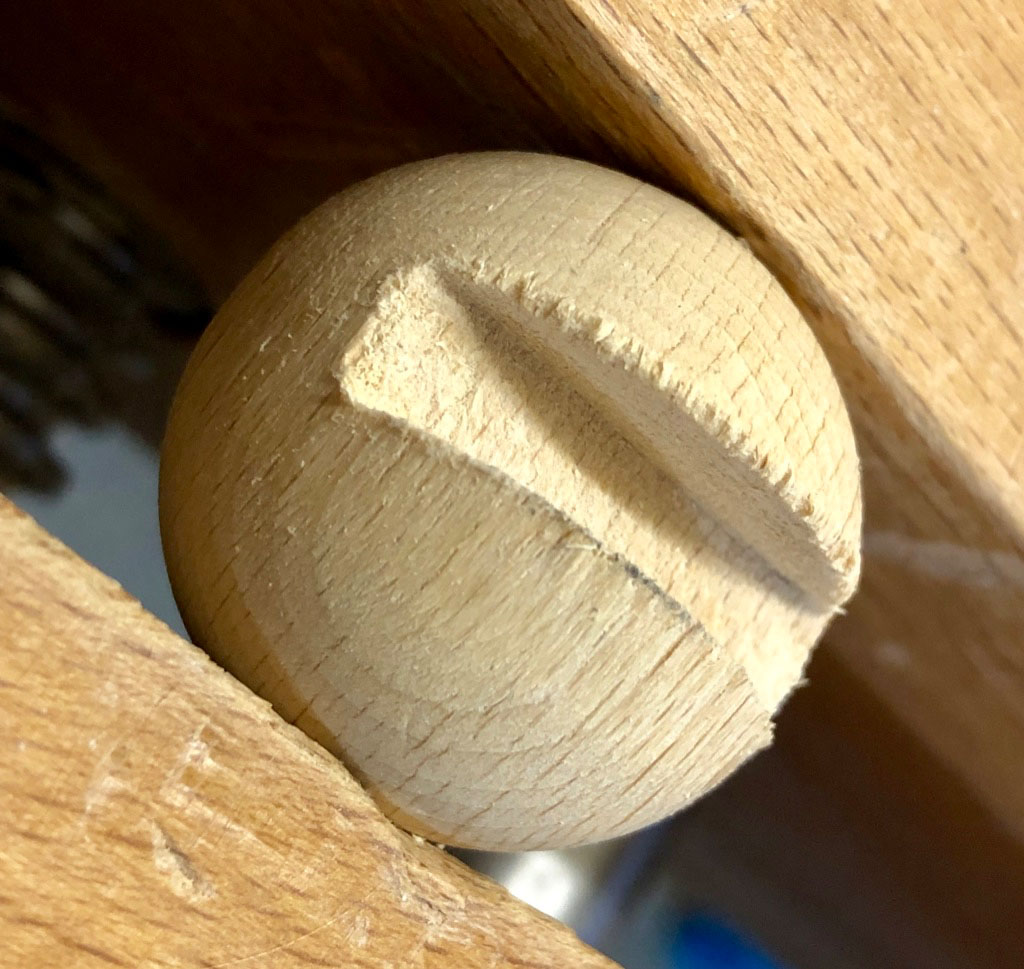
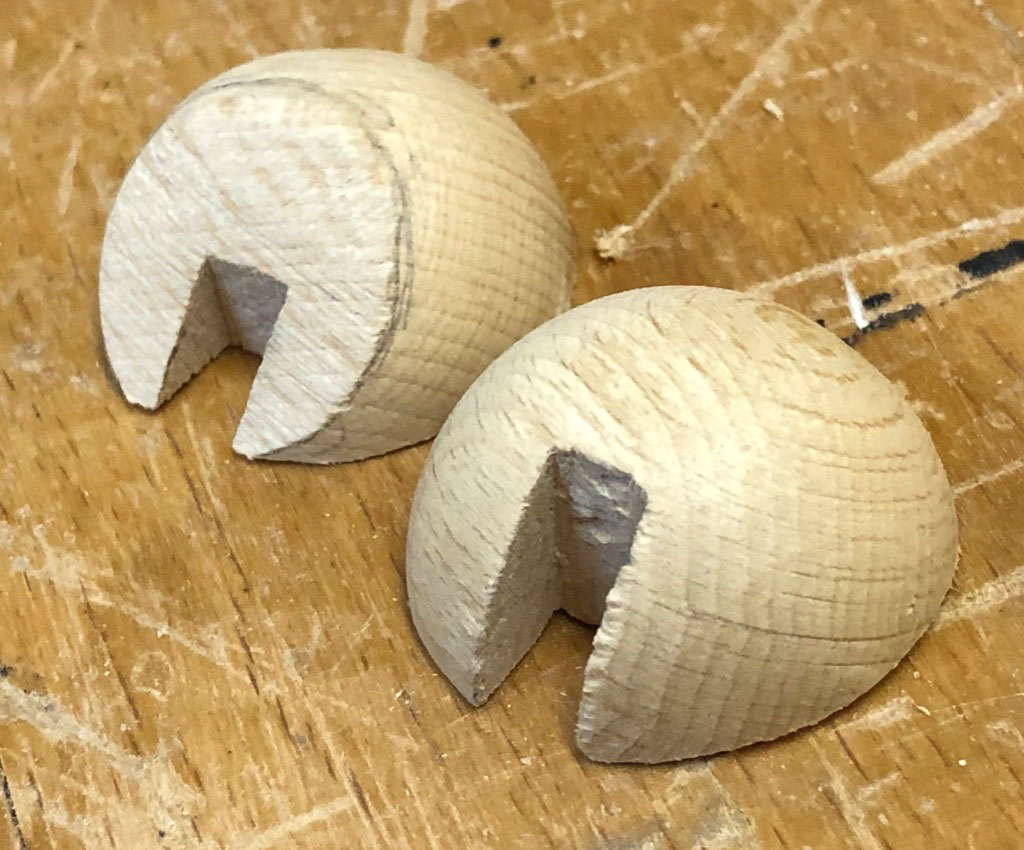
Cut the head into 2 pieces so that the cat can miaow 
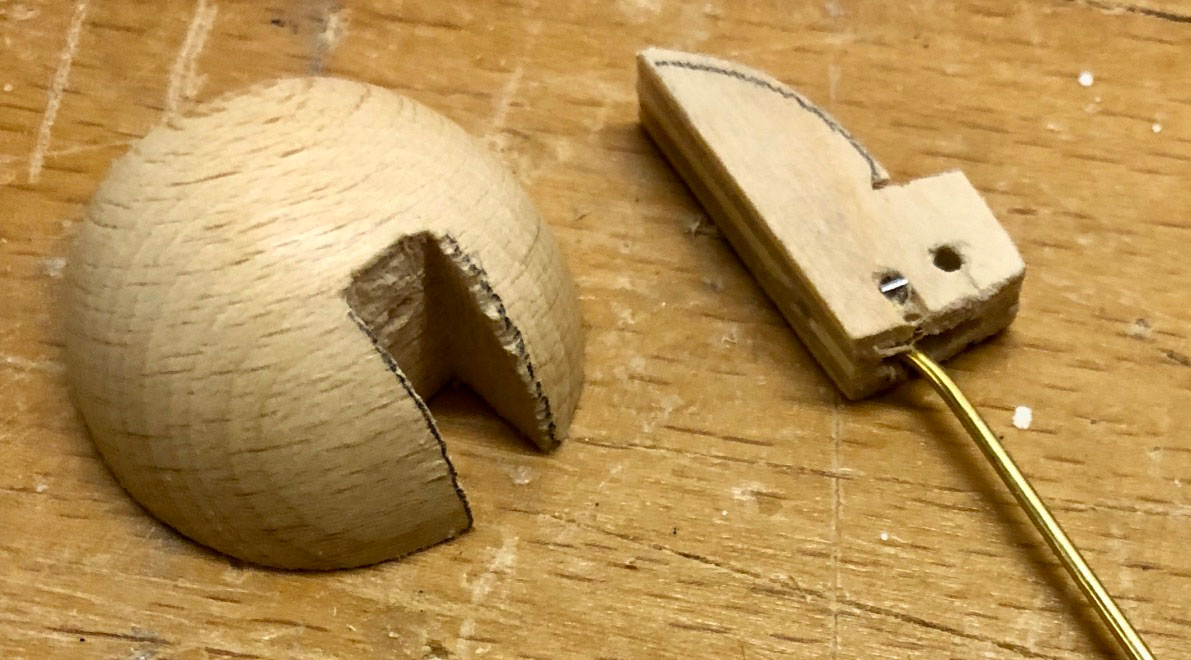
Make a hinge to be glued to top part of head with 2 holes for push rod and hinge pin which is pushed through a hole in one side of the body 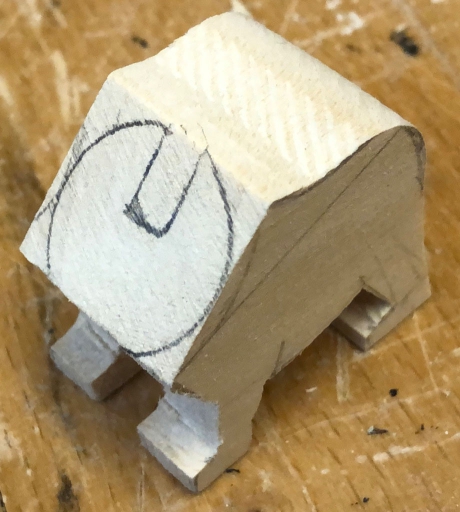
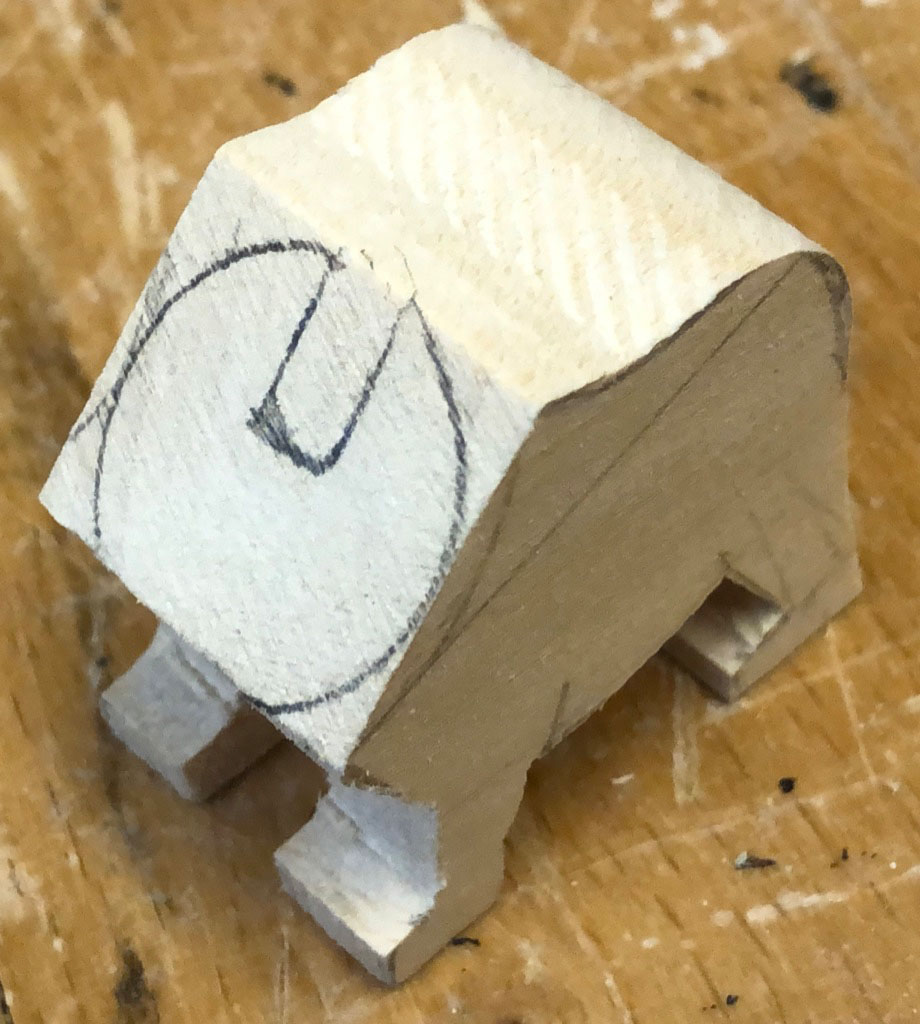
Cut a slot in body to loosely hold the hinge with enough space for it to move easily 
Glue hinge into the head. Carve & glue on ears. Glue on eyes and nose. Drill holes to glue whiskers. For the whiskers, simply use pliers to pull two tufts out of a brush, then glue one tuft into each of the holes next to the nose. 
Cut slot in the movable base to take the loop on the end of the push rod. Insert brass hinge pin to hold the loop. Putting it all together was tricky and required quite a bit of patience as I could only bend the top loop on the push rod once it had been fed through the body. With hindsight, I should have cut slots which were long enough to let the loop through. That would not have detracted from the general impression. That’s life innit? When you only make one of anything, you never get it quite right.

Fix fishing line to movable base. While squeezing the spring in the base fix it to the tail. While squeezing hard, push the pin in to catch the loop on the push rod in the hinge. Now wiggle the hinge about until the holes line up and push another pin into the carved body and through the wooden hinge. 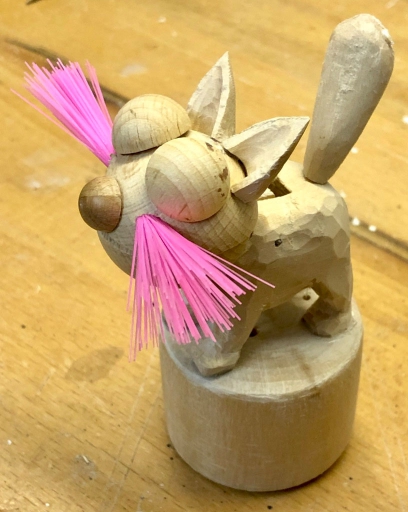
Ready for painting -
Postscript – The Marvellous Mechanical Mouse Magician
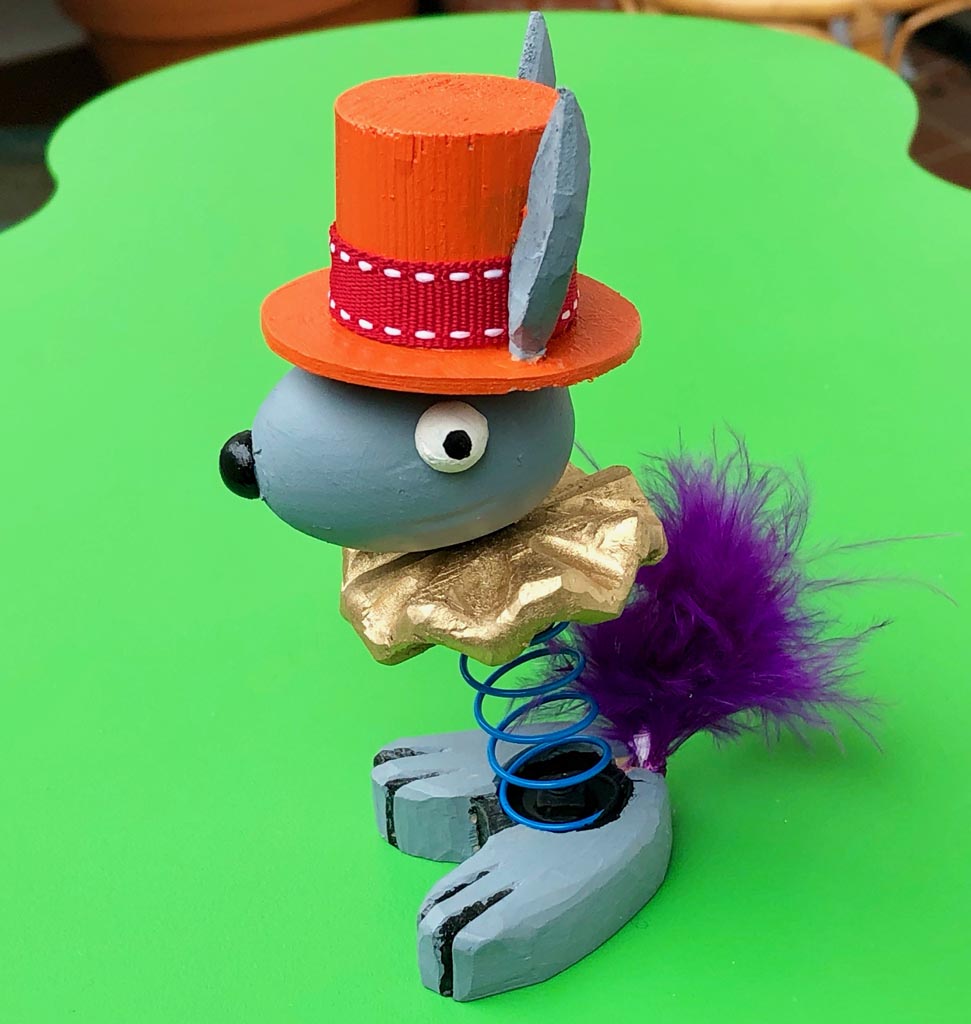
Hello, I am The Marvellous Mechanical Mouse Magician
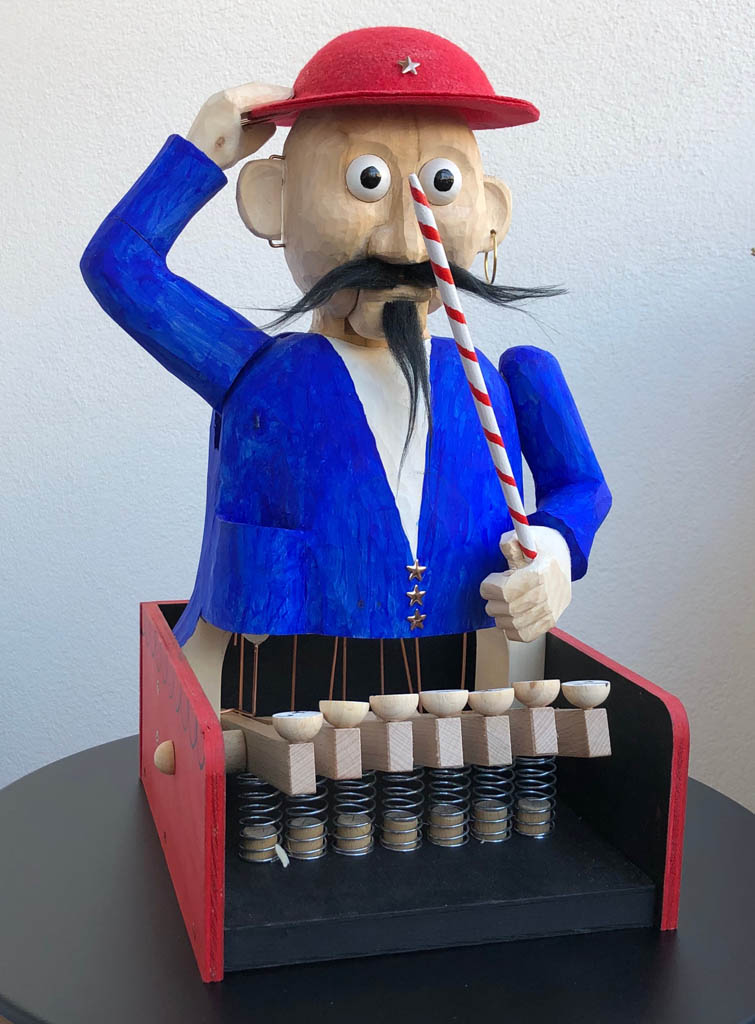
Welcome to my modest show!
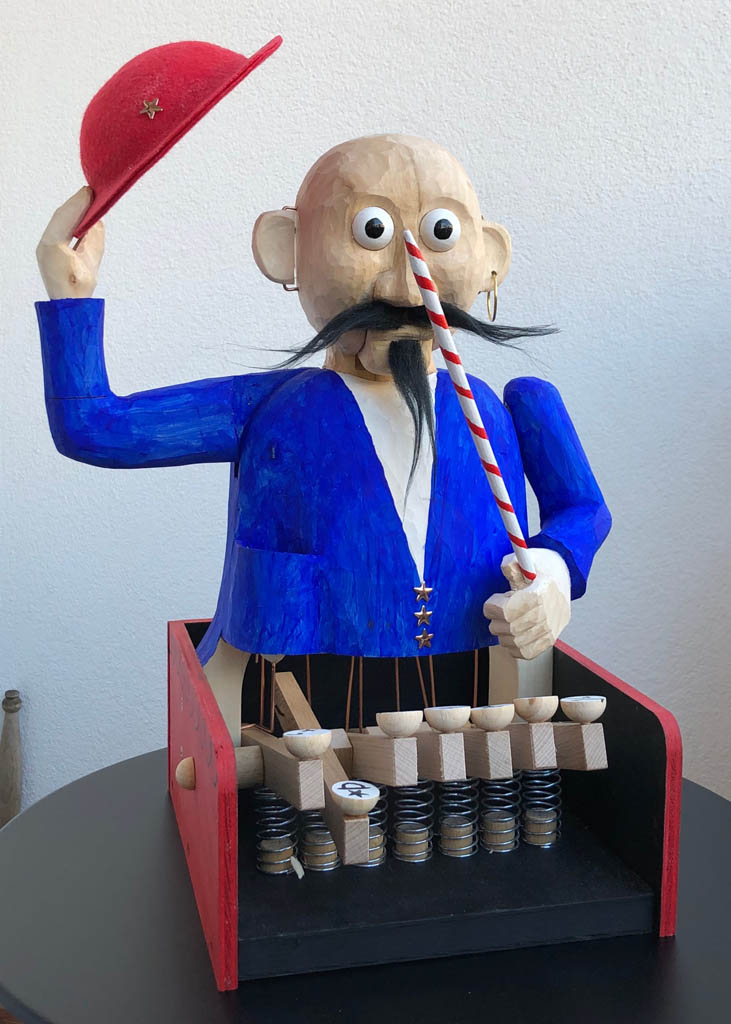
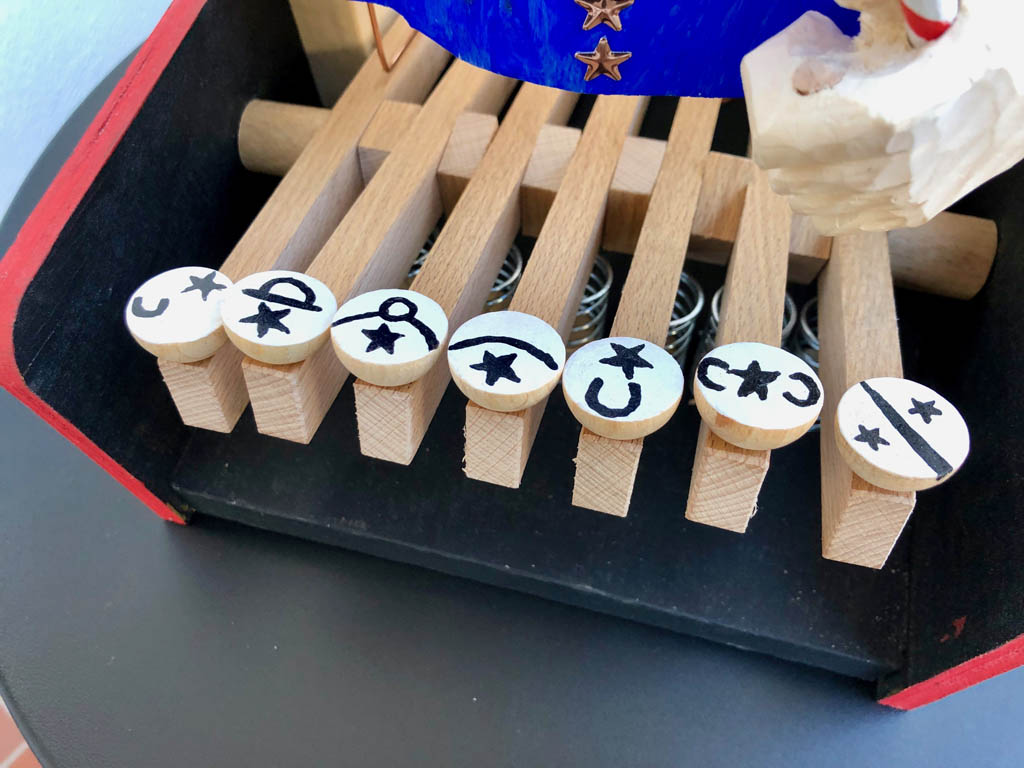
With my astrological buttons, you too can work magic! Press the digits to show off your prestidigitation.
First you need to summon my assistant Humphrey.
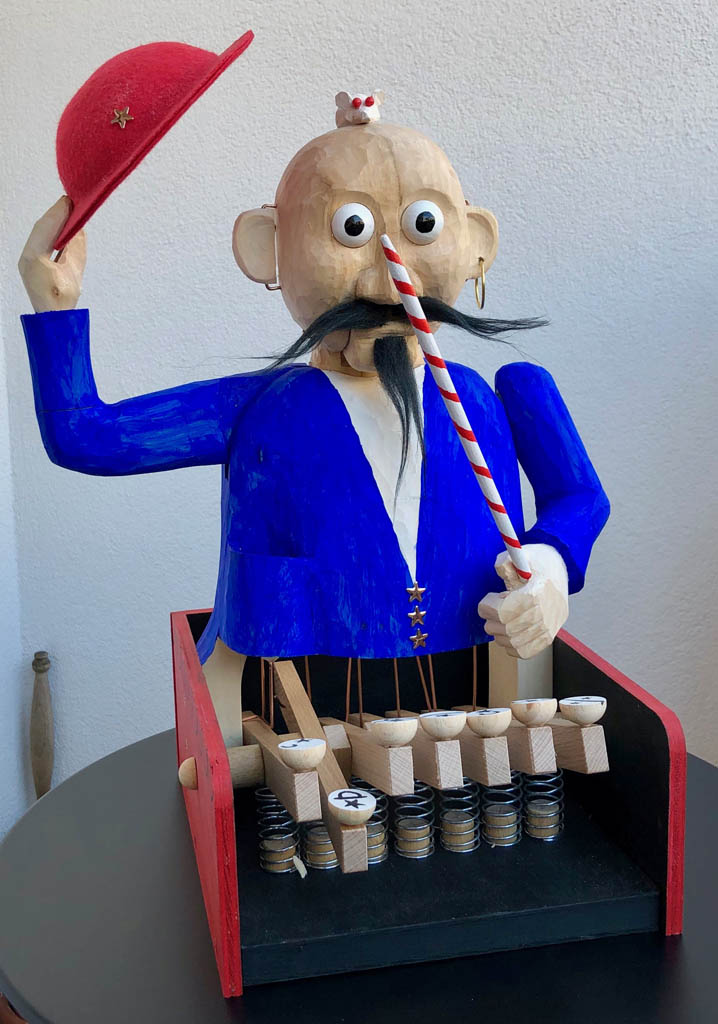
Then lower my magical hat carefully over him and tap it three times with the magic wand.
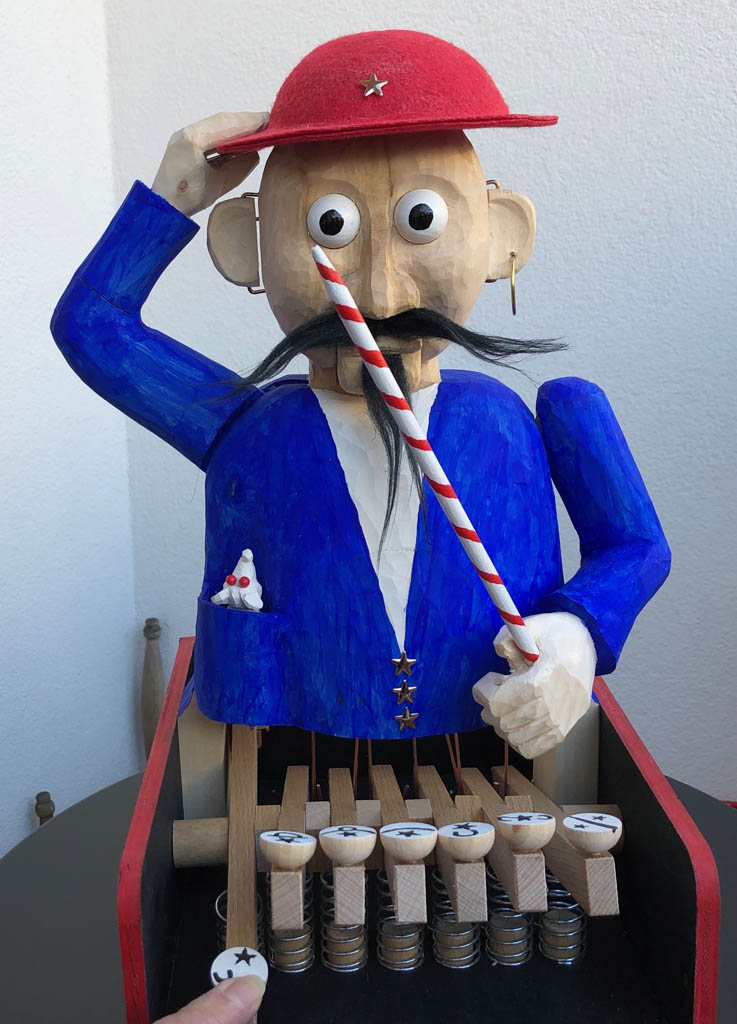
If he doesn’t disappear, try waggling my ears to shake my magic earring.
Once he has disappeared, say the magic phrase “Maus, Maus, komm heraus” and be amazed at the stupendous power of your own magic.
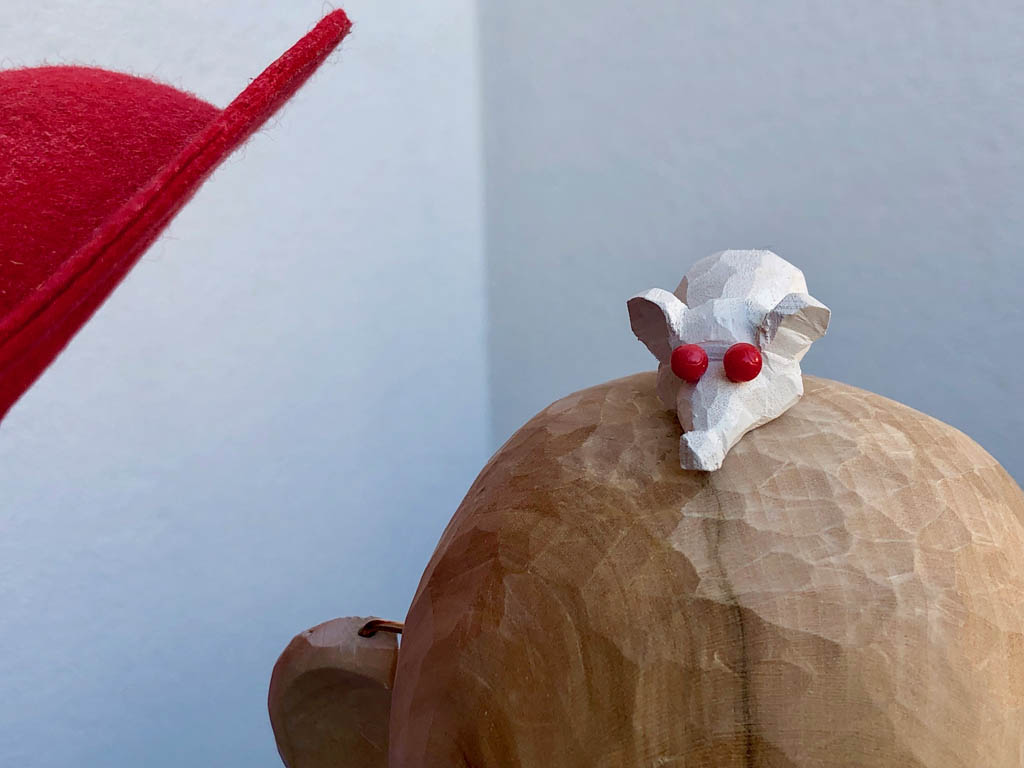
Take great care however, not to try this when the moon is full or you may find yourself transformed into a small white mouse with hypnotic red eyes.
The secret of the trick
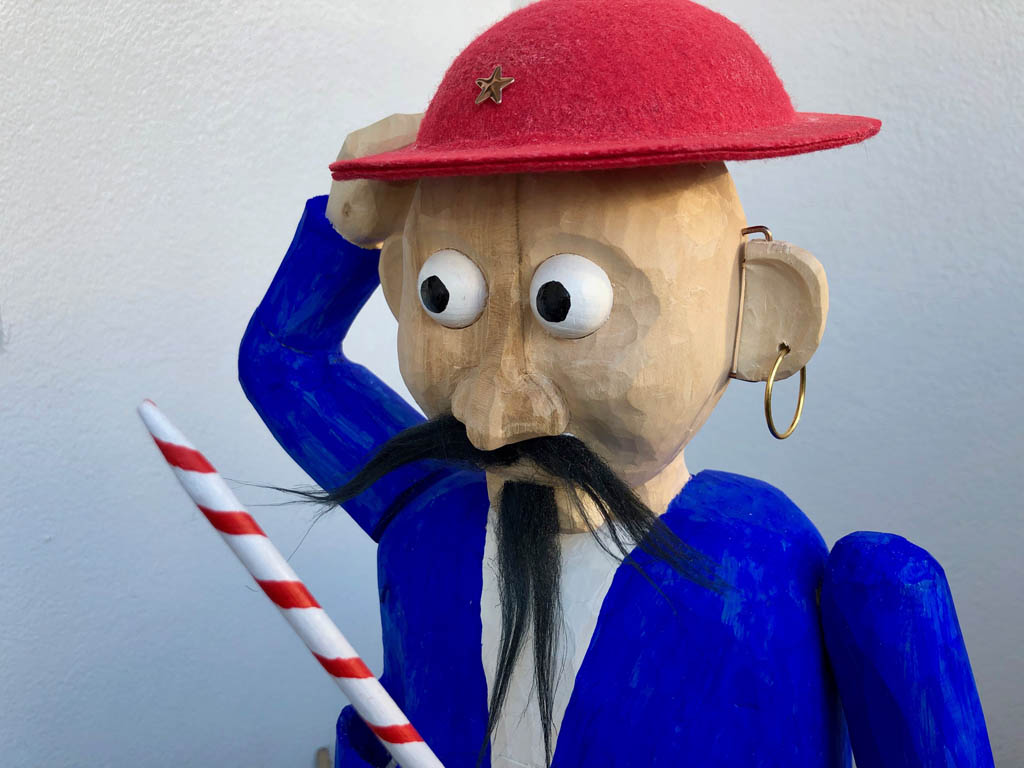
All shall now be revealed
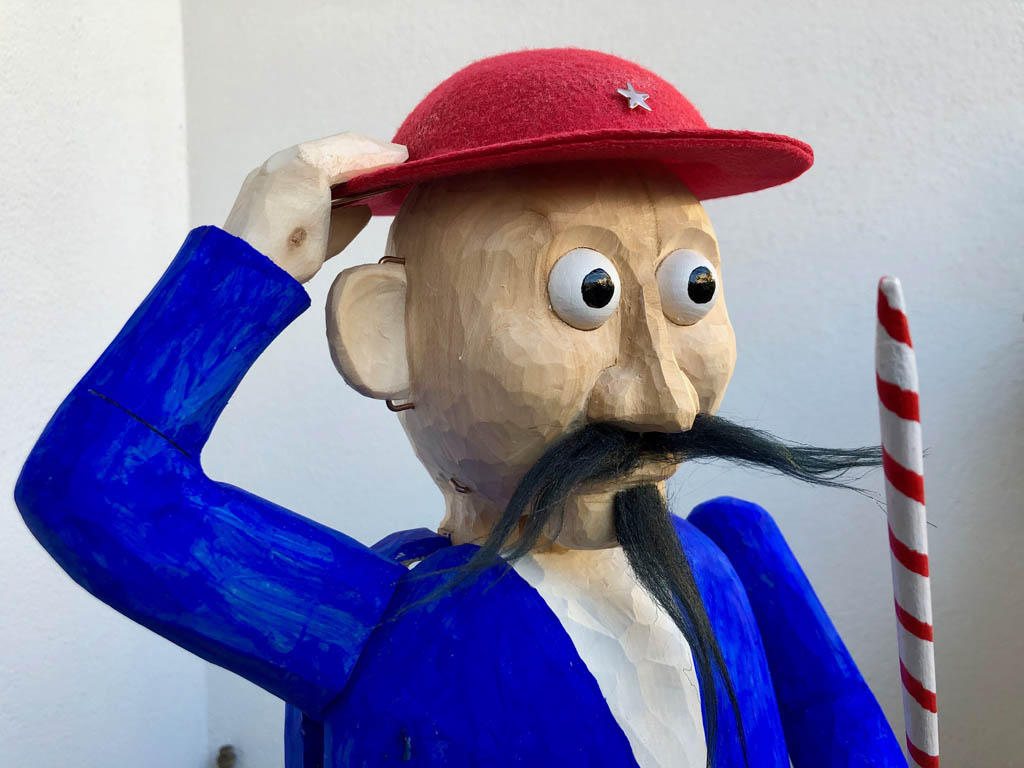
Be astounded about the wondrous, never-ending miracles of the universe
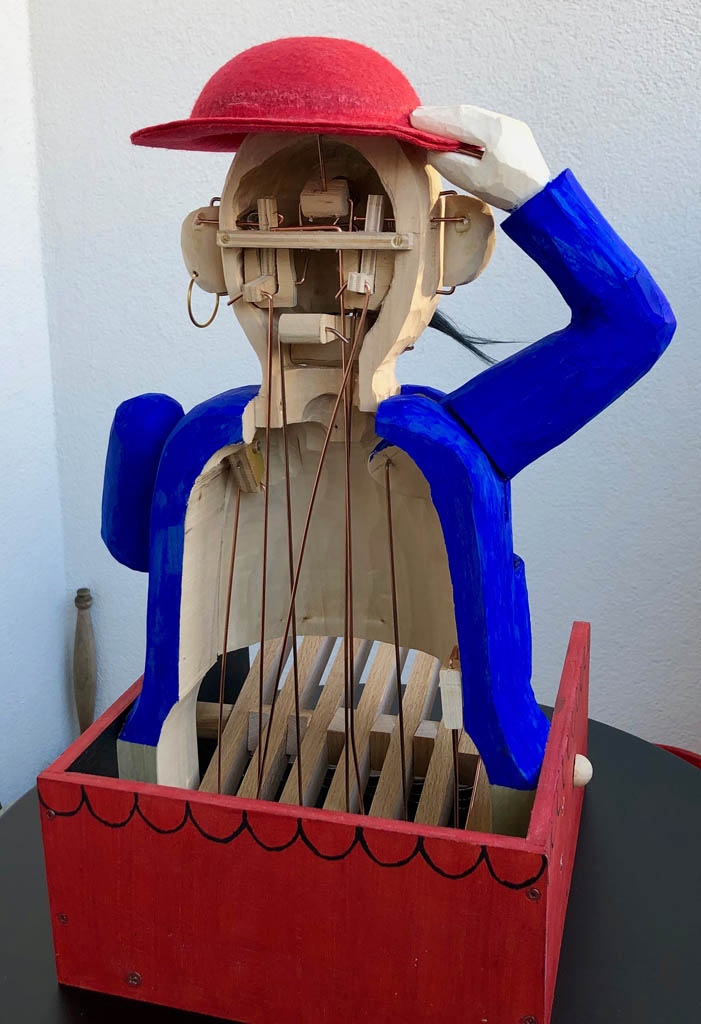
Children, ask your parents’ permission before looking any closer
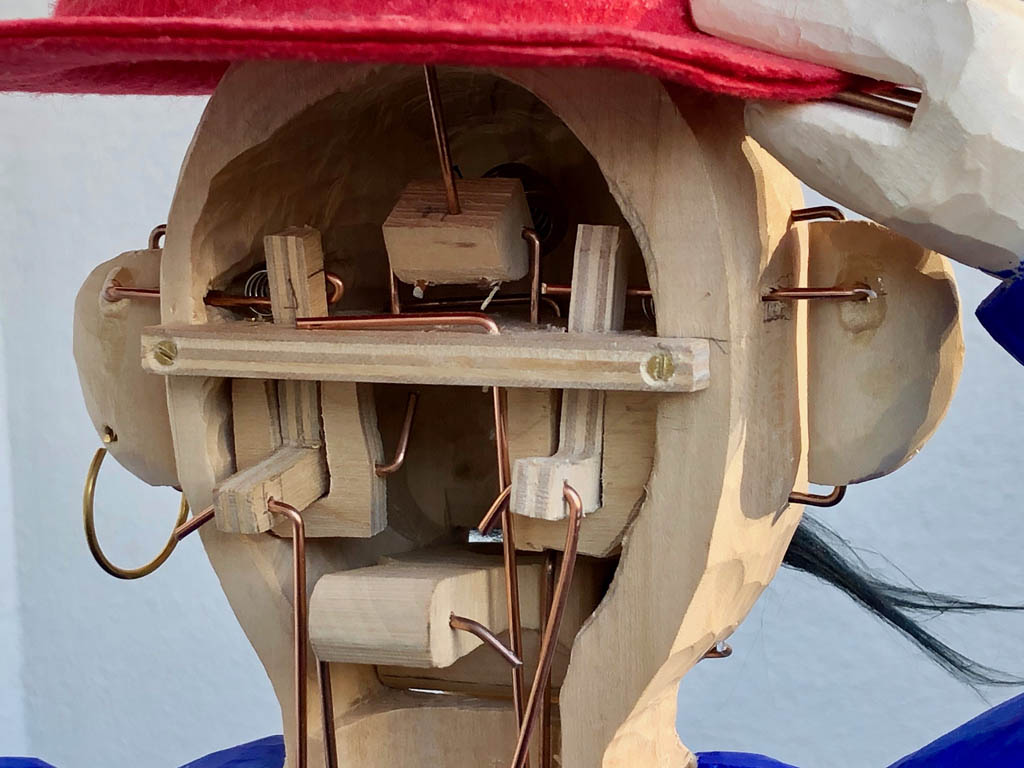
Thanks to all of the woodworking wizards of Puppets in Prague who made me into the magician I am today!
-
Probošt’s mechanical Christmas crib
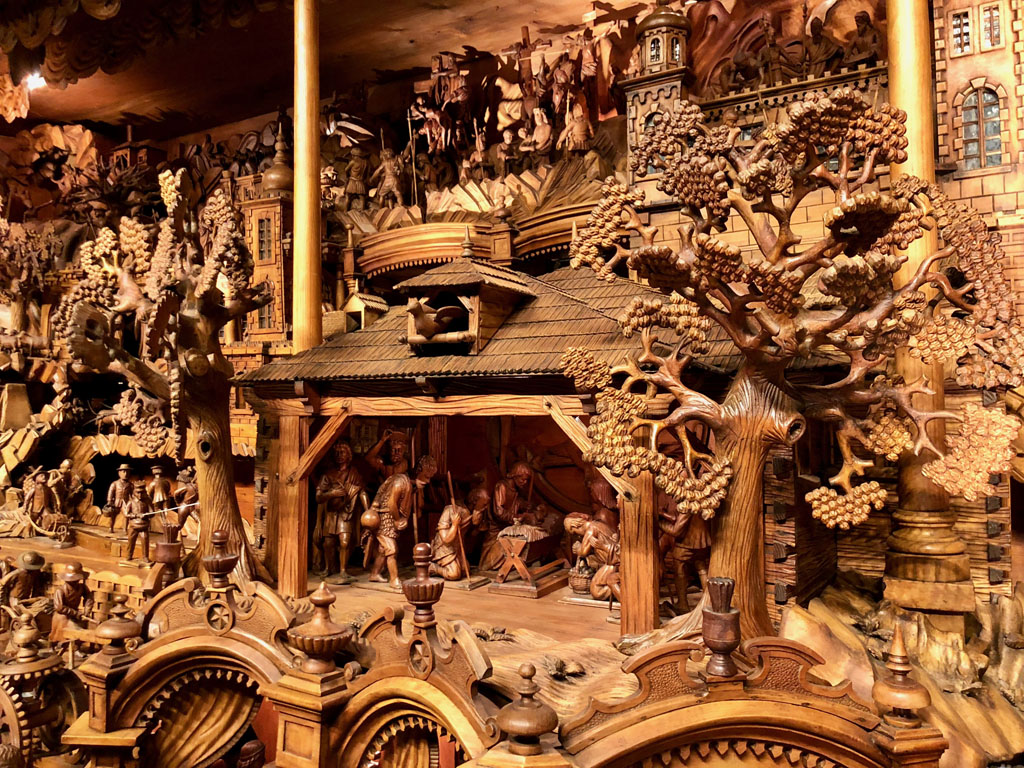
Czech Nativity Scenes
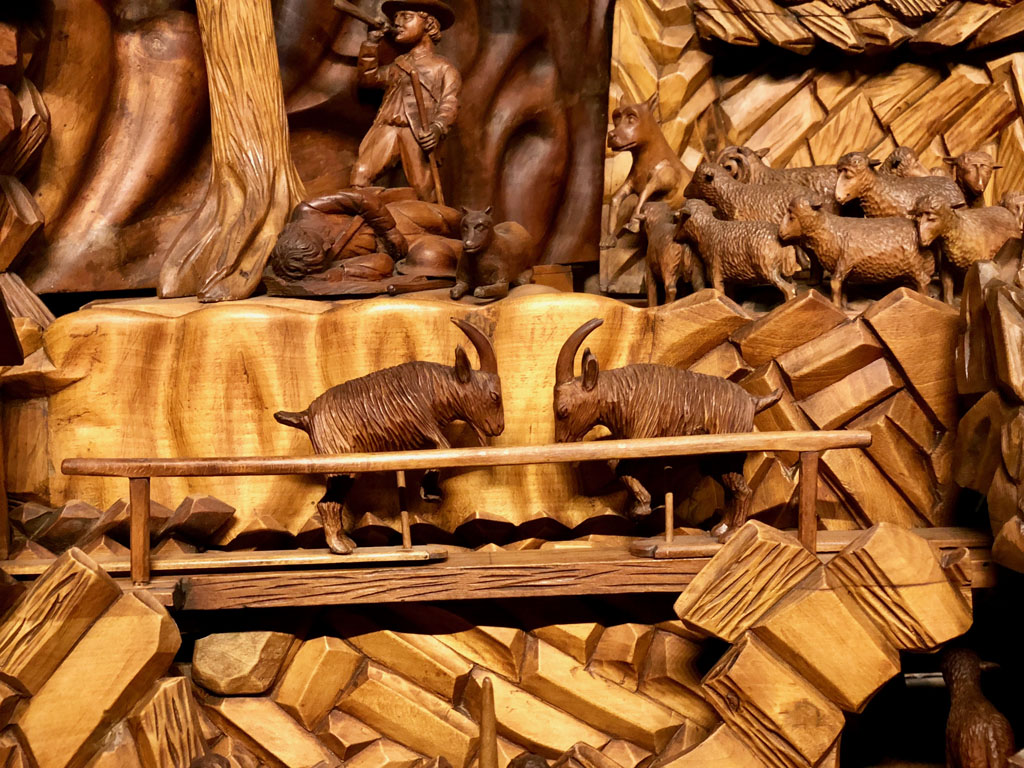
Nativity scenes are an inseparable part of Christmas in the Czech Republic, and as the festive season approaches you will find them at almost every Christmas market. Nearly every Czech city or town has a Christmas tree in the main square with a nativity scene beneath the tree. Each nativity scene is original and unique. The story of baby Jesus, with a manger for a crib, is shown in many ways by artists and one artist in particular is responsible for perhaps the most elaborate nativity automata in Europe: Josef Probošt.
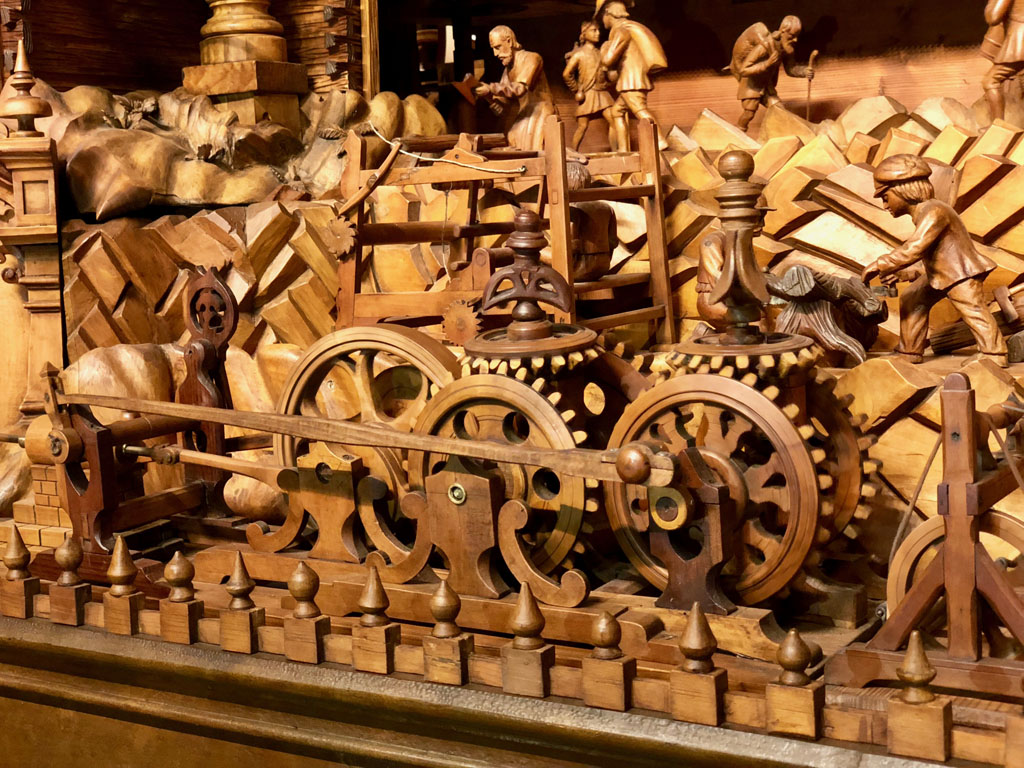
Probošt’s mechanical Christmas crib
Czech farmer and carpenter Josef Probošt lived in a small village called Třebechovice pod Orebem (current population 5700), about 120 km east of Prague in the Czech Republic. In 1999 his automata was declared a Czech national cultural monument, but work actually started in 1885, while Queen Victoria was still on the British throne.
It is thought that he initially made it for his wife, following the death of their 7 month old son. She liked it and he decided to enlarge it, bringing in another carver Josef Kapucián, and Josef Friml who was a “mill carpenter” and a specialist in the making of cog wheels and other mechanical parts made of wood. Probošt was a deeply religious man who held his work for an altar. His original, modest concept was of a religiously based nativity scene with the infant Christ, angels, stars, wise men and so on.
As it grew year for year, the concept grew with it to show all aspects of rural life in Bohemia at the beginning of the twentieth century including subjects such as mining, carpentry, weaving and farming, not forgetting the blacksmiths and the musicians. Local residents who visited Probošt to admire the nativity scene during its construction served as models for many of the characters depicted. Probošt himself can be seen as a carpenter and Kapucián as a wise old man. Probošt kept working on it for forty years until he died in 1926, leaving all of the farmwork to be done by his wife and daughter…
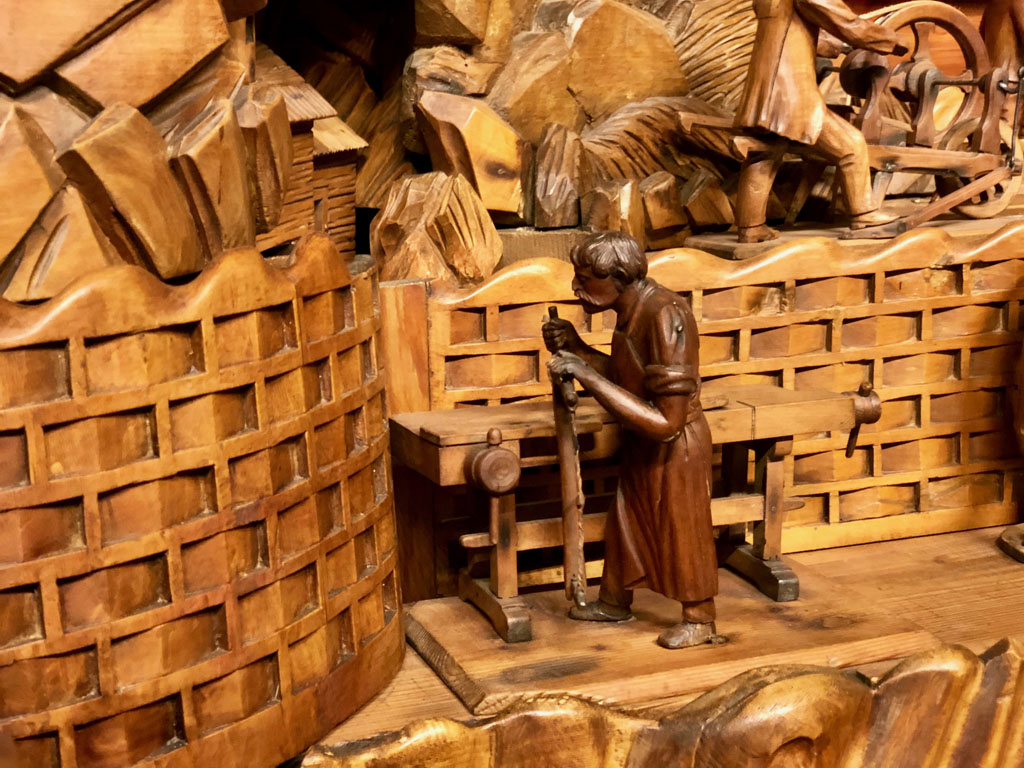
How does it work?
To make it work, there is a large wooden wheel around the back which could originally be turned by hand, activating the belt drives, shafts, cogs, cams, wooden chains etc. to bring all of the scenes to life. From 1935 a motor was used and since its extensive restoration a few years ago, an electronically controlled electric motor does the work, with laser beams monitoring its smooth operation.
It is 23 feet long and is made up of about 2 000 carved parts, including 373 individual figures, illustrating 51 crafts in the community with 120 figures which move in a procession around the scene on simple but obviously effective wooden conveyors.
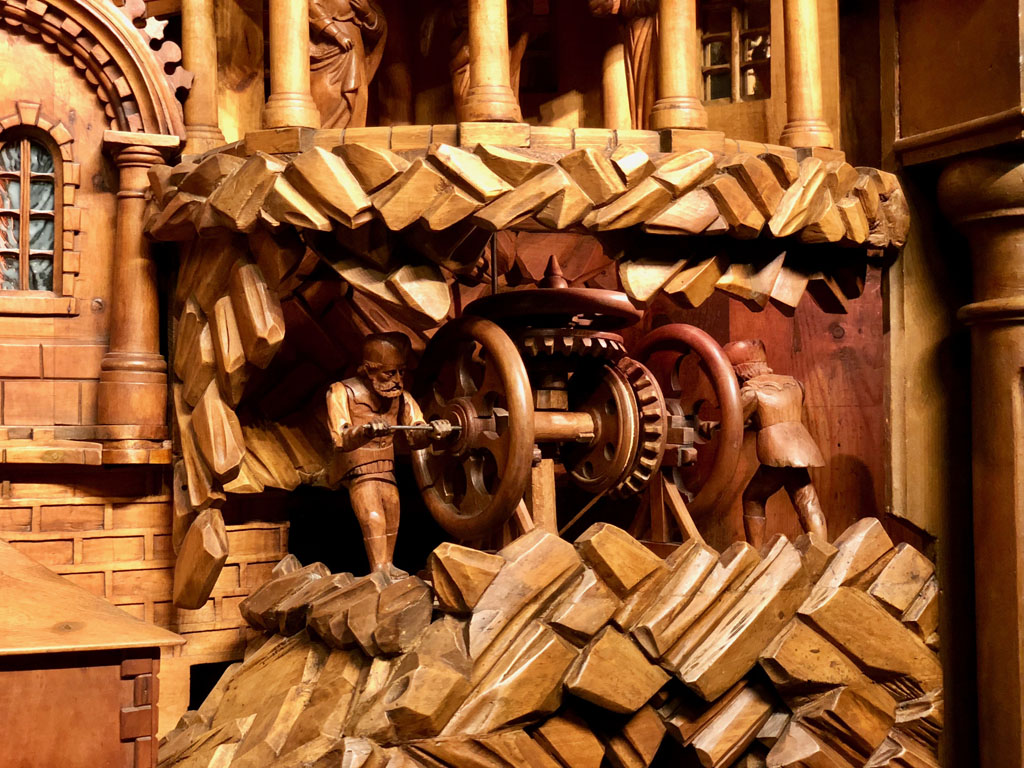
Where can you see it?
It was first exhibited in 1906 at the Provincial Artisan Union in Chrast where it won a diploma and a gold medal. After Probošt’s death it was occasionally exhibited in various places in central Europe, even being shown at Expo 67 in Montreal where more than 8 million visitors saw it, including Queen Elizabeth II and in 1970 it was shown in London at the Ideal Home Show exhibition.
Since 1972, it can be seen in a small village called Třebechovice pod Orebem, which is presumably part of the Czech government’s attempt to entice tourists away from central Prague. You can drive there, or, from Prague you can take a train to a town called Hradec Králové and there you can change trains to cover the last 14 km to Třebechovice. From the station it is a short walk to the Museum of Christmas Cribs. The village has one small restaurant, Restaurace Na Roli serving traditional Czech meals.

It is fascinating to see how a vast automata could be built up by a man with a passion, helped by a couple of friends, using very rudimentary but very effective technology, over half a century before the Mechanical Model Museum in Covent Garden launched the new wave of automata building. Equally fascinating is to consider the trades and activities shown and to consider what their contemporary equivalents might look like, carved in lime wood of course.
Details
Museum web site http://www.betlem.cz/en/
One minute video
Twenty minute video
The wooden conveyor mechanism
-
Mechanical Models Course in Prague
Background to the Class
The Czech Republic and Prague are well known for puppetry. In the days of the Austro-Hungarian empire, conventional theatres were obliged to perform in German, so small travelling companies of puppeteers who were allowed to perform in Czech could offer more than just entertainment for the children and even now, one hundred years after the end of that empire, puppet shows for adults are still to be found and seem to be much appreciated from the couple that I saw. Modern Prague also has a well-regarded film animation scene, resulting in a good supply of experts in puppet, armature & model making. Master craftsman Miroslav Trejtnar and his team have also taught hundreds of students how to make puppets at his Puppets in Prague workshops and when he announced a brand new “Mechanical Object Workshop”, I thought it’s time to pay Prague a visit.
Some of the Team
Miroslav (Mirek) Trejtnar graduated with high honours from the puppet design department of the Prague Academy of Performing Arts. He has trained with Institut UNIMA in Charleville – Mezieres in France. In 1989 he started the KID Company, designing and producing wooden puppets, toys and sculpture. Mirek’s art has been exhibited around the world, including at several UNIMA festivals. He has designed puppets for numerous productions, including “The Baroque Opera” by the Forman Brothers. He has also produced puppets for the Jiri Trnka animated film studio in Prague. Mirek has taught hundreds of students at Puppets in Prague workshops. He has also taught for the Academy of Performing Arts in Prague, St. Martin’s College of Design in London, New York University in Prague, Chapito Circus Academy in Lisbon, Portugal, and in Macao and Hong Kong. 
Zdar Sorm worked for the Jirí Trnka animated film studio at Barrandov studio in Prague for 20 years, and is now a freelance designer of puppets for film animation and theatre, as well as a graphic and furniture designer. He is one of Prague’s leading experts in the technological designs for animated films. 
Leah Gaffen is an American who has lived in the Czech Republic for over fifteen years. She founded the Puppets in Prague workshops with Mirek Trejtnar, and has worked with him as a producer for the course since then. She has also done production and translating work for the Prague Theatre Academy and numerous theatre education projects. The Preparations
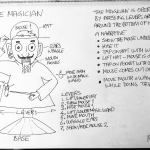
Drawing of suggested project for the Mechanical Models Workshop To apply for a place, I sent a few details of things that I had made in the cellar. Once accepted, Mirek asked for an idea of what sort of mechanical model I would like to build, so I sent him a drawing, with a rough outline of what movements I’d like. We exchanged a couple of emails and he said, yes we can make that.
Mirek’s American wife, Leah Gaffen dealt with all of the organisation, booked accommodation, a puppet show just before the course started as well as an evening at the circus, sent a pocket map of Prague and even some tickets for Prague’s public transport system, which is great when you first arrive, confused by the unfamiliar surroundings. Add a schedule for the course and loads of tips about Prague and we were all set.
Via the social media page set up for the course I was pleased to see that three of the five students were repeat offenders, which is a very concrete statement about the previous workshops.
The course
The six-day course, 8 hours a day, with a day off in the middle, was basically in 4 parts:
- workshop fundamentals about machines, tools and materials
- various mechanisms to make things move
- maquettes to test out the movements for your own project
- building your own project
Fundamentals – photoessay
One tidy workbench per student ready to get started.
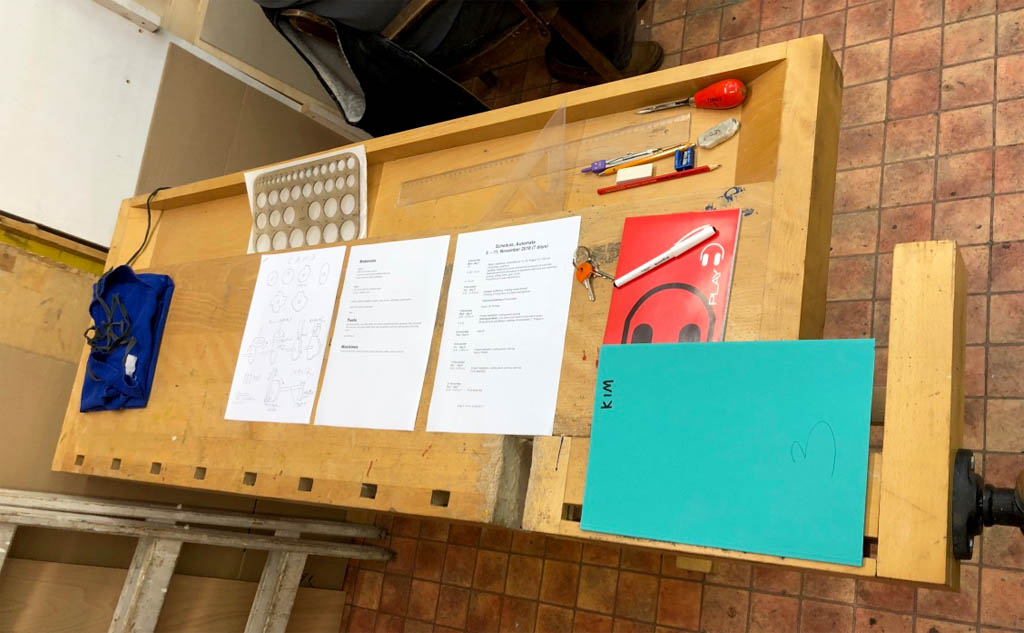
Types of material and their quality.
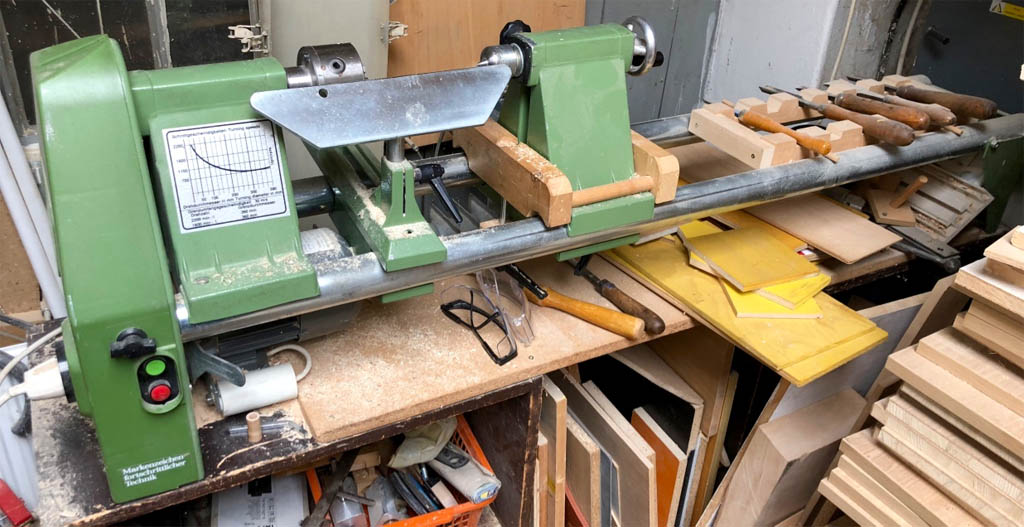
The lathe ready to turn some wooden wheels.
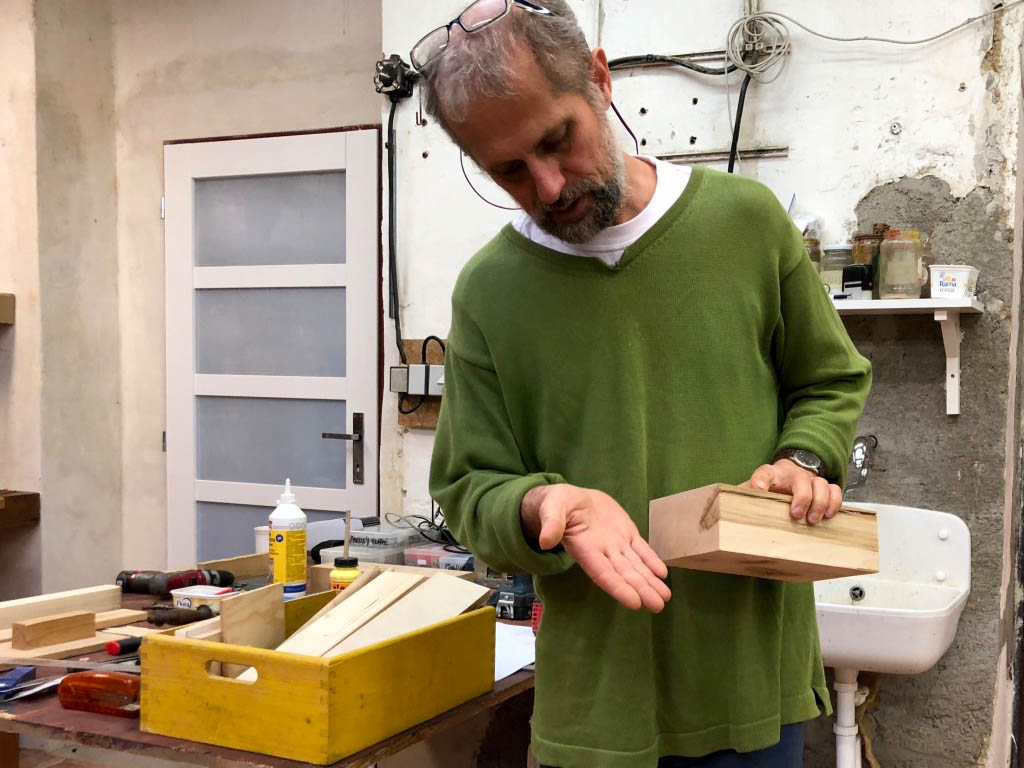
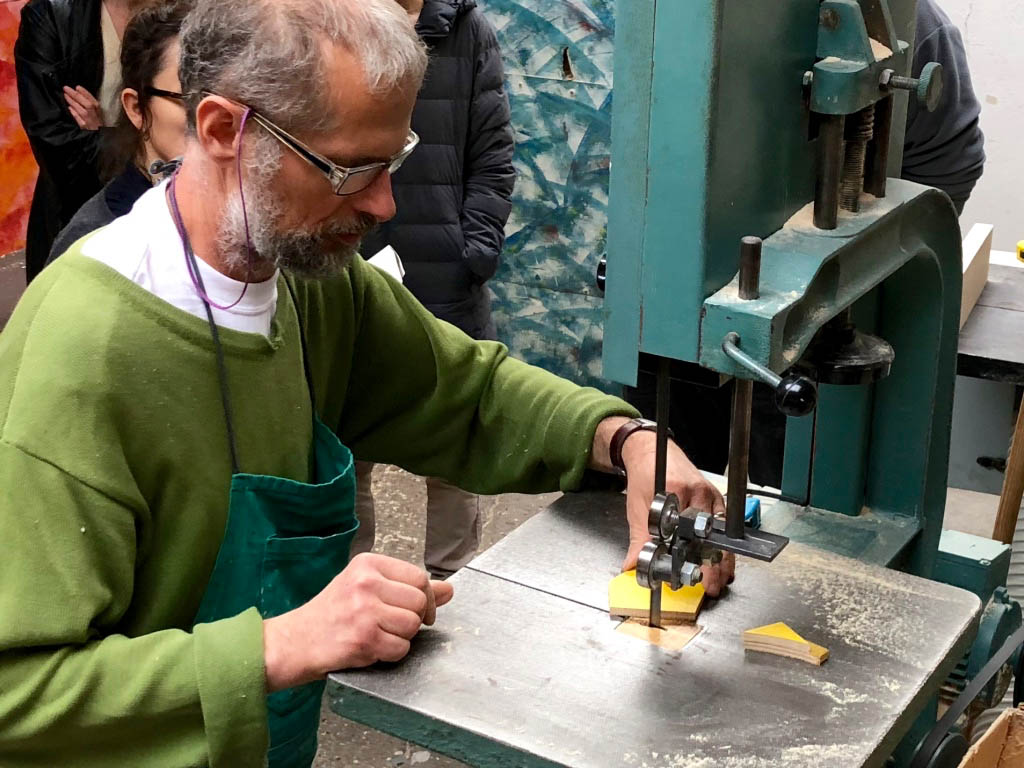
How to use a bandsaw properly.
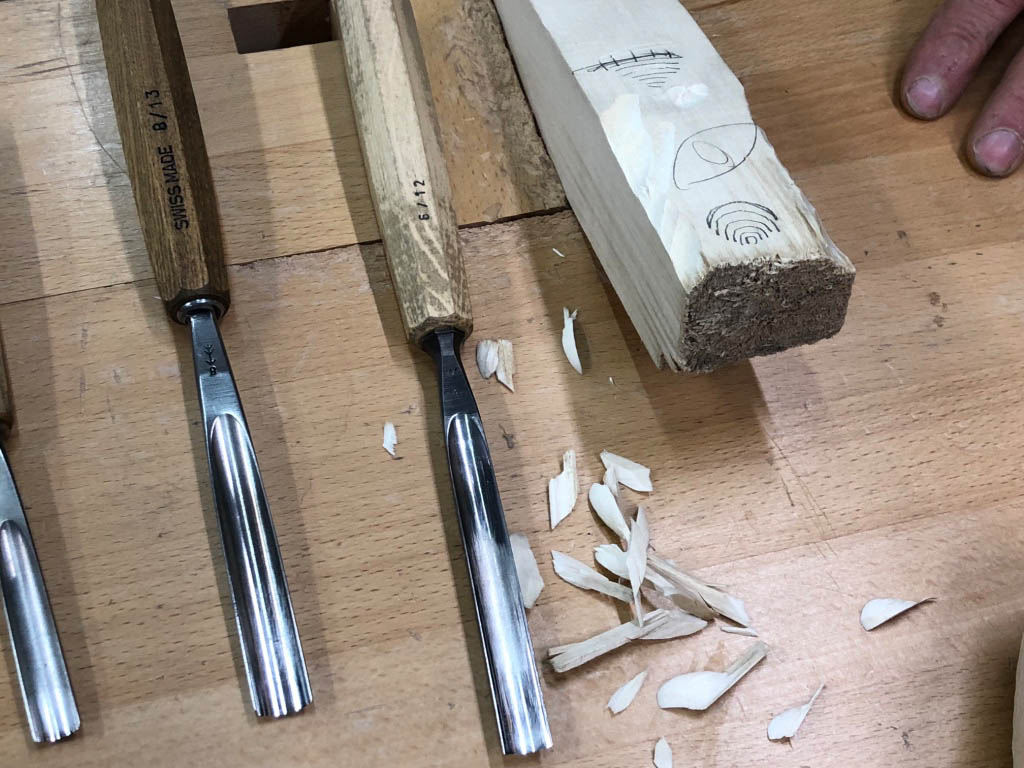
Chisels, sizes, shapes and their care.
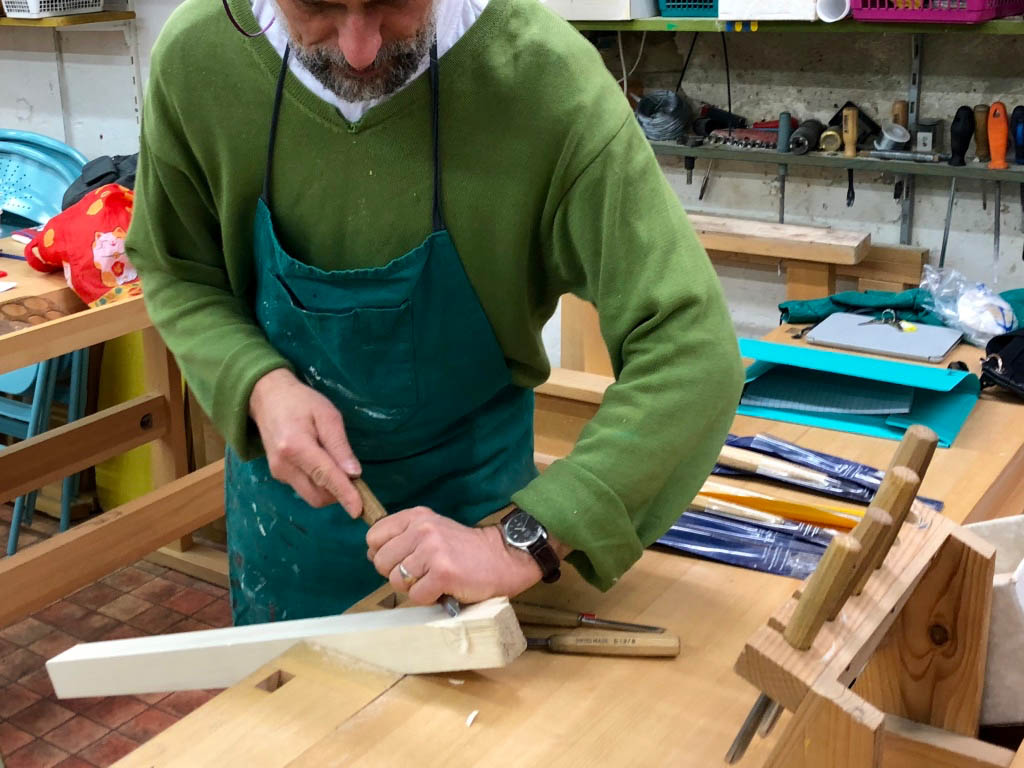
Using a chisel.
Basics of brazing.

Tapping holes.

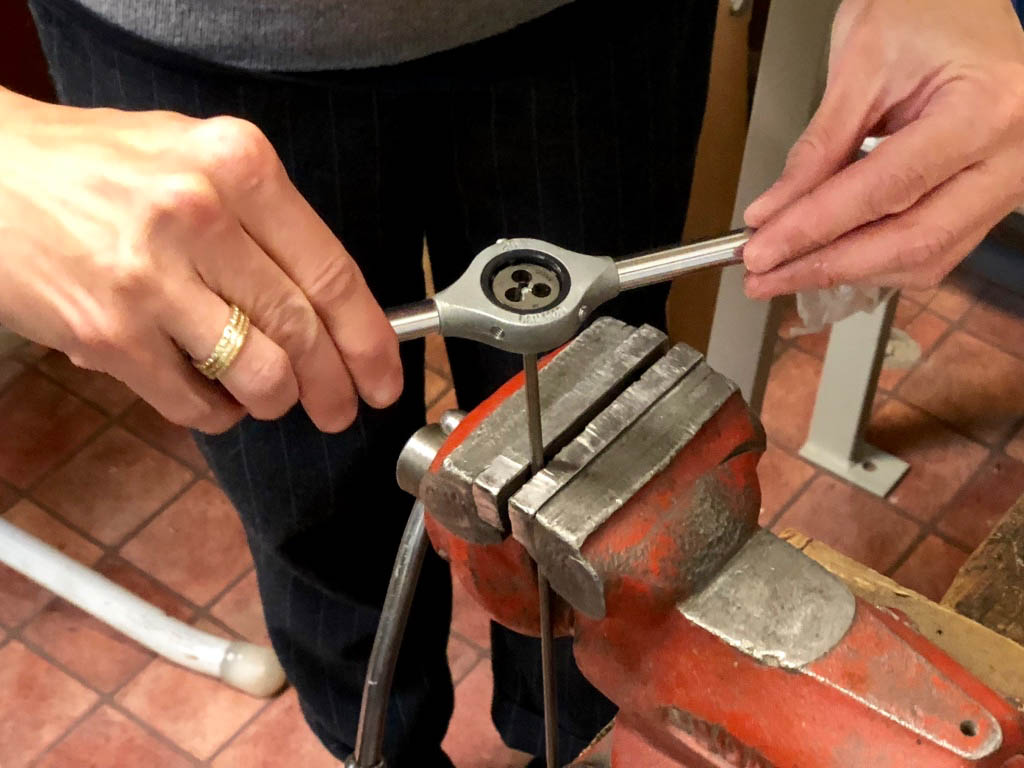
Cutting threads.
Mechanisms
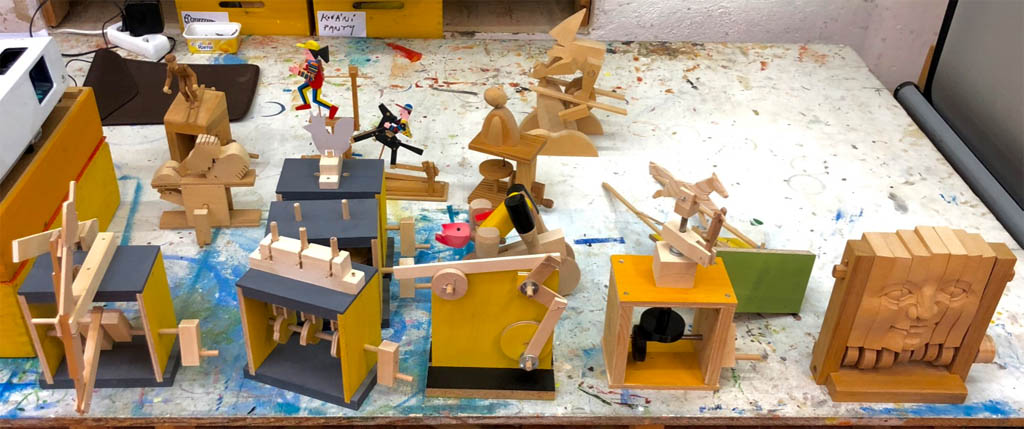
There is nothing better to understand a mechanism than to pick it up, make it work and inspect it from all angles. Mirek has a collection of mechanisms, some complete models from other artists and some basic mechanism, which he produced himself to illustrate how cams and levers can be used. This included Mirek’s own push along cyclist which is now included in the collection of the prestigious Victoria & Albert Museum in London.
The “horse” and the “runner made by Peter Markey use fascinating mechanisms, I spent quite a while handling them to see exactly how the movement is produced.”Man and fly” by Robert Race uses a very simple mechanism but is very entertaining and shows that it doesn’t have to be complicated to be a success. Mirek’s own animated, carved face produce a really striking effect, just from a set of cams.
Mechanisms – photoessay
Examples, for inspiration and to understand the basic mechanisms.
Mechanisms, theory and practice.
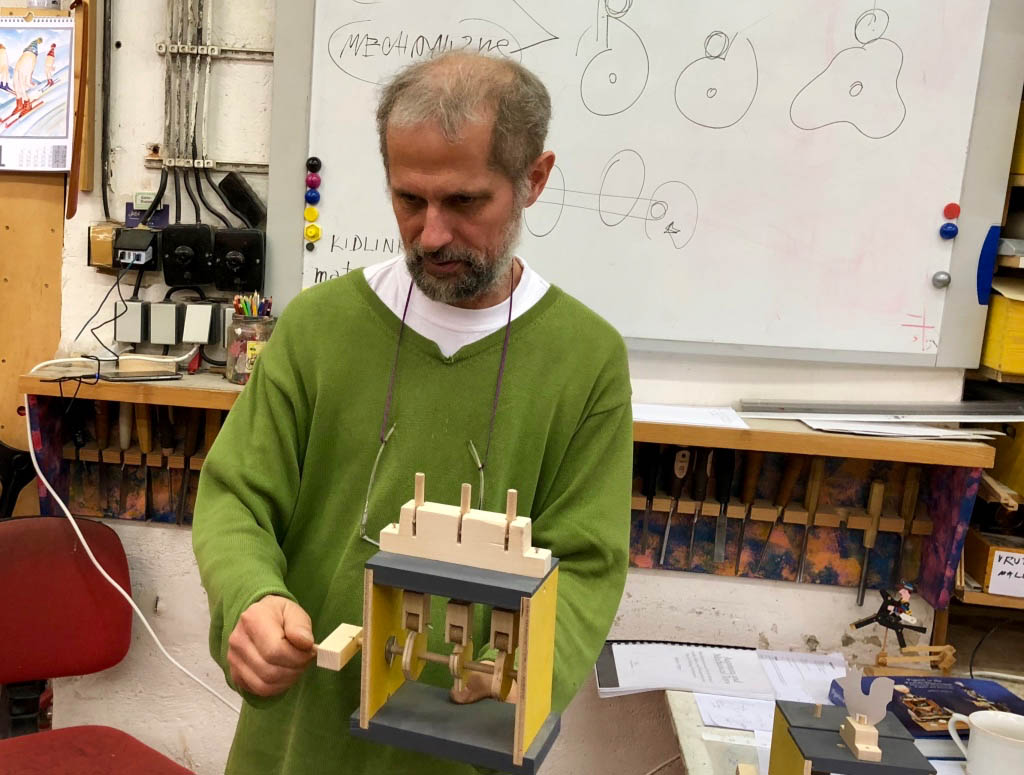
Mirek with some of his small friends hanging around behind him and some online inspiration.

Mirek has made plenty of base kits so that we can try out the mechanisms ourselves.

Templates for three cams.

Three cams in action.
Making a maquette
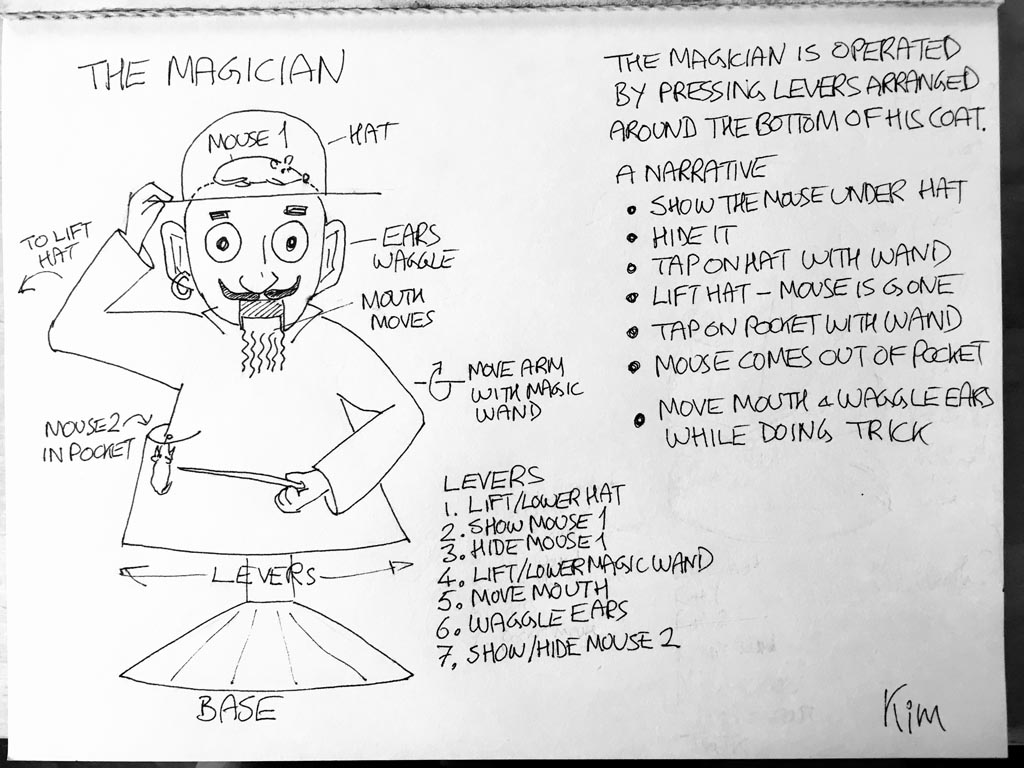
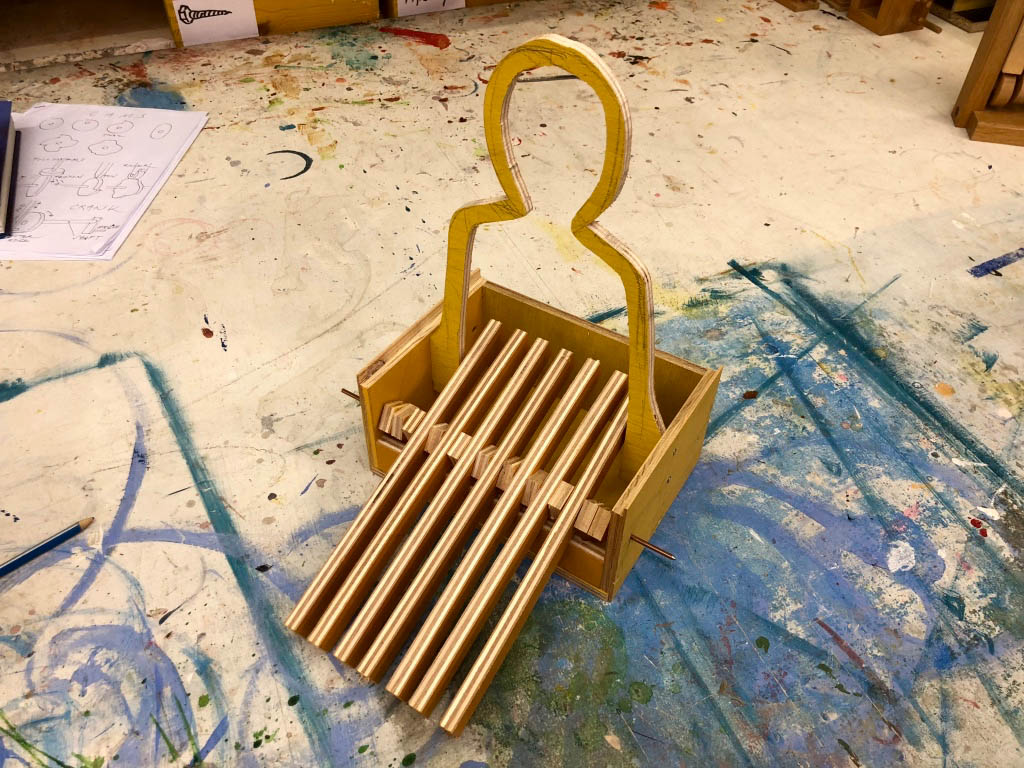
Having understood what mechanisms we could use in our own projects, we then moved on to trying our ideas out on a sort of working model or maquette. This means drawing your idea with enough detail that you can see how the moving parts move, which bits are hinged or which parts sit on an axle, or rest on a cam. This is a fascinating intermediate stage which shows whether your great idea can work or not. From this point on there was a flurry of activity as Mirek and Zdar and the team took our more detailed drawings and conjured up just enough of a starting point for us to work on the movements. In my case this meant a strange centimetre wide outline of my magician figure, standing on a box with seven levers, ready to do whatever I planned for the finished object.
Once I had screwed together the parts which Zdar made for me, I could start the process of adding movement. This first means a real-size pencil drawing of something that moves like one of my magician’s arms. When you are satisfied, cut it out and try it on the maquette to see if it works. Is it the right size? Does it hinge in the right place? With a sharp pair of scissors this takes no time at all and a second or third attempt allows you to get it just right. When you are happy with the paper version, trace it onto a piece of plywood and cut it out on the bandsaw.
Making a maquette – photoessay
A “technical” drawing of your project.
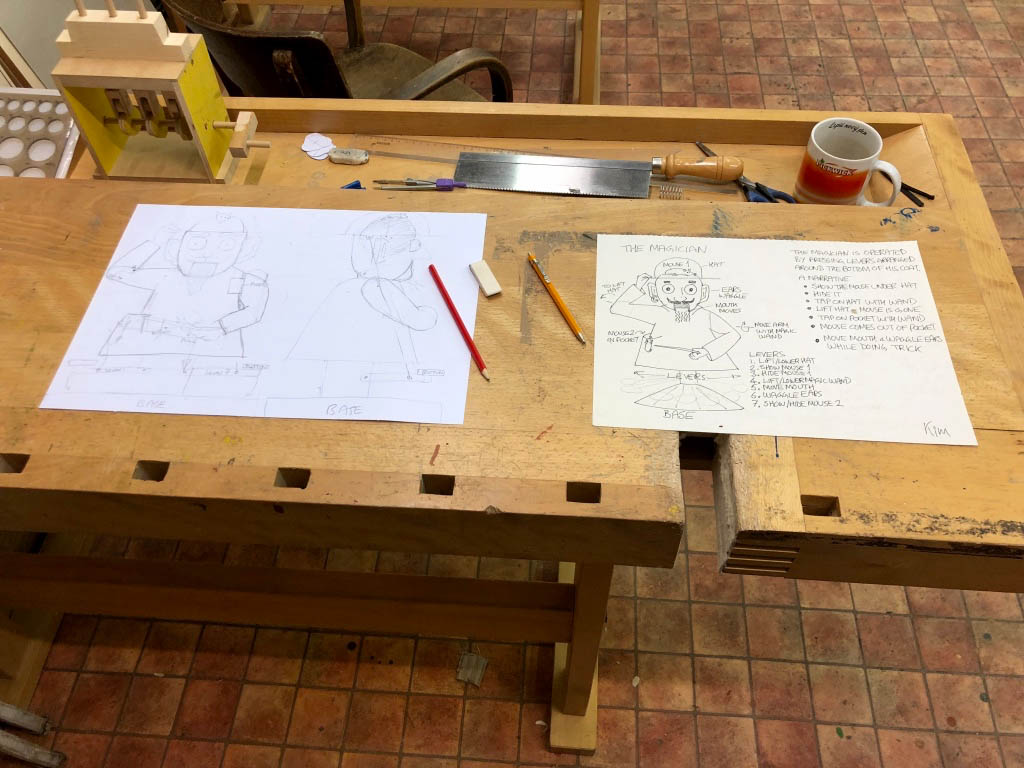
The basic magician maquette, with seven levers and a simple outline of the figure.
Cut out parts in card, if they are OK, cut them in plywood.
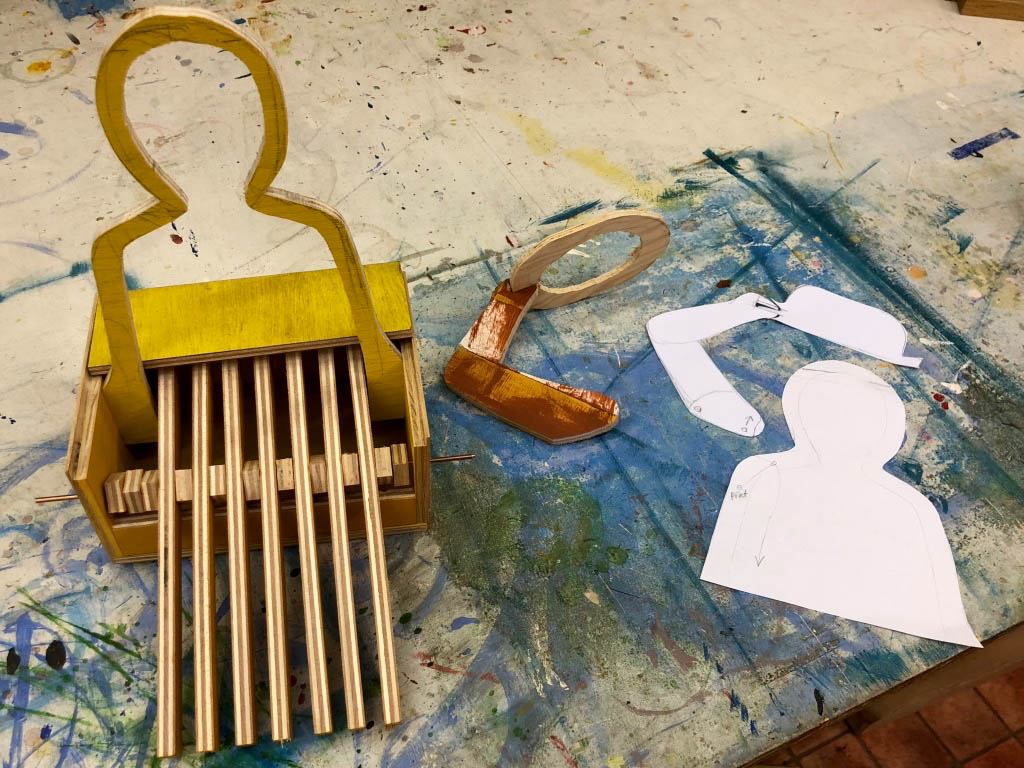
Two mechanisms already proven on the maquette, he can politely raise his hat and wave his magic wand..
After a day off to see the marvellous sights away from Prague, today we return to the workshop, eerily quiet at the start of the day.

The maquette is finished enough with its 7 movements to get ready for the real thing.

There’s always a magically replenished supply of nibbles to go with your tea.

Making the real thing
Having proved the principles on the maquette, it was now time to start on the real thing. To make the most of the time available I dismantled the maquette so that we could use the pieces as rough templates. For the real craftsmen it didn’t take too long to cut lime wood pieces roughly into shape, which I could then carve and prepare for assembly.
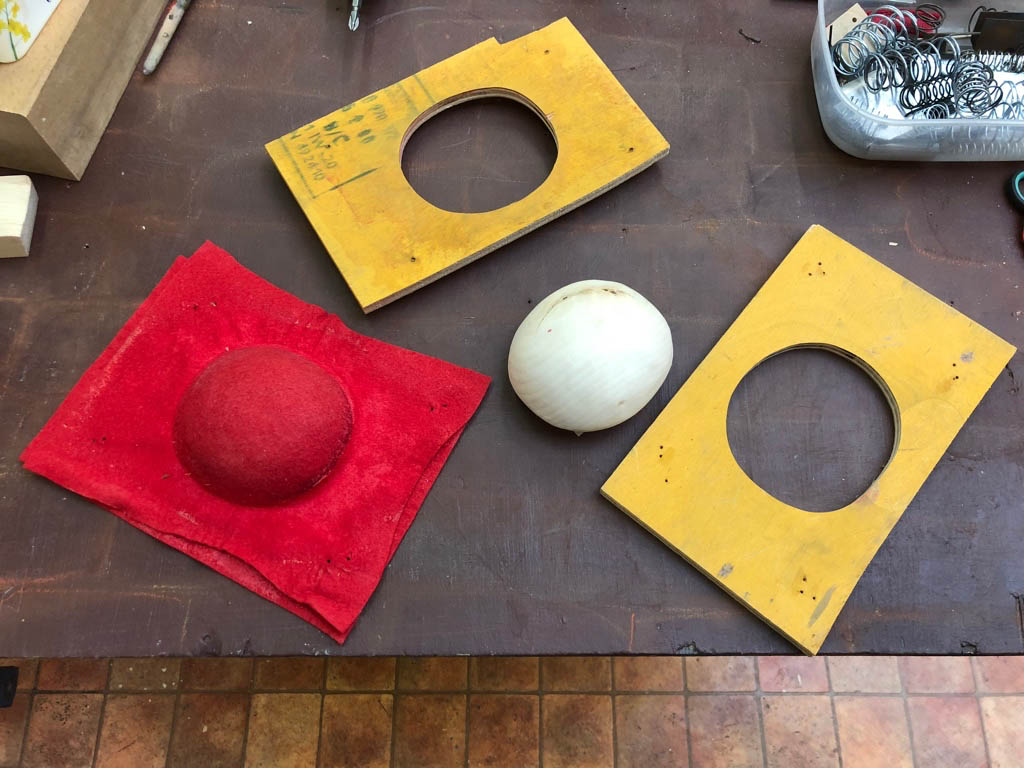
My magician also needed a hat and it was again wonderful to see how the experienced model makers go about that. Once we had decided that it didn’t need to be made of wood (I mean, who wears a wooden hat!), two layers of felt were soaked in diluted wood glue and clamped into an improvised hat mould. After drying out over night, I used a flat iron to smooth the rim and trimmed it to shape with a pair of scissors. Add a bit of wire reinforcement where the hand holds it and taraaa! A hat!
Making the real thing – photoessay
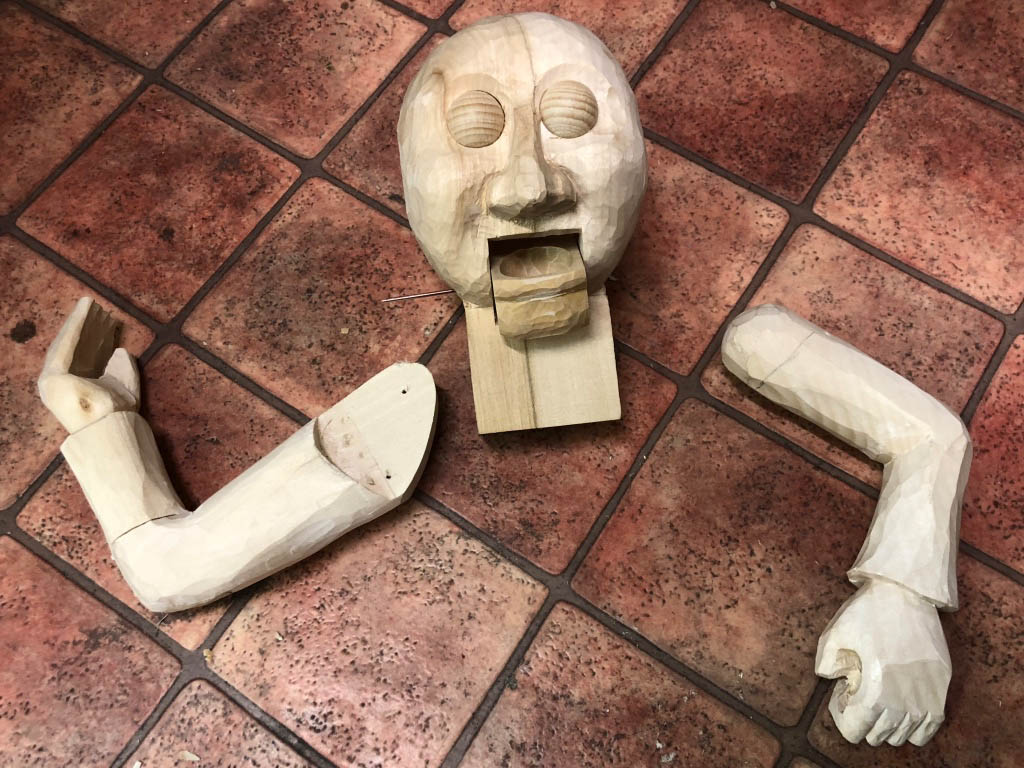
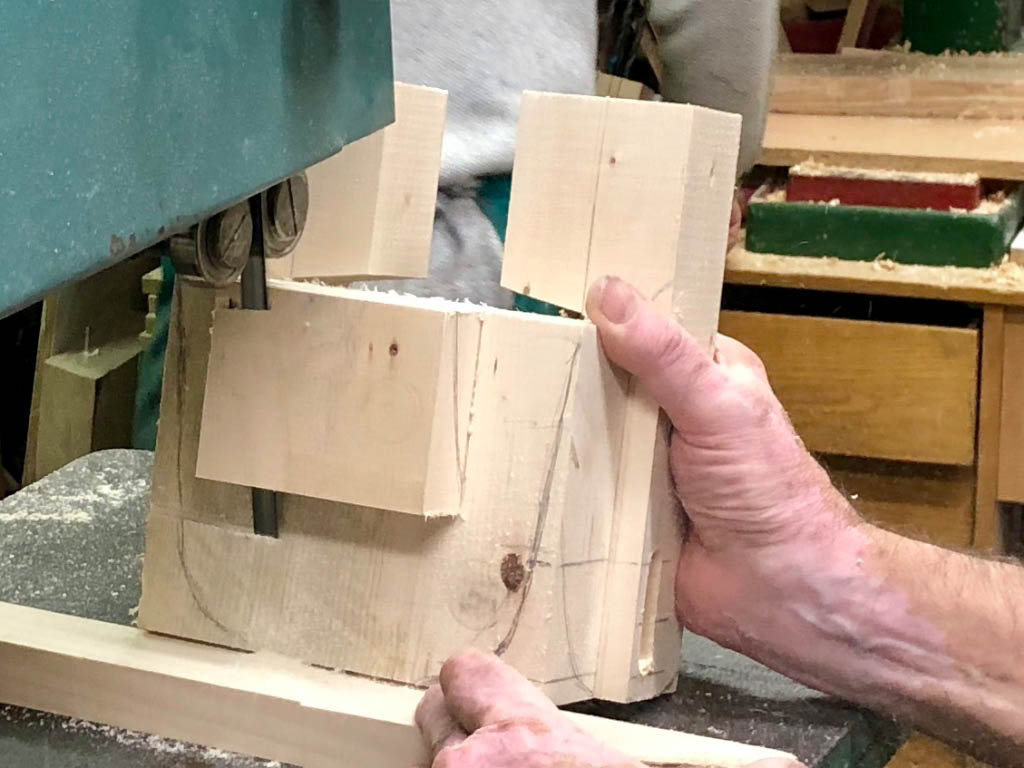
Cutting the left arm on the bandsaw from the marquette.
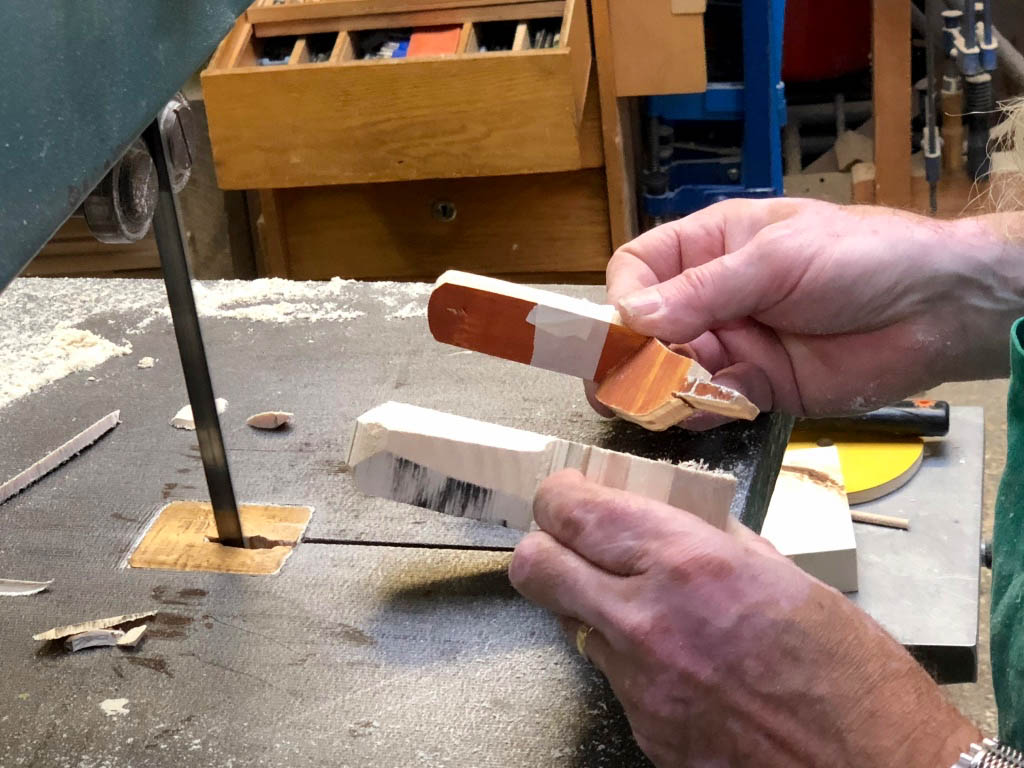
As finished from the bandsaw.
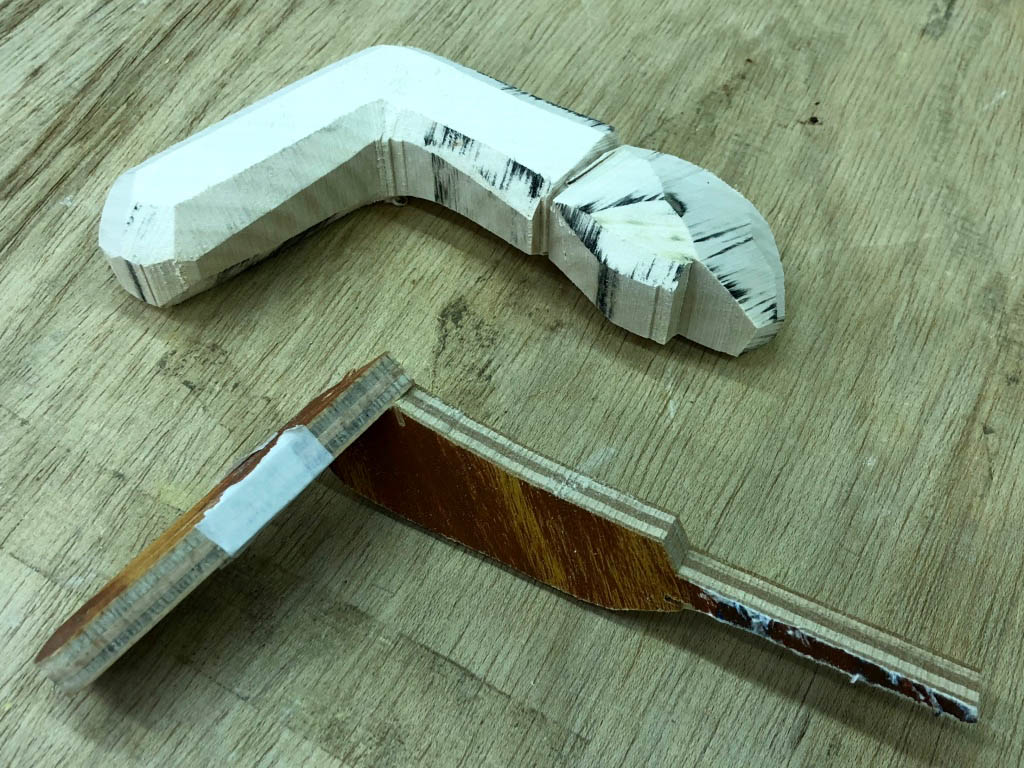
Same for the right arm.
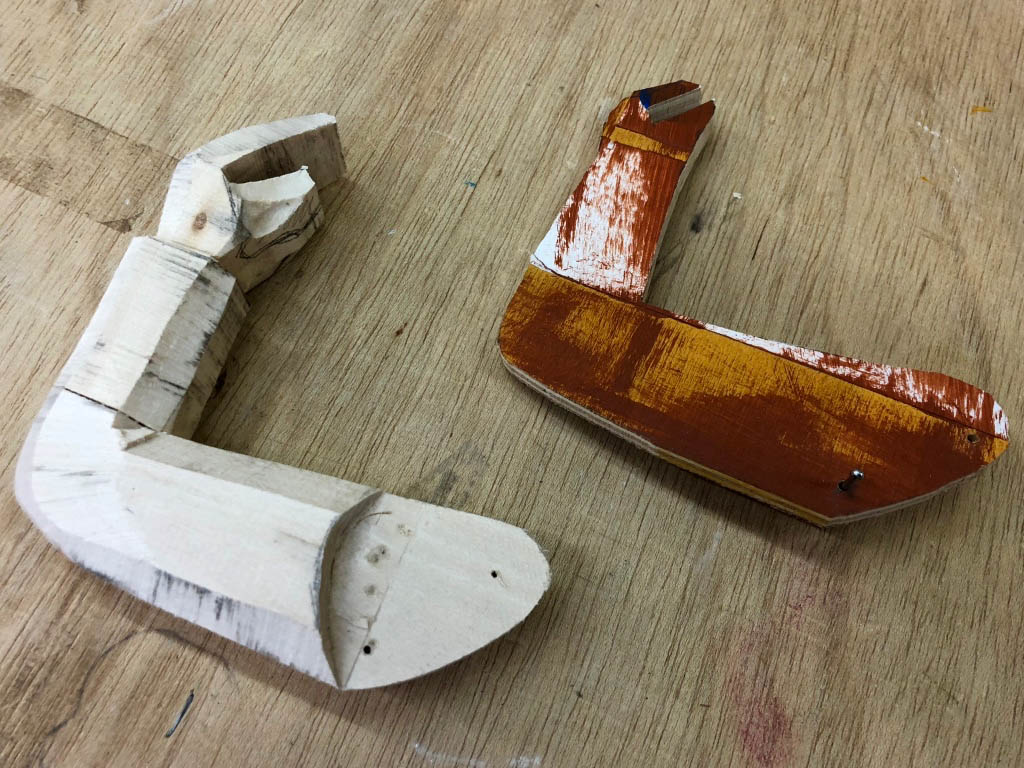
The head’s a bit more complicated…
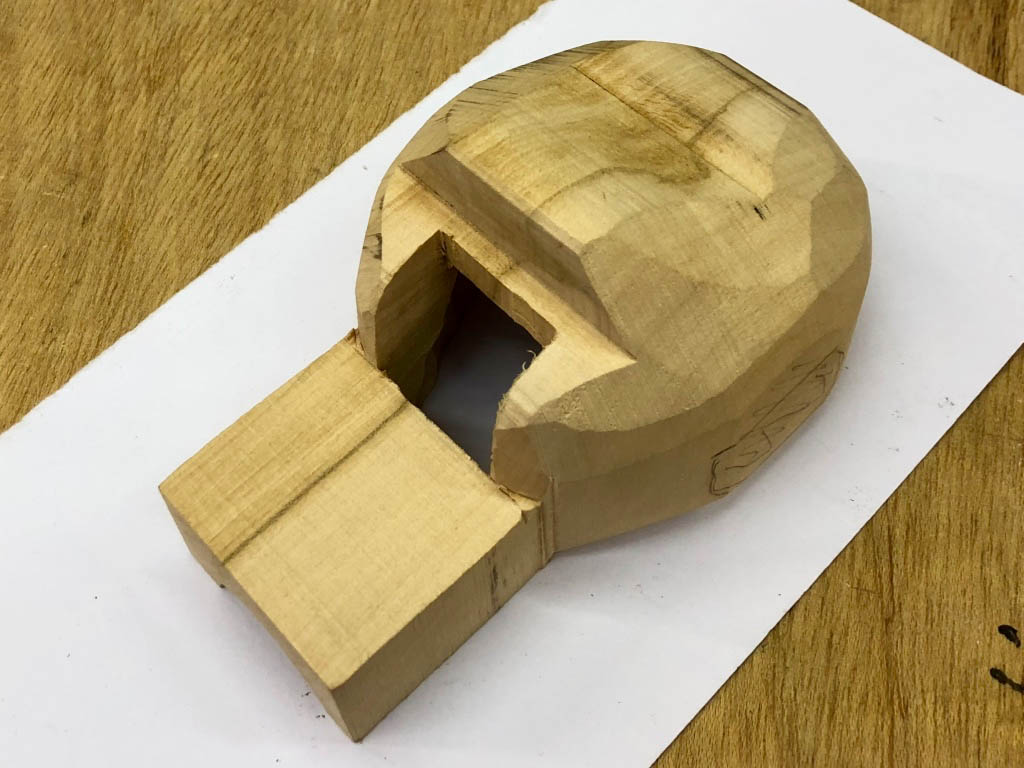
After carving.
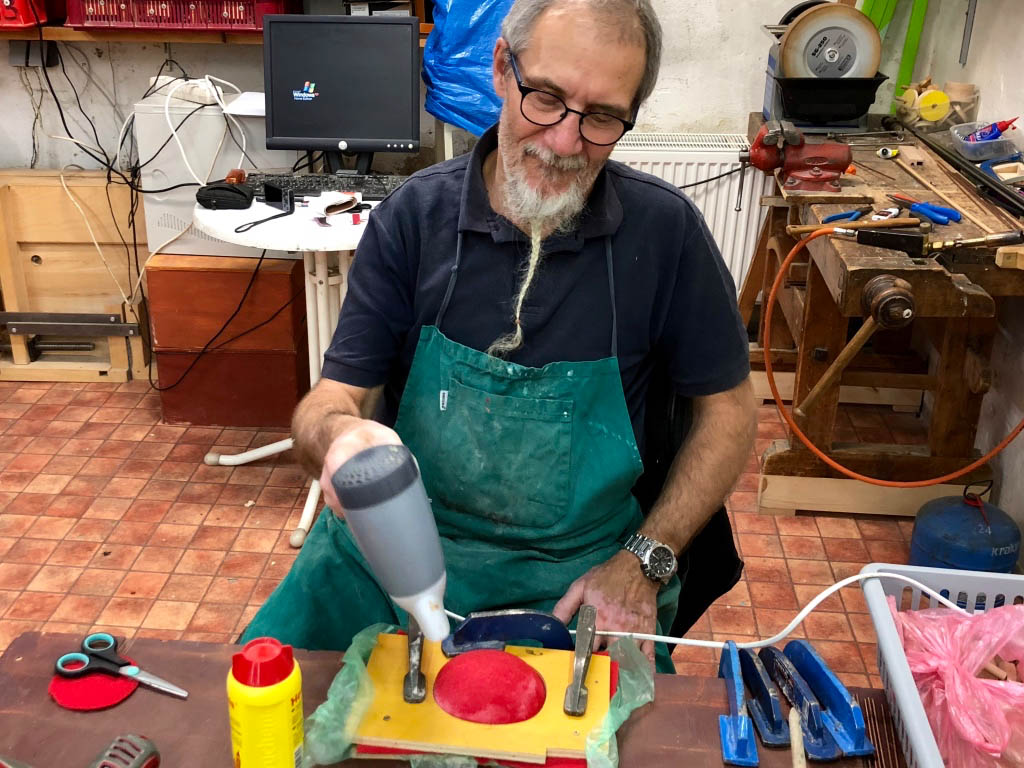
Zdar making a hat from two layers of felt soaked in glue.
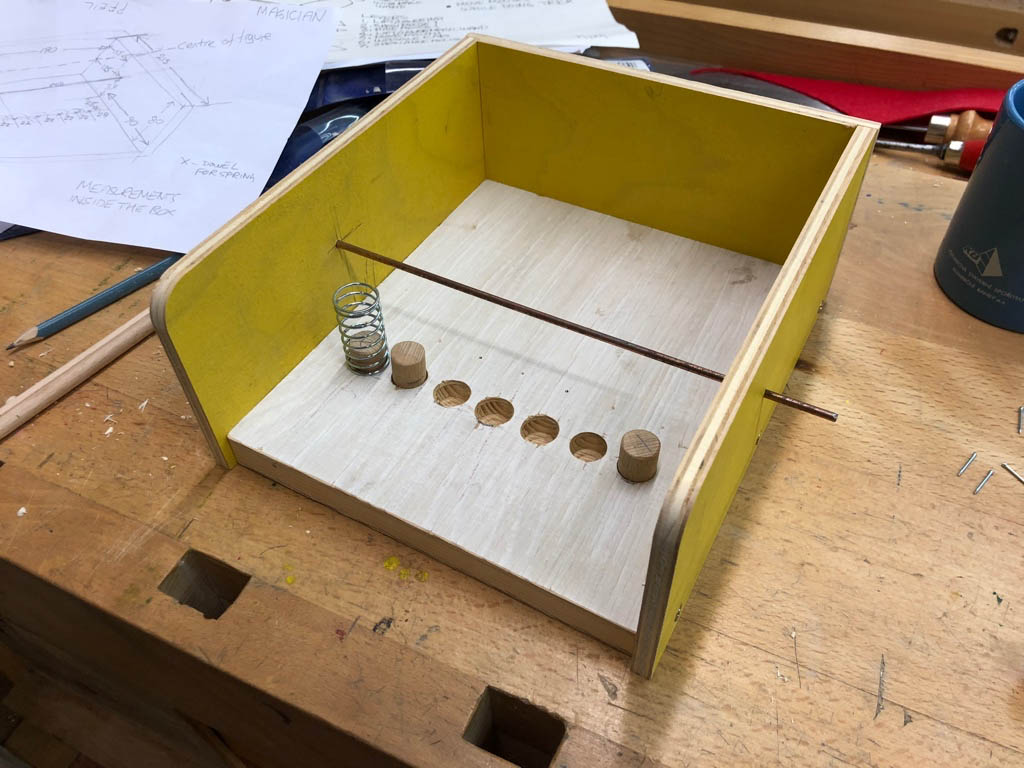
A new base in the right size, with holes in the right place.
New levers in nice wood.
Take the hat out of its mould and iron the rim flat.
Take the glued together blocked up body which dried overnight and trim it roughly to shape.
Try the head and body together.
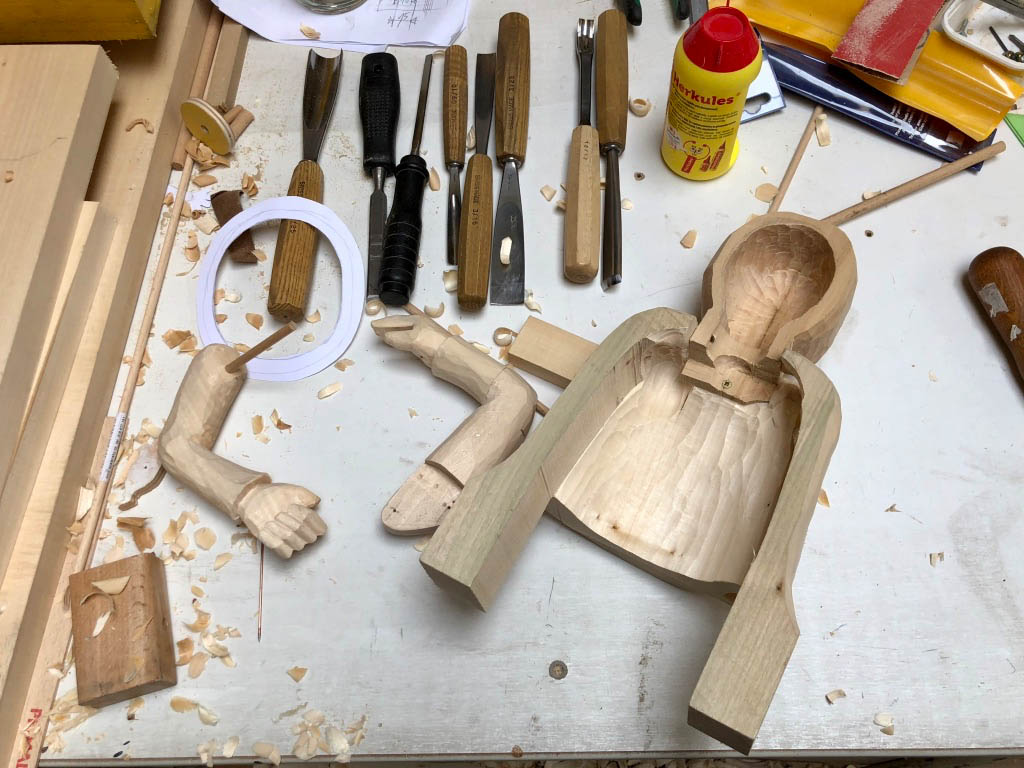
Add the jaw.
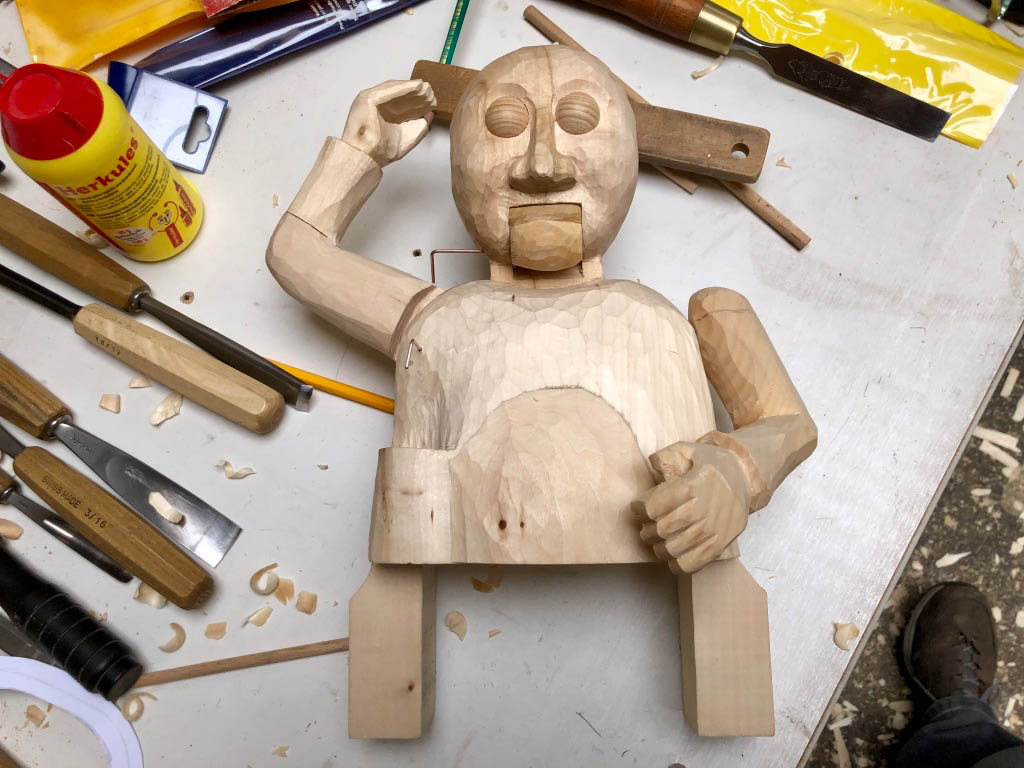
Paint the assembled base.
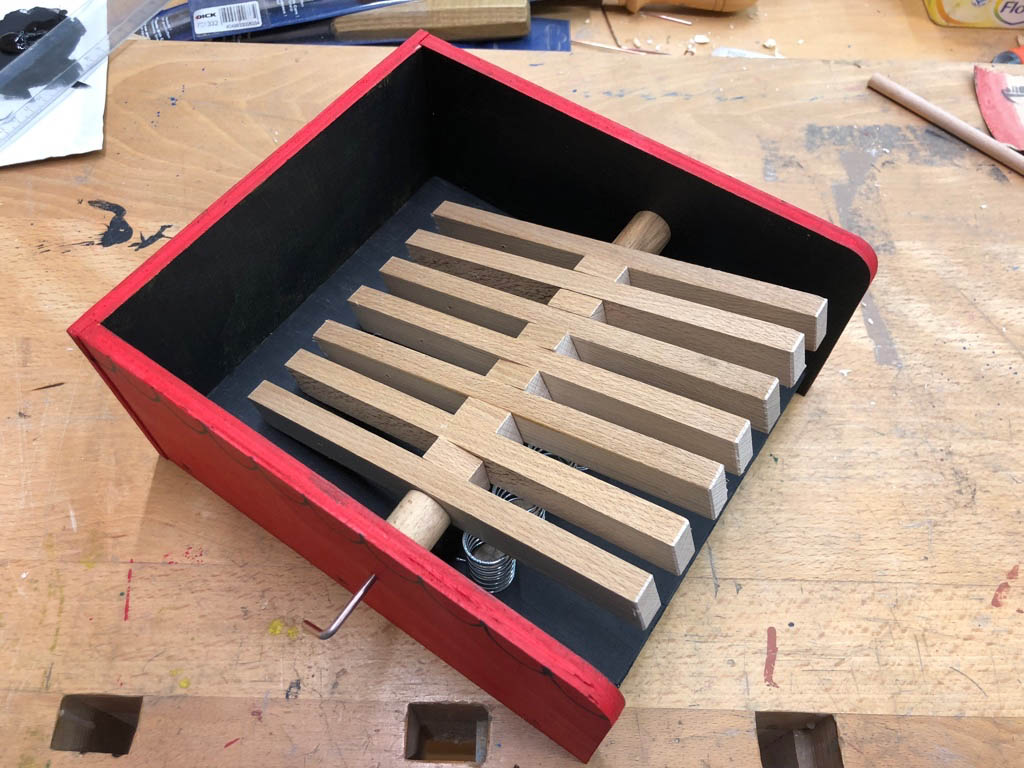
Glue the head to the body and screw it into the base and start fitting the mechanisms as used in the maquette.
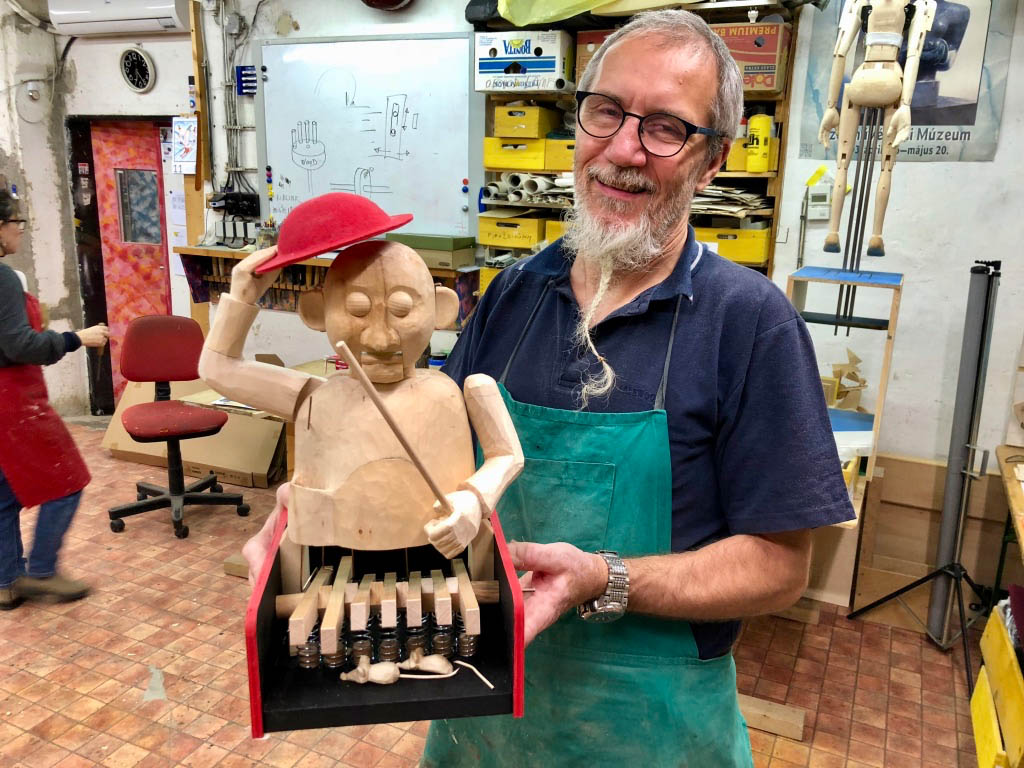
How did I like the course?
Although there wasn’t enough time to completely finish him, my magician was finished enough, and I was confident of completing it at home. I snaffled a few pieces of welding rod and some fishing line and set off for home, quite astonished about what we had achieved in one week. Once the magician was set up on my desk at home, I was very proud of him!
The other participants in the course came from a very diverse range of backgrounds and were very supportive. The atmosphere in the workshop was a very happy and positive experience. The course was held in English and sometimes some of the tutors struggled a bit to find just the right words. That didn’t actually matter at all, as actions speak so much louder than words and we all communicated just fine.
I also enjoyed seeing machines and tools in action which I don’t have at home. More or less the first thing that I did on returning home was to order a set of chisels and a few other bits & pieces which I had found particularly useful, to maintain the momentum and enthusiasm. The very deliberate process of making a maquette to quickly test out your ideas also really impressed me. In my days as a working engineer I would have called that “fast prototyping”. Seeing it used for mechanical models was a surprise for me, although it shouldn’t have been. That’s why you go on courses I suppose.
The accommodation was reasonably priced and very close by. The local high street was full of places to grab a bite of lunch. Leah organised an amazing cultural programme which for me included a puppet show, a music show, a modern circus, a trip to see the biggest mechanical Christmas crib on the planet and a very special visit to see one of Mirek’s old tutors. Fortunately I arrived a little early and had a chance to do some conventional sightseeing in advance. All in all I had a great time, learned a lot and now I understand why three out the five students had returned to Puppets in Prague after having attended a previous course.
-
Mechanical Mutt
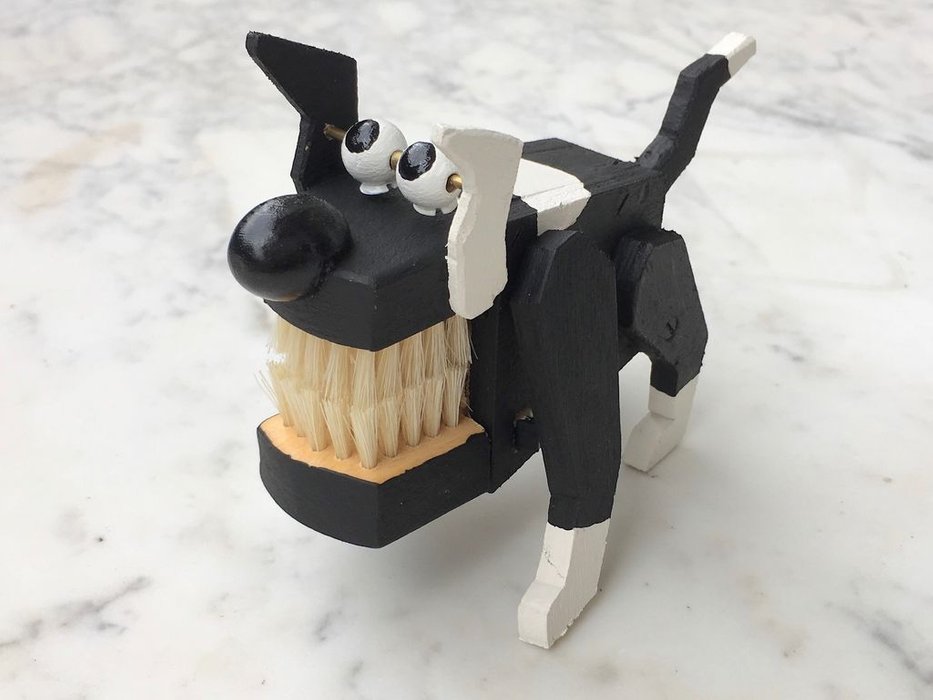
Mechanical Mutt What’s the brief?
What can you make, that doesn’t have a fixed base, but can still do tricks? Man’s best friend of course! For simplicity’s sake, the design has to be reduced to just those things that make a dog a dog. If you like them, their essence is a shiny nose, appealing eyes, a wagging tail and a smile. If you don’t, it all comes down to the teeth. With four legs, one can be used to wag the tail and another to work the smile. The nicer the smile, the less there will be to worry about with the teeth.
What do you need?
My dentist says that you must always brush your teeth for a nice smile, so a brush is vital.
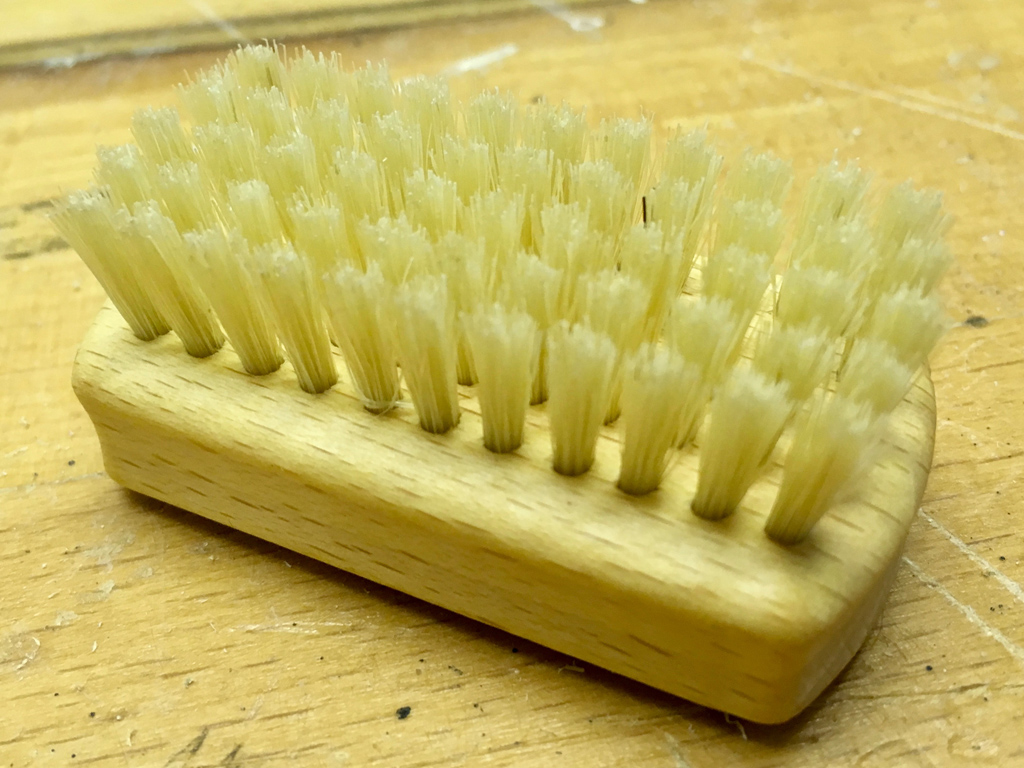
Brush
Sand the varnish off of the brush and cut it into two equal halves and an appealing smile is guaranteed and no one will be worried about the teeth!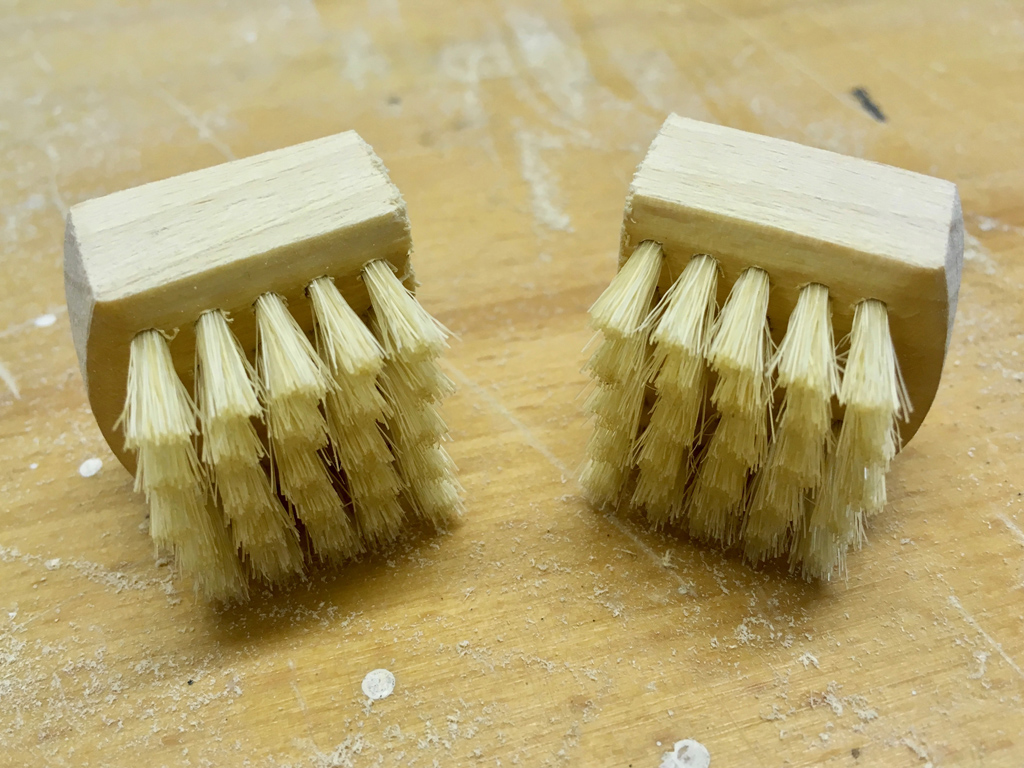
An instant nice smile 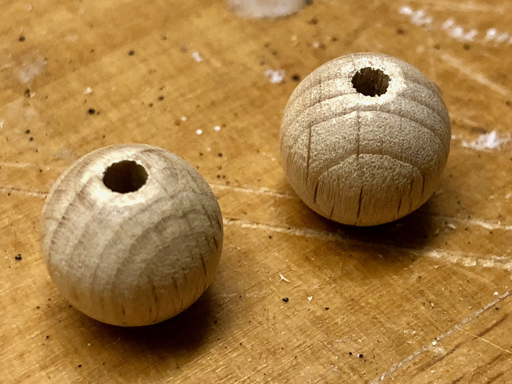
Eyeballs without brass screw heads Bright eyes complement the perfect smile, and by gluing cut-off brass screw heads into two 10 mm beechwood balls, the painted eyes always look appealingly up at you, however you tilt the body. Intelligent eyes must never be too close together, so there is a small piece of brass tube between the eyes sliding on the brass rod glued between the ears. As the smile is so nice, no one notices the brass rod.
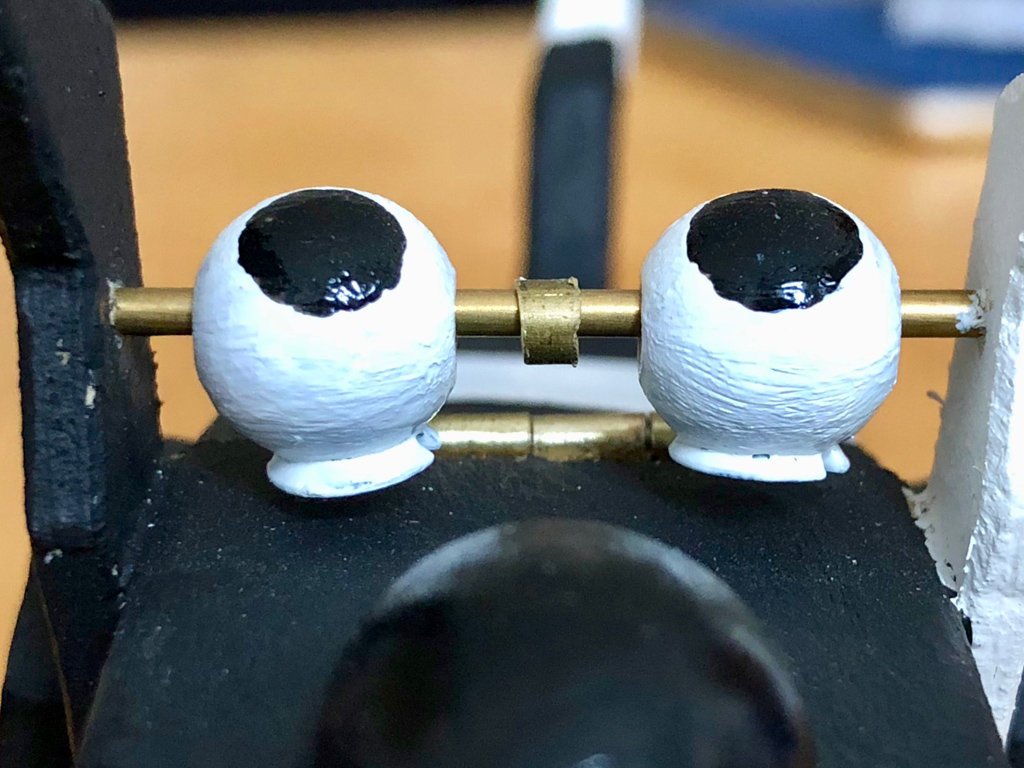
Bright eyes 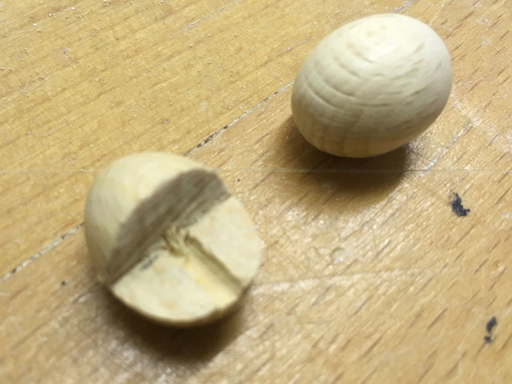
Nose A 20 mm long beechwood egg just needs one quarter to be cut away so that it fits nicely in place and high gloss black paint gives it that healthy shine.
6 mm thick plywood serves very nicely for the dogsbody and its legs, cut with a scroll saw. The back legs are a little smaller than the front legs, which are hinged so that you can press them to work the dog’s tail and jaw.
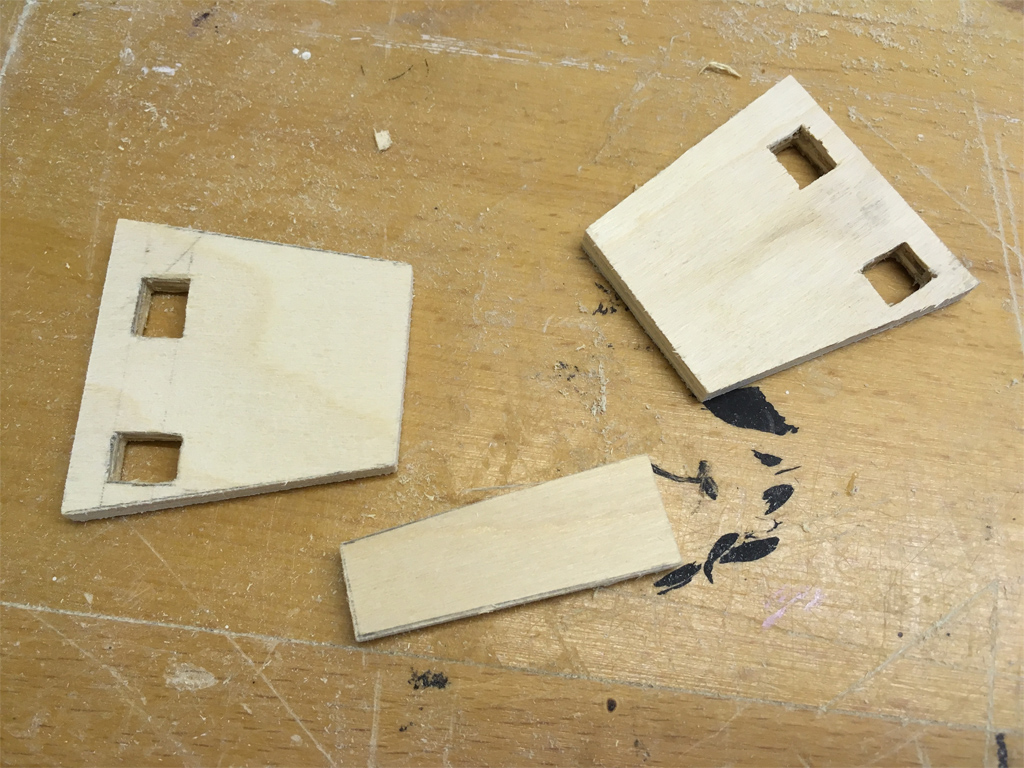
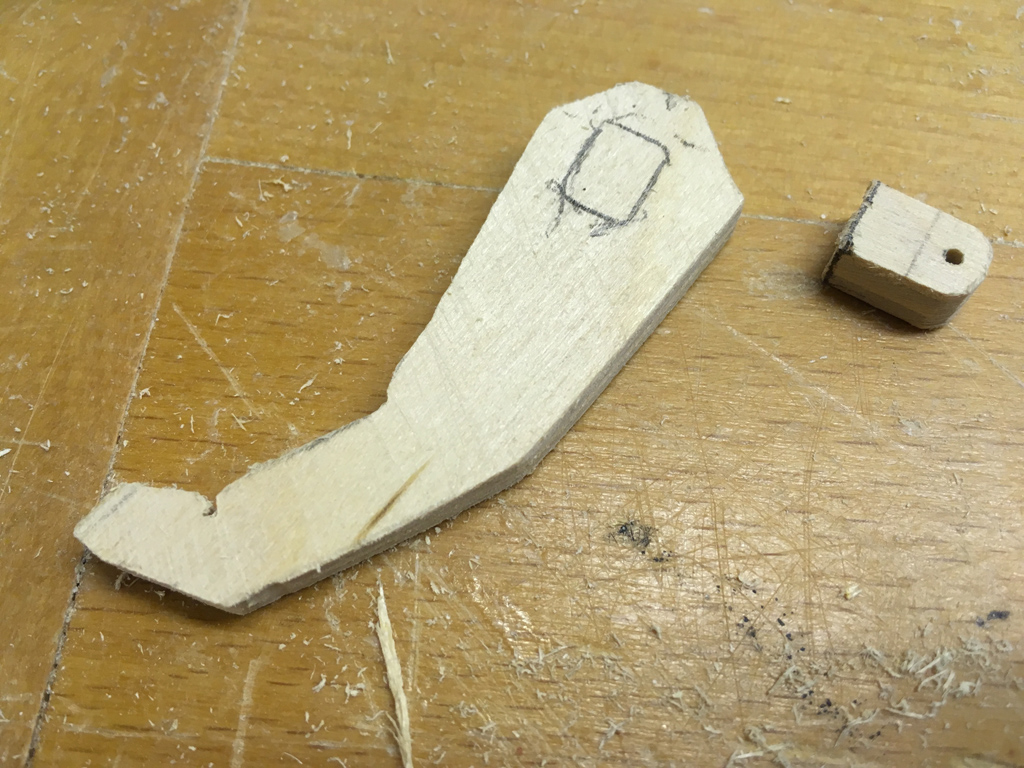
A leg and its hinge, which is glued into the cutout marked on the leg The tricky bit
Each side has two rectangular cutouts. The top cutout is to hinge the leg, pivoted on a brass rod inserted from the front. The bottom cutout takes a crank, hinged on a brass rod inserted from the bottom. When you squeeze the dog’s leg against its body, the crank is pushed in, and its action then pushes the top jaw open via a sprung lever. Tricky huh? Here’s a picture and there’s a video underneath, showing it in action, which hopefully makes it easier to understand.
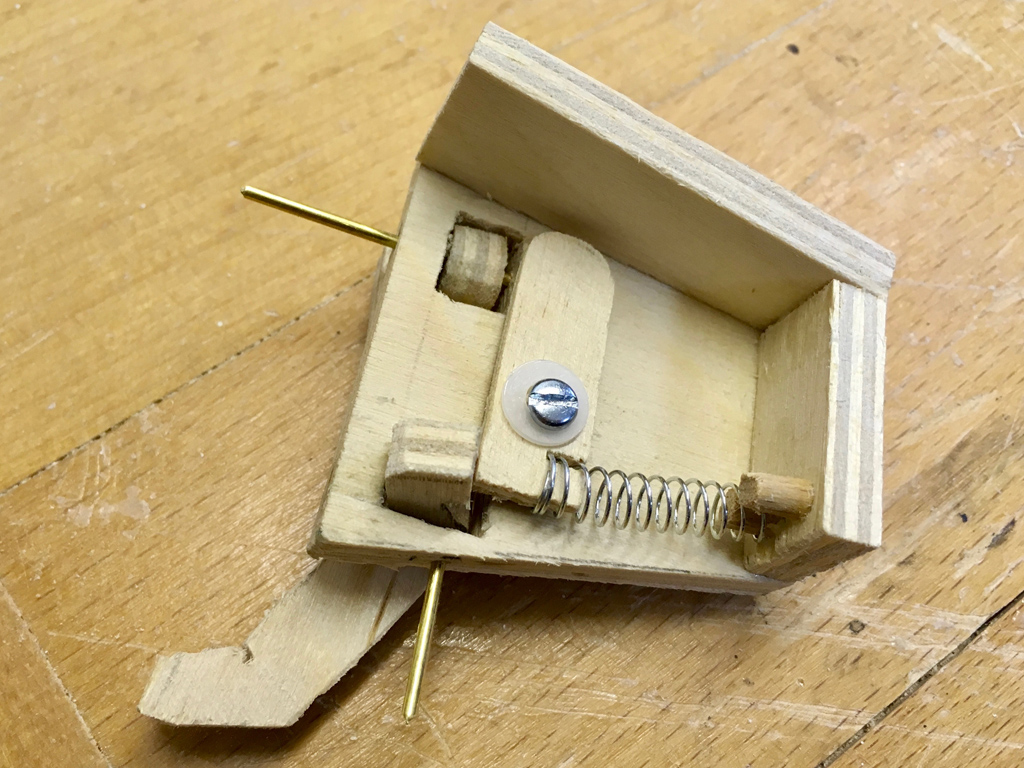
Mechanism to open the jaw
Pressing the crank from outside moves the lever, which then moves the jaw via the brass rod Interesting things about brushes
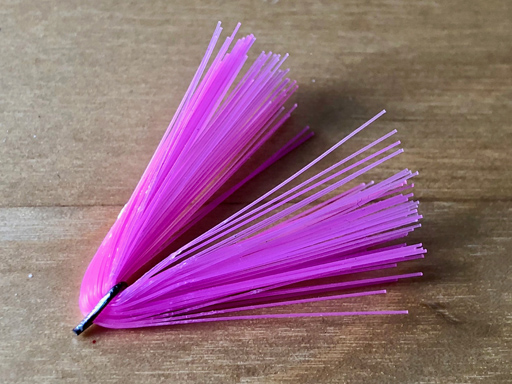
One tuft held by a small piece of wire Each tuft in a brush is just pushed in with exactly the right number of bristles to fit snugly. To remove a tuft just grab it with a pair of pliers and pull, just like a dentist! This is how I made space in the dog’s upper jaw for the slot needed to take the loop on the end of the brass rod.
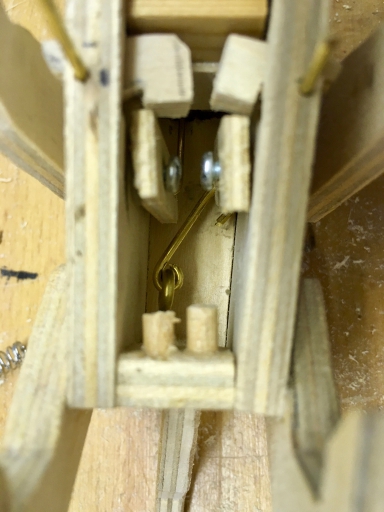
The link to wag the tail 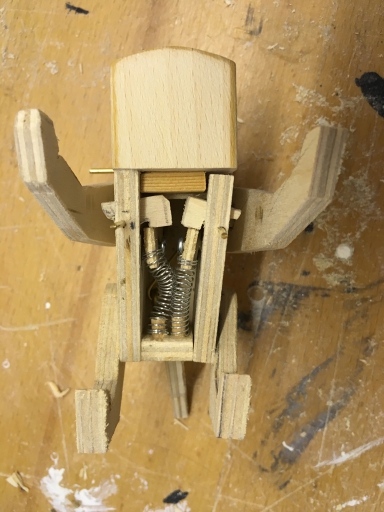
The return springs fitted The end of my tale
I had to experiment a little to get the tail to wag nicely and to look OK when it’s not wagging, so its hinge is not exactly central. As you can see from the pictures not much is particularly square, but hey it’s a dog right, and here he is in his finished glory – Mechanical Mutt.
Mechanical Mutt – The video

Kim Booth – Bearded, bespectacled British bloke, born in the best bit of Birmingham, he blithely beavered to become a Bachelor in electronics, before boxing his bespoke belongings and boarding his bike to brave the borders, breaking out for beautiful Berlin. Belatedly, being both bilingual but bereft of business, he breezily became a broadband bandit, translating buckets of balderdash into Brummie British and by the by, builds bulldogs with bite. -
Twelve Tweeters
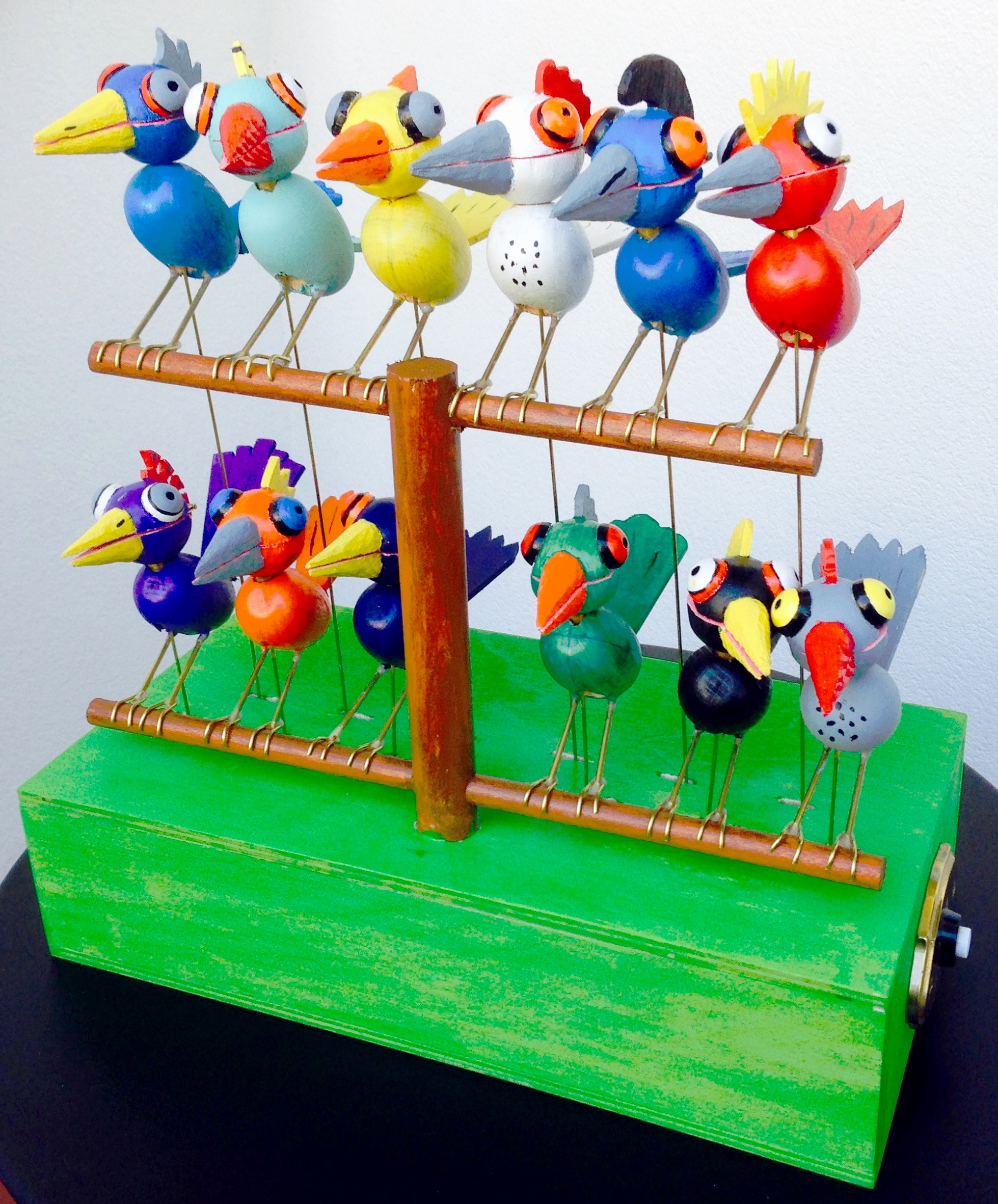
Twelve Tweeters – A clock
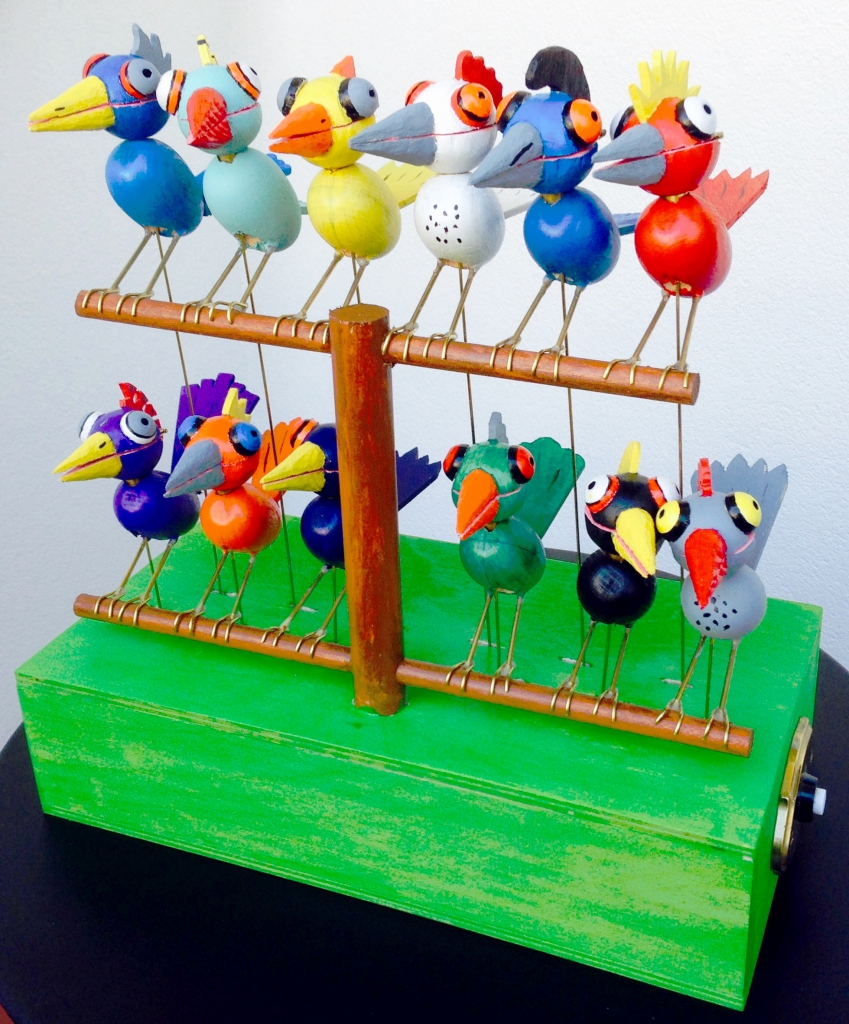
A clock with roots that occasionally hoots.
The time it can tell without even a bell.
Ask it nicely and it will tell you precisely,
But if no one’s around it won’t make a sound.
A dozen on their perch won’t leave you in the lurch,
The assembled dawn chorus will sing something for us.
To make time a pleasure – a real treasure – not just something to measure.Why did I make this?
My aim was to make a clock that doesn’t look like a clock, and has no rotating hands to point to the hours and minutes. Cuckoo clocks came to mind and I really liked “bird’s tree” by the amazing Carlos Zapata, so birds seemed like a good start. Then I heard the BBC’s fantastic Tweet of the Day so I just had to make it.
Moving from the initial concept to the final design
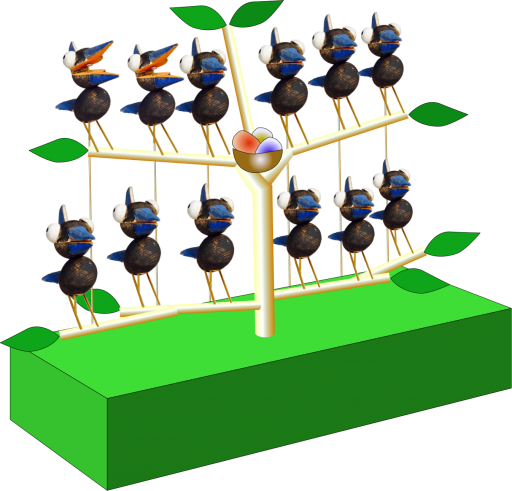
Original design for Twelve Tweeters Things that are interactive are more interesting, so if no one is paying attention to the clock it shouldn’t do anything. Only when you really want to know what the time is should it do anything. Things that constantly move eventually just become part of the background and you don’t notice them any more. Not to mention the wear and tear on the mechanism.
Remembering Swiss cuckoo clocks, I thought it would be fun if the birds sang to tell us the time. Of course I had to break the Swiss cuckoo’s monopoly and open up the tree to all sorts of birds, so I chose a different bird for each of the twelve hours of the day. To tell whether it’s two in the morning or two in the afternoon, you just have to turn around and look out of the window.
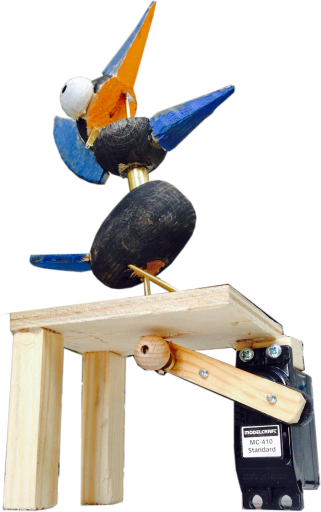
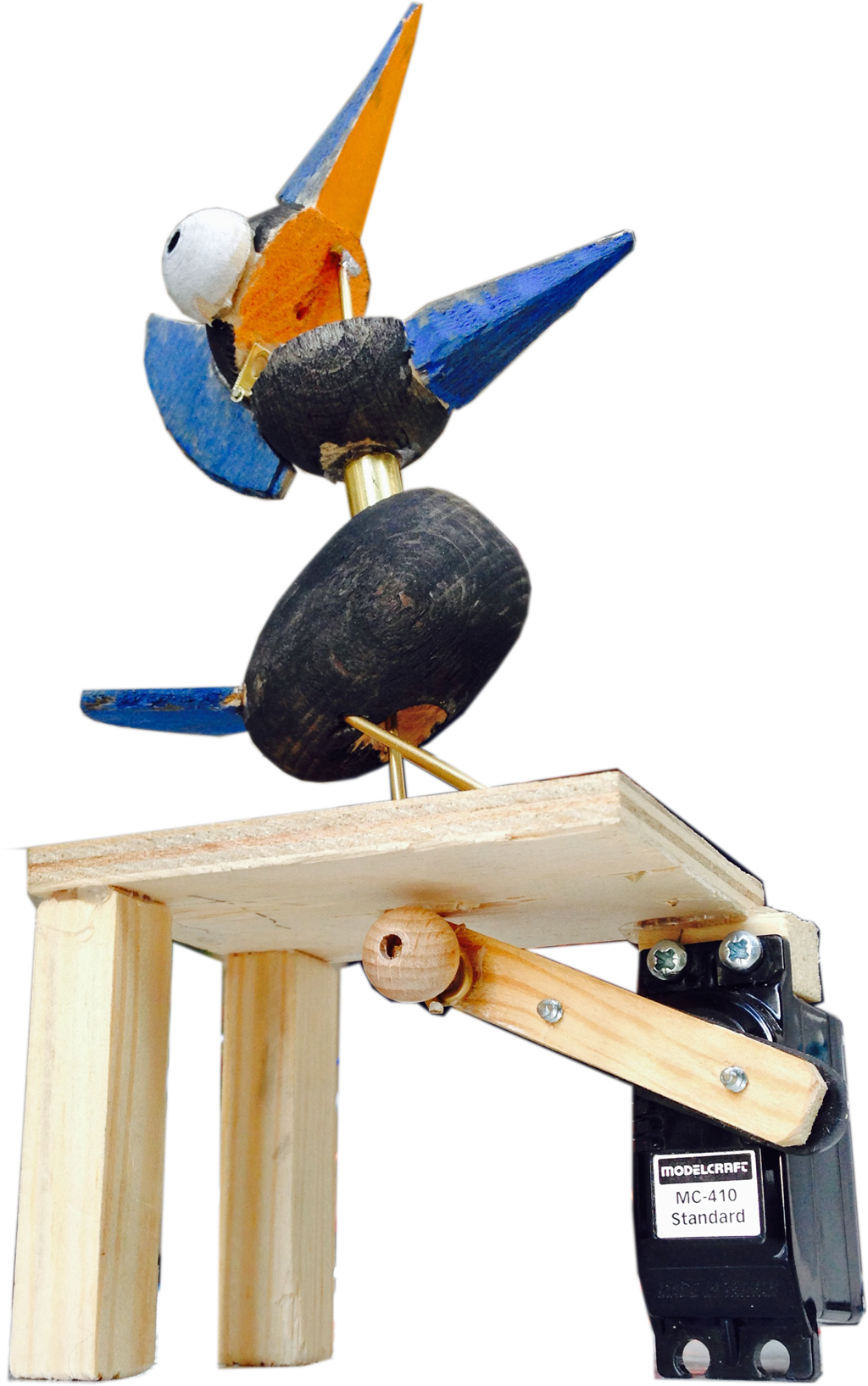
Simple lever on the servo pushes/pulls the brass rod in this prototype. For the minutes, the birds had to do more than just sing and more than one servo motor per bird was too complicated so, after experimenting with a prototype, the idea of a two-stage movement popped up. Push a brass rod half way and the bird’s beak opens. Push the rod all of the way and its head lifts up away from its body, apparently stretching its neck.
So now, when you push the button to ask the time, the birds first stretch their necks to show the number of hours from 1 to 12. For example, if it’s 3 o’clock, 3 birds will stretch up. The second part then follows, where each bird is responsible for 5 minutes, so for example, if five birds open their beaks and the fifth bird sings that means twenty-five past the hour.
For the ornithologists, each bird has its own voice 1 – blackbird, 2 – bee-eater, 3- chaffinch, 4 – goldfinch, 5 – skylark, 6 – duck, 7 – greenfinch, 8 – great tit, 9 – mistle thrush, 10 – ortolan, 11- marsh warbler, 12 – nightingale.
For more drama, a light shines on the birds perched on their tree as soon as you push the button. This stays on for half a minute or so after a bird has sung the time and a “dawn chorus”, recorded by someone early in the morning in an English forest, then plays quietly in the background for a while.
In the end I also succumbed to tradition and allowed the cuckoo to briefly show off on every full hour. When we have visitors, this inevitably tickles their curiosity and is an invitation to push the button and see what happens.
A short video showing Twelve Tweeters in action
Materials for the birds
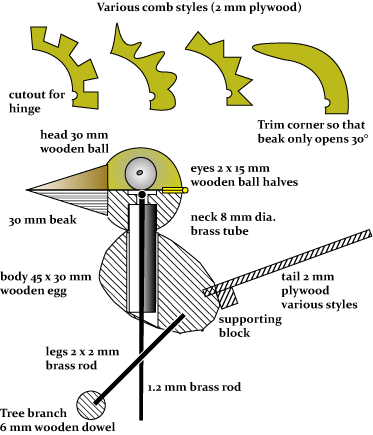
Anatomy of a tweeter 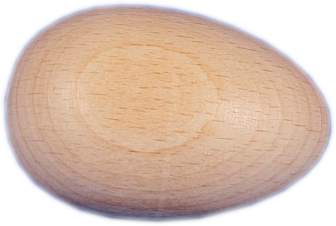
A beech egg, from which a bird will hatch Everyone knows that birds hatch from eggs, so for each bird, I used one 45 x 30 mm egg for its body, one 30 mm ball for its head, two 15 mm ball halves for its eyes, 13 x 10 mm wooden strip to cut its beak, 8 mm brass tube for an extensible neck, a small free-moving hinge, 2 mm plywood for the comb, 2 mm brass rod for the bird’s legs and feet and 1.2 mm brass rod to connect to the servo arm.
Precisely drilling beech eggs and balls is tricky and although I made some jigs to hold them in a fixed position and drilled pilot holes, each of the 12 birds is slightly different, just like in nature. It wasn’t practical to screw or nail the hinges so I used fast-setting, two-component epoxy resin adhesive instead, taking care not to gum up the mechanism so that the beak still moves easily. The 1.2 mm brass rod is used to push the beak open until it reaches 45°(ish) and is restrained by the comb when the whole head will move up, exposing the brass neck which is fixed to the bird’s head but not to its body.
Making the birds move

12 servo motors with wooden arms to push a brass rod up and bring the birds to life Previous generations would have used clockwork I suppose, but the flexibility of being able to programme the movements and sounds electronically is ideal when you are feeling your way with no exact plan. That’s why the base hides 12 cheap and cheerful servo motors which turn through an angle set by an Arduino Uno computer. I collected the bird tweets wherever I could find them on the Internet and they are kept in a micro SD card, which is read by a Music Maker shield and this is what drives the loudspeaker. A real-time clock board then tells the Arduino what time it is. When I got fed up of having to reprogram the Arduino from my laptop for summer time and then for winter time, I added a new button on the back which sets the time to 12 o’clock when pressed.
Ready to paint
It’s hard to say how much time you spend on a project like this. It takes a while to settle on an idea and then try a quick prototype to see if it does what you intended. I suppose once you start to make 12 of everything, that’s when the “work” starts. Maybe I then needed a week to make the parts and assemble everything.
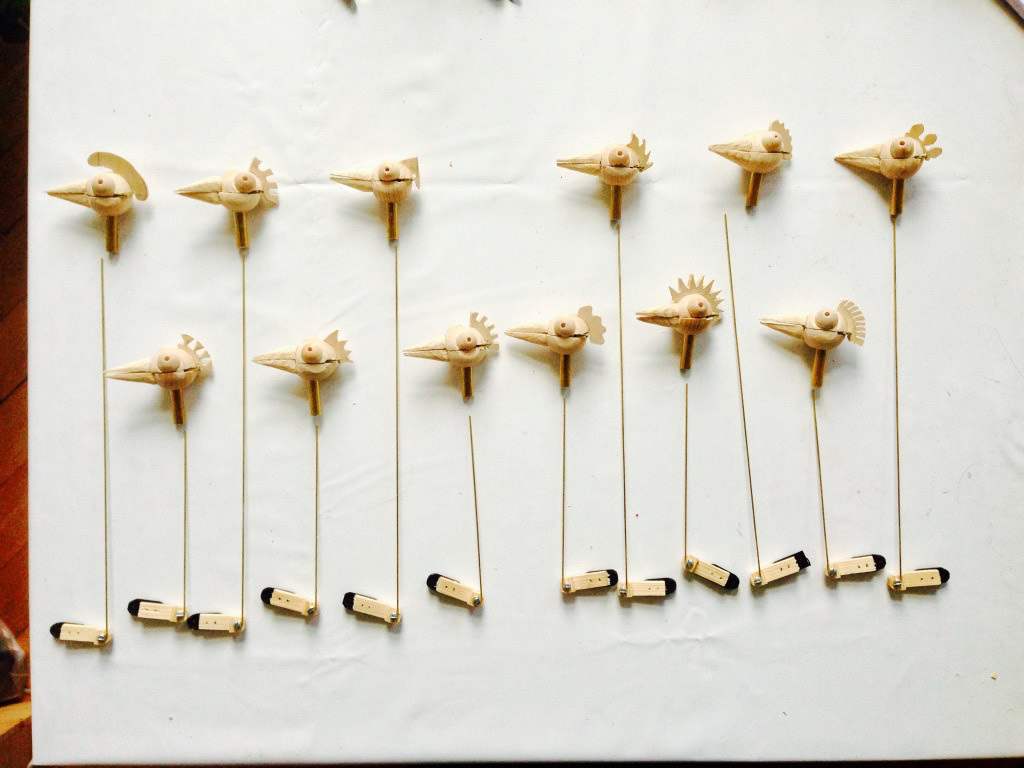
The brass rods moved by the servo motors to bring the birds to life 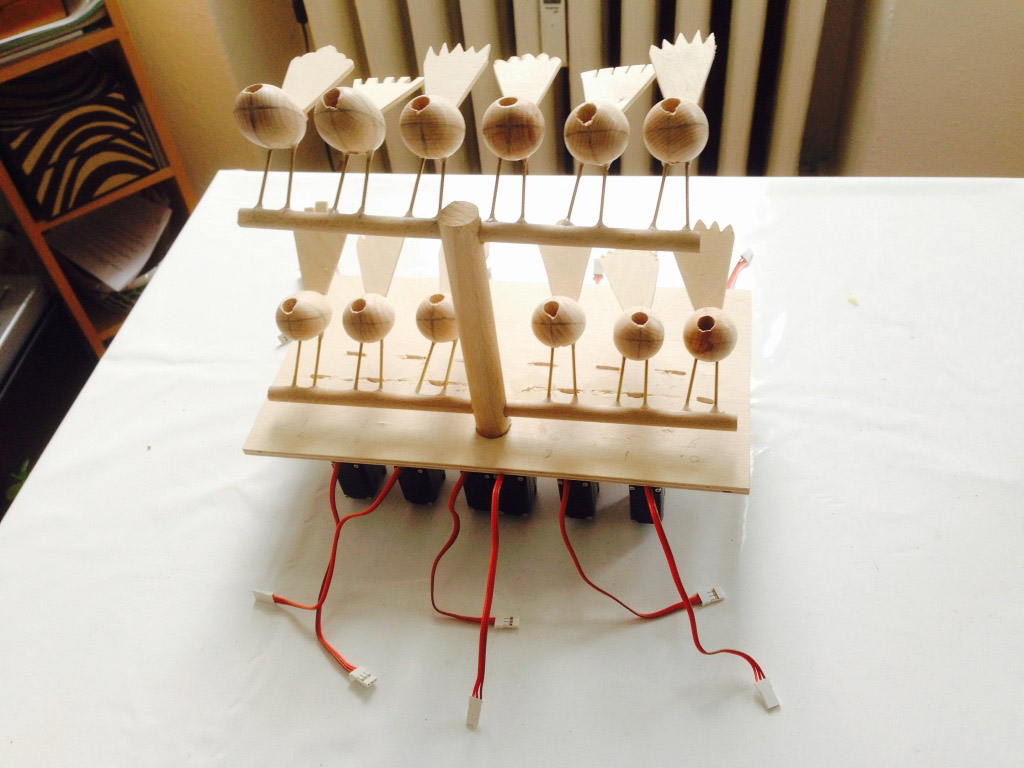
Twelve headless birds waiting for feathers Something like this is never quite finished. Once I had painted it and put it all together I found that having a button on the side meant that the whole thing slides around when you push it. After I while, I moved the button to the top and that problem was fixed. Then I put it onto a shelf at the dark end of the room and each performance required the lights in the room to be turned up. I made a quick trip to get some LED strips, added a new socket to the back and a small power circuit and now everything is brightly lit as required.
Now I am content and every time I hear a cuckoo in the distance, I think, is it that time already?
Kim Booth – Bearded, bespectacled British bloke, born in the best bit of Birmingham, he blithely beavered to become a Bachelor in electronics, before boxing his bespoke belongings and boarding his bike to brave the borders, breaking out for beautiful Berlin. Belatedly, being both bilingual but bereft of business, he breezily became a broadband bandit, translating buckets of balderdash into Brummie British and by the by, builds bright beechwood birds. -
Nantes 2019
See everything on one long page here, or choose a day.
[catlist id=102]Nantes (edit)
To order a taxi, call +33253457796
French Summer Holidays 7 Jul to 1 Sep 2019
Nantes tourist info. – see & do https://www.nantes-tourisme.com/en/see-do
Online Nantes tourist guide in English https://fr.calameo.com/read/000106866637adca9d026
Lonely Plant online https://www.lonelyplanet.com/france/southwestern-france/nantes
Guardian online https://www.theguardian.com/travel/2017/apr/27/nantes-france-city-breaks-with-kids.
Le Voyage à Nantes – Follow the Green Line
The 2019 edition of Le Voyage à Nantes will take place from 6 July to 1 September!
- https://www.brittanytourism.com/matching-what-i-want/culture-and-heritage/brittanys-main-events/le-voyage-a-nantes/
- https://www.levoyageanantes.fr/en/parcours-plan/
Meandering around Nantes, you will notice a painted pea-green line snaking along the pavement, zipping up unexpected staircases, sneaking along backstreet alleys and prancing with purpose across cafe pavement terraces. This, ingeniously, is Le Voyage à Nantes(www.levoyageanantes.fr), an urban art trail that leads curious visitors to dozens of works of art – sculptures, contemporary art installations, stunning viewpoints, architectural works – all over the city. Many – such as sky-rise bar Le Nid or the slide built into the 15th-century ramparts of Château des Ducs de Bretagne – are amusingly playful and interactive. The trail is 12km long, but can be traced in sections too. Pick up a city map, marked with the trail, at the tourist office or simply follow the green line and see where it takes you.
Flights
Transavia flights on Thursdays & Sundays only. Web site
4 Jul SXF 15:35 -> Nantes 17:50
21 Jul Nantes 12:45 -> SXF 14:55
Flat in Nantes
Do, 4. Jul 2019 – So, 21. Jul 2019, 17 Nächte/2 Gäste
Anzahlung € 666,23 €. Fällig zum: 19.06.19 € 1.155,13
Les Machines de l’île de Nantes

Galileo Fernsehbericht
https://www.lesmachines-nantes.fr/en/
Les Machines de l’île is a totally unprecedented project. A product of François Delaroziere and Pierre Orefice’s collective imagination, it is the only place where you’ll find Jules Verne’s “Invented Worlds,” the mechanical universe of Leonardo da Vinci, and Nantes’ industrial history, all on the exceptional site of the city’s former shipyards.
Some strange machines came to populate the Île de Nantes. After the Grand éléphant, this is now the turn of a Manta Ray, a Sea Snake and of all kinds of incredible boats to take possession of the banks of the Loire River in the Carrousel des Mondes Marins. These uncommon machines were born from the hands of the constructors of the company La Machine and came to life in between those of Les Machines de l’île before the public’s eyes. Their backwards and forwards between the building workshop and the Galerie des Machines give impetus to the movement at the heart of the former Dubigeon warehouses. They convey a mysterious reality to this island just like the time when vessels were launched there for all the trips of the world.
http://www.lamachine.fr/boutique/
La Loire à Vélo from Nantes to Le Pellerin
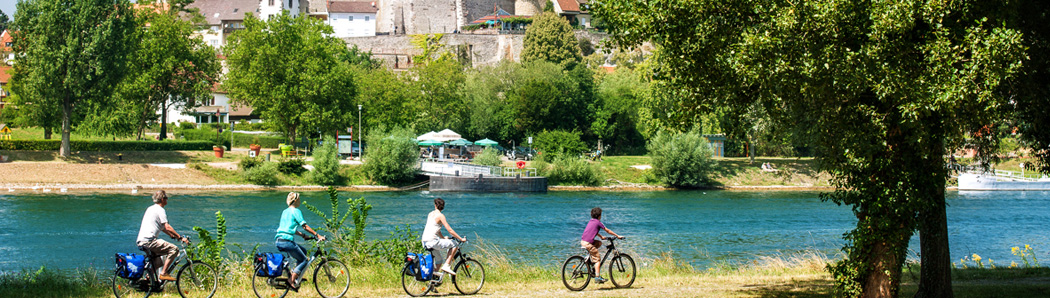
17.8 km
https://en.eurovelo6-france.com/etapes/la-loire-a-velo-nantes-le-pellerin
Contemporary art features large along the Loire’s long estuary and this stage shared by the Loire à Vélo and Velodyssey cyles routes. The installations are startling, set in unusual locations. They offer joyous surprises close to the city of Nantes.DÉTOURS DE LOIRE
9h30-13h & 15h30-19h Monday to Saturday / 9h30-12h30 & 18h-19h Sunday and bank holidays
Classic bike for a half day : adults 10€ / Children 9€
Quai de Malakoff02 55 10 11 74BICLOO
THE SELF-SERVICE BIKE123 stations and 1230 bikes are available in a wider area around the city center
For your short trips: Bicloo, self-service bike (the first half hour free). After subscription (on site or terminals) valid for 1 day,3days, or one year, you take your Bicloo and check it back in the stations available in the city center.
Open 7j / 7 and 24 hours a day, bicloo is a real complementary(additional) means of transportation in the bus, in the Navibus, in the stations and in the tram.
PRICE
Subscription from 1 to 3 days: 2 – 5 eurosThe first half an hour : free
Then add : 0,50€ additional half an hour / 1€ : The extra half an hour / 2€ : additional half an hour
Further information at Maison Bicloo (6 rue Léon Maître) and Bicloo mobile application
Seaside Day Trips
The city of Nantes is only 50km from the Atlantic Ocean, making a coastal day trip a must.
- Pack your bucket and spade for the classic seaside town of Le Croisic (population 4036), a pretty, half-timbered fishing harbour where shrimps, lobsters, crabs, scallops and sea bass are sailed into shore and unloaded. Talking of fish, the town’s aquarium is well worth visiting. Trains head to Le Croisic (€16.80, 1½ hours) from Nantes.
- Along the way, it’s worth stopping at St-Nazaire (population 68,513; €12.30, 45 minutes), where cruise ships – including the Queen Mary II – are built.
- Also along this stretch of coast is the glamorous belle époque resort of La Baule (population 15,456; €15, one hour), boasting an enormous beach. Gare de Nantes TGV8917 “Le Croisic” 47 Min. to Gare de Pornichet.
Les 23 petits voyages
Online booklet in French https://fr.calameo.com/read/0001068665425523fa703
e.g. Lac de Grand-Lieu is a lake located 15 km to the south-west of Nantes
http://www.grandlieu-tourisme.fr/en
CHÂTEAUX
Cycle along the Loire? to CHÂTEAU MÉDIÉVAL D’OUDON
https://www.pays-ancenis-tourisme.com/accueil/
http://www.chateau-serrant.net
http://www.chateau-angers.fr/en/
Saumur by train, change in Anger
Clisson
Clisson is really easy to get to (30 minutes by train) and is a lovely little town. https://www.tripadvisor.de/Attractions-g1842343-Activities-Clisson_Loire_Atlantique_Pays_de_la_Loire.html
Directly from Nantes, you also have diferent cruises on the Loire or the Erdre River : en.nantes-tourisme.com/cruises-3813.html
Nantes is a very good railway hub and there are trains going to interesting and attractive towns in almost every point of the compass. Eastwards up the Loire alley you could visit either Angers or Saumur. That chateau at Saumur is one of the most picturesque and was, indirectly the model for Sleeping Beauty’s castle. Southeast of Nantes you could visit Clisson or continue southwards to La Rochelle. There is a regular service southwestwards to the pretty little port of Pornic. Another line heads westwards along the northern side of the Loire estuary goes to Le Croissic, another picturesque fishing port, and passes through the traditional seaside resort of La Baule. Going northwest you can get to Vannes, an attractie town from where you an take a boat trip on the Gulf of Morbihan. To get there you may hae to change at Redon which is worth spending an hour or two, particularly if you have any interest in canals. To the north there is Rennes, a city often seen as no more than a stage on the way to Mont St Michel but it is a city with a rich history. Finally, to complete the circle, you can get to Chateaybriand on the new tram train service. You may find you need a couple more weeks!
-
Sunday- Final assembly & painting
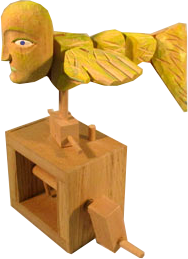
09:30 – 17:30 Final assembly.
Dinner at Leah and Mirek’sA new base in the right size, with holes in the right place.
New levers in nice wood.
Take the hat out of its mould and iron the rim flat.
Take the glued together blocked up body which dried overnight and trim it roughly to shape.
Try the head and body together.
Add the jaw.
Paint the assembled base.
Glue the head to the body and screw it into the base and start fitting the mechanisms as used in the maquette. Zdar is a real star!
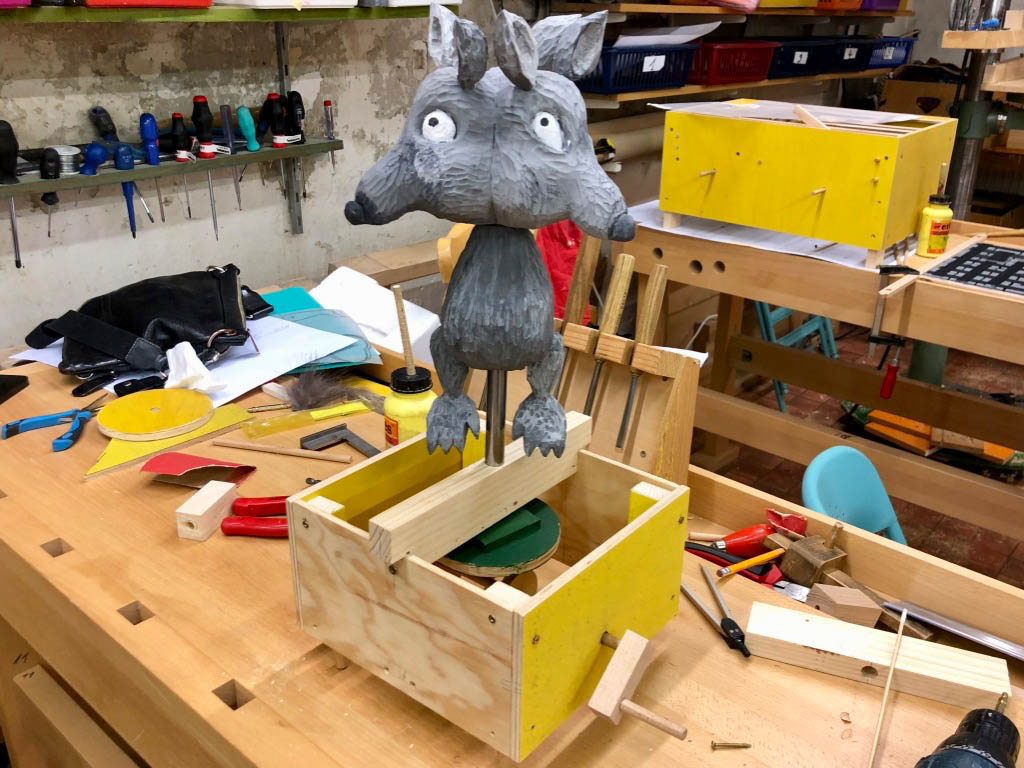
Elena’s mousemousemouse freshly painted.
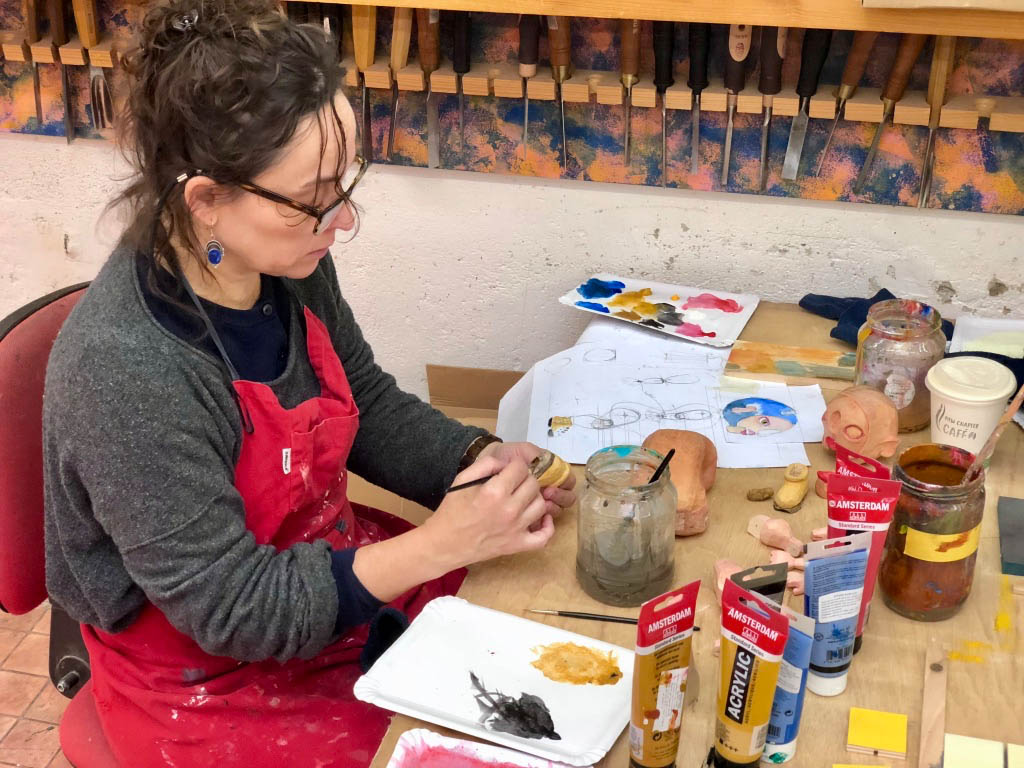
Flavia painting.
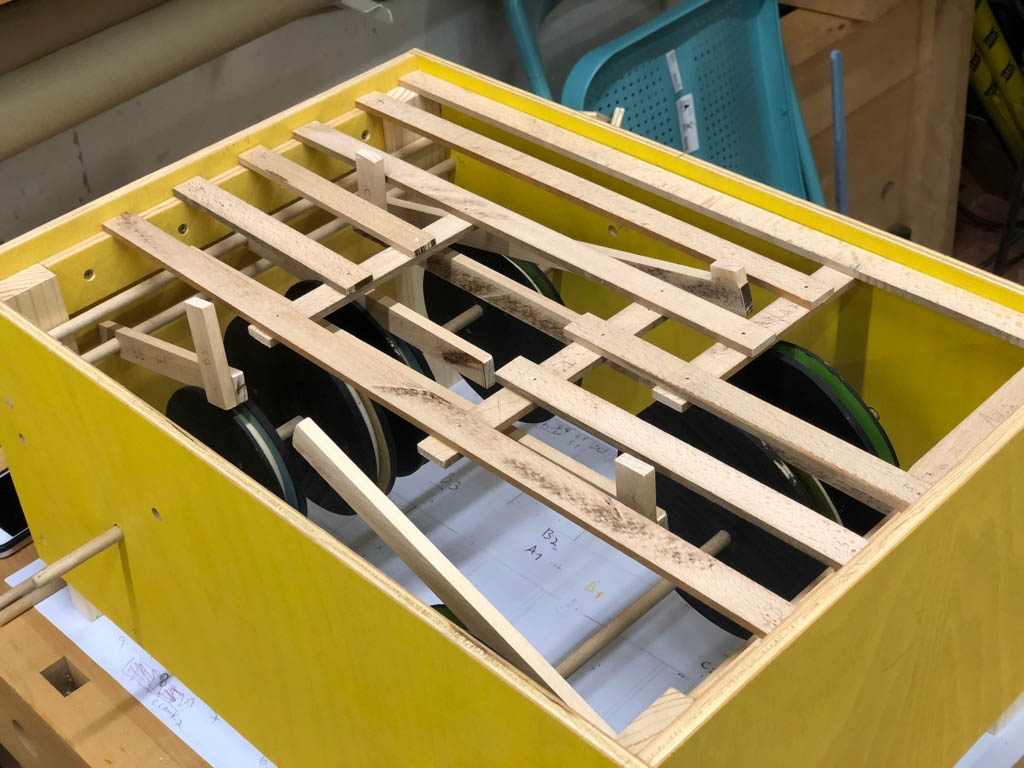
Earthquake mechanism.
Whale in sight.
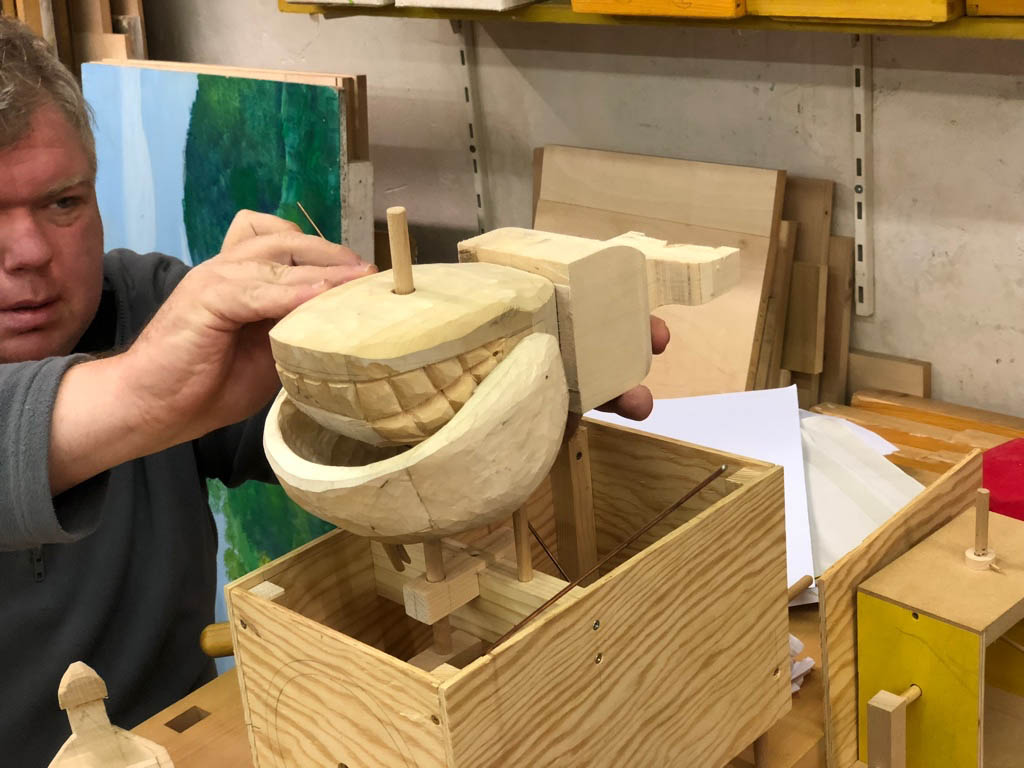
Show and tell.
- Noa’s work https://www.noa-heyne.com/animation
- Elena’s work https://www.instagram.com/alena.chitzi/
- Kim’s work http://www.bbno.info/wordpress/?cat=29
- Flavia’s Facebook page
- Dylan’s Facebook page
- Mirek’s work http://www.kidpraha.cz/sculptures/sculpturesindex.html
- Article in the NY Times
- Leah on Radio Praha in English https://www.radio.cz/en/section/arts/leah-gaffen-discusses-puppets-in-prague-celebrating-15-years
- http://www.teatrotoc.eu
- Mirek on Wikipedia https://en.wikipedia.org/wiki/Miroslav_Trejtnar
Monday
Package up the work.
Set off for home.
-
Saturday – Turning the marquette into the real thing
09:30 – 18:00 Project realization, cutting wood, carving, painting. Final assembly.
Cutting the left arm on the bandsaw from the marquette.
As finished from the bandsaw.
Same for the right arm.
The head’s a bit more complicated…
After carving.
Zdar making a hat from two layers of felt soaked in glue.
Trying the ears for size.
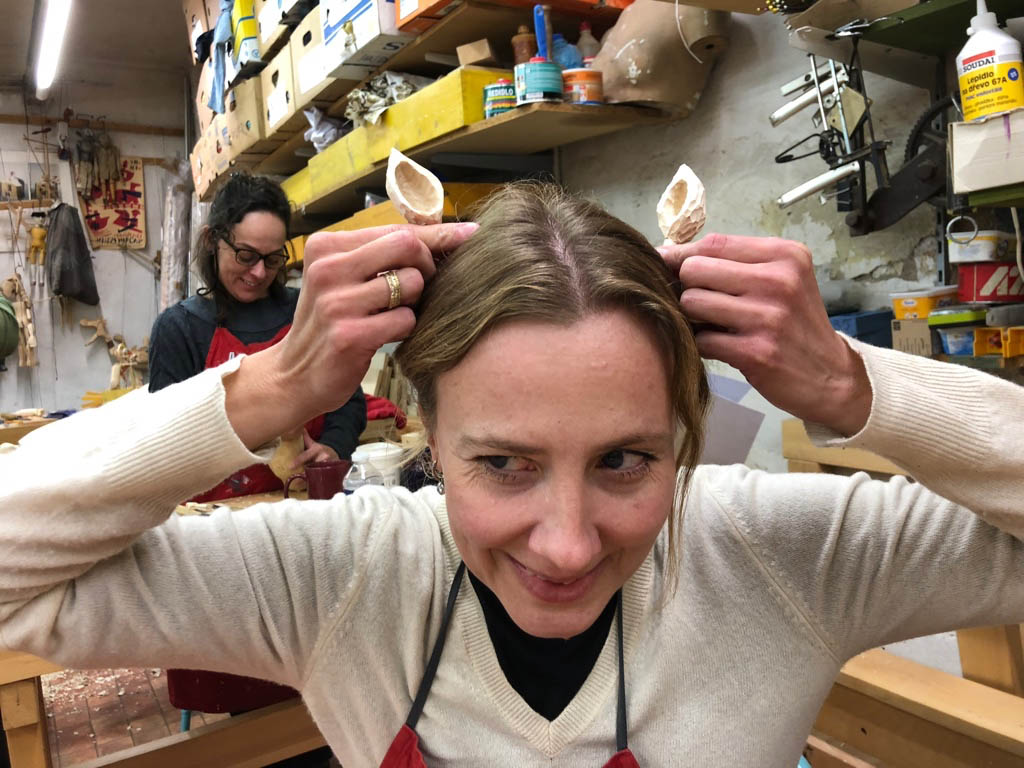
Earthquake 1
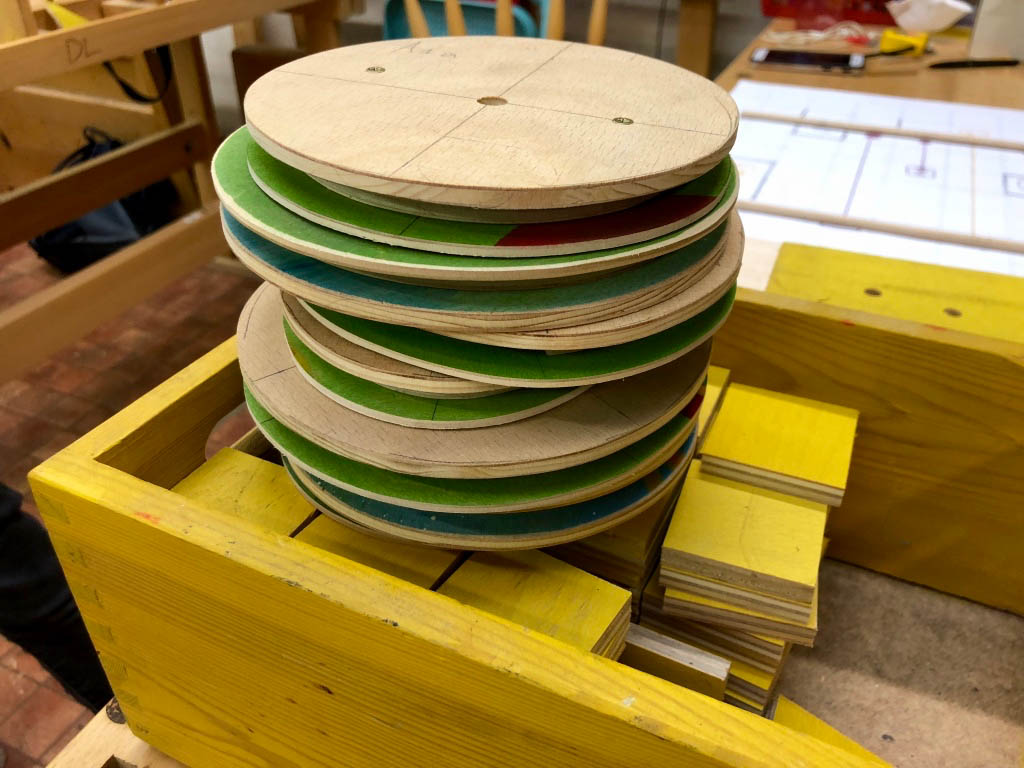
Earthquake 2
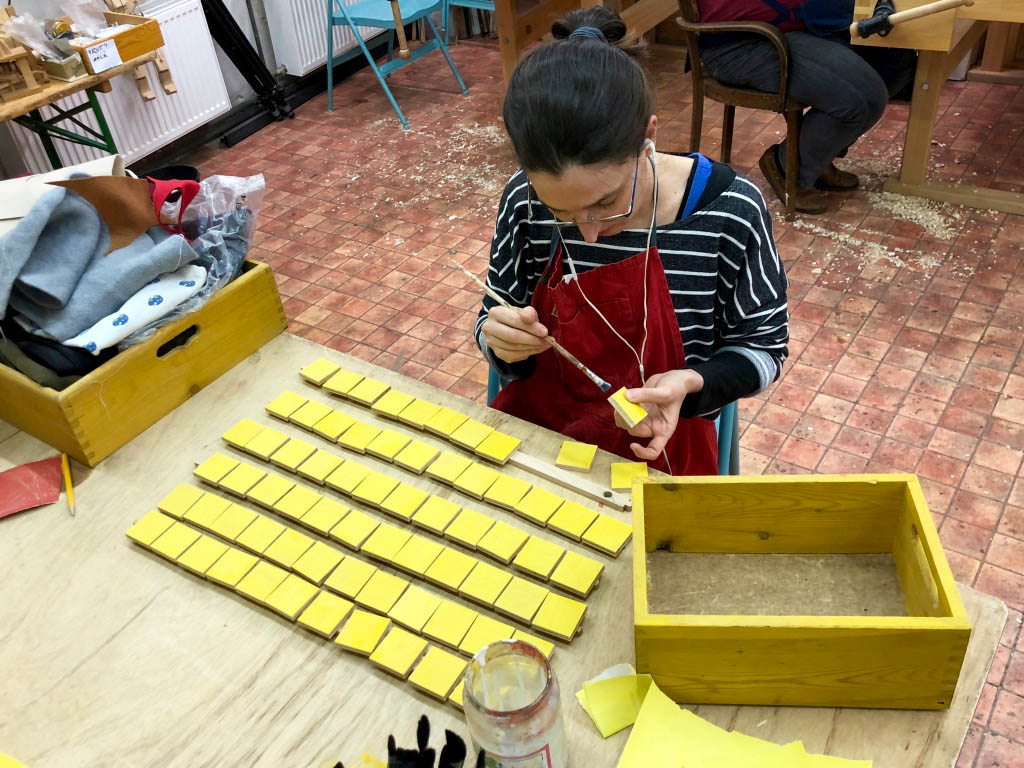
-
Friday – Back to work
09:30 – 17:30 Project realization, cutting wood, carving
Back to work
After a day off to see the marvellous sights away from Prague, today we return to the workshop, eerily quiet at the start of the day.
Kim’s maquette is finished enough with its 7 movements to get ready for the real thing.
Dylan is already beavering away at the real thing.
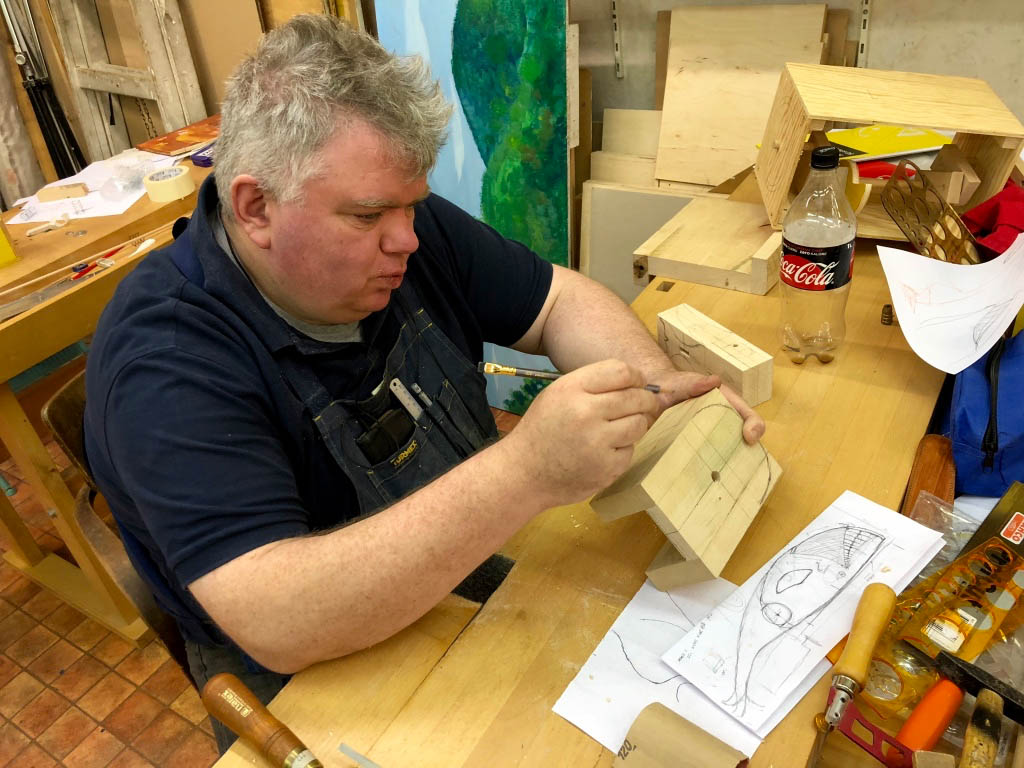
Elena is making good progress too.

There’s always a magically replenished supply of nibbles to go with your tea.
Busy hands everywhere you look.

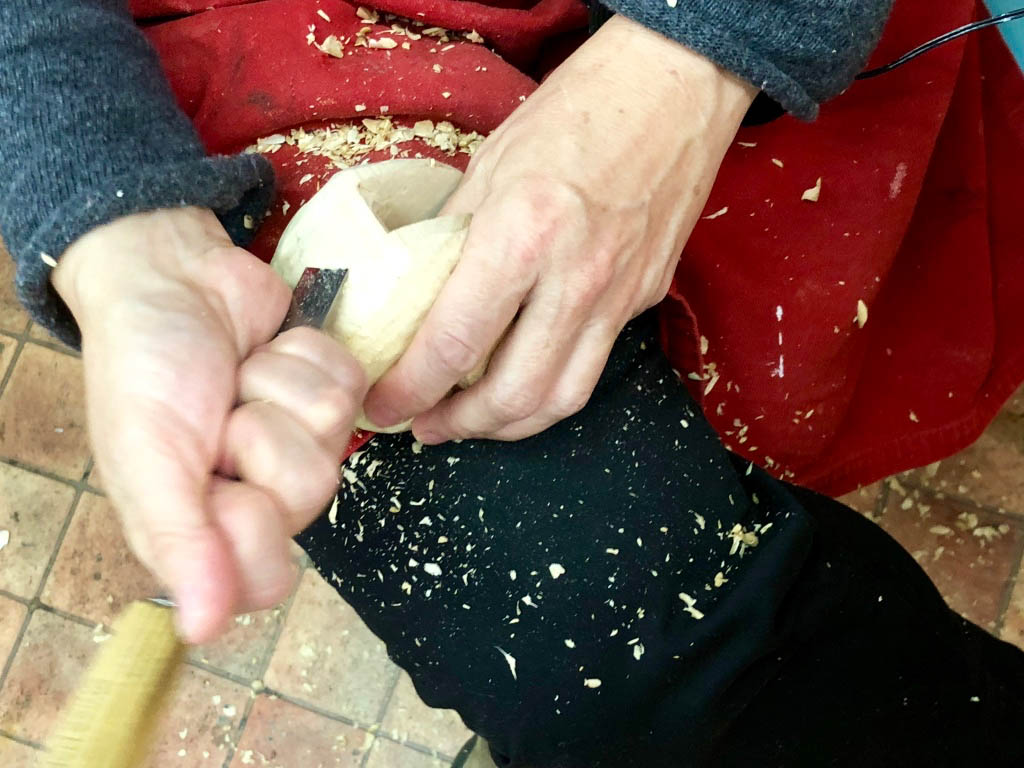
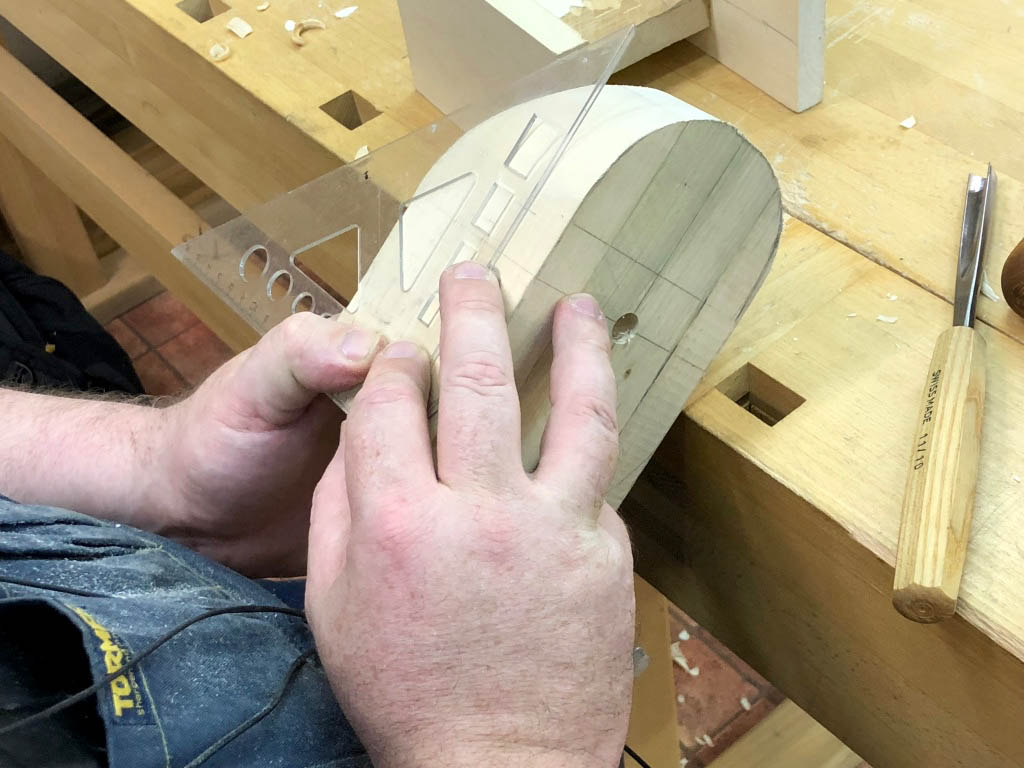

Only two days left! -
Thursday – Nativity museum in Trebechovice & and Martin Lhotak visit
Day off, out of the workshop.
Trip to Nativity museum in Trebechovice (GoogleMaps link) and to visit Renate and Martin Lhotak.Probošt’s Mechanical Christmas Crib
Kim’s 1 minute video
The “official” (longer) video
Třebechovické muzeum betlémů
The Most Famous Nativity Scene in the World or the Ingenious Work of Master Josef Probošt of Třebechovice. Probošt’s mechanical Christmas nativity scene in Třebechovice pod Orebem has filled people with wonder for decades and will continue to do so long into the future. That is because TIME plays no role in the nativity scene …
Scénář: Andrea Žbodáková
Režie: Renata PazderováLunch
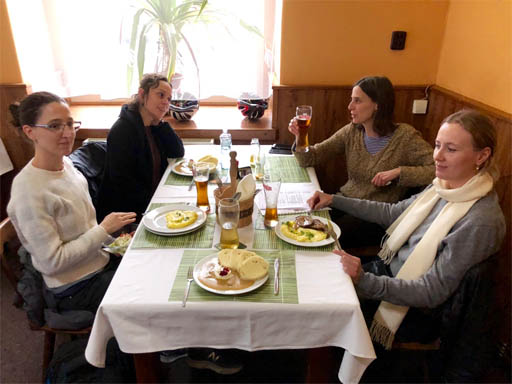 Flavia & I ate a traditional Czech specialty, svíčková na smetaně in Restaurace na Roli.
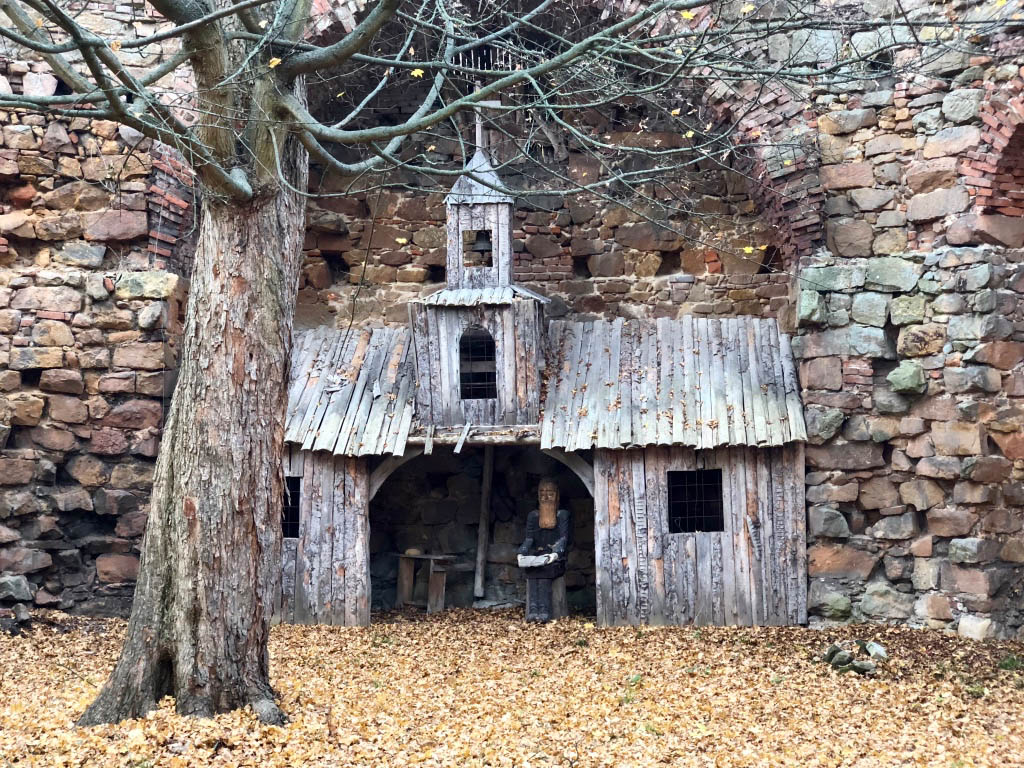
Jilin Loggia
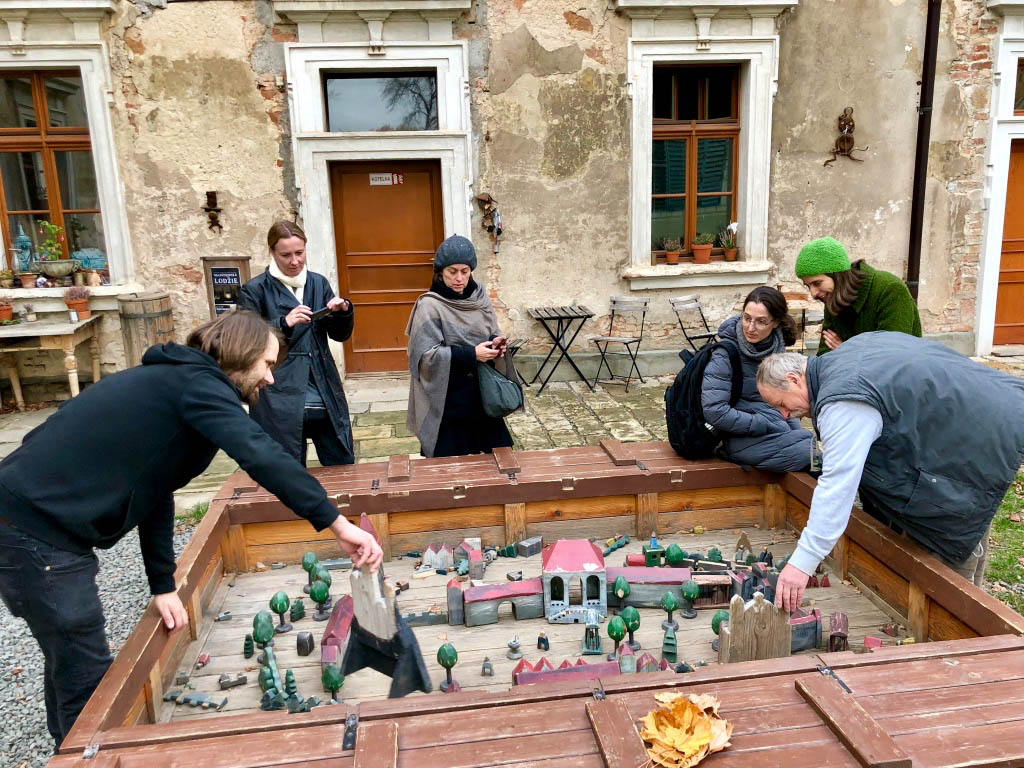
Town planning for children
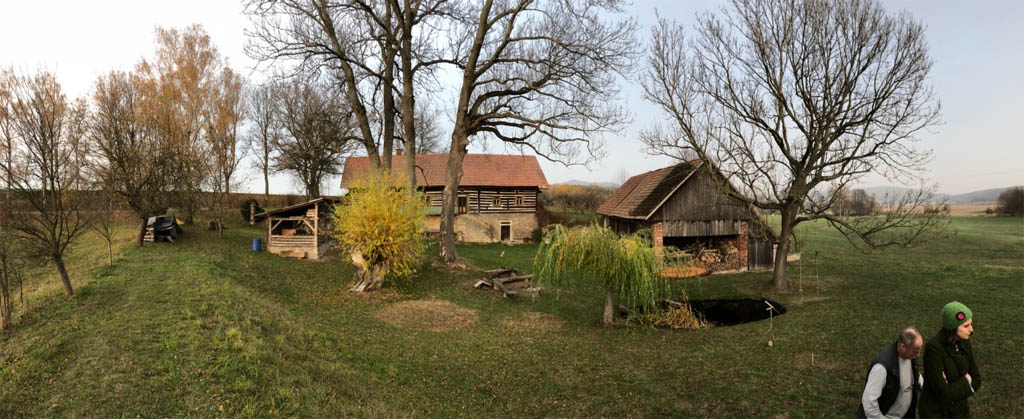
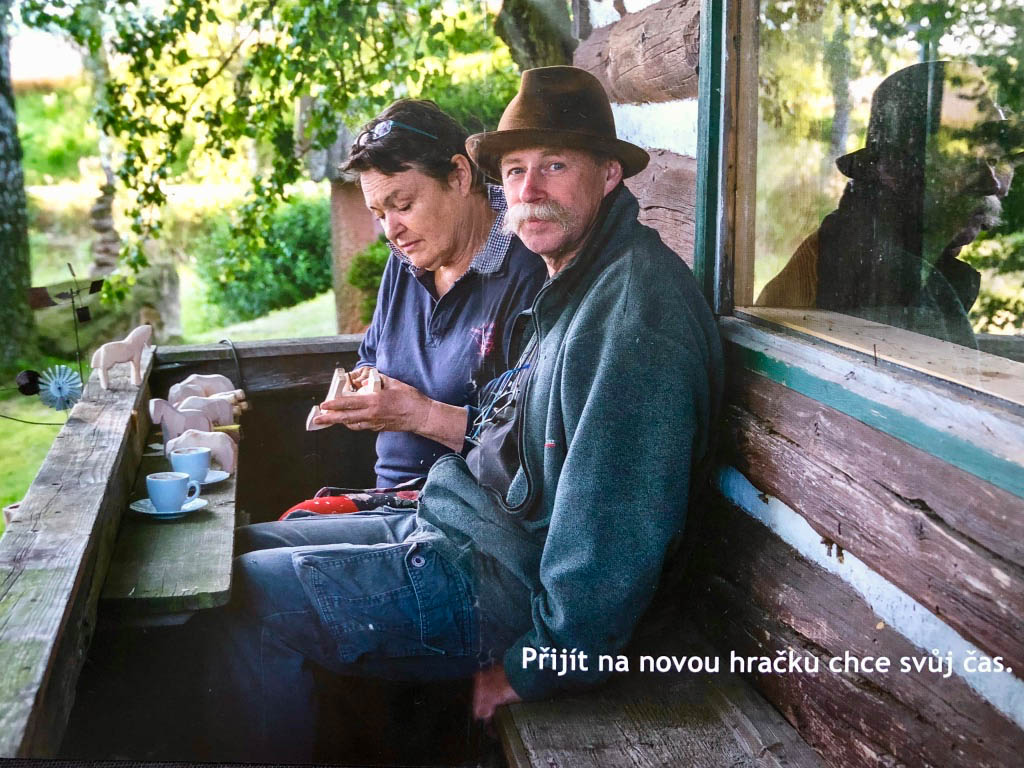
Visit to Renata and Martin Lhotak
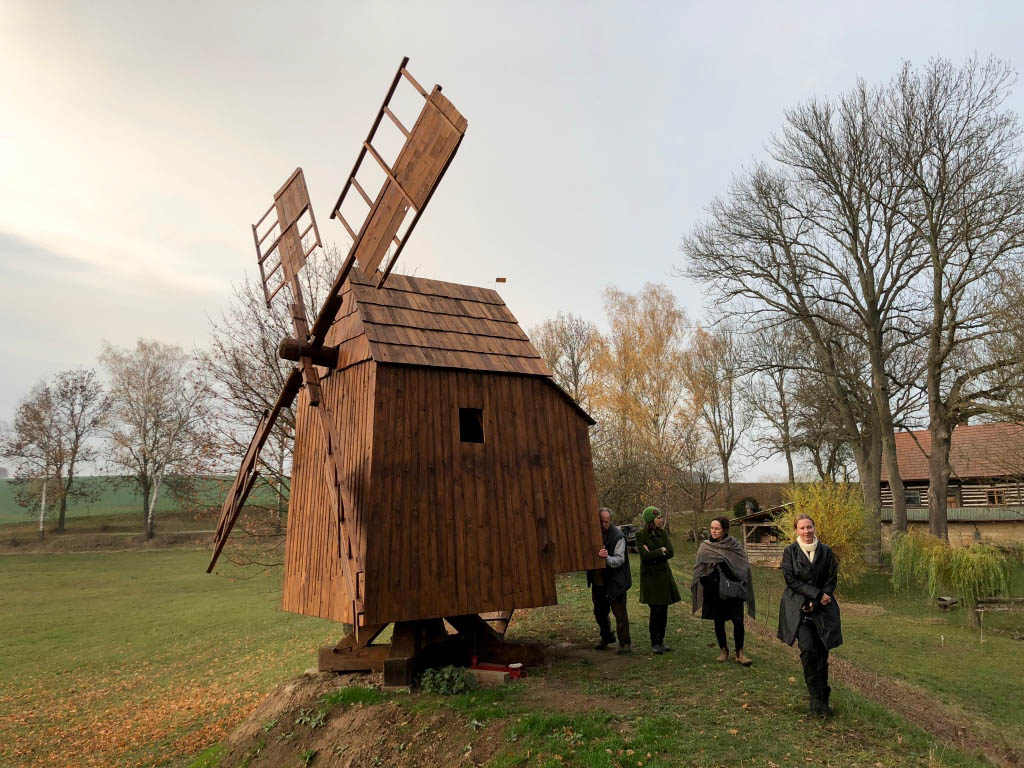
Renata was really welcoming and cooked a wonderful meal for us all!
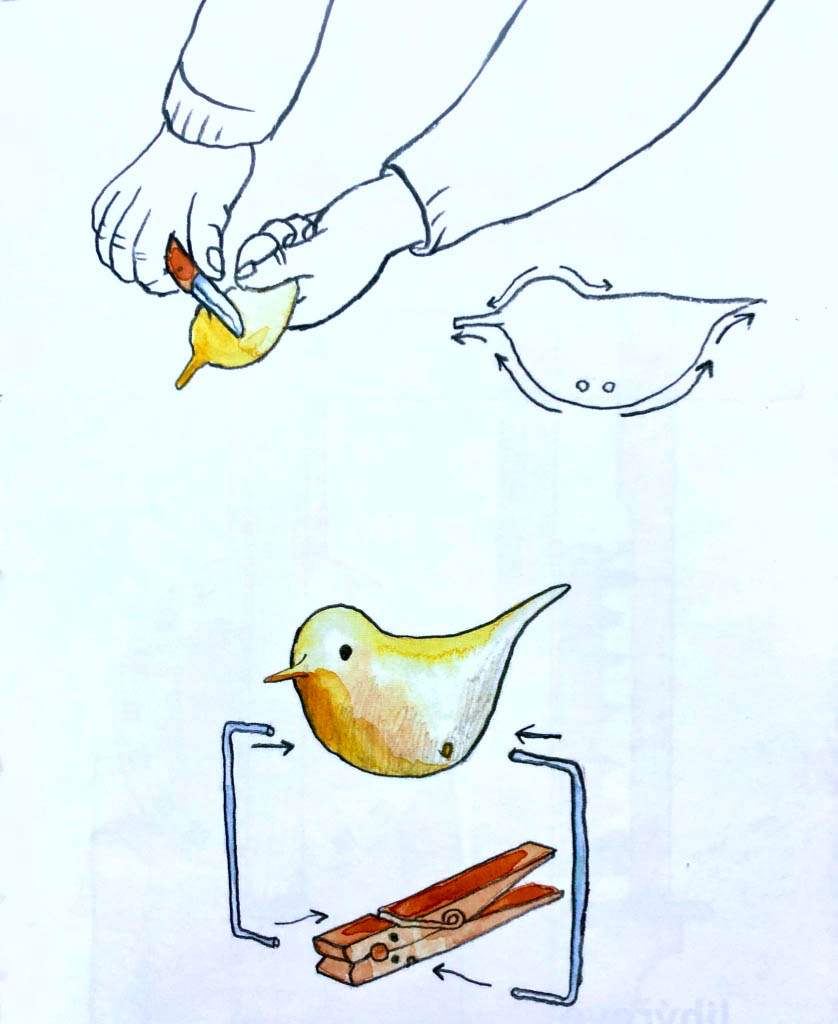
Clothes peg bird
And Renata even gave us instructions on how to make one.
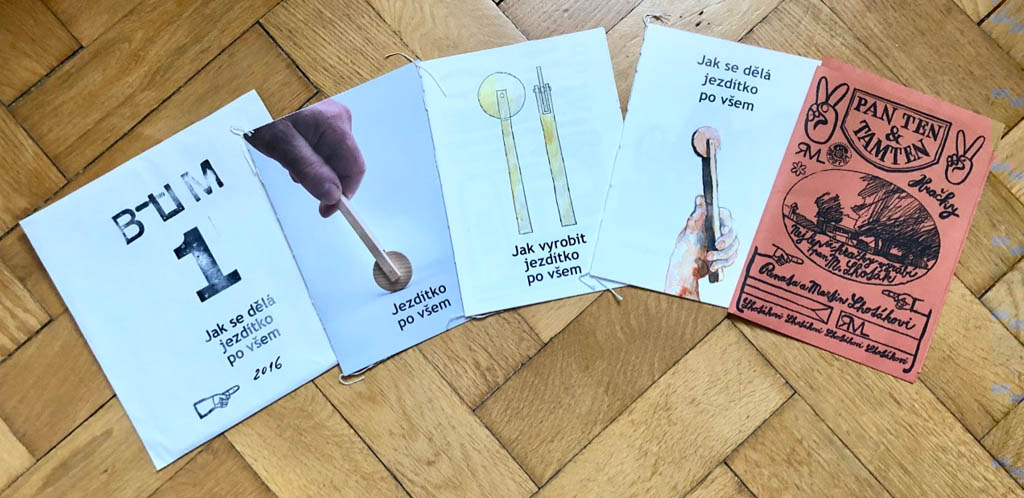
In a brochure made by one of Martin’s students.
Ballerina on horseback driven by the heat of cooking
Martin turning a pear spinner for each of his guests, pedal-powered!

The secrets in Martin’s magical workshop. In German this is called a “Hui Maschine“, and according to Wikipedia in English it’s called a Gee haw whammy diddle
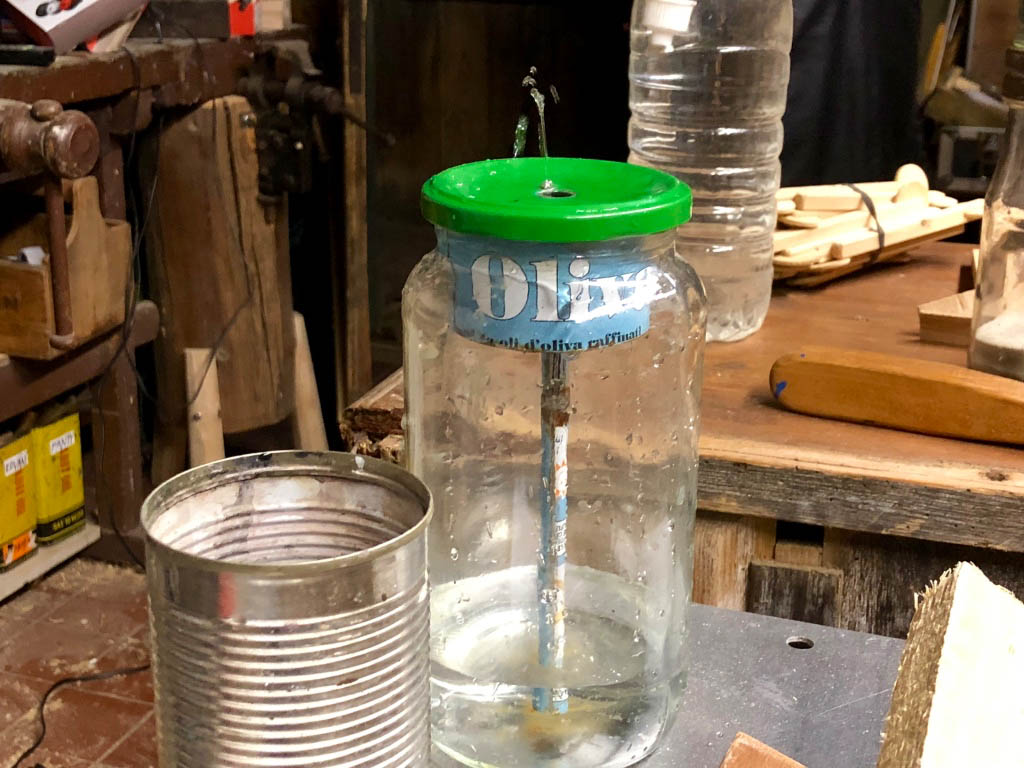
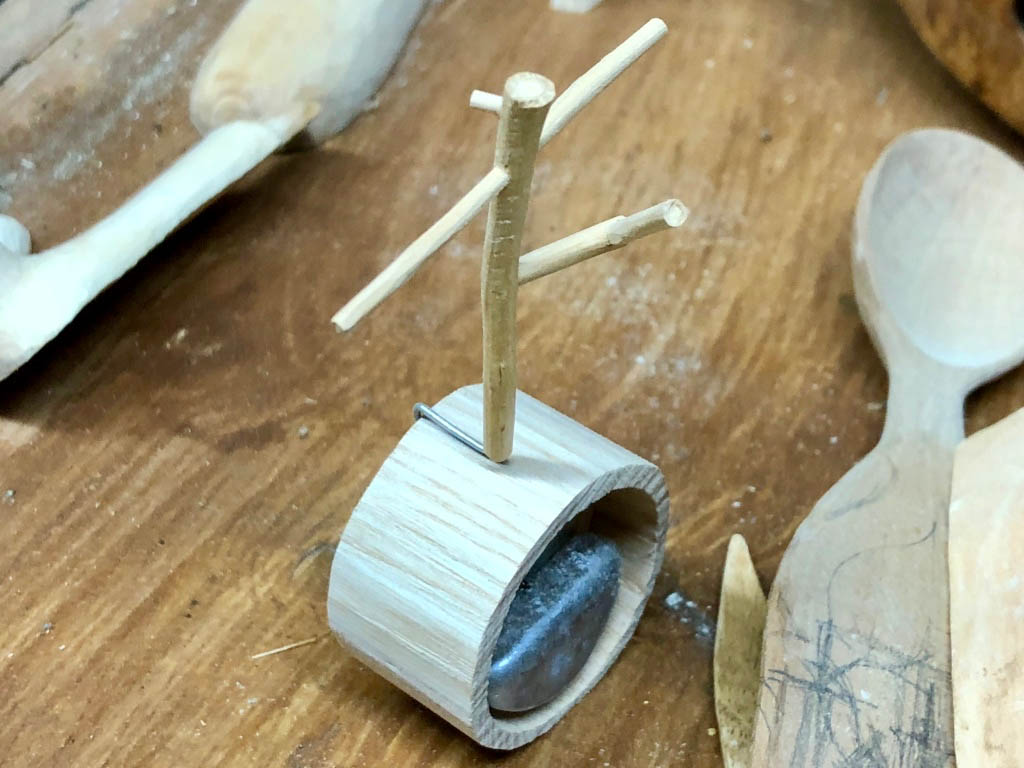
-
Wednesday – Maquettes
09:30 – 17:30 Project realization, cutting wood, carving.
Demo: Robots.Zdar building a base box to give Kim a quick start with his magician maquette.
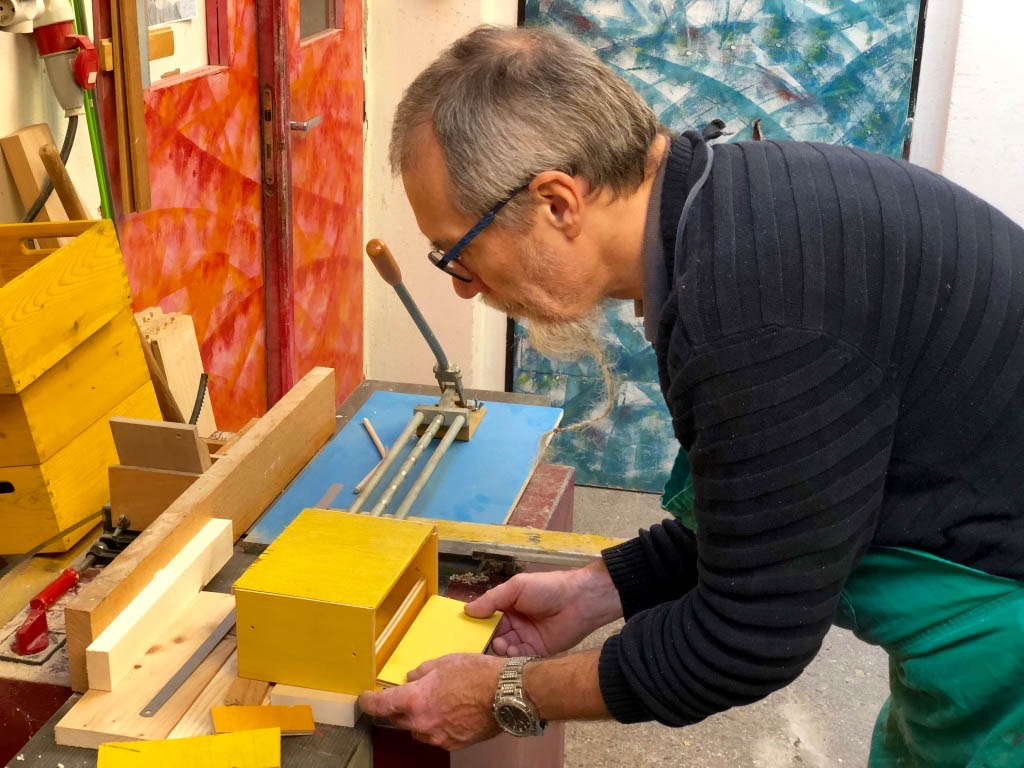
The basic magician maquette, with seven levers and a simple outline of the figure.
Cut out parts in card, if they are OK, cut them in plywood.
Two mechanisms already proven on the maquette, he can politely raise his hat and wave his magic wand..
With a little help from your friends.
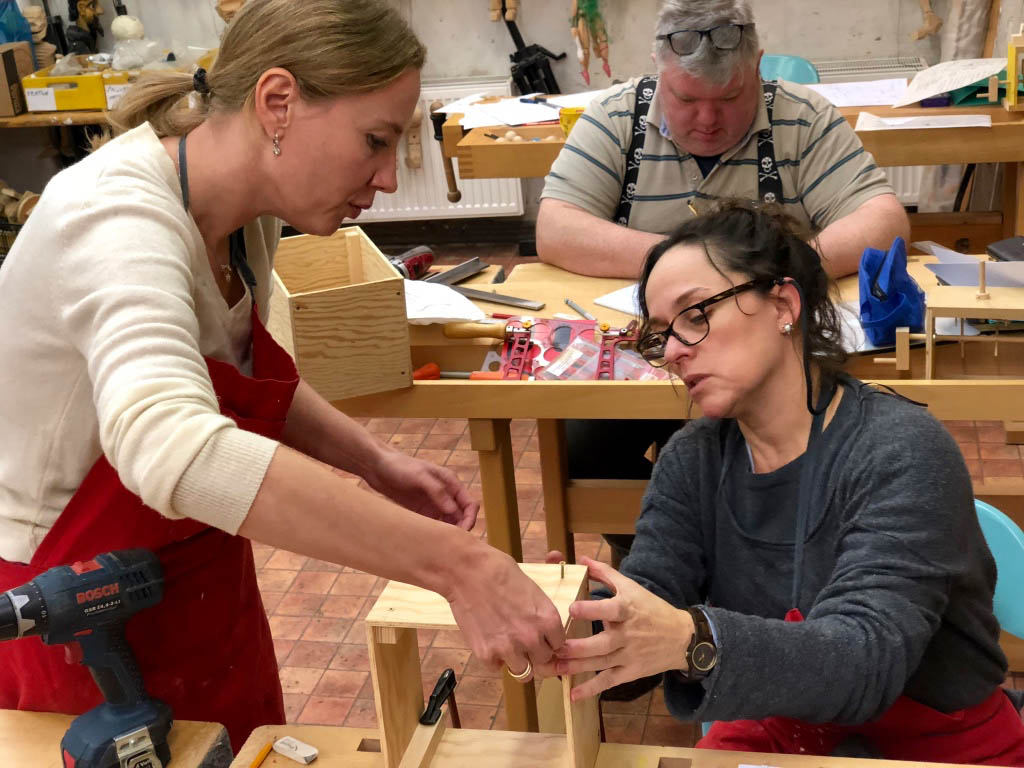
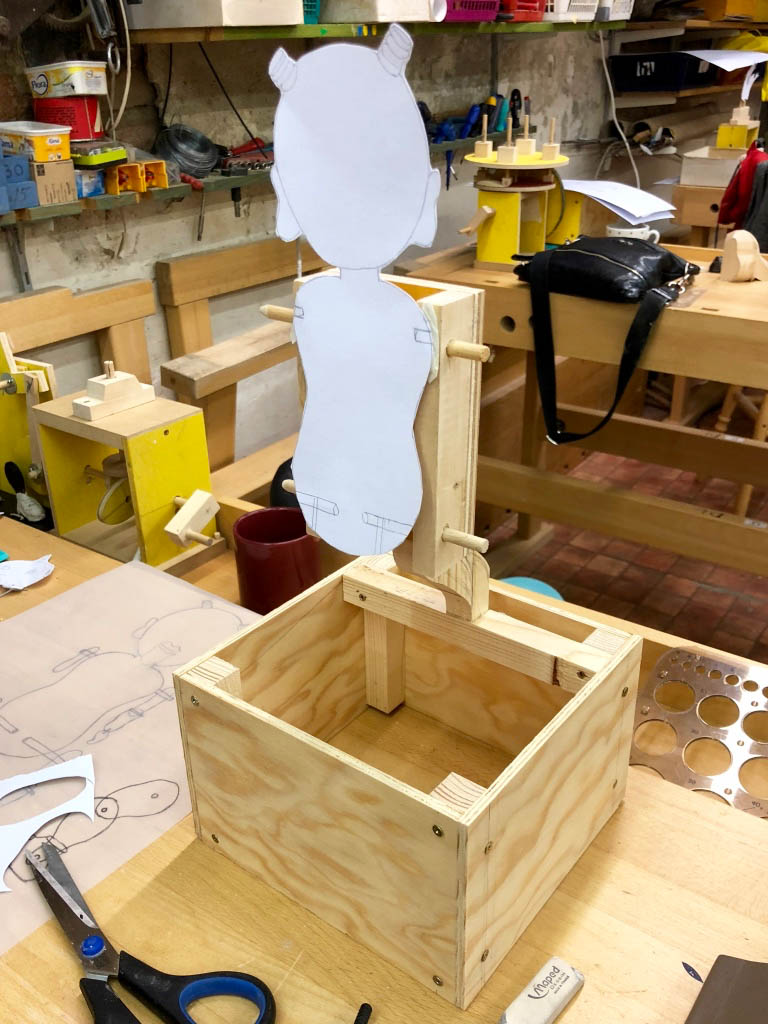
Noa’s maquette.
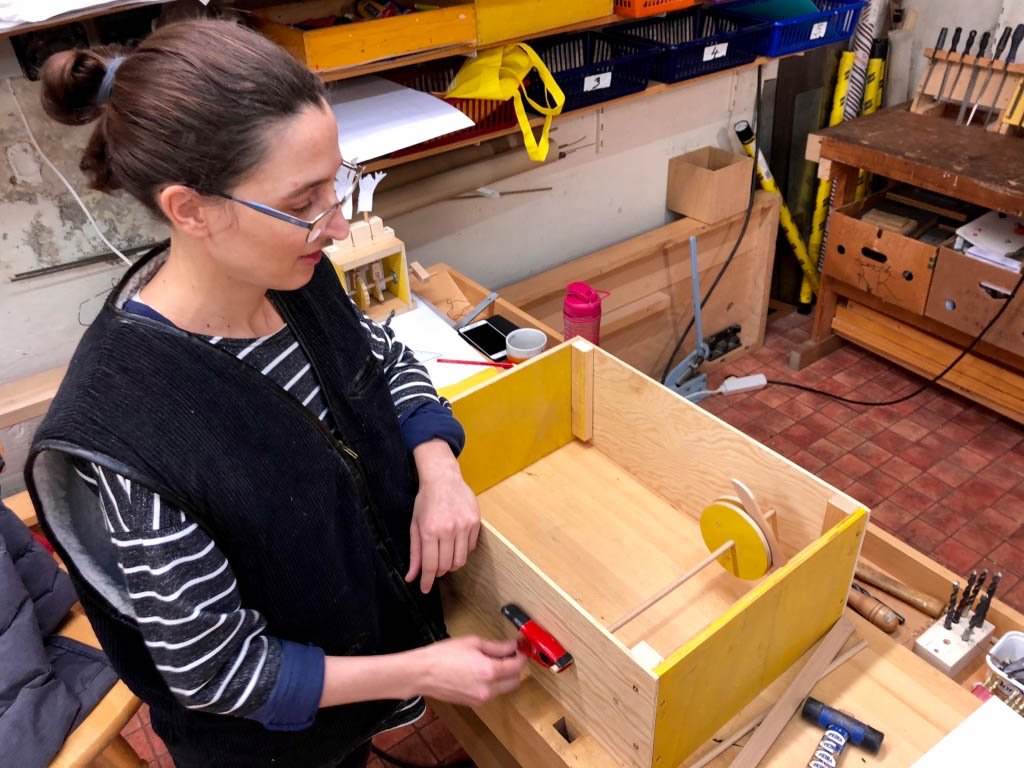
Flavia’s maquette.
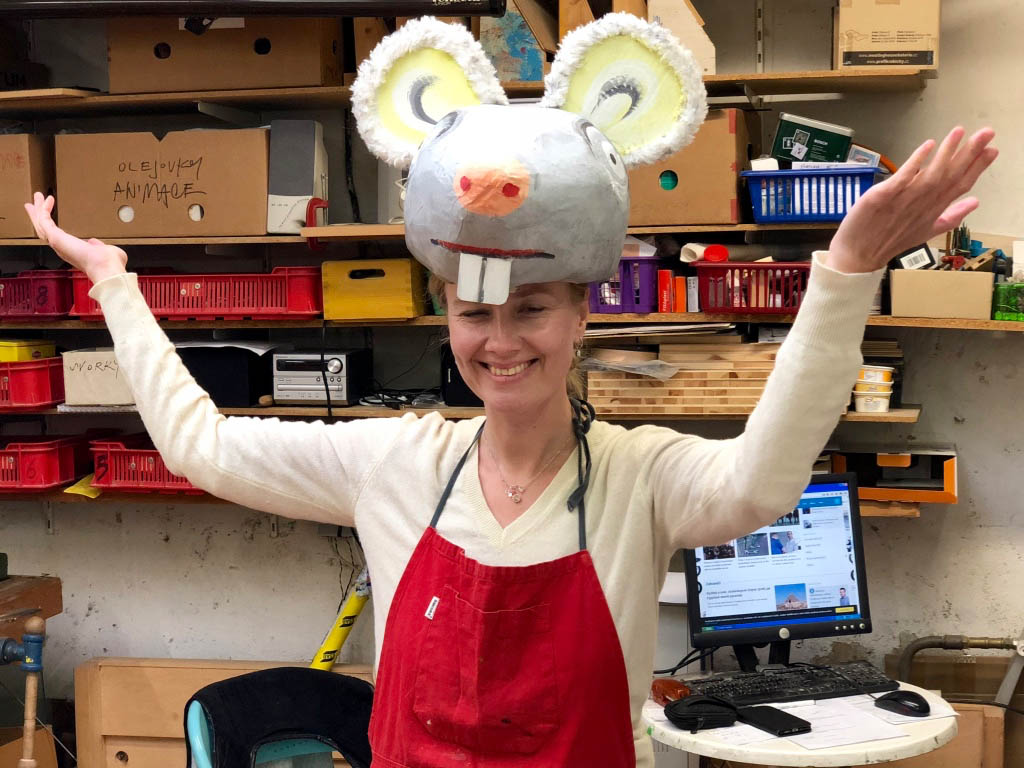
Eeek, a mouse in the workshop!
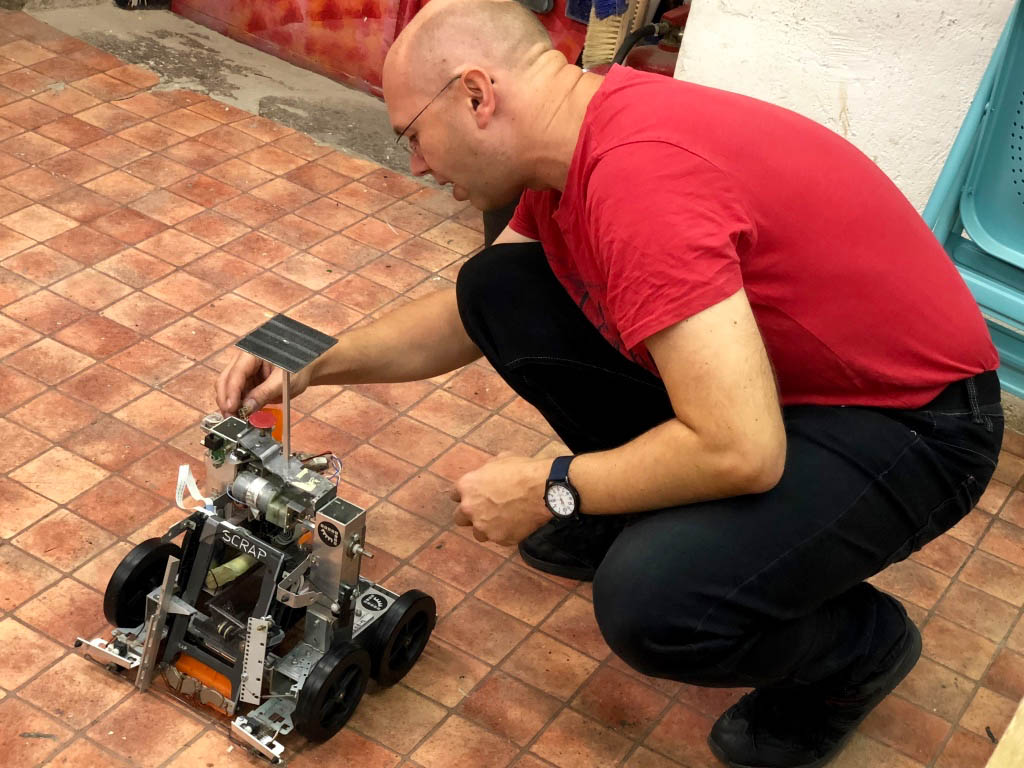
Some electromechanical movement to end the day with something different.
-
Tuesday – Metalwork & technical drawing
09:30 – 17:30 Lecture: soldering, making screw thread
Finishing of Production of 2 basic mechanisms
Technical drawing of final projectLecture: soldering, making screw thread
All ready for metalworking basics!
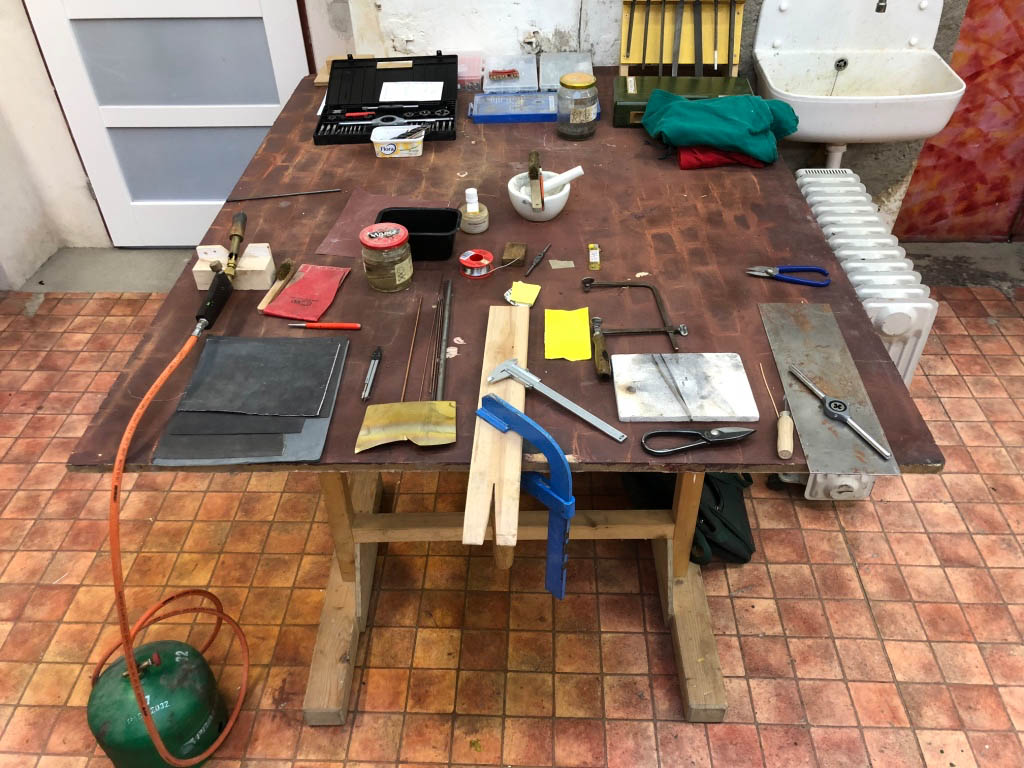
Brazing with Milan

(Soft) soldering

Time to try it yourself.
Three taps to cut one thread. One ring first, two rings second, no rings last.

First drill a hole in a metal plate.

Then tap a thread in the hole.
Now cut a thread on a metal rod.
Finishing of Production of 2 basic mechanisms
Cut out three cam templates.
Kim’s three cams in action.
What’s going on here?
The experts at work.
Technical drawing of final project
If everything’s moving, then start on a “technical” drawing of your project.
Visit to the theatre

19:30 Performance, Finale, Jatka78 theatre (GoogleMaps link) on the site of an old, abandoned abattoir.
-
Monday – Starting the course
10:00 Meet in workshop (GoogleMaps link)
Web site showing Mirek’s work.
Meet in the workshop
Introduction, payment.
Introduction to the mechanical movement of automata.
Materials and tools and basics of operations with tools and machines (cutting, drilling, lathe, glue, joints)
Production of 2 basic mechanismsHere are the raw materials, so we must be in the right place.
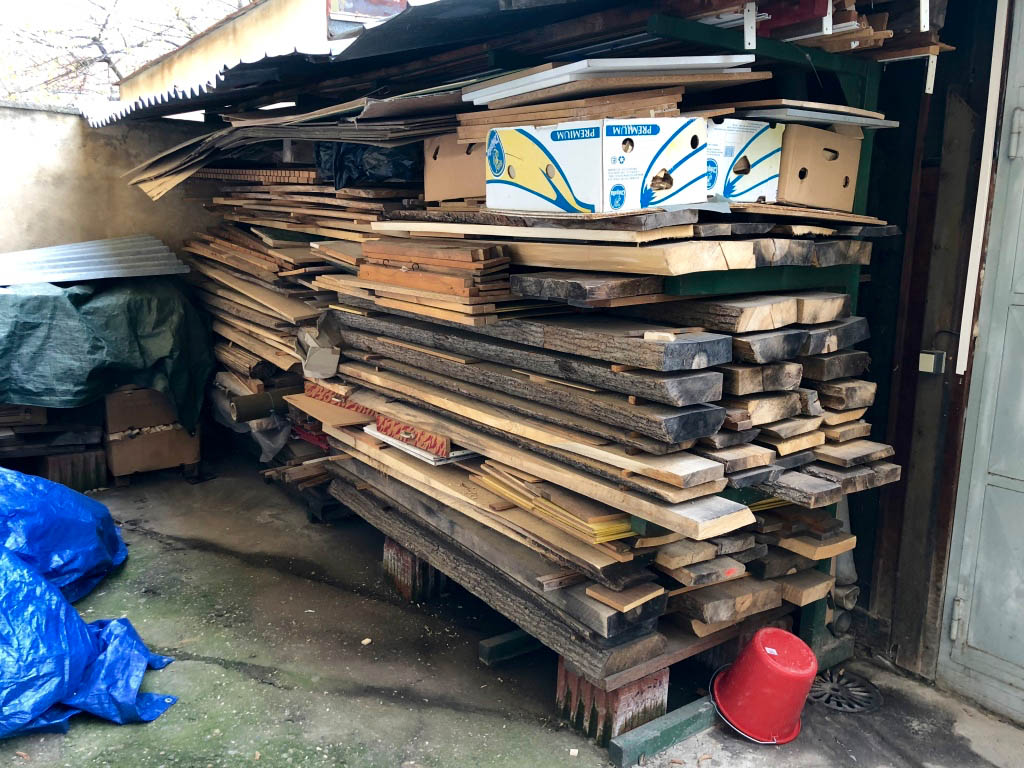
One tidy workbench per student ready to get started.
Examples, for inspiration and to understand the basic mechanisms.
Mirek with some of his small friends hanging around behind him and some online inspiration.
Types of material and their quality.
Mechanisms, theory and practice.
The lathe ready to turn some wooden wheels.
How to use a bandsaw properly.
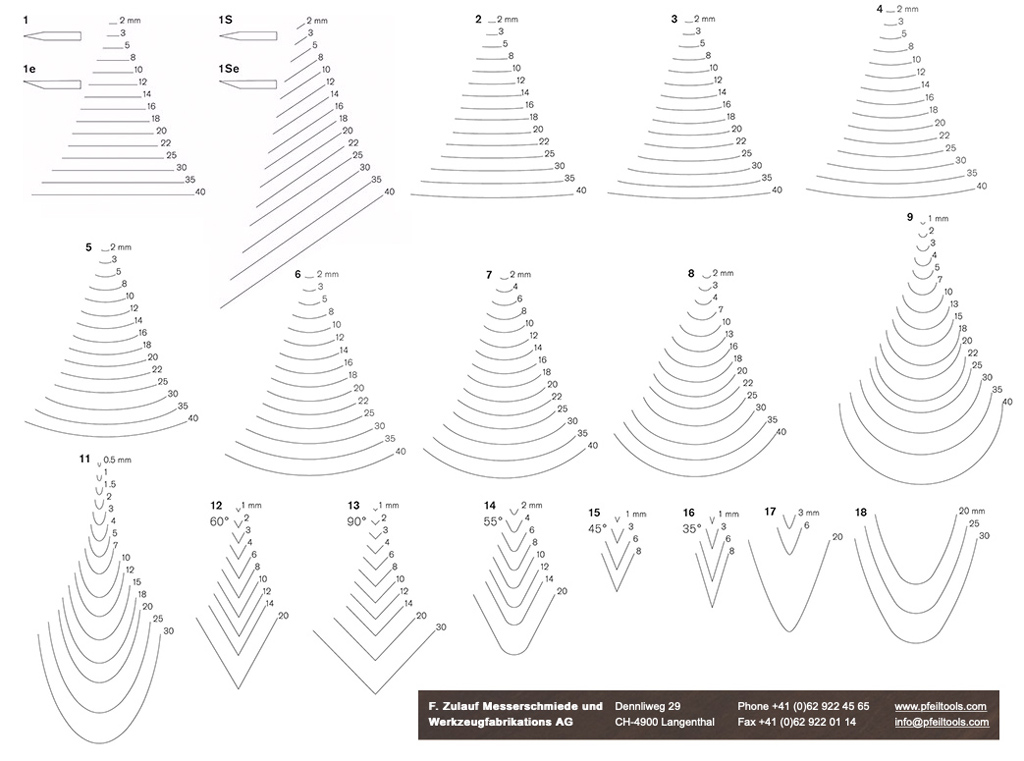
Chisels, sizes, shapes and their care.
The naming system for Pfeil chisels (see their web site)
Using a chisel.
Mirek has made plenty of base kits so that we can try out the mechanisms ourselves.
One of Mirek’s demonstration pieces.
-
Sunday – Prague and Palác Akropolis
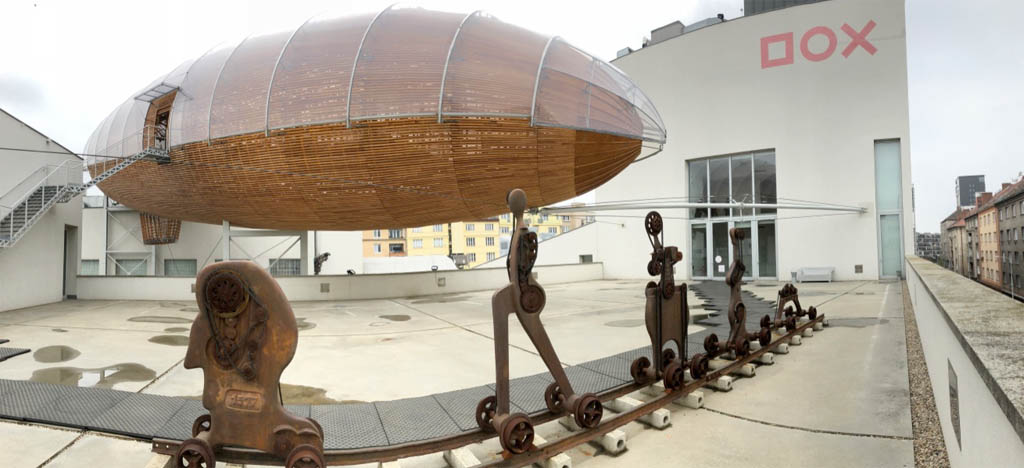
One day for sightseeing before the course starts so today I went to the DOX museum of contemporary art, then walked via the metronome monument to Marionette Truhlář.
[catlist id=101]
DOX museum for contemporary art
Tick tock
An enormous Stalin statue replaced by a metronome – work that one out! The popular name for this was apparently the queue for the butcher – referring to the shortages in shops under communism. Finished in 1955 it was eventually embarrassing enough to be dynamited in 1962.

Now the sprayers have taken over the remnants.
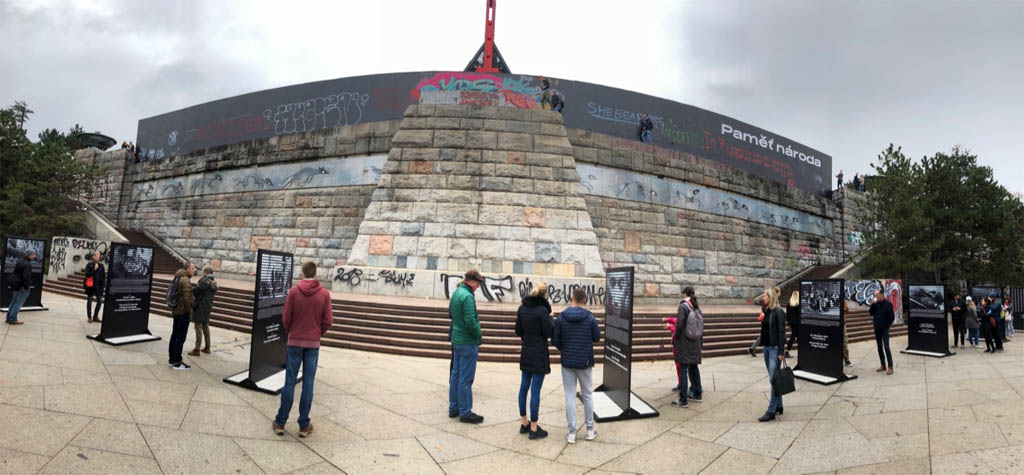
Nice view over Prague and its bridges over the Moldau.

Marionety Truhlář
www.marionety.com. Right next to Charles Bridge. (GoogleMaps link)
The puppet to the right was made by Sota Sakuma and was used in a film. The two puppets to the left are Don Quixote and his faithful horse, Rocinante.

These are nice, but €240 each, so I guess I will have to make one…

Puppets, puppets and more puppets.

The Palác Akropolis theatre
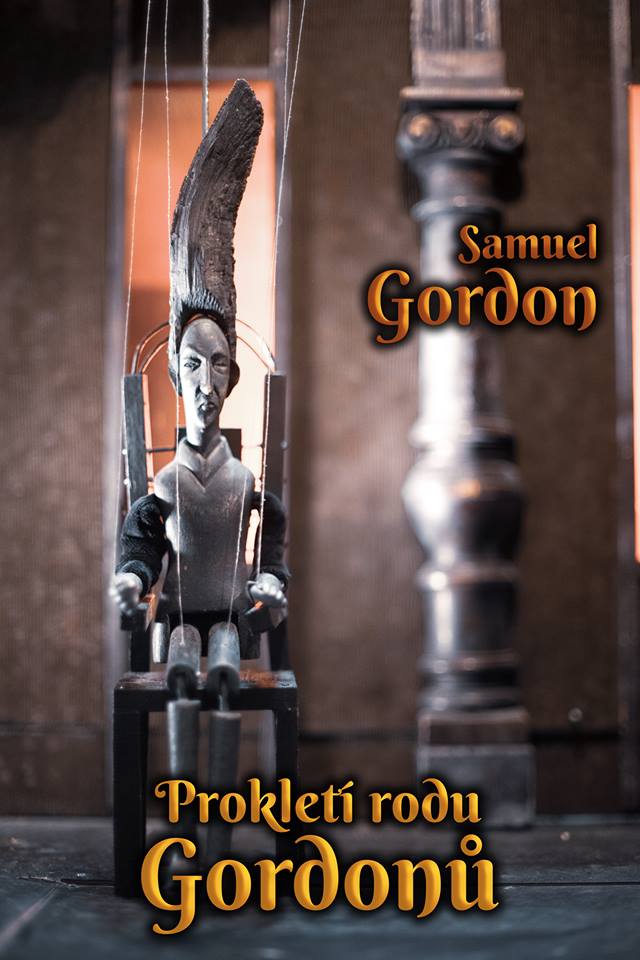
(GoogleMaps link)Prokletí rodu Gordonů – premiéra (The Curse of the Gordons)
The plot
After years away from home, the hero returns to the family estate to solve the series of strange deaths that happened at the castle. He is gradually confronted with all his inhabitants and the distrustful commissioner in charge of the investigation. The story has a fixed beginning and end, but the course of the performance changes, depending on which variant the viewers are in.

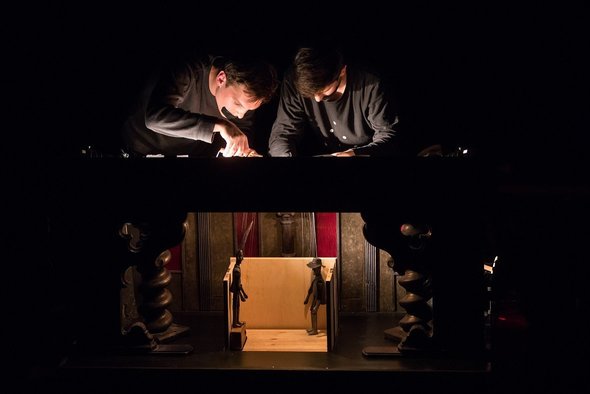
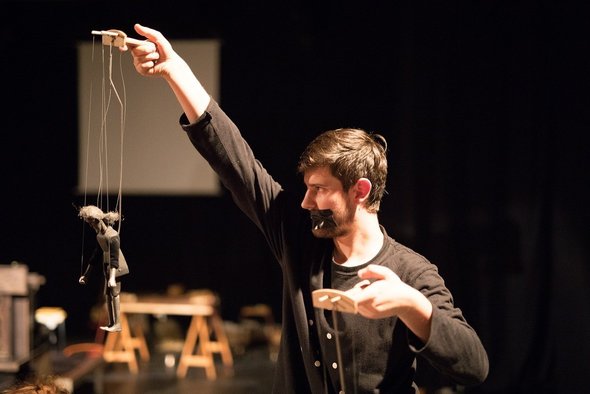
Palác AkropolisFekete Seretlek ► Kar
This second show, Anna Kerenina, was very good. Even got a free glass of vodka during the performance!

-
28 Sept. Appt. Seespitz – Hintersteiner See
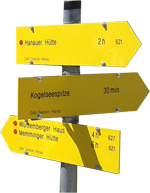
Early start today.

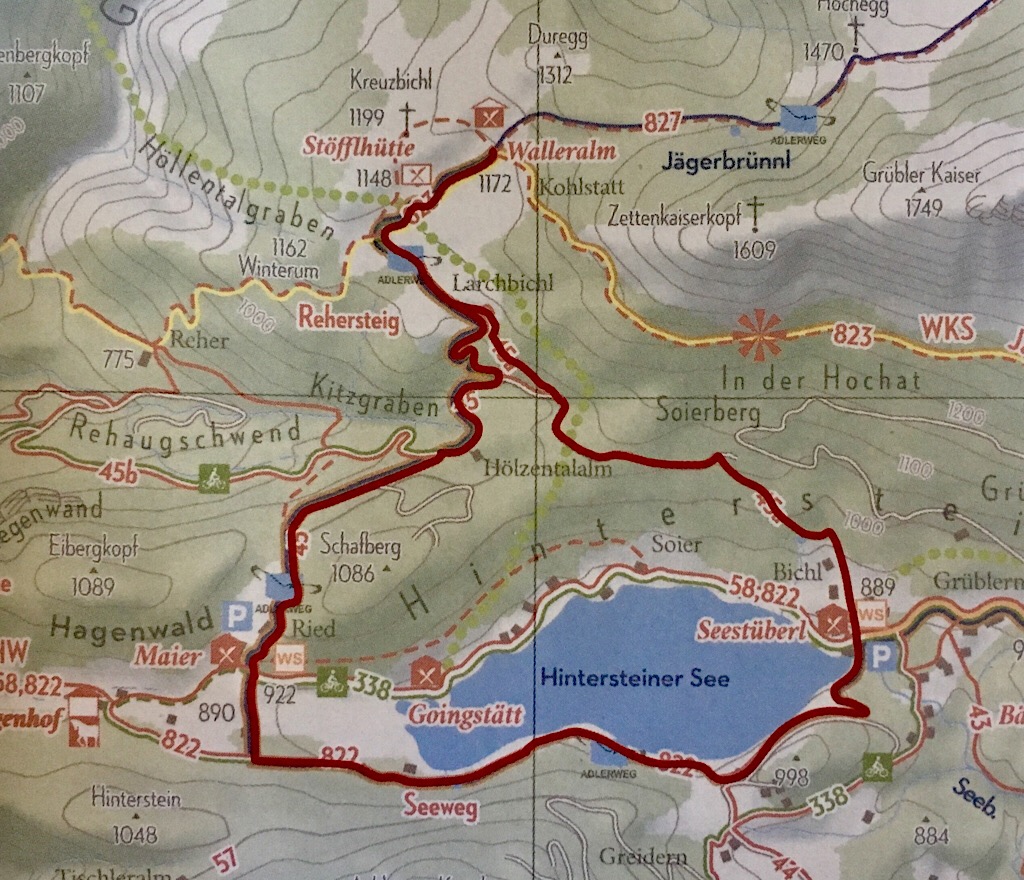
What is he looking at?

In the blue depths of Hintersteiner See.
Look! A cloud.
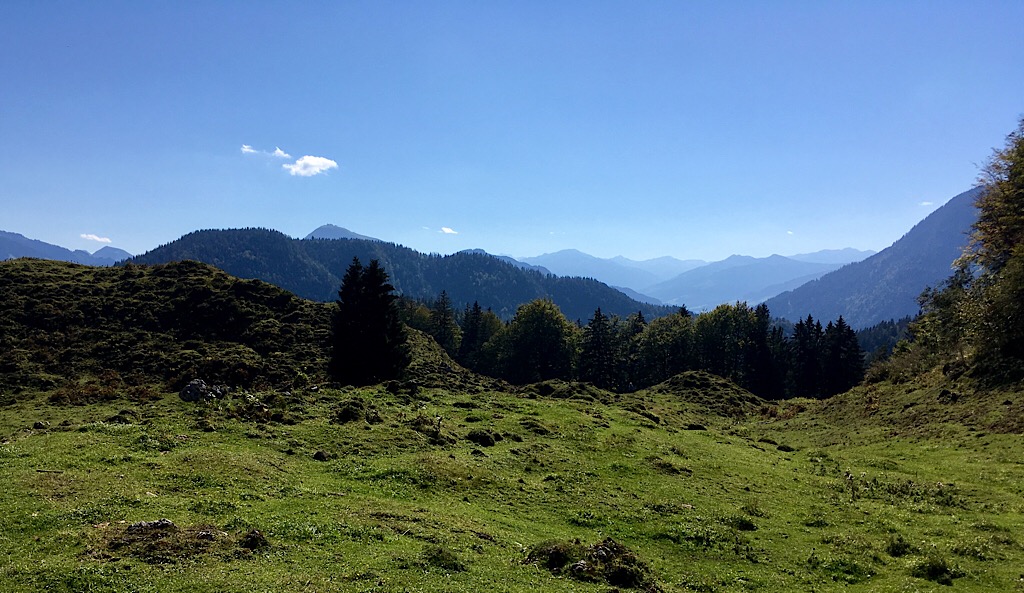
-
27 Sept. Appt. Seespitz – Brandstadl
Blue sky today, all day.
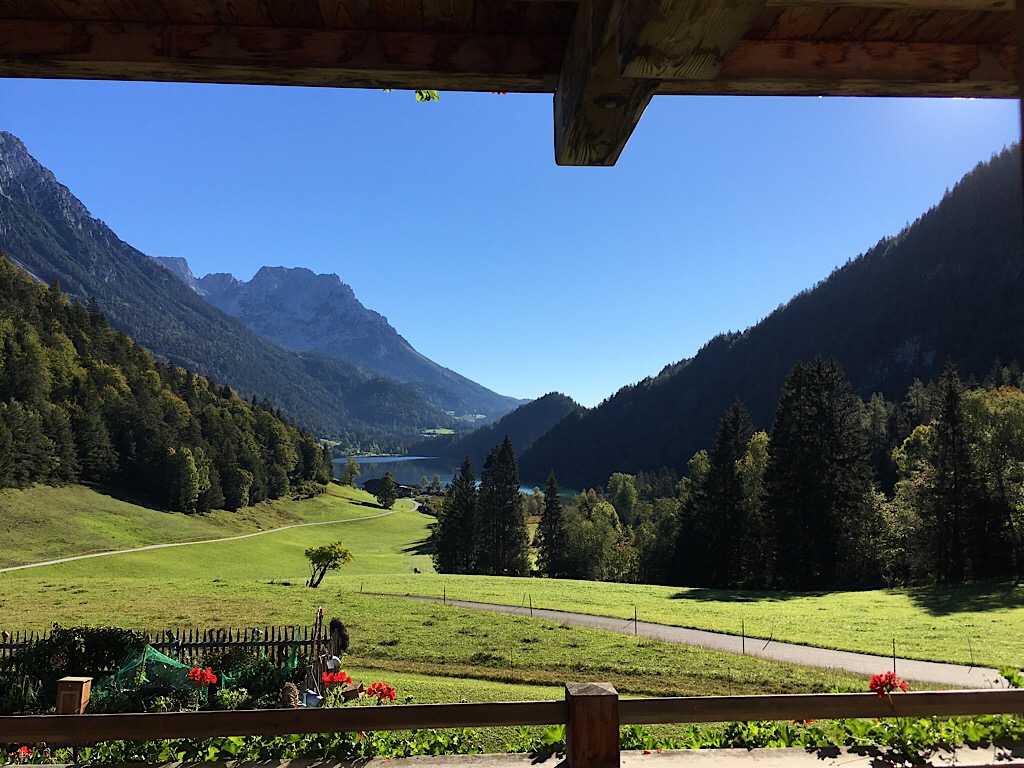
Elevenses at 1630 m.

Look at that blue.

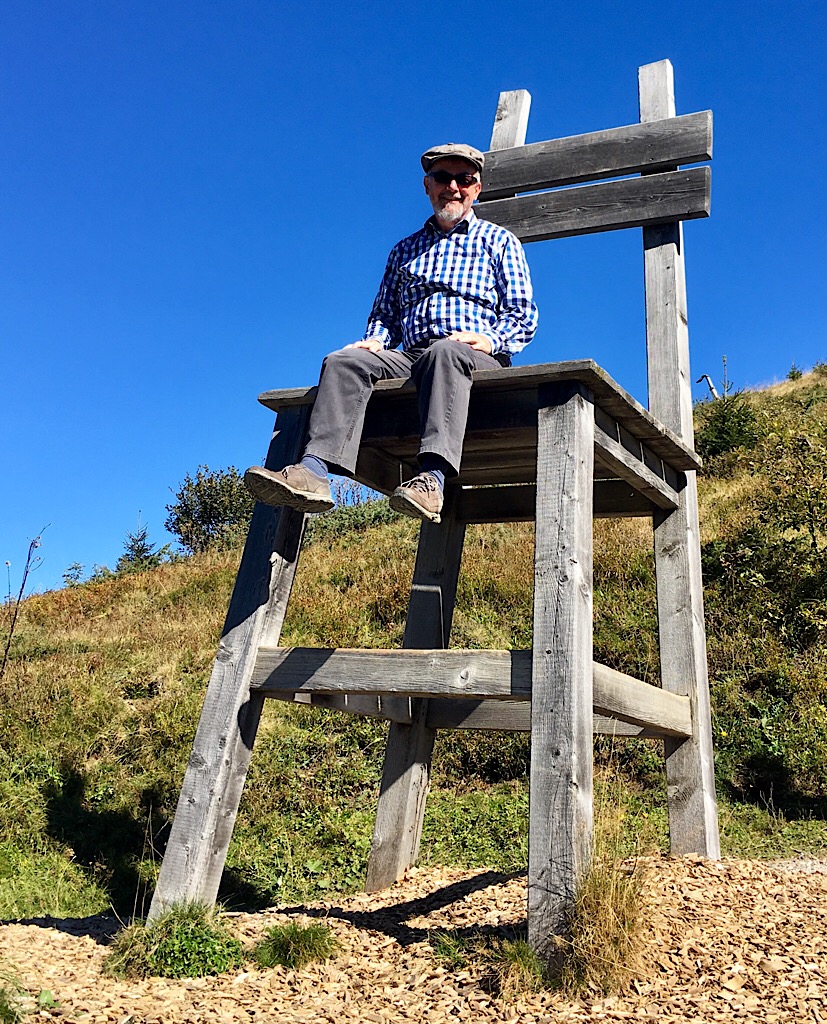
There are plenty of places to sit and have a rest, even if Austrians seem to be a bit taller than average.
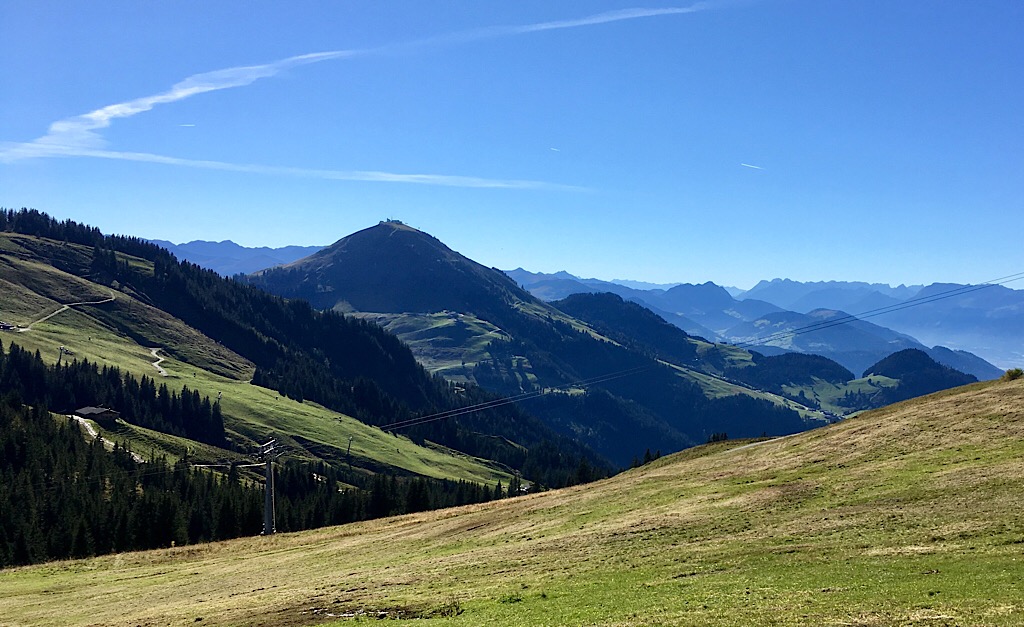
Did I really order all that? (Tanzbodenalm)

-
26 Sept. Appt. Seespitz – Achleiten & Söll
Every morning is different.

Local walk today around Achleiten.
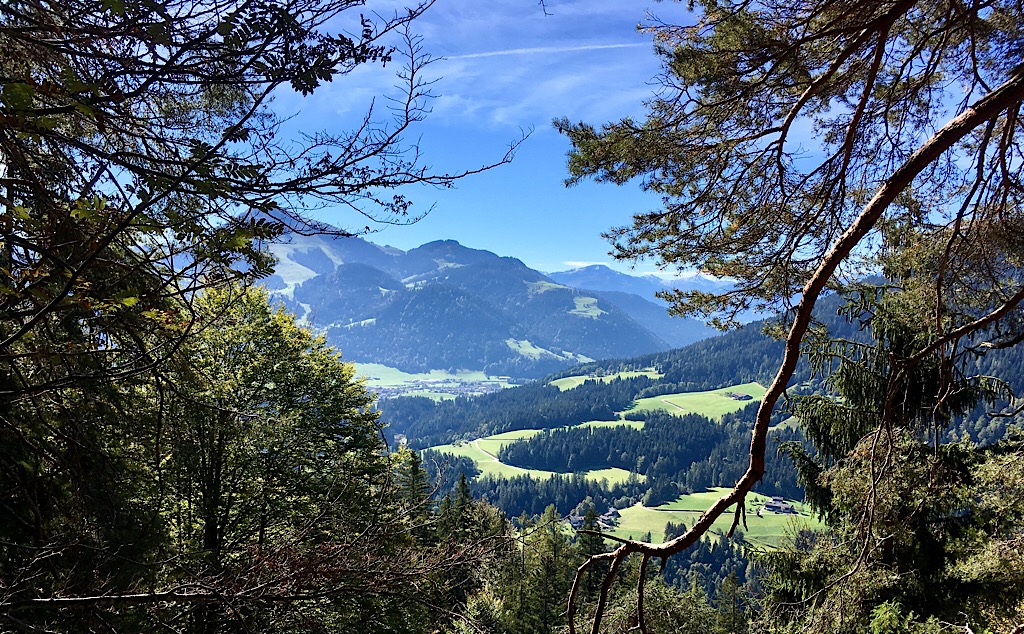
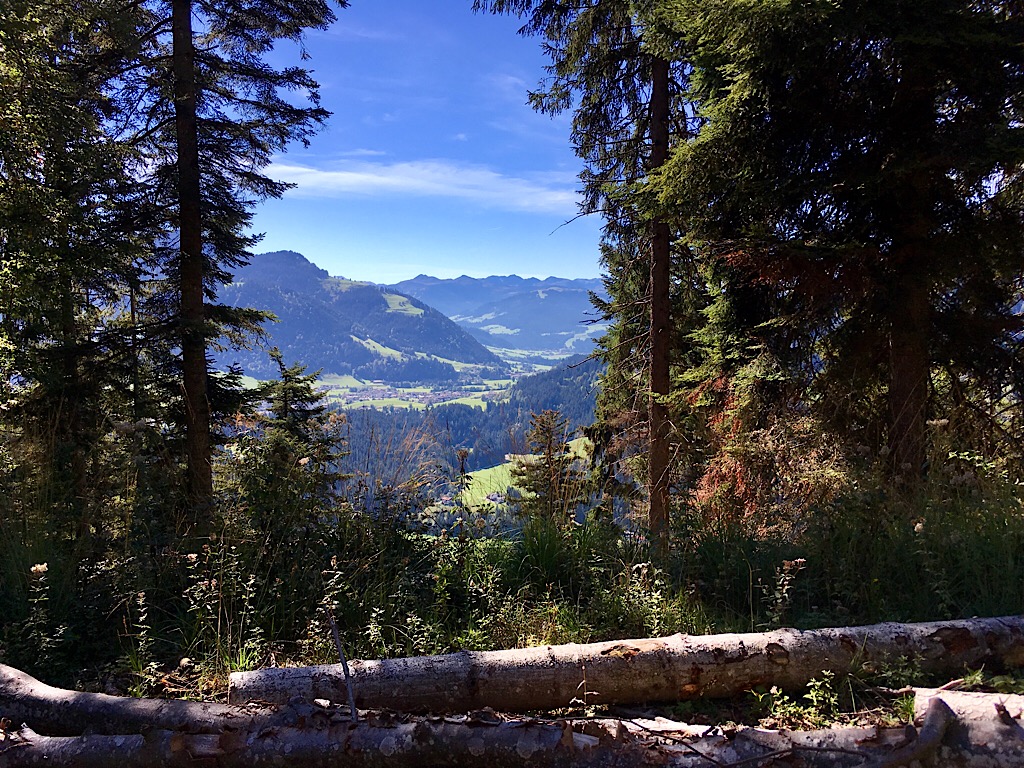
Magic forest.
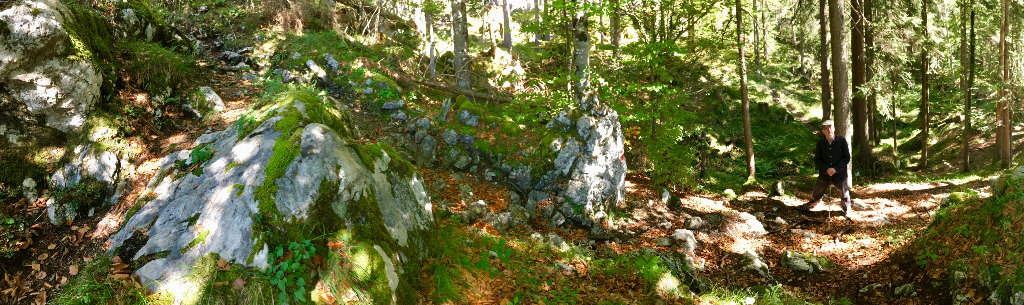
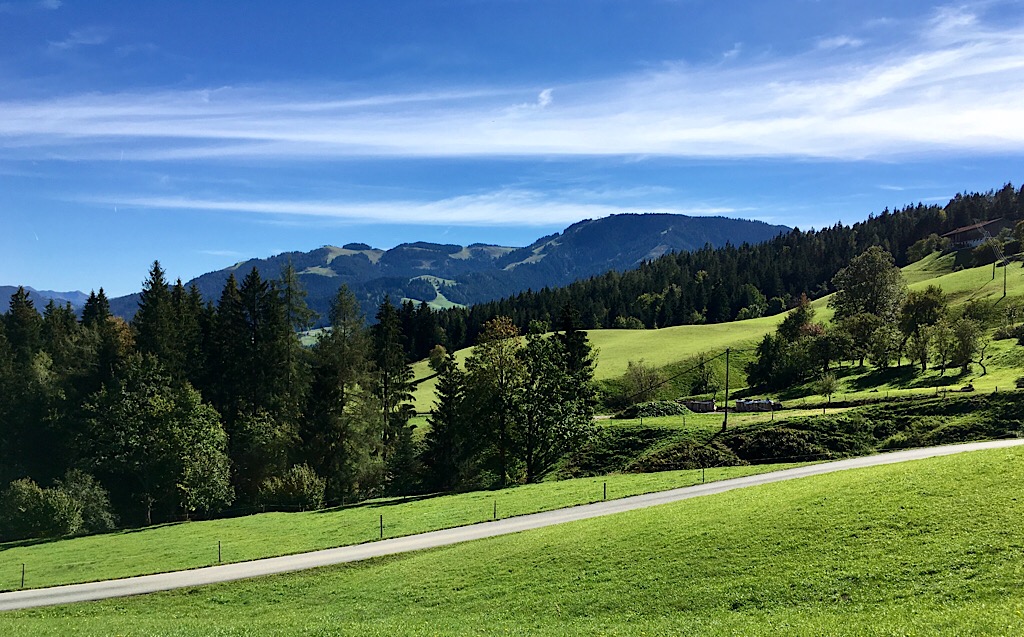
Bit of culture in Söll this evening.
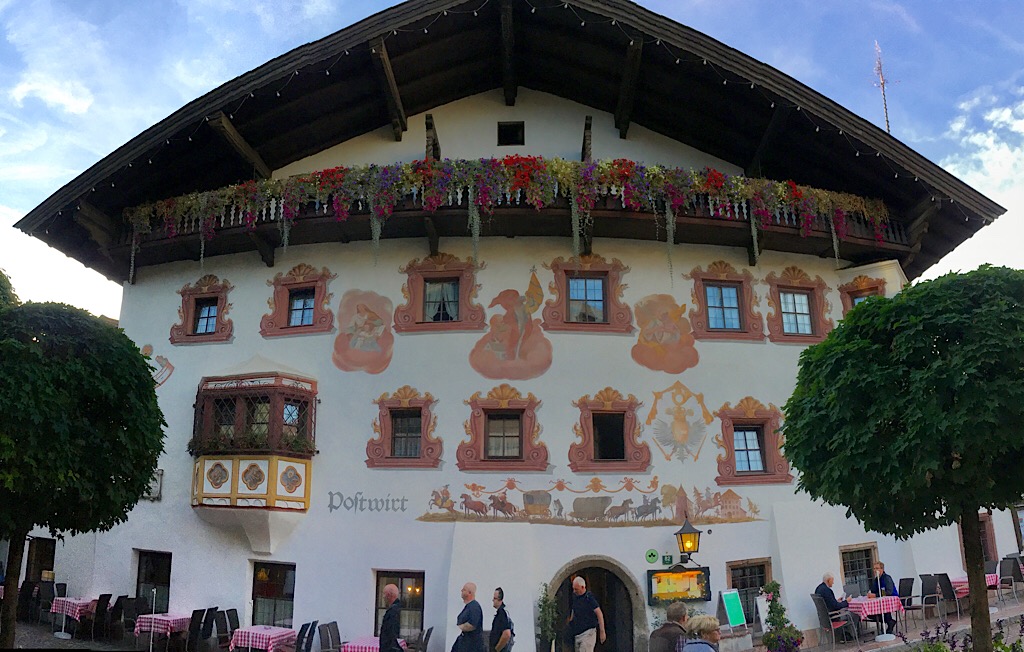
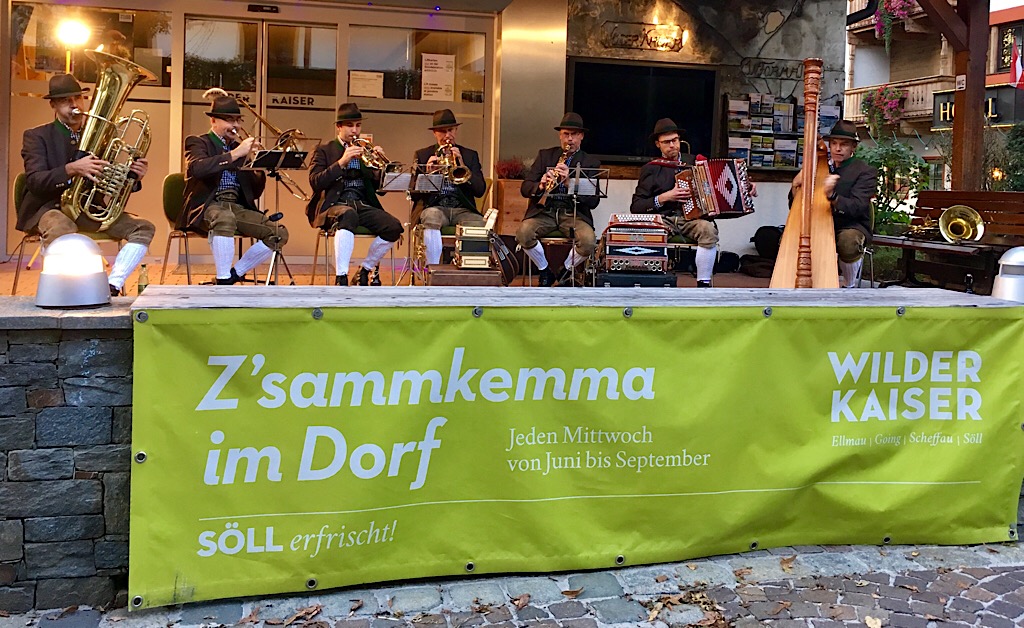
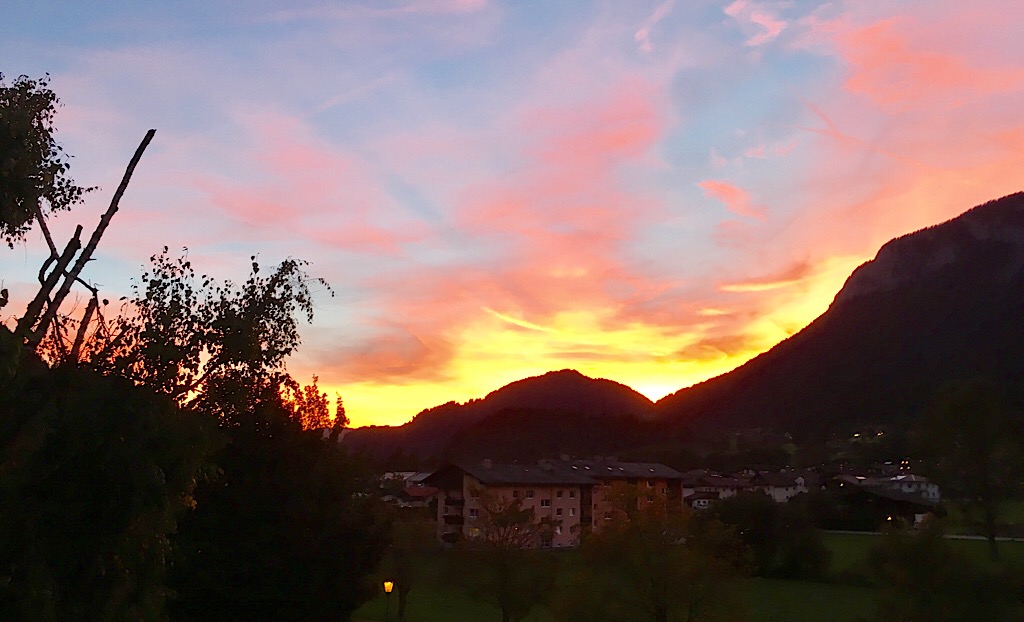
Nice meal in Auf Da Mühle with a glorious sunset.
-
25 Sept. Appt. Seespitz – On giant’s tracks
Nice start to the day.
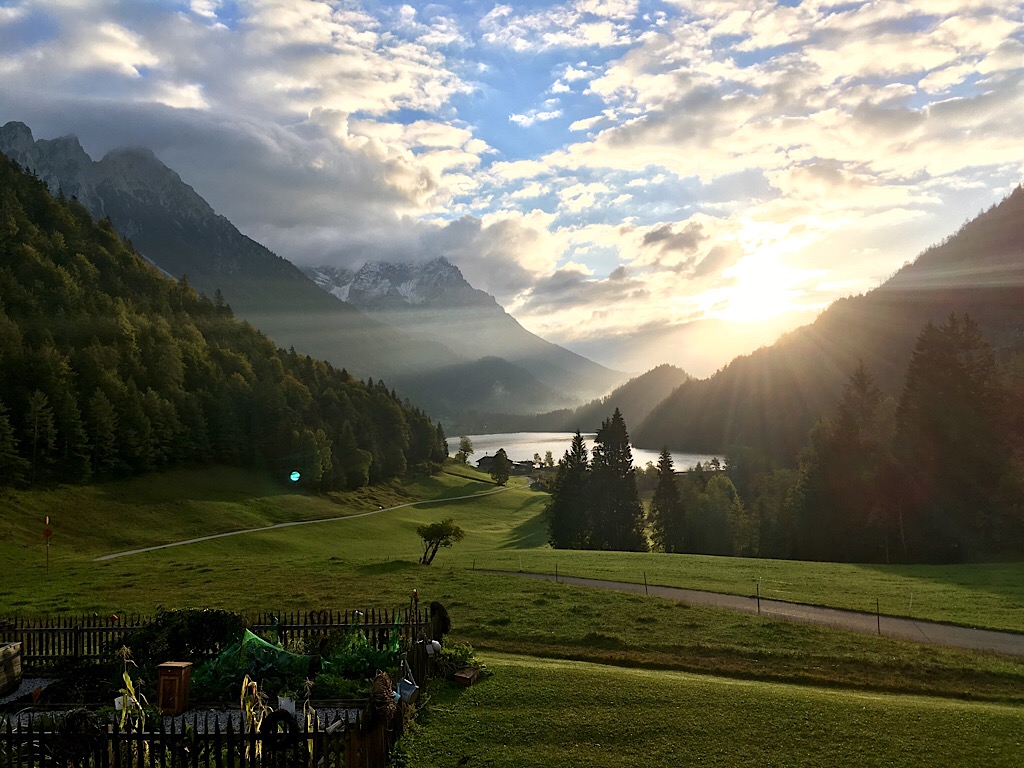
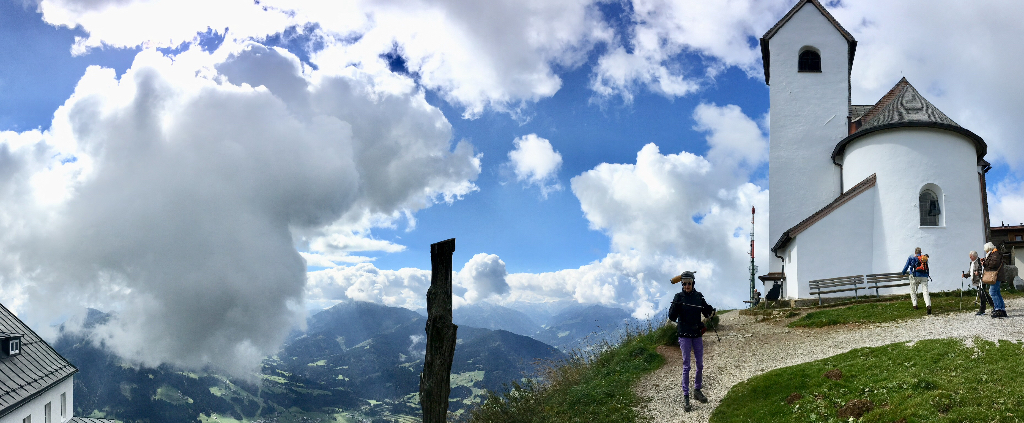
We accidentally got on the wrong lift today and went right up to the peak of the mountain Hochsöll. It was pretty cold, so we had to wrap up warm for the walk down.

Someone put a nice little church right on the top.
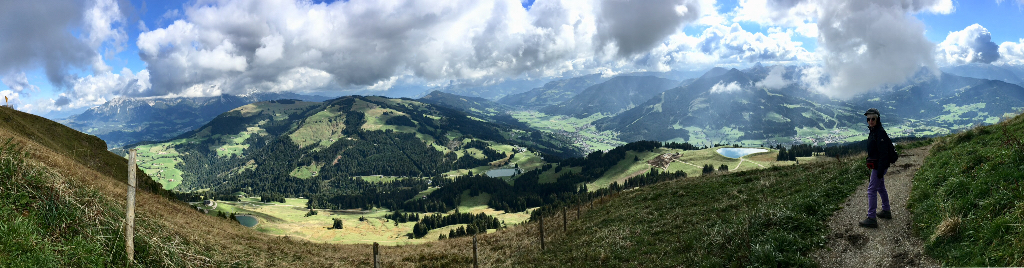
Someone else scattered reservoirs over the mountain.

At the end of the walk the serious business of eating some delicious apricot crumble cake begins.
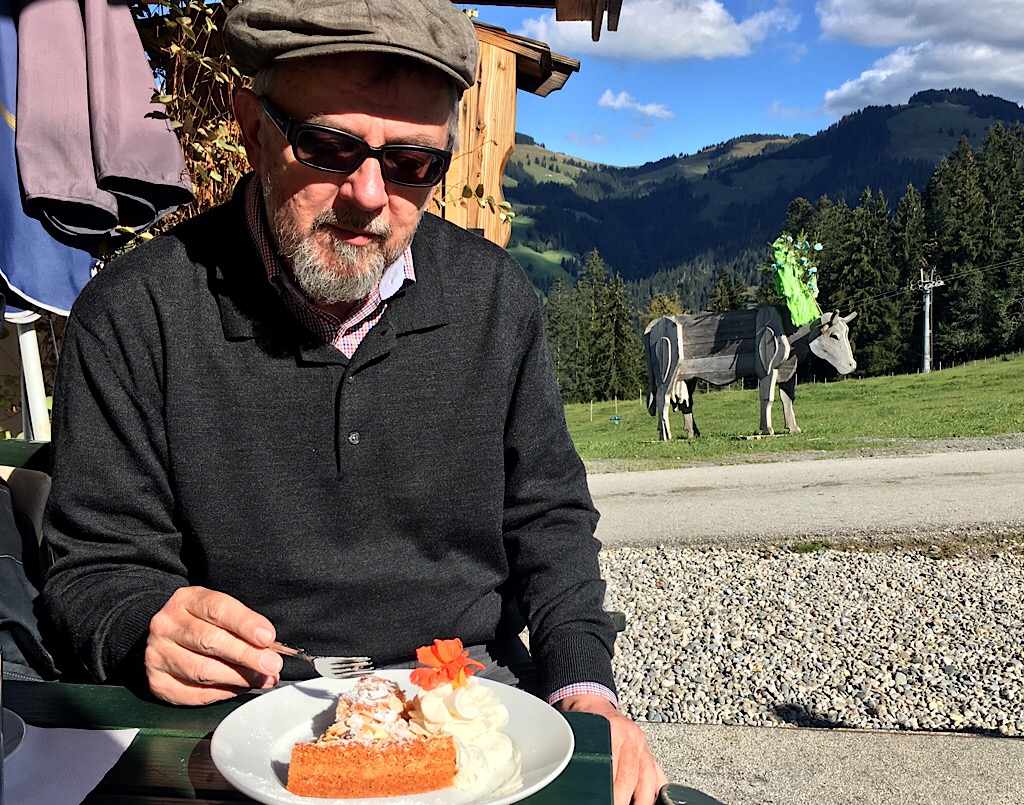
You know that feeling that the way back is much faster than the way out. This time it was really true.
-
24 Sept. Appt. Seespitz shopping & reading
I found this beautiful basket of bread in front of our door this morning and we watched the farmers harvest the plums yesterday. That’s the way to have breakfast!
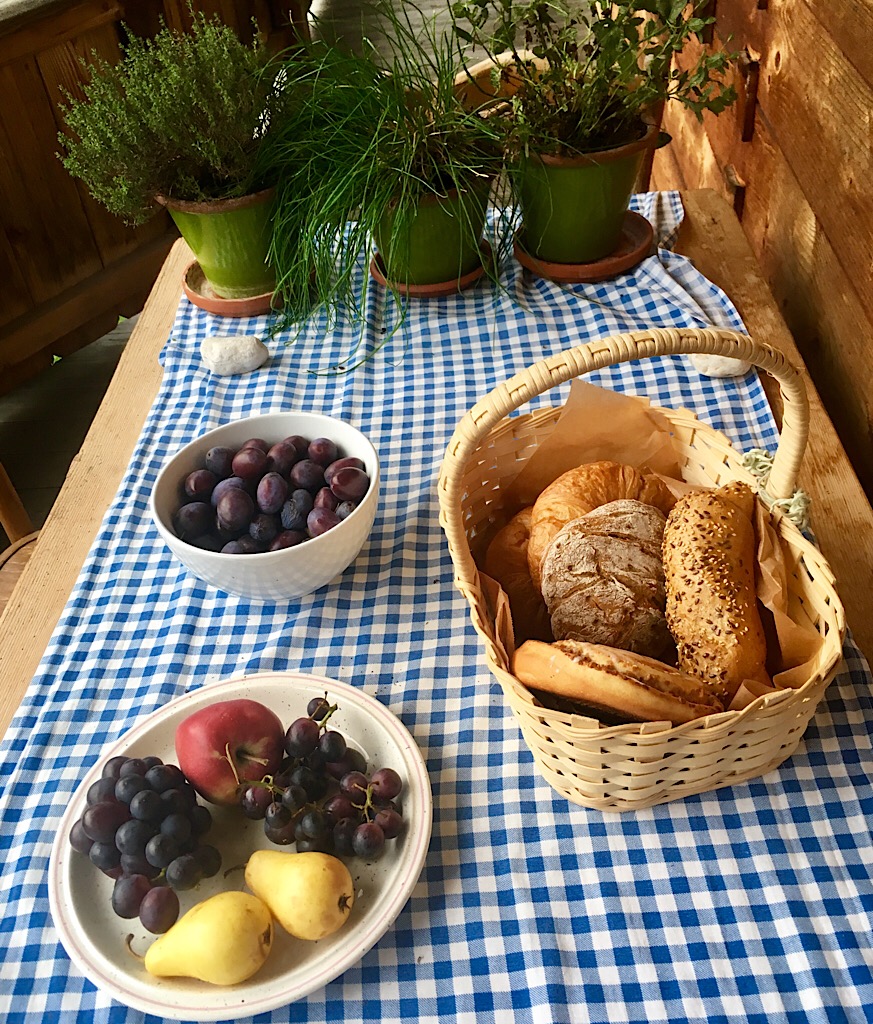
It rained today, so apart from shopping we had a lazy, luxurious, literary day.

-
23 Sept. Appt. Seespitz – Walleralm
Atmospheric start to the day from our balcony.

Just like England.
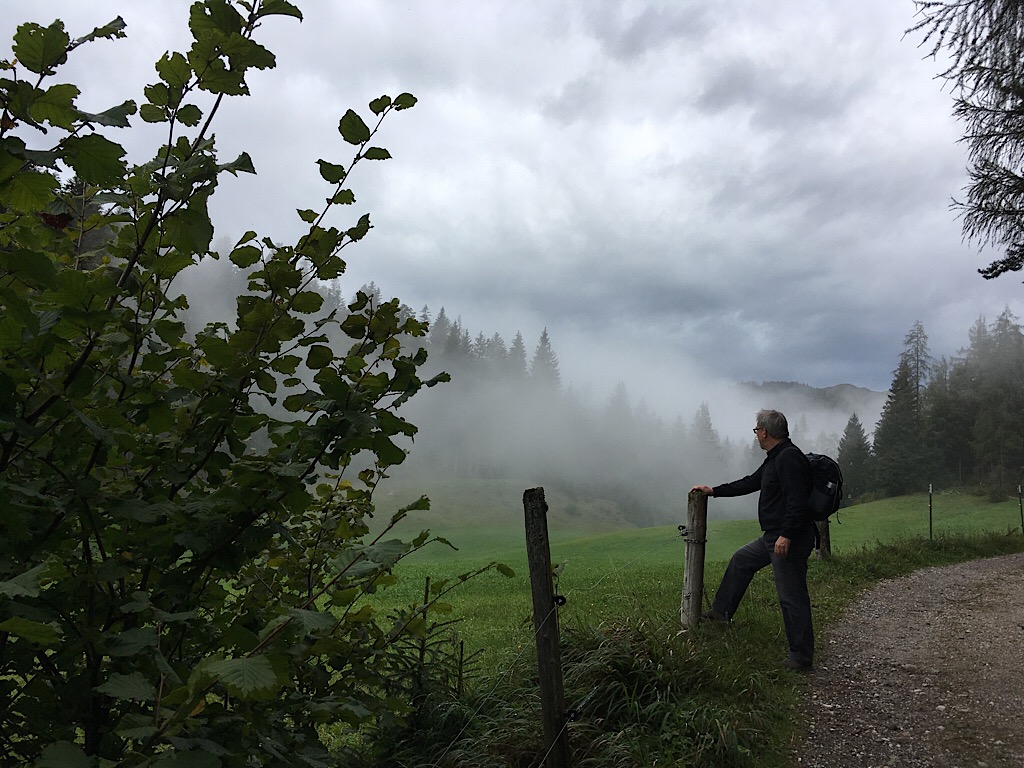
If you go down to the woods today…

Lost in the mist?
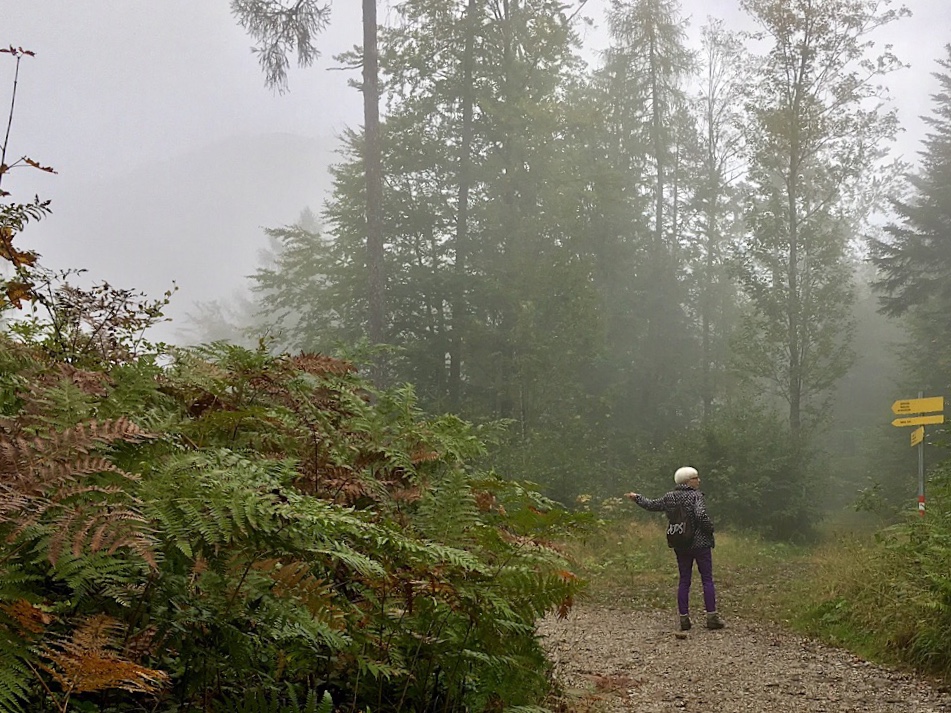
No way! On top of the cloud we can see the sun.

A short while later.

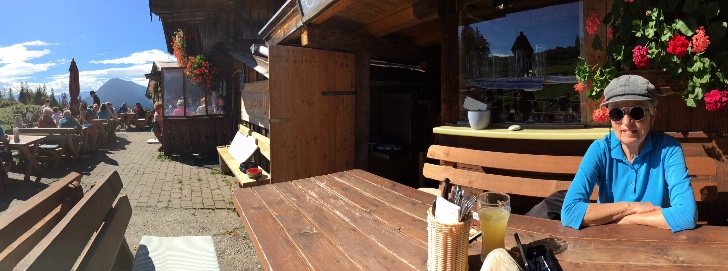
Time for a glass of Almdudler.
-
22 Sept drive to Appt. Seespitz via St. Peter

Today we left Bozen for Hintersteiner See, stopping off in St. Peter to find somewhere to stay for next year.
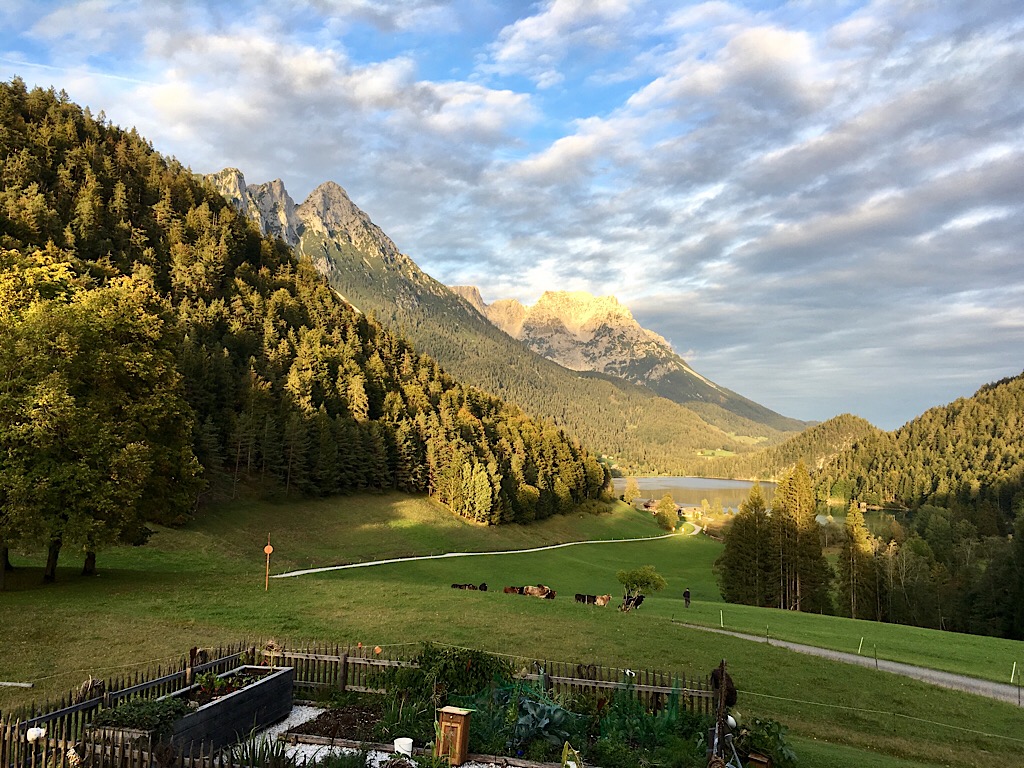
This is the splendid view from our balcony. Quite a step up from the camp site.
Appartement Seespitz
Interaktive Karte
Wilder Kaiser Touristen Info
Panoramic path
Kaiserjet Bus

-
21 Sept Camping Steiner – Jenesien to Locher
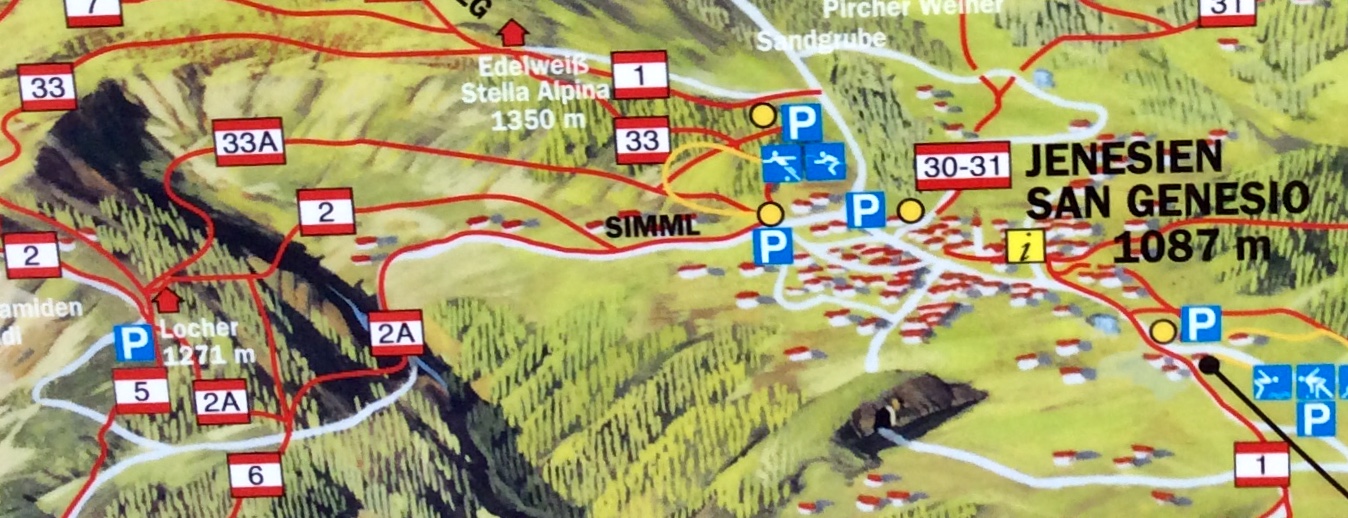
Today the GPS route tried to send us up a nearly vertical rabbit hole so we turned it off and took another free cablecar ride up to Jenesien.
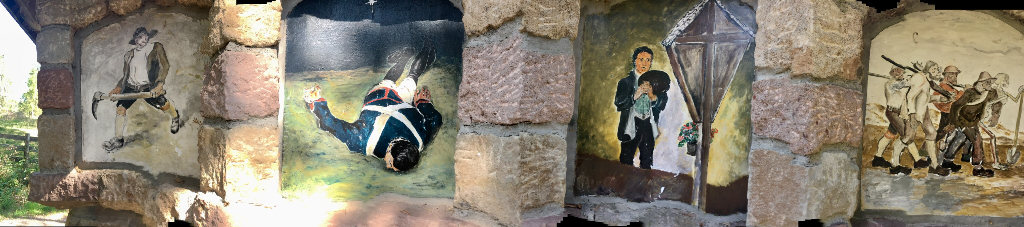
In the forest on route 32A we bumped into this war memorial.
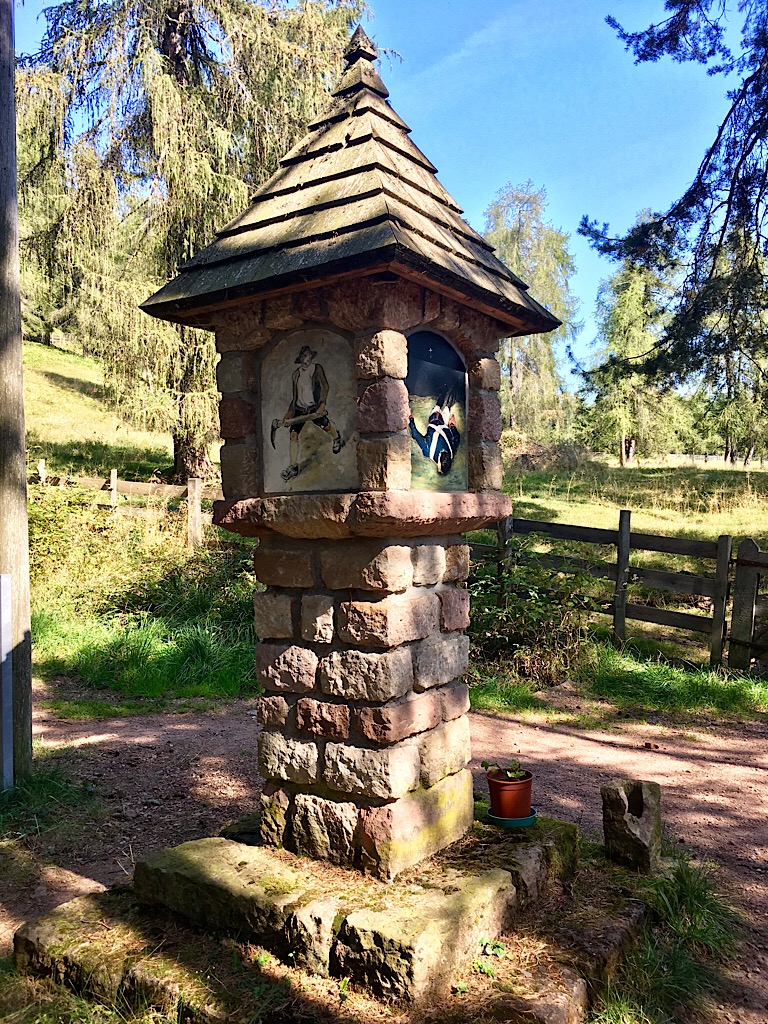
No, not that one, but the “French” battle of 1797 and remembering the death of 7 soldiers and their captain in 1809.
This is Gerhild’s latest great idea – a shadow selfie! We take them around with us most of the time this week, so it’s only right that they get into the picture too.
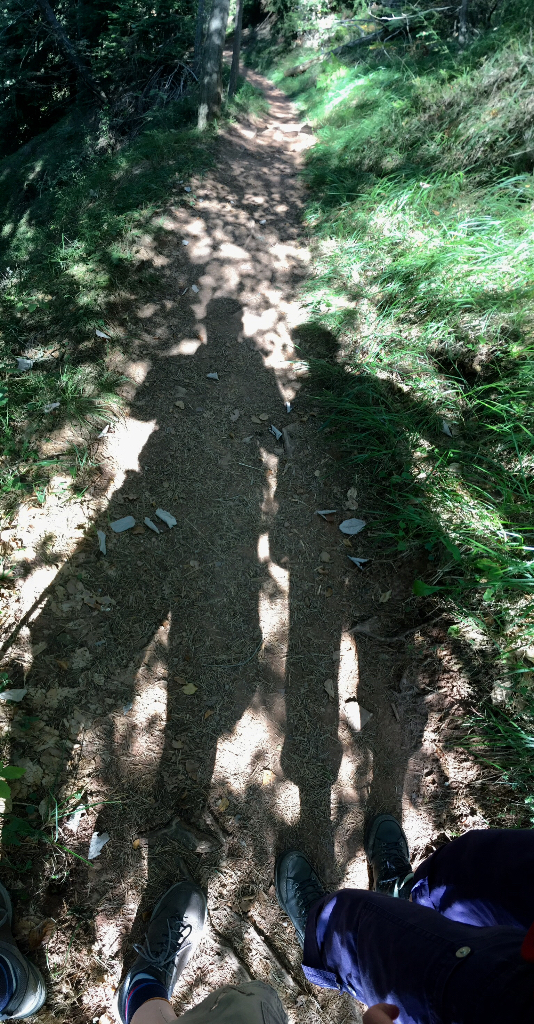
Well she says it’s this way but SHE says its the other way.
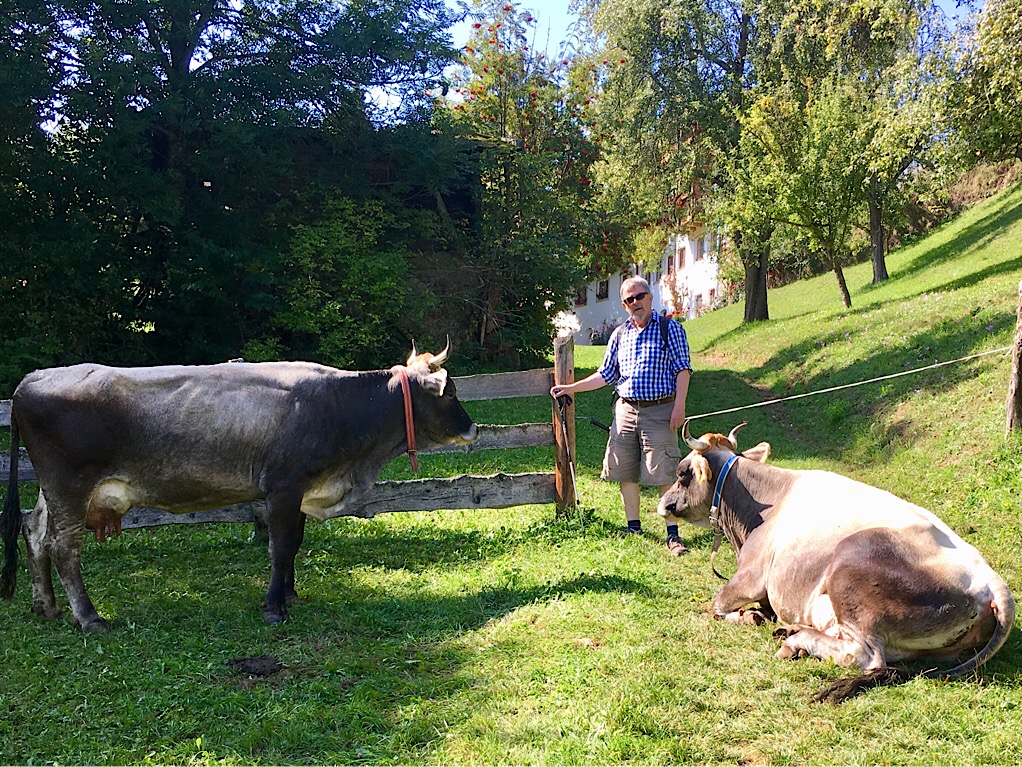
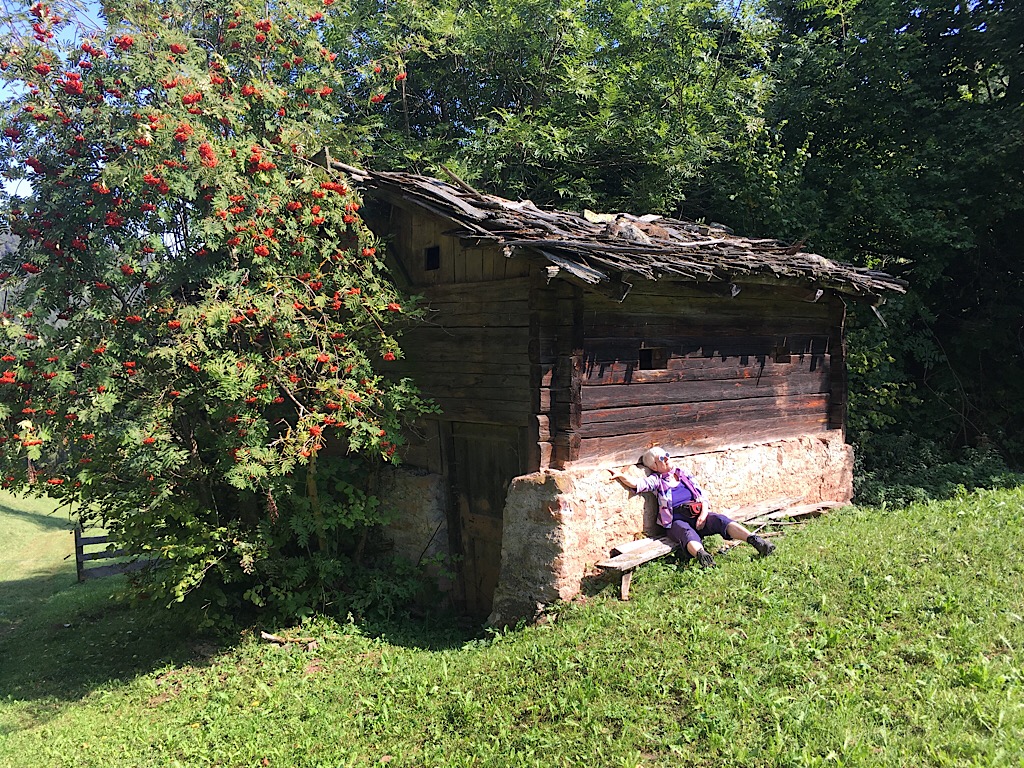
Gerhild said she needed a sit-down!
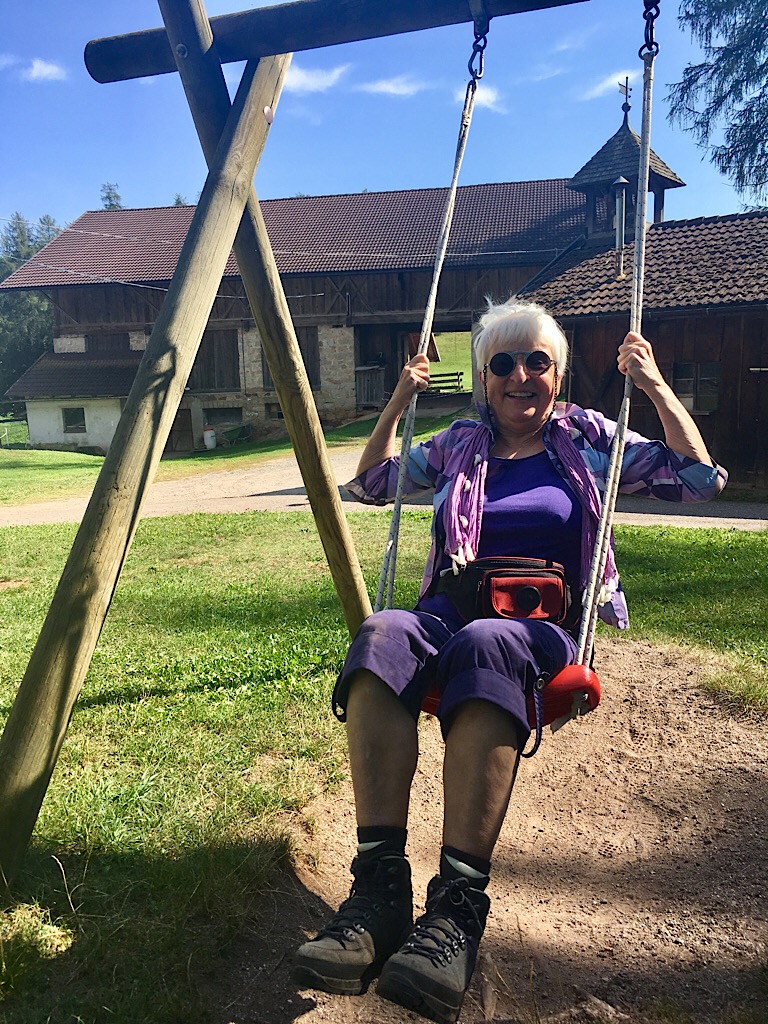
Now that’s what I call a sit-down.
Schoolchildren in green T-shirts with rucksacks filled up the lift on the way down. A school trip, walking through the mountains with one pupil presenting a “mountain” book on its literary merits each evening. I can’t remember doing that in my schooldays… might have been quite a lark.
-
20 Sept Camping Steiner – Kohlern
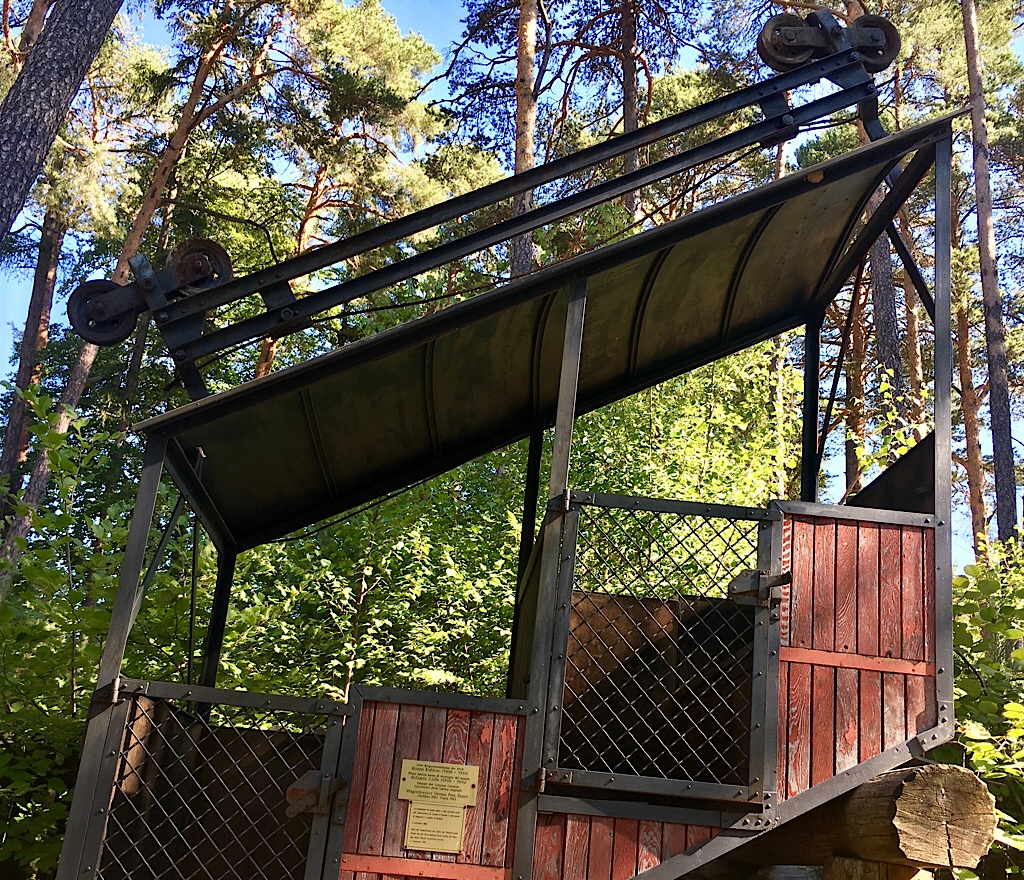
Today we went on the “oldest aerial cablecar in the world” Kohlerer Seilbahn. Yes this replica is as they originally travelled in. These days you are unfortunately kept safe by milky panes of perspex.
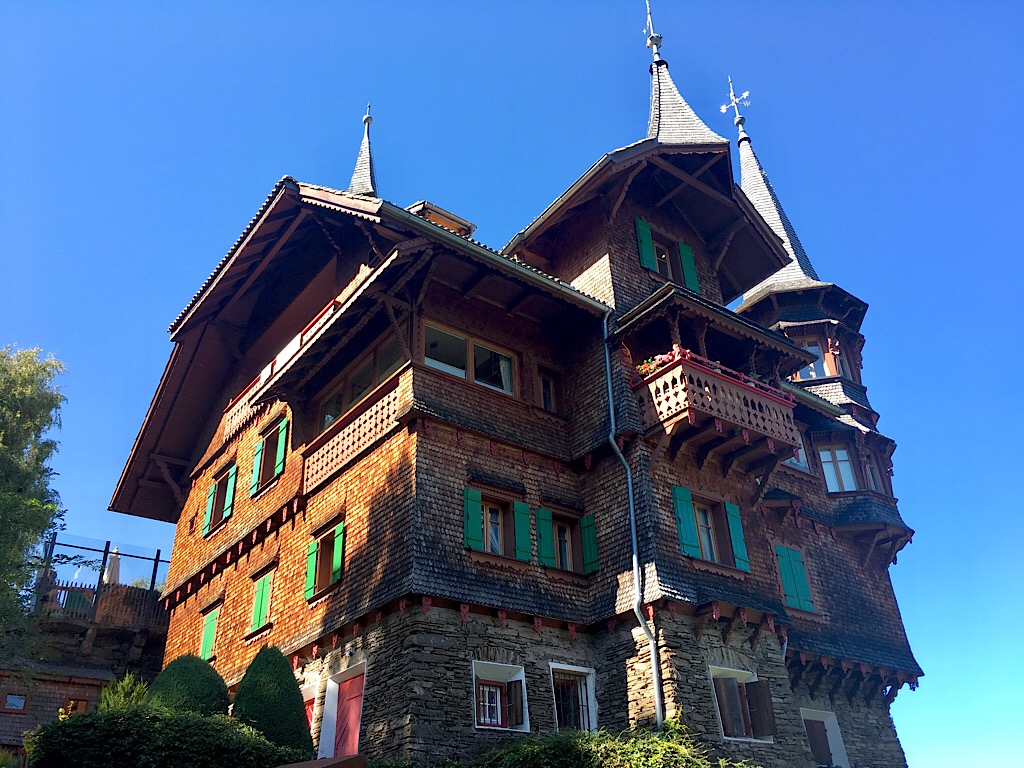
This beautiful old wooden house in Kohlern is probably from the same period.
The mushrooms around here just grow and grow, AND, you are not allowed to pick them, even if your rucksack was big enough!
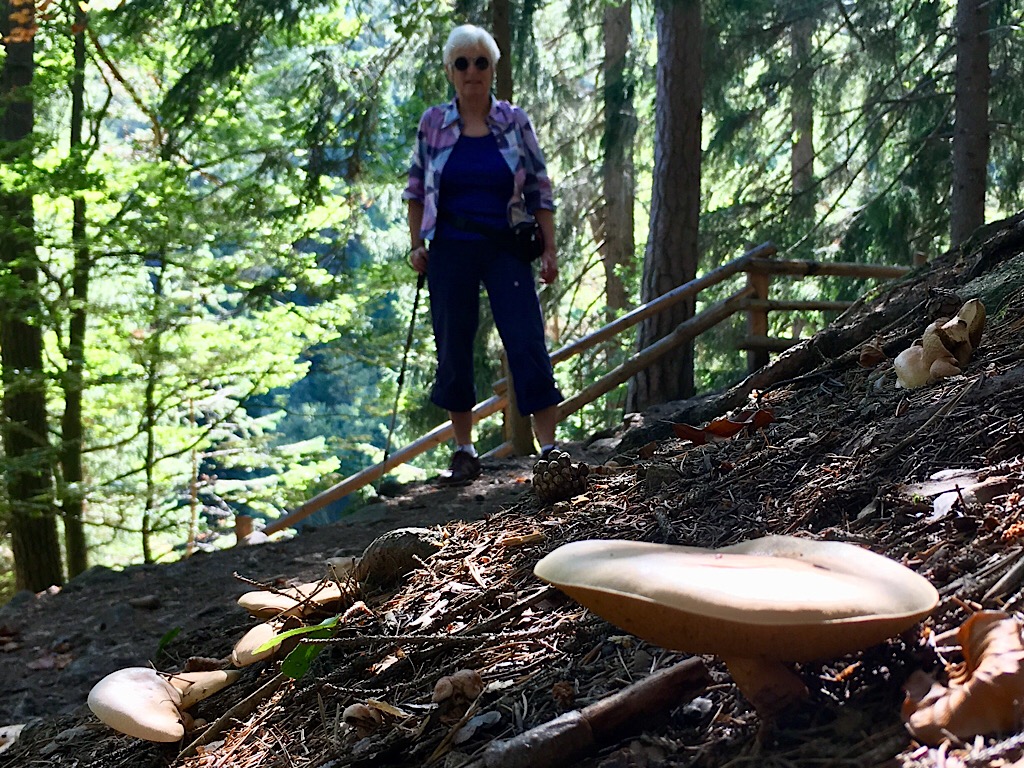
Look at this gorgeous Parasol! It was bigger than my head, and that is saying something!

We walked to Schneiderwiesen today. Wiese means meadow and a fantastic meadow it was too. After a nice lunch it was just right for a snooze…
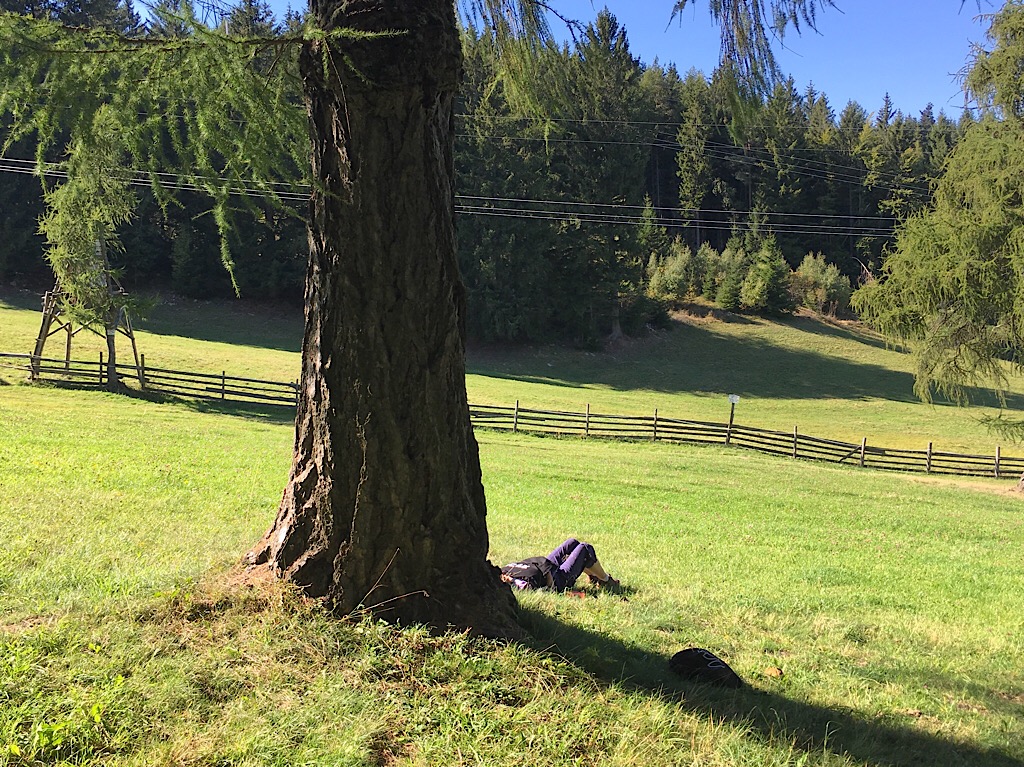
…or to read a good book.

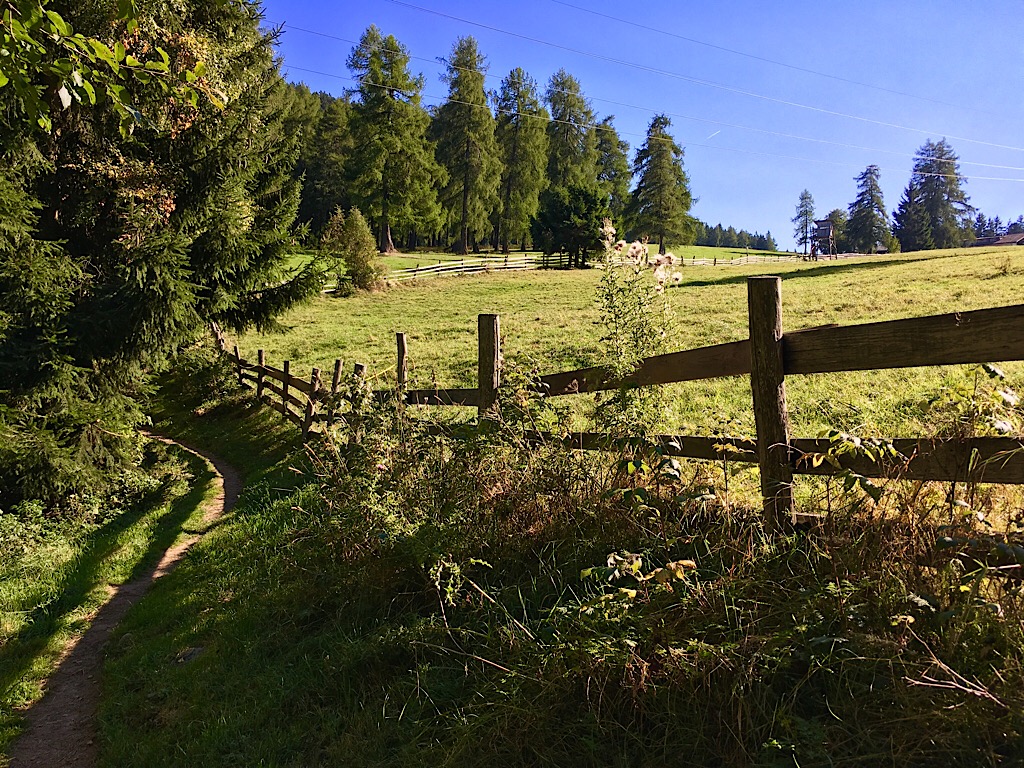
Or to just enjoy.
We chose a slippery (stoney) way down, but look at these!