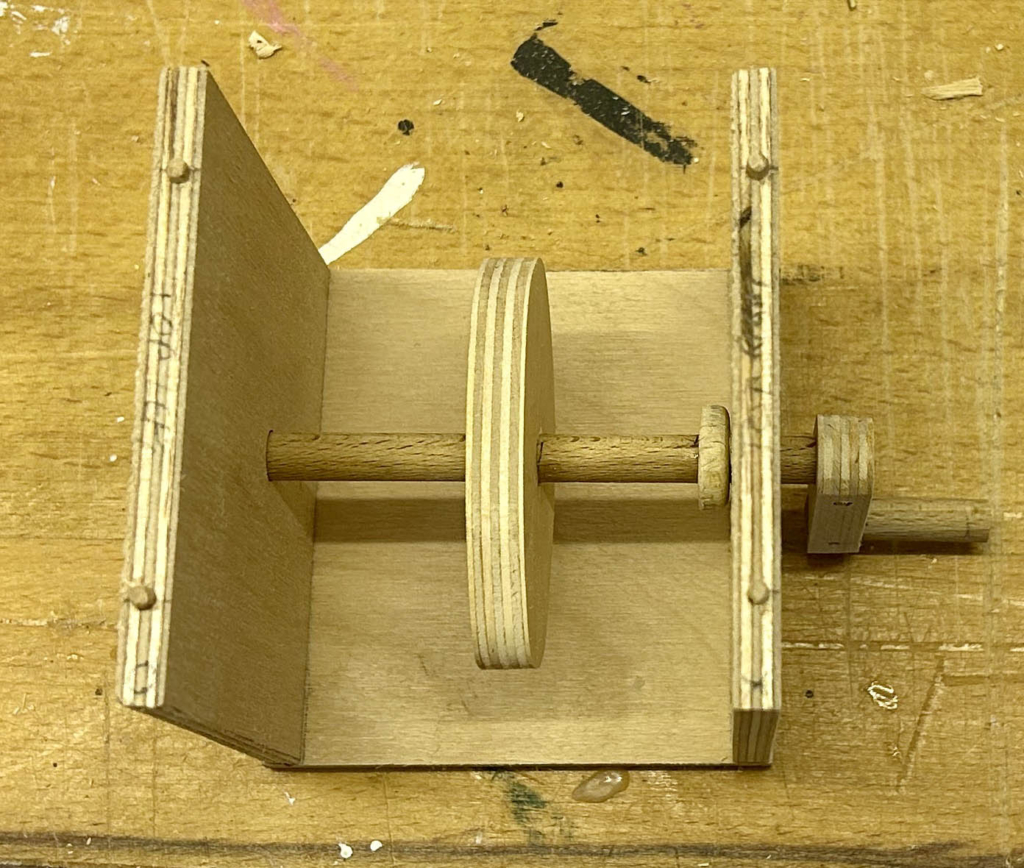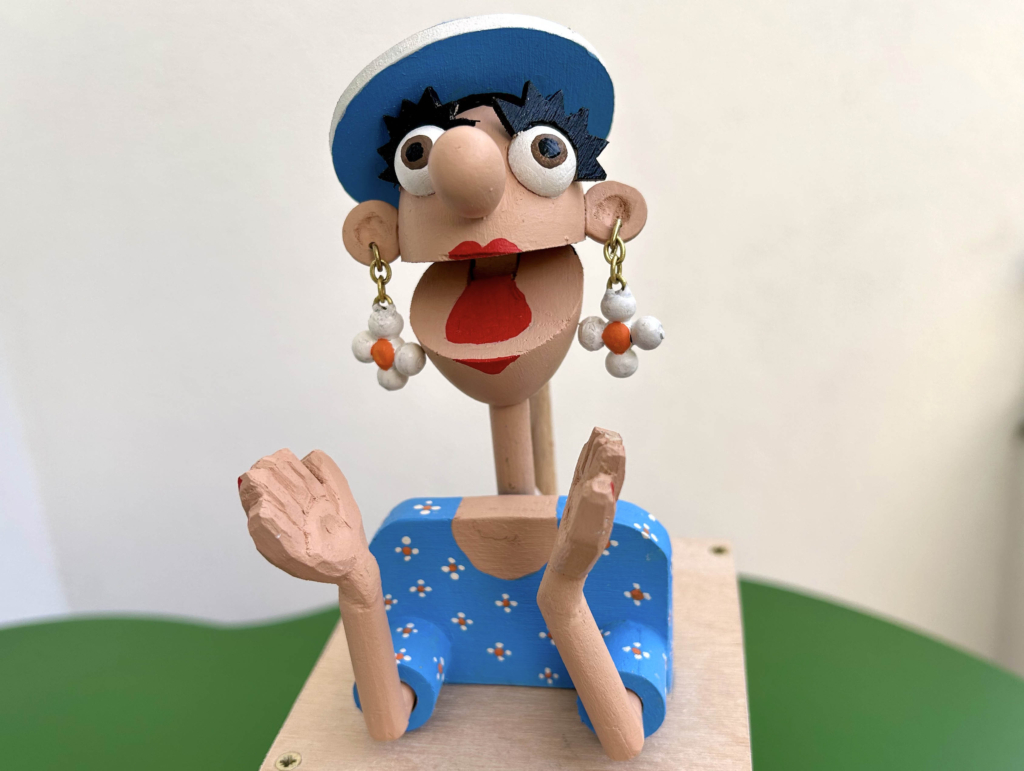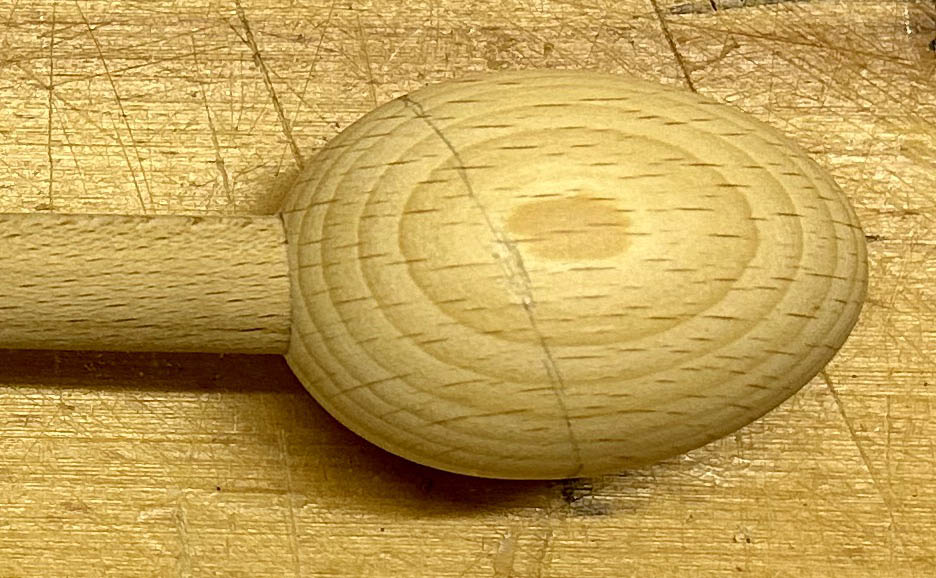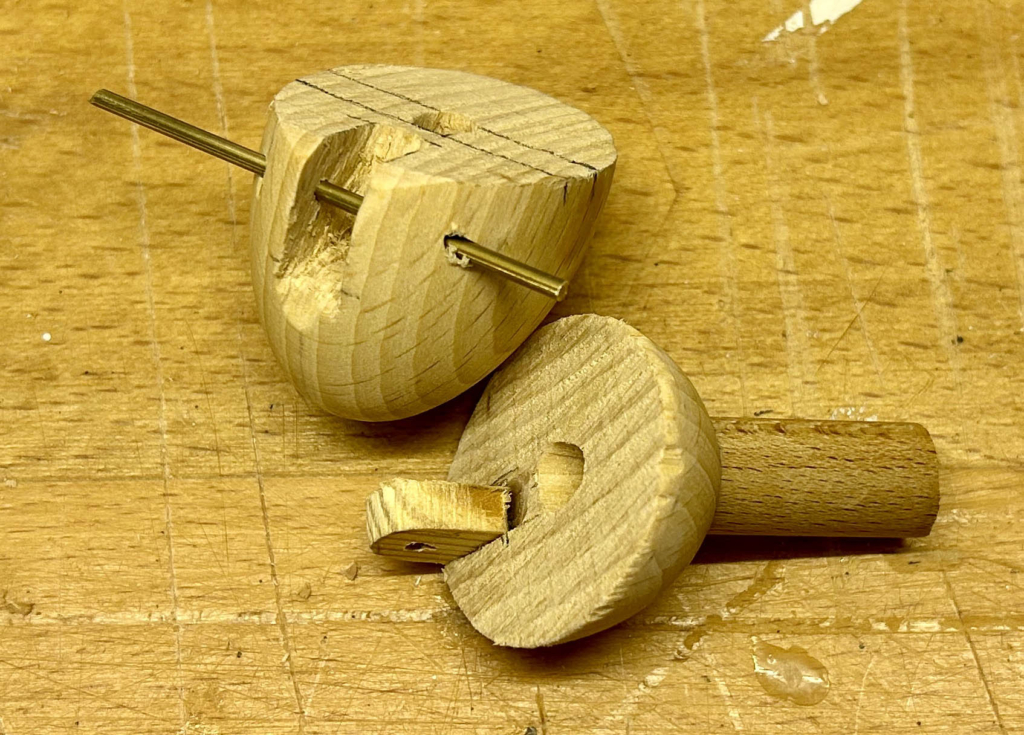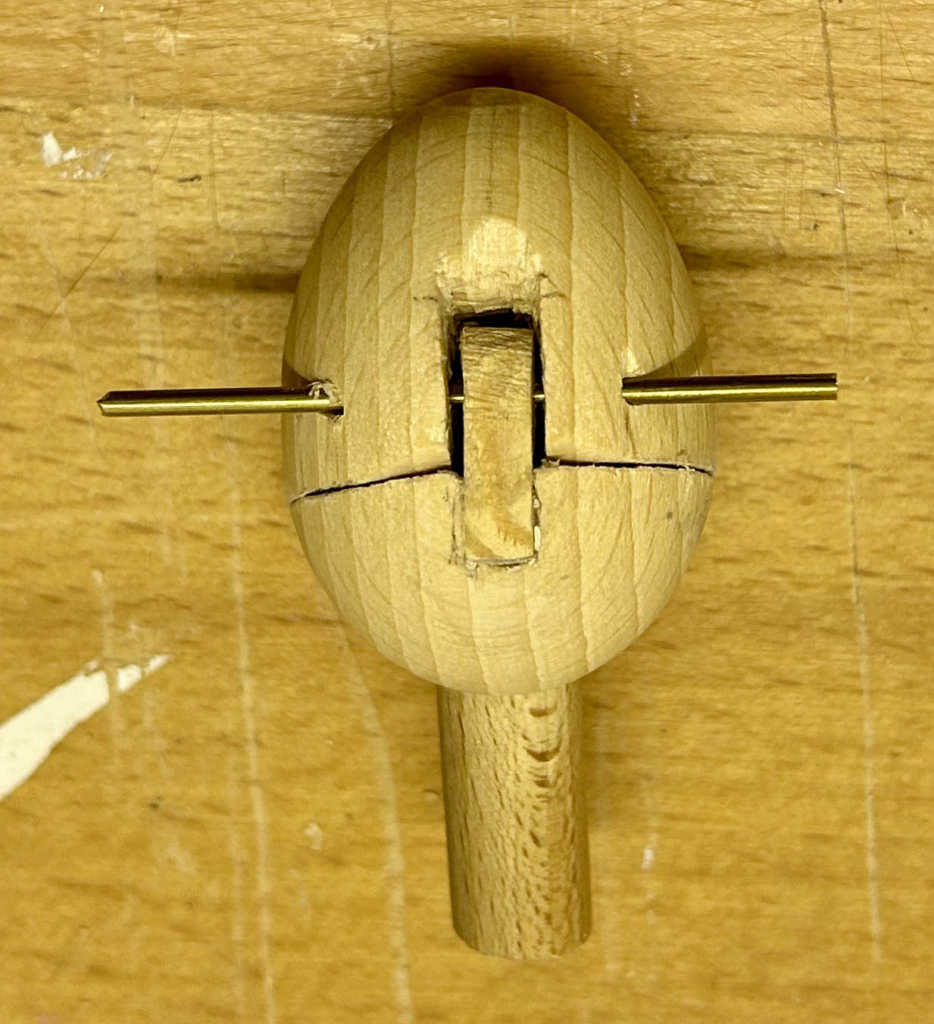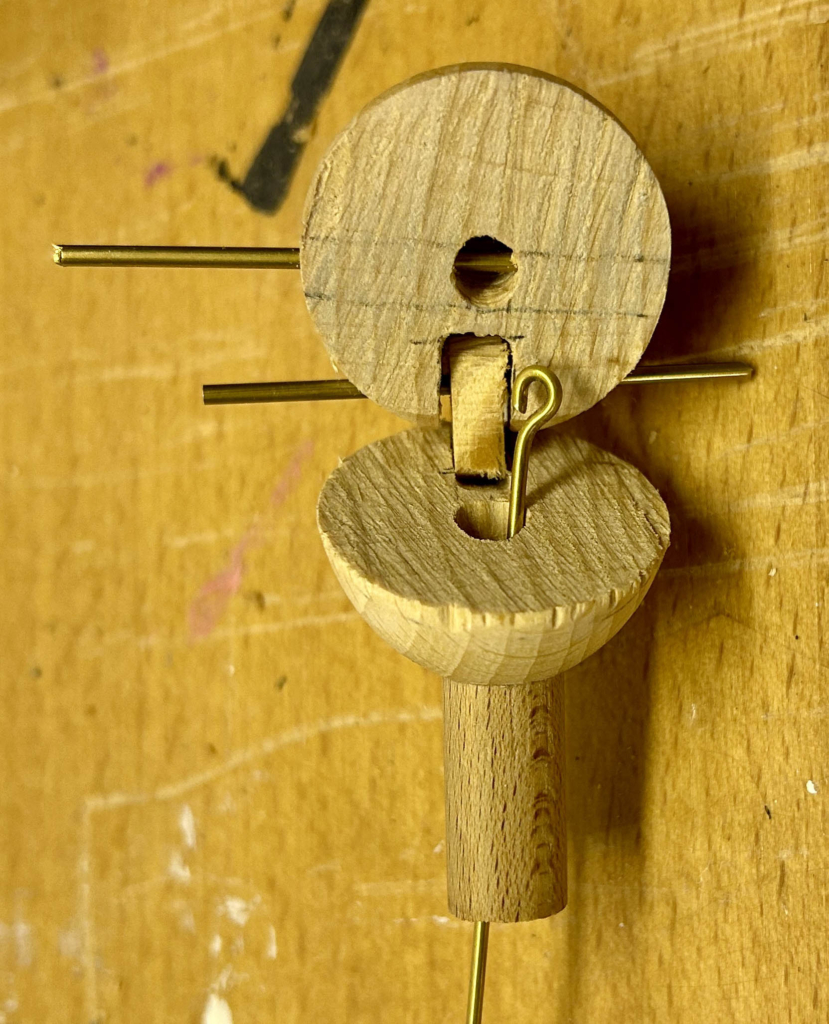
Our Adventures

Category: Blog

  • Mooning Around

    Mooning Around

    What was the big idea?

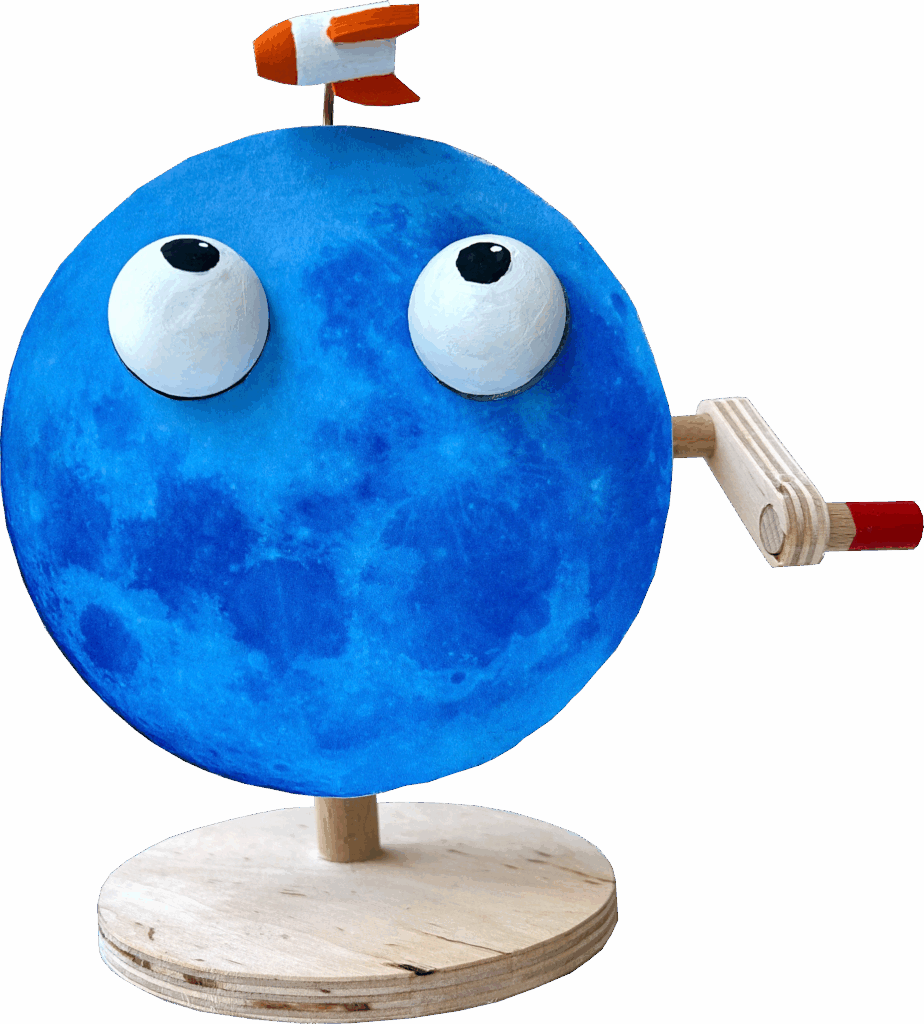
    I first thought of making a crocodile mostly submerged in murky waters, its eyes tracking some annoying insect as it circled overhead. I couldn’t really build enthusiasm for that idea so I let it rest for a while. Then one day I bumped into “The trip to the moon” from George Méliès” on YouTube, as you do. After admiring the way the cast acted in 1902 (constantly waving their arms about, to remind the viewers that this is indeed a MOVING picture) I thought yes, that’ll do instead of a crocodile and set off for the workshop.

    Making

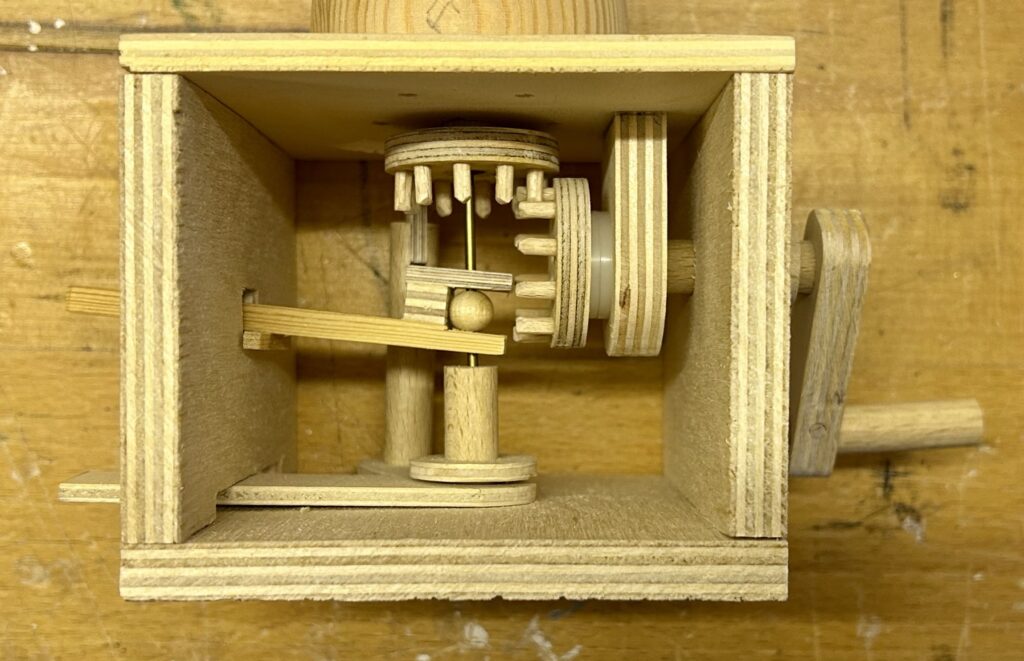
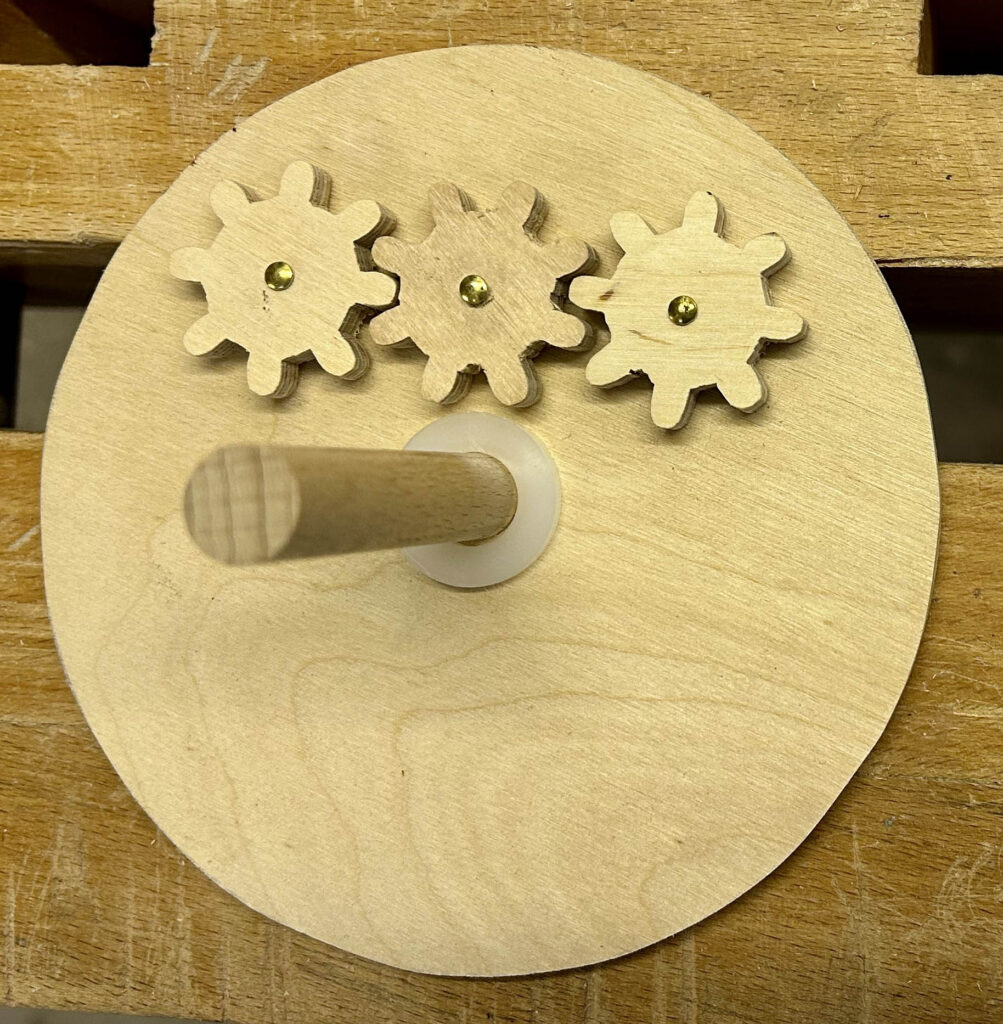
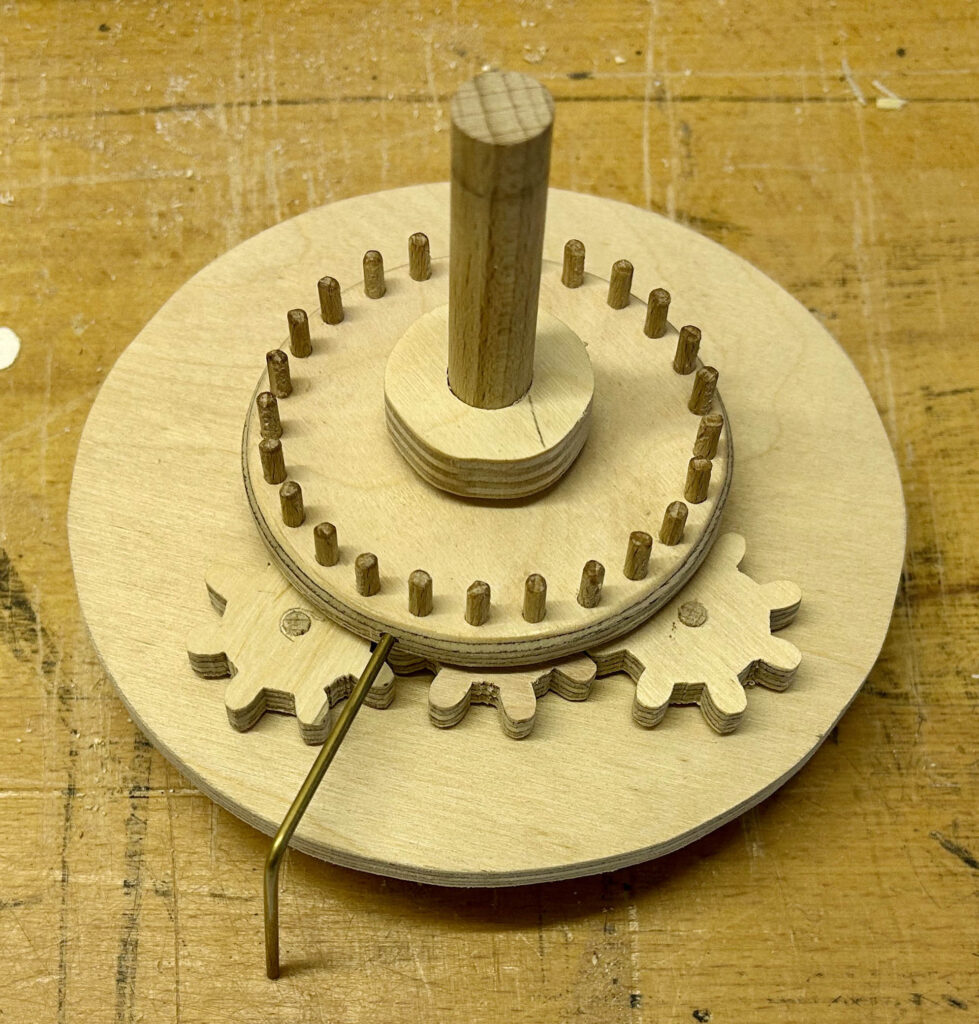
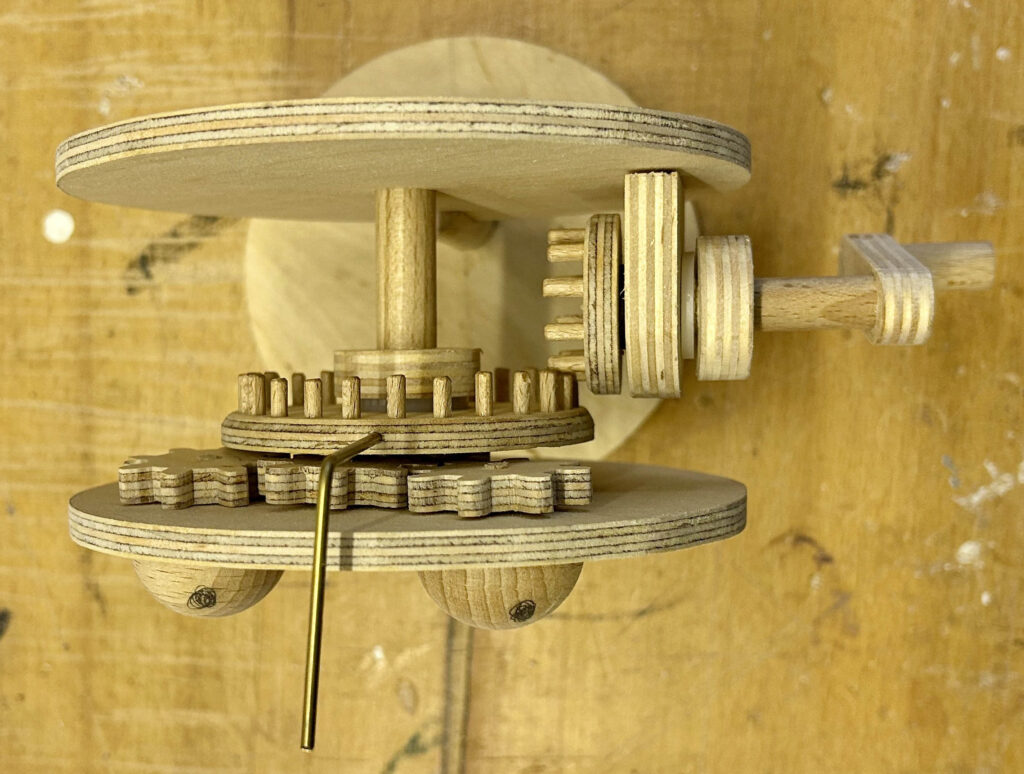
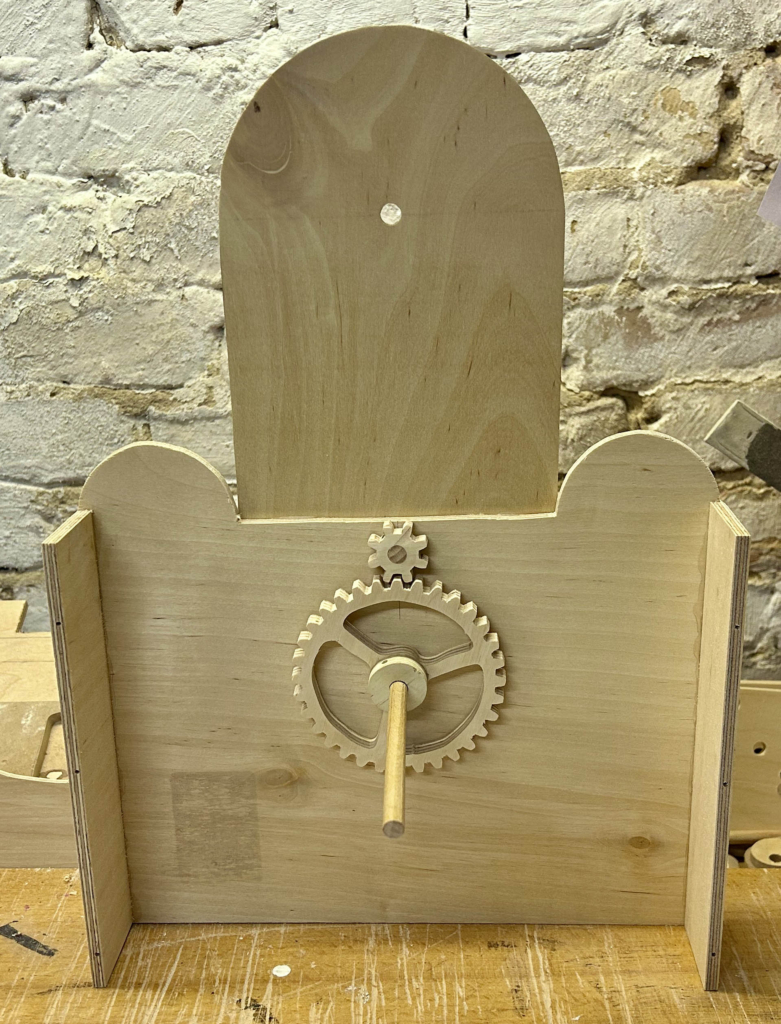
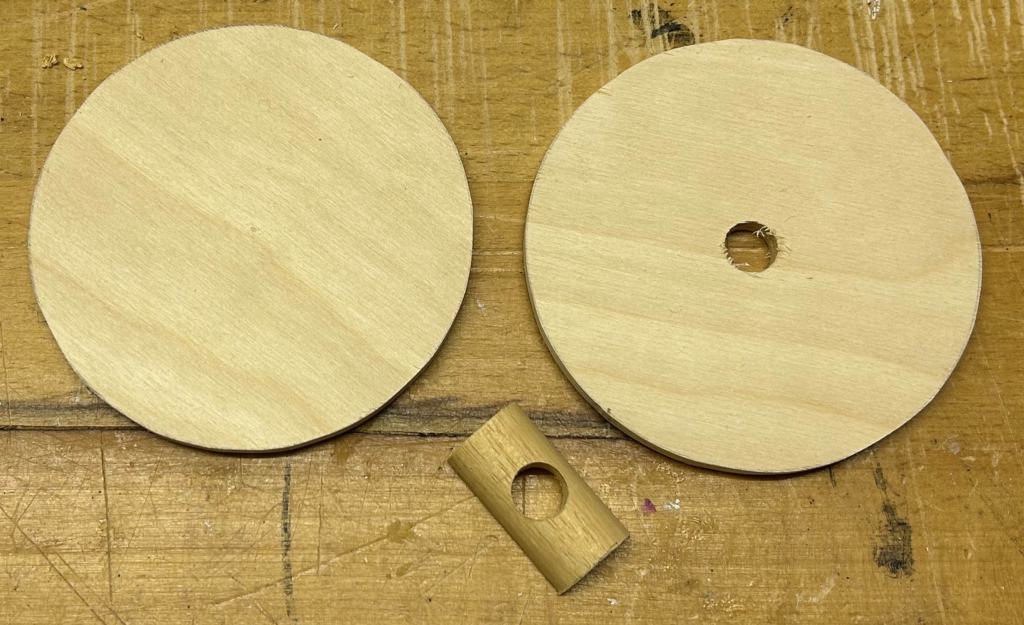
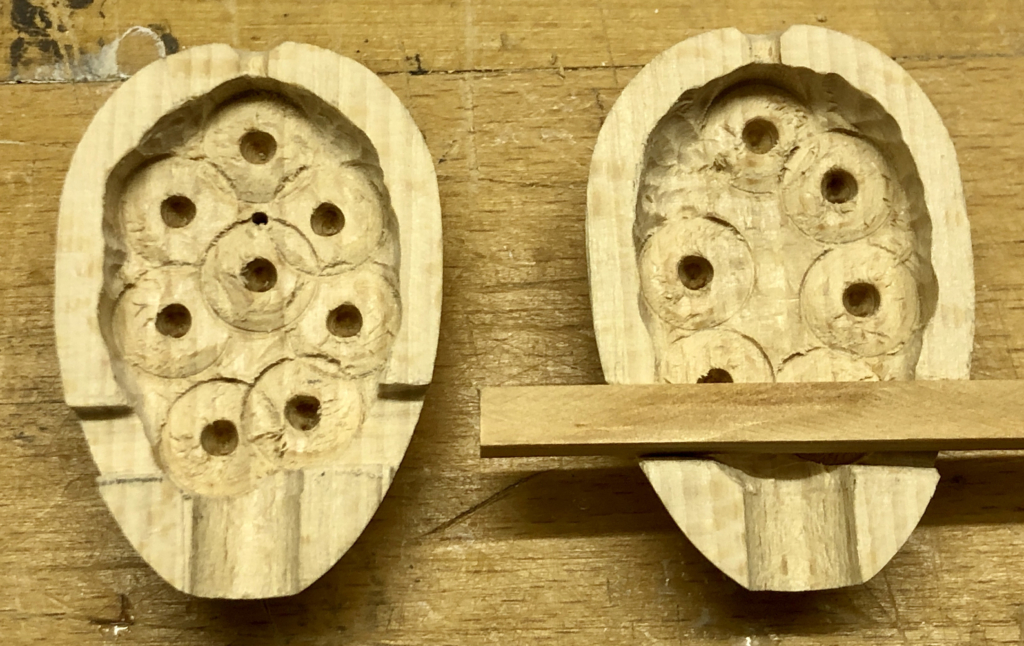
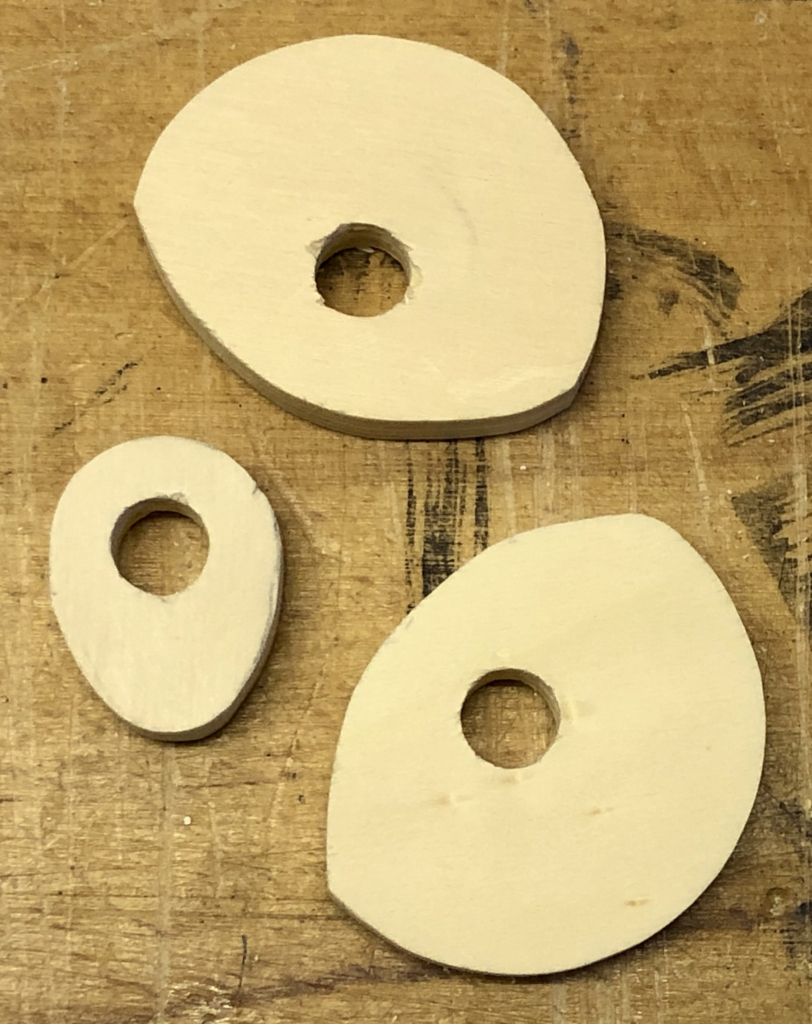
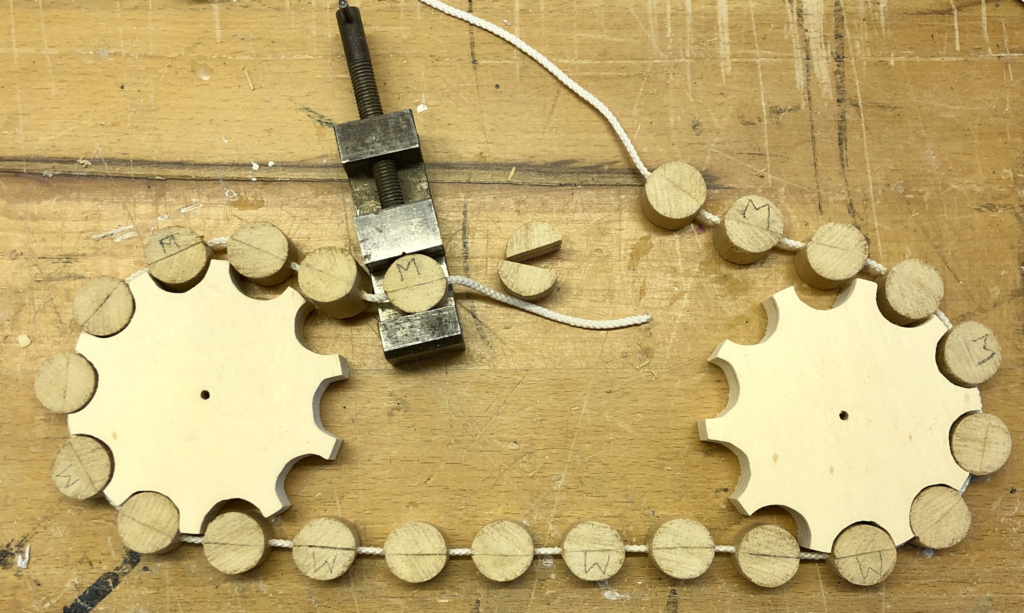
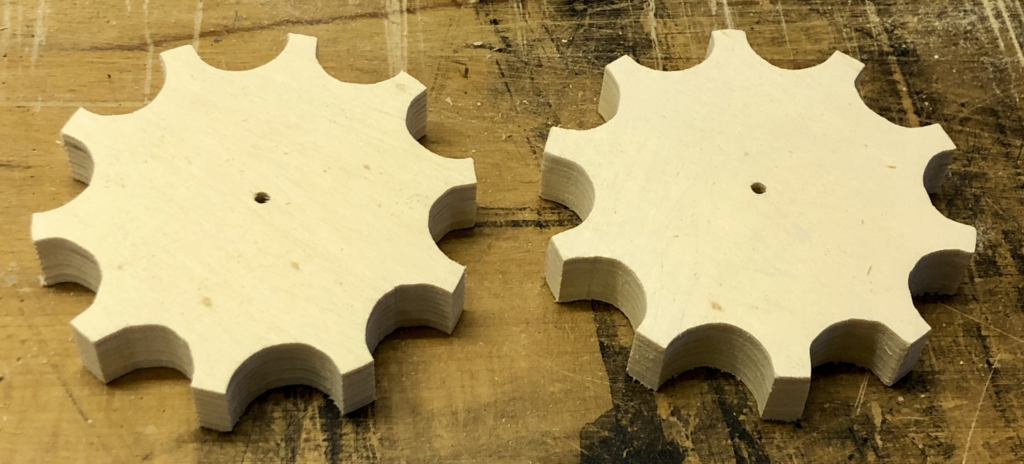
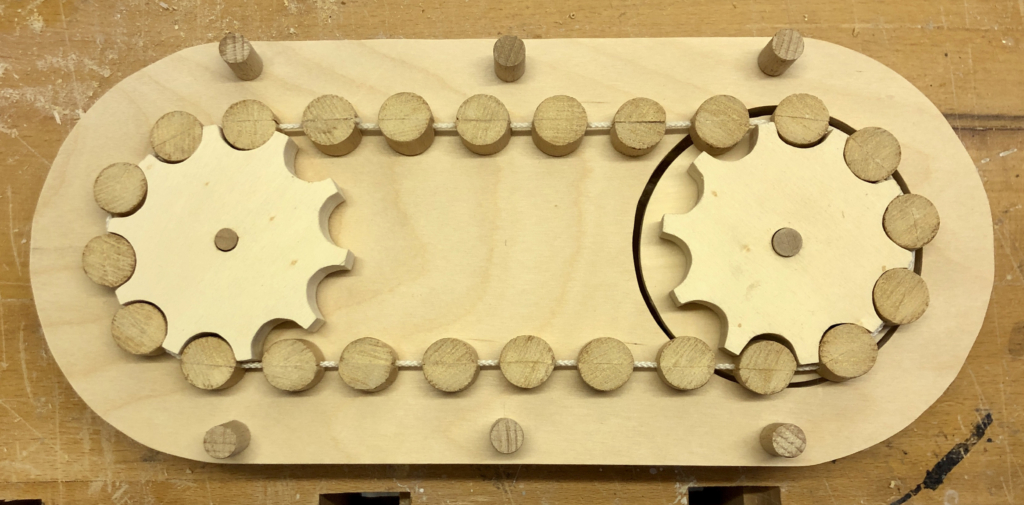
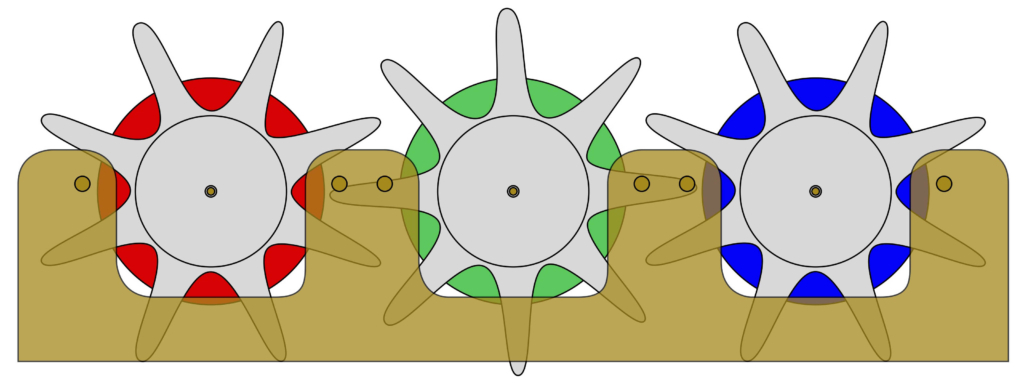
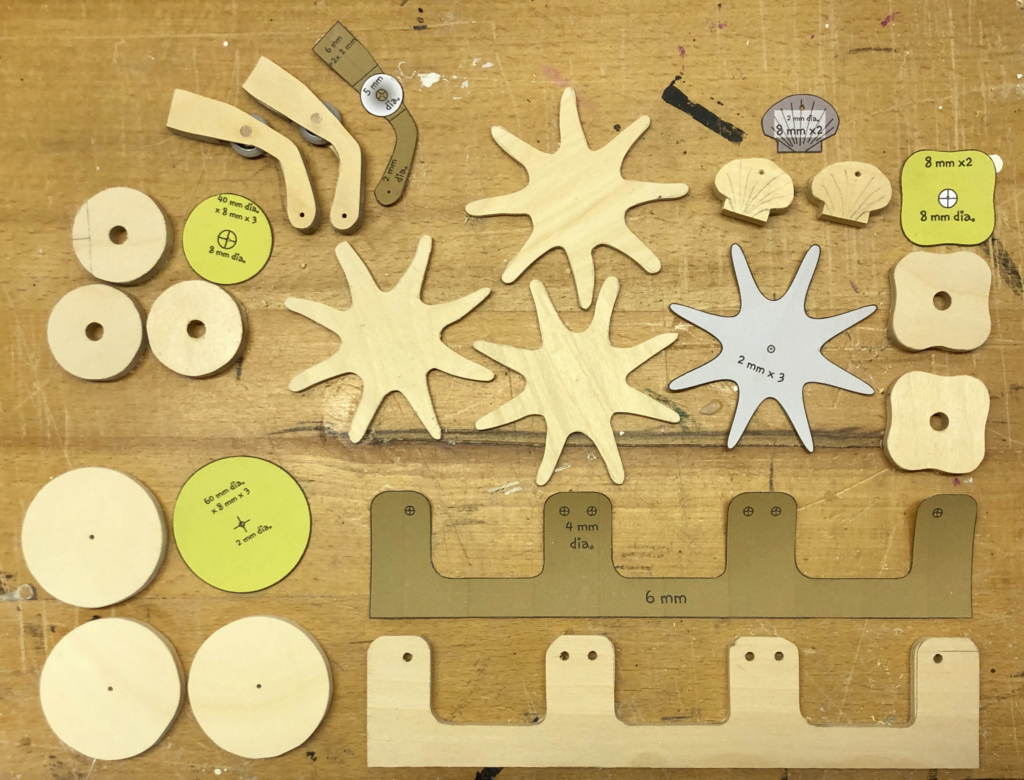
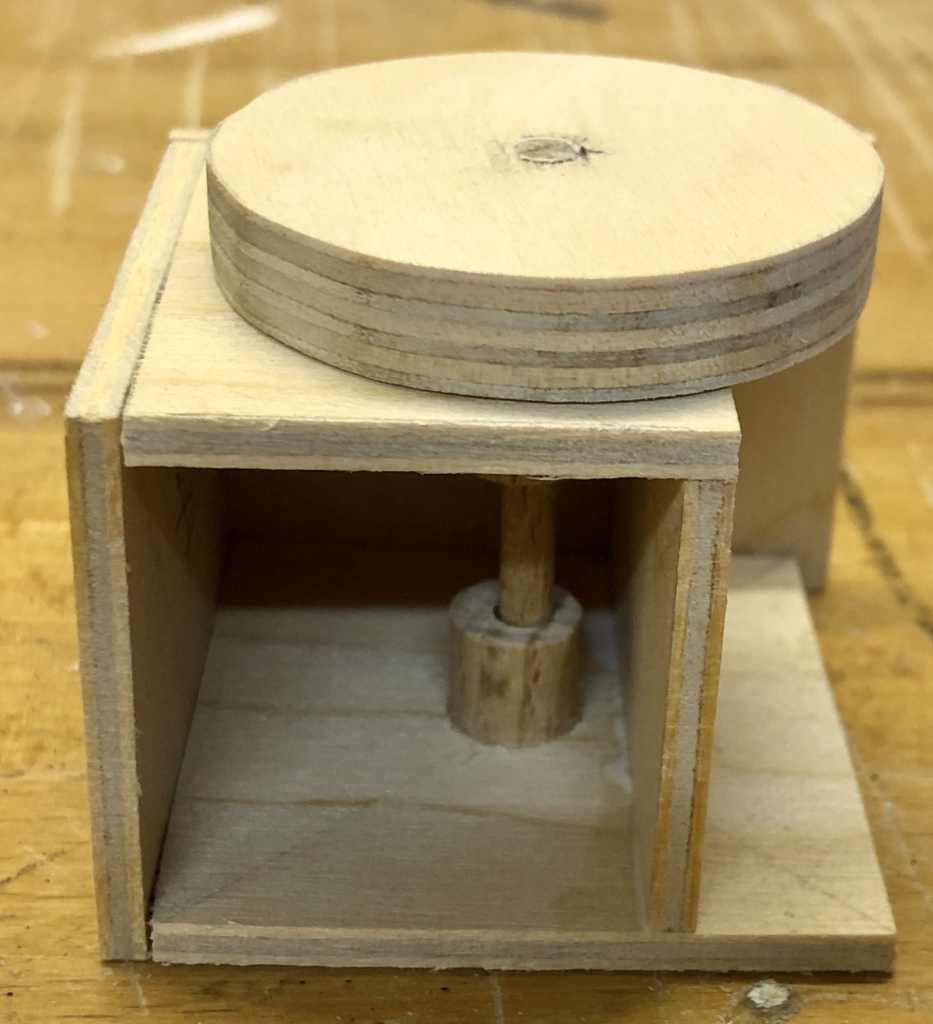
    The moon is round, so I needed a round 13 cm dia. front as well as some cogs to turn the eyes. To make the eyes rotate in the same direction I also needed one cog in between. The cogs each have 8 teeth with 11 mm tooth spacing.

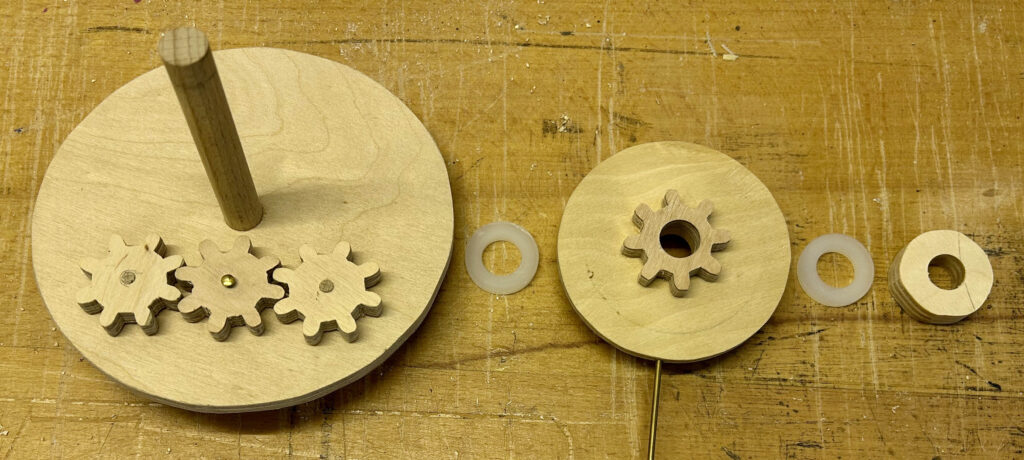
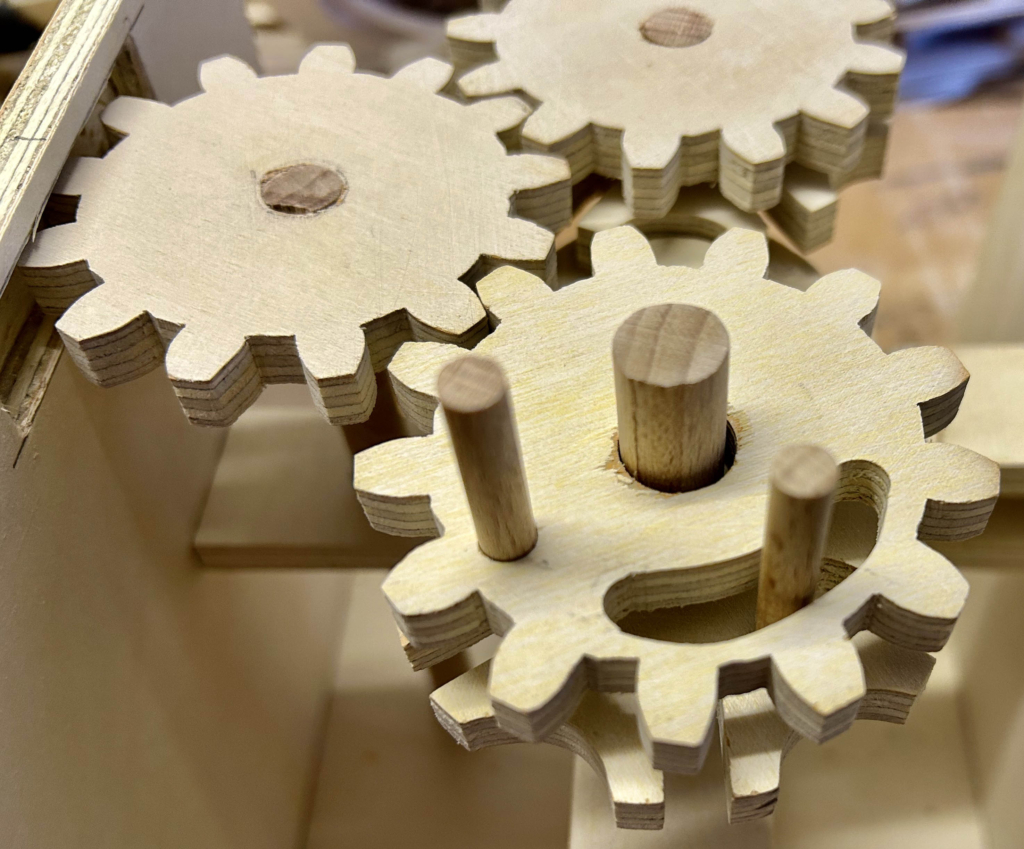
    Three cogs

    I initially used 2 mm brass pins to get the spacing right between the cogs, so that they turn freely without jamming. Later on I put the eyes on 4 mm dowel and drilled the holes out to 4.5 mm.

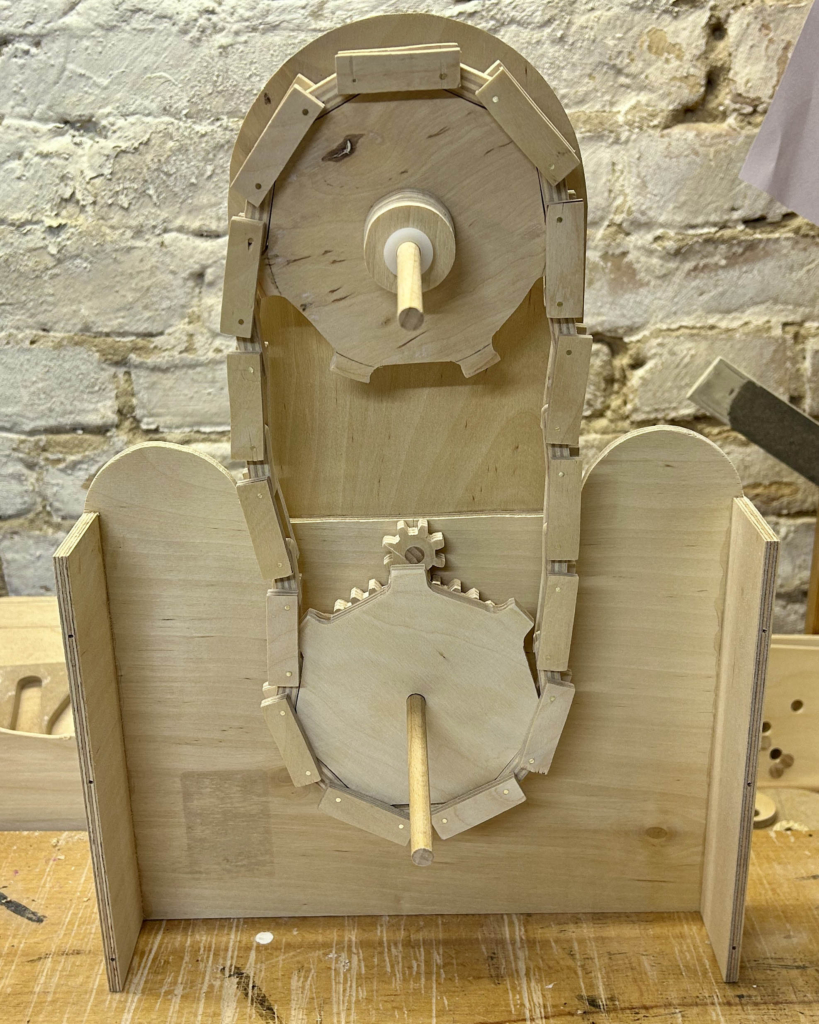
    The rocket pinwheel

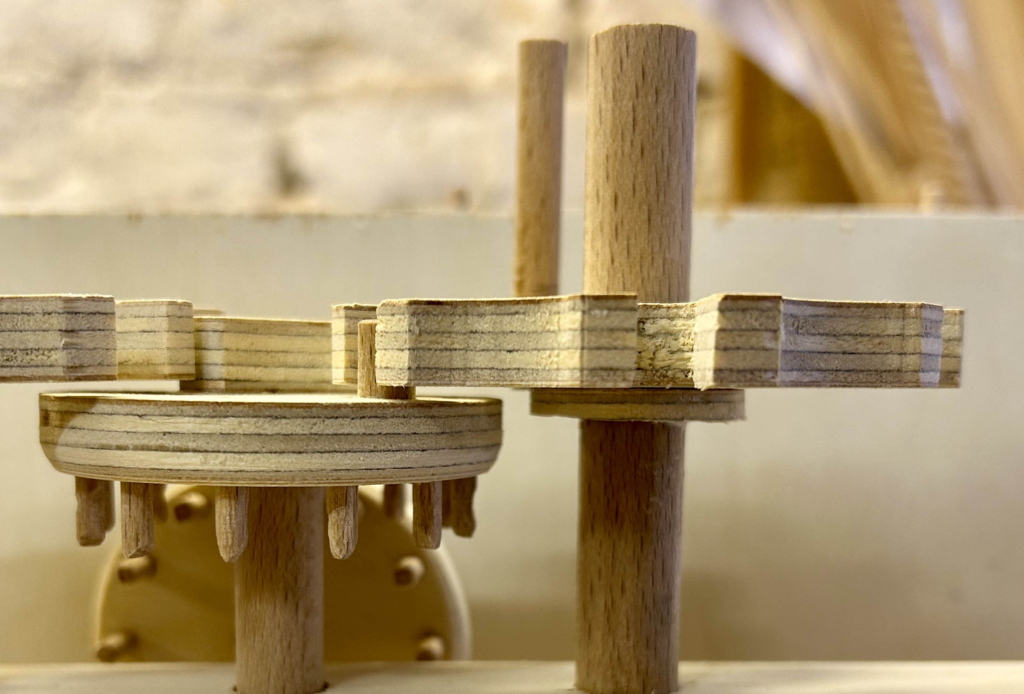
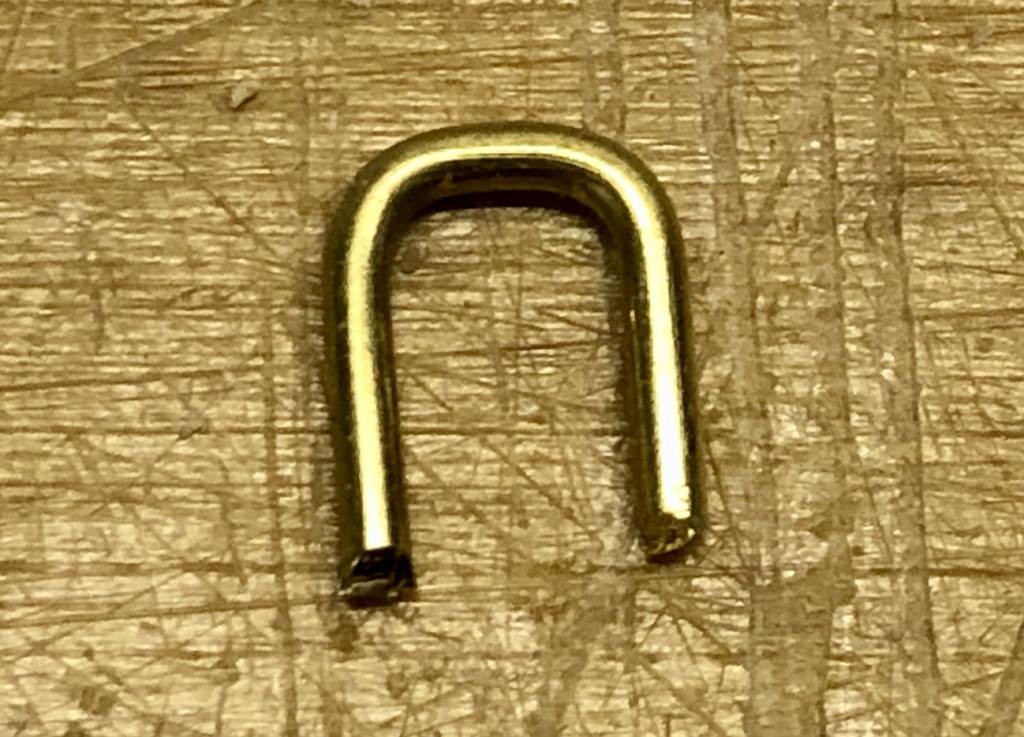
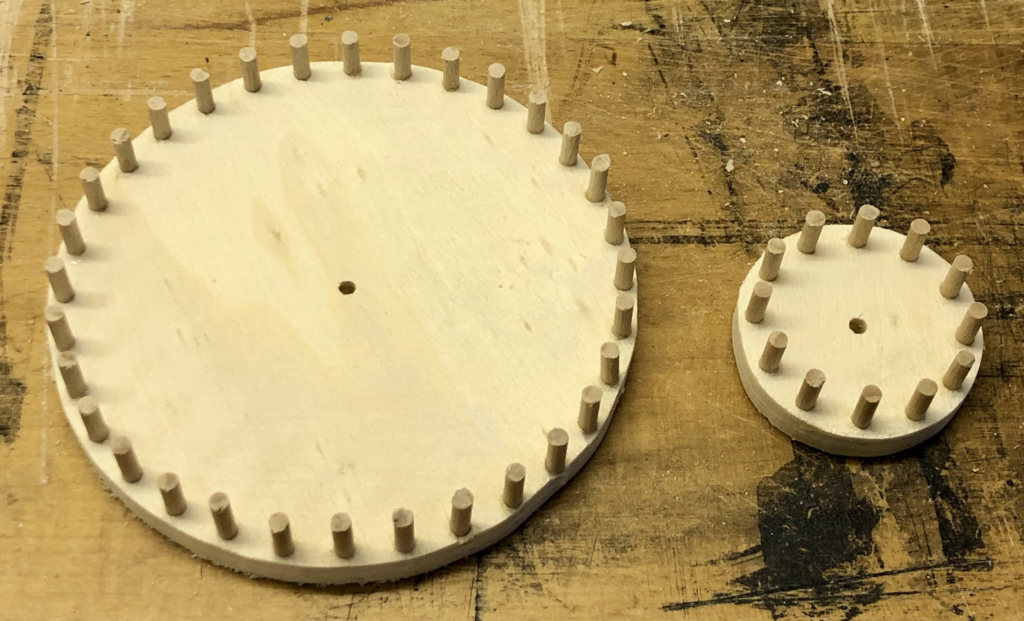
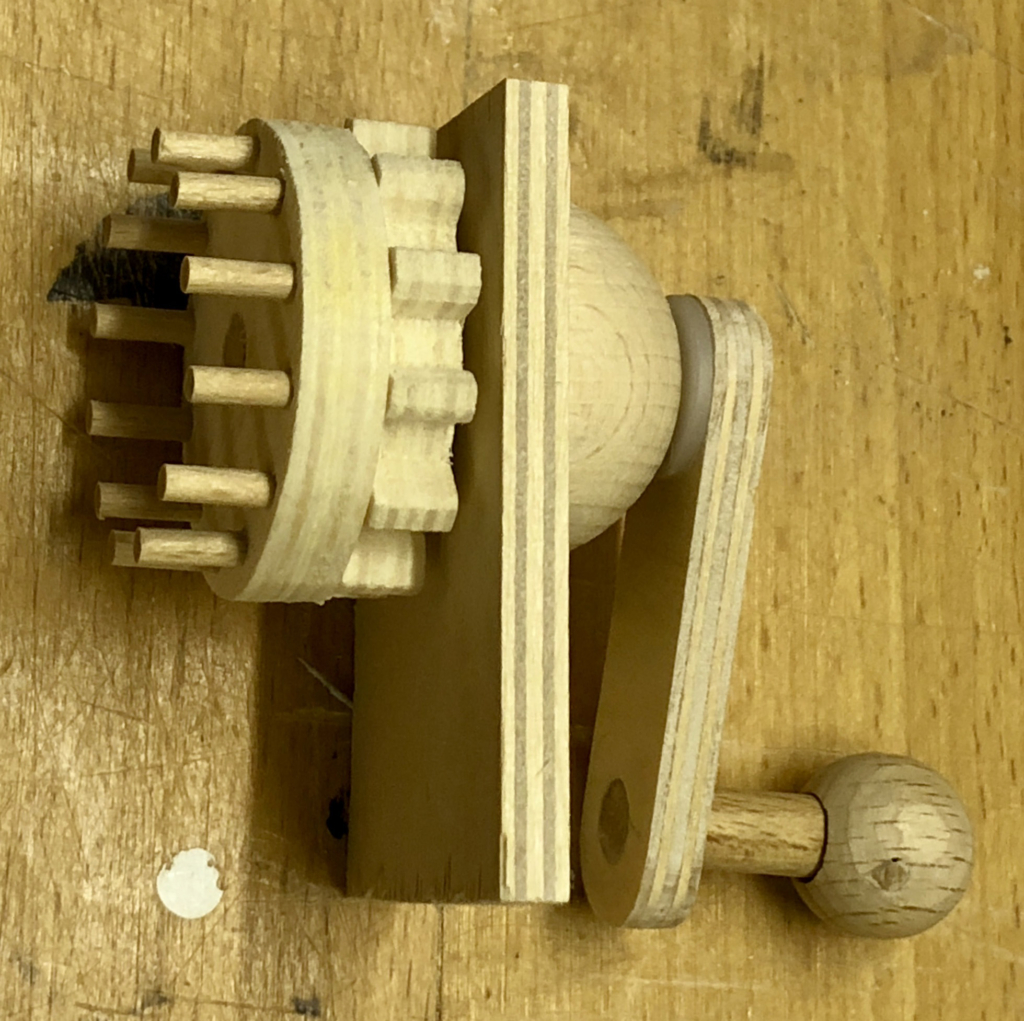
    I made a pinwheel with 25 x 3 mm dia. pins @ 8 mm spacing. This moves the rocket in orbit around the moon via a 2 mm bent brass rod..

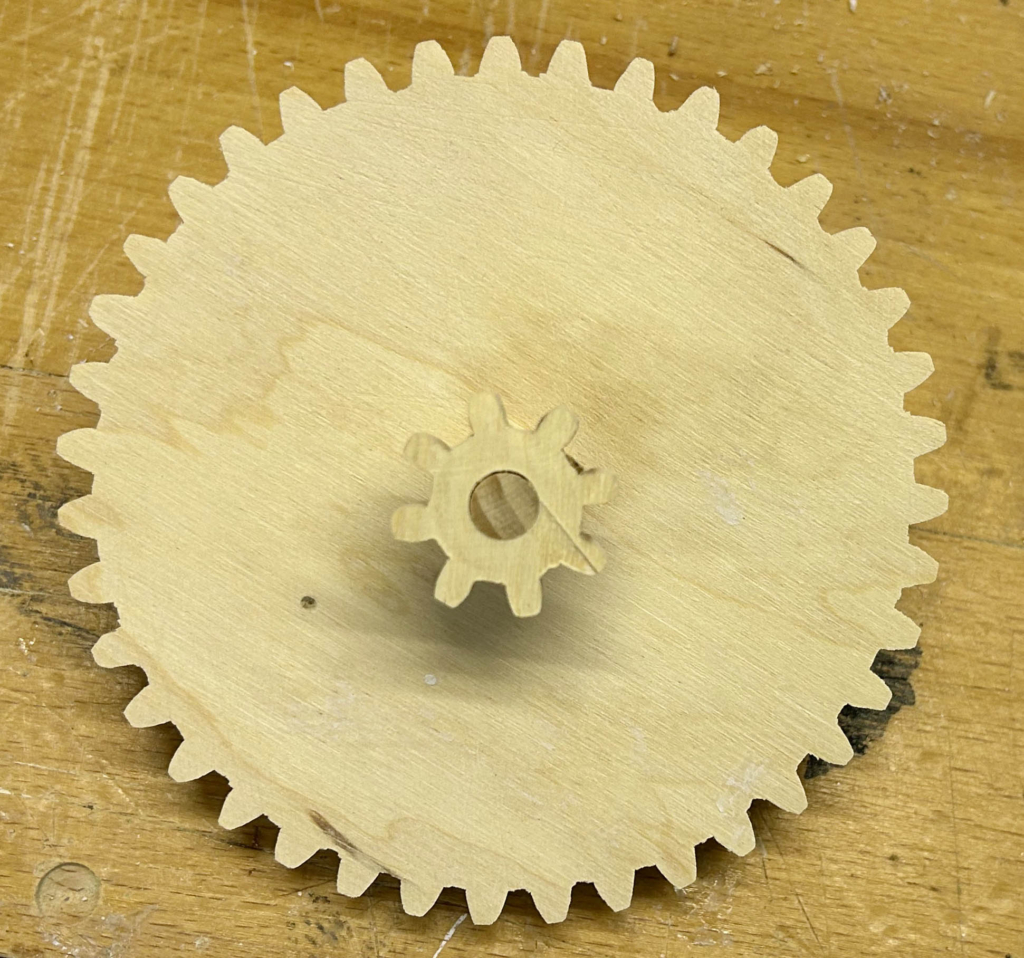
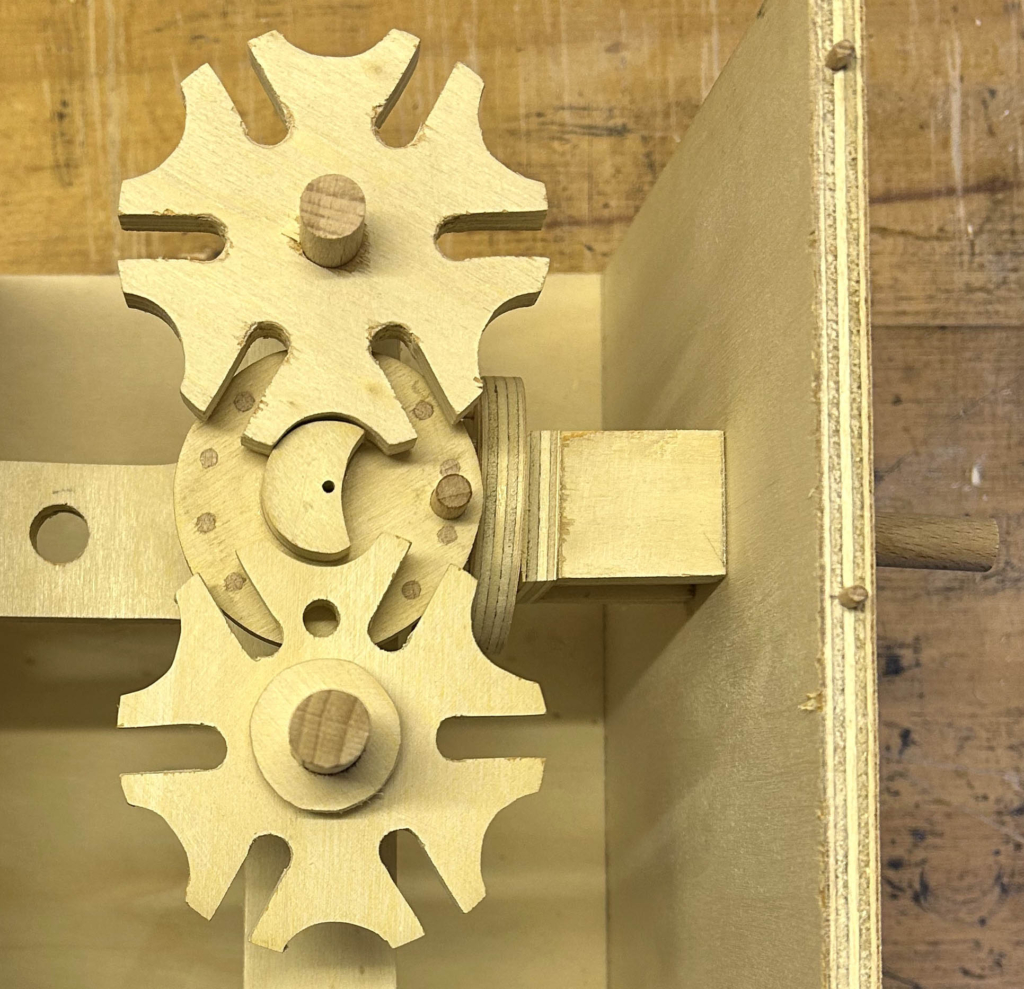
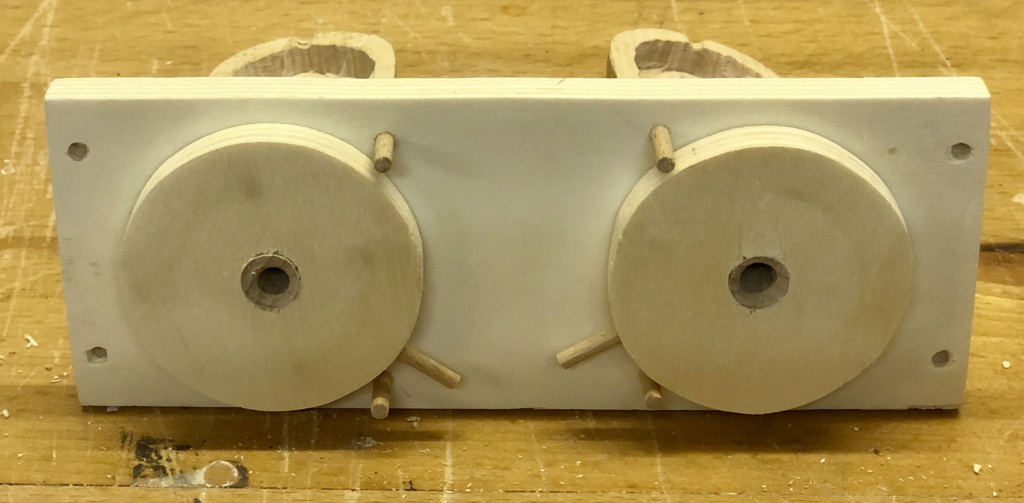
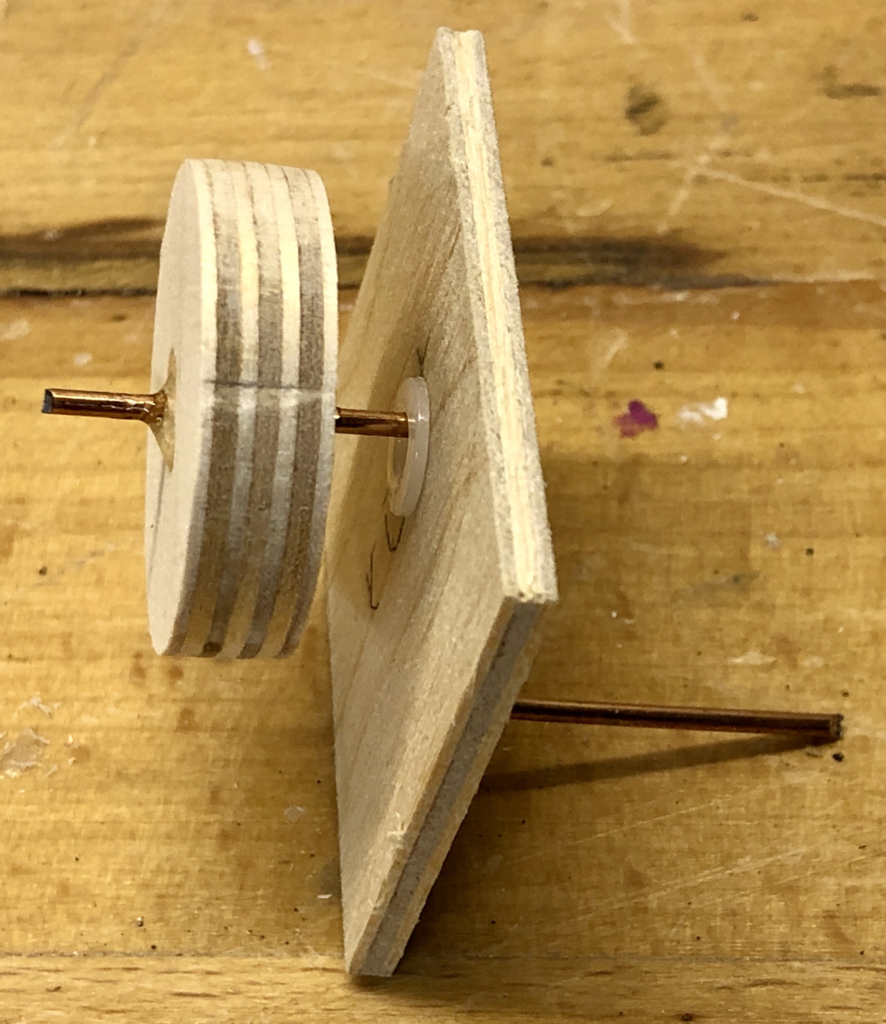
    The fourth cog on the back of the large pinwheel

    On the back of the large pinwheel I glued a fourth cog. All four cogs are the same. The large pinwheel thus turns the eyes at the same angular speed as the rocket. A couple of washers help the cosmic mechanism to turn smoothly.

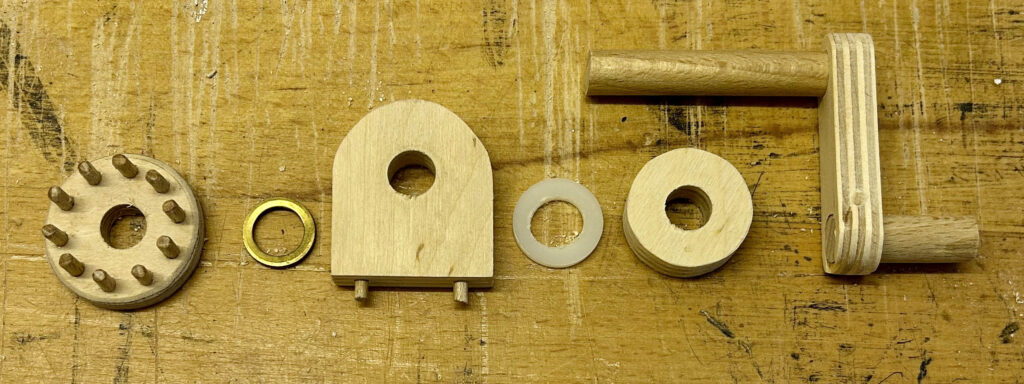
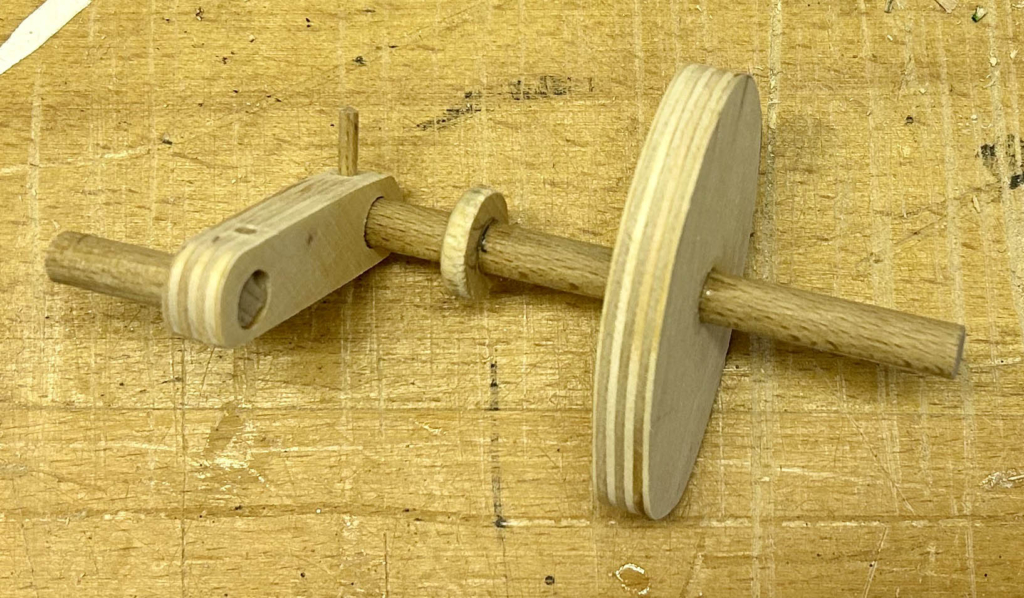
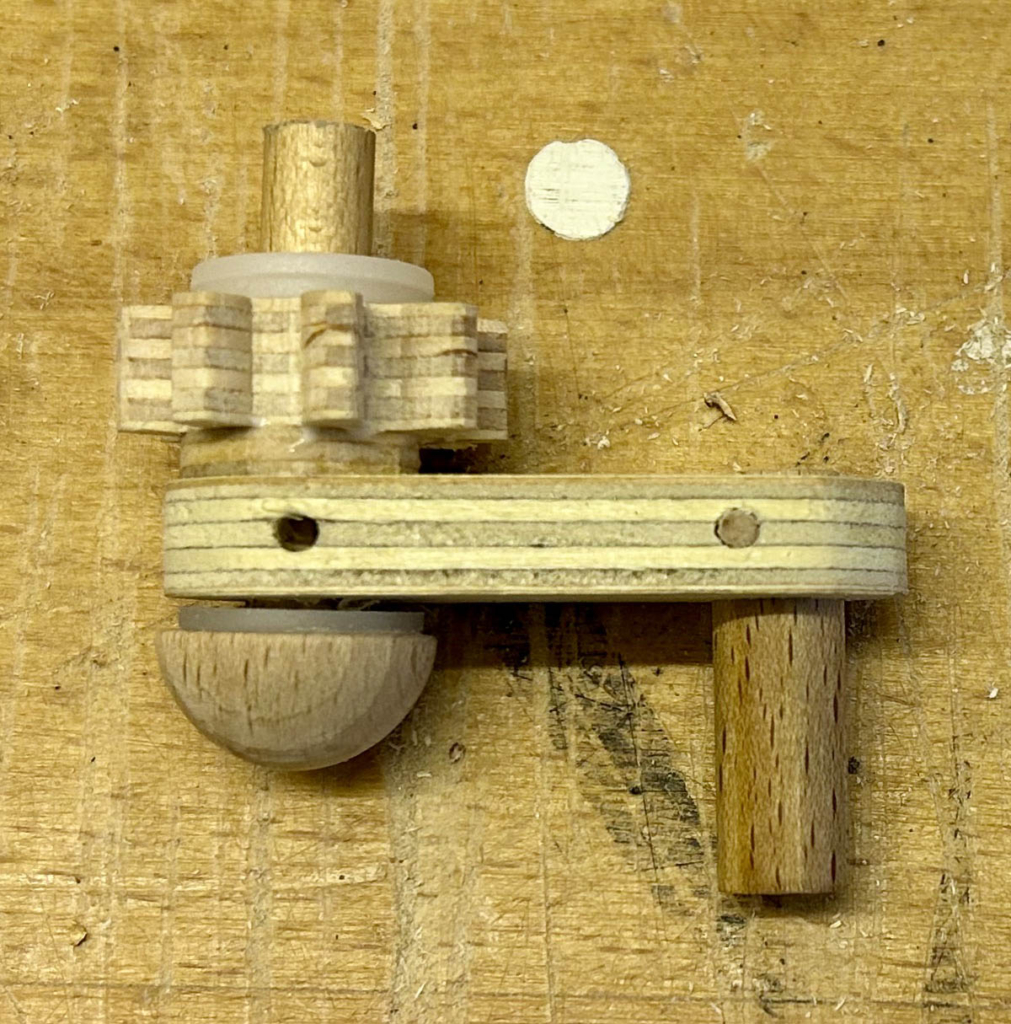
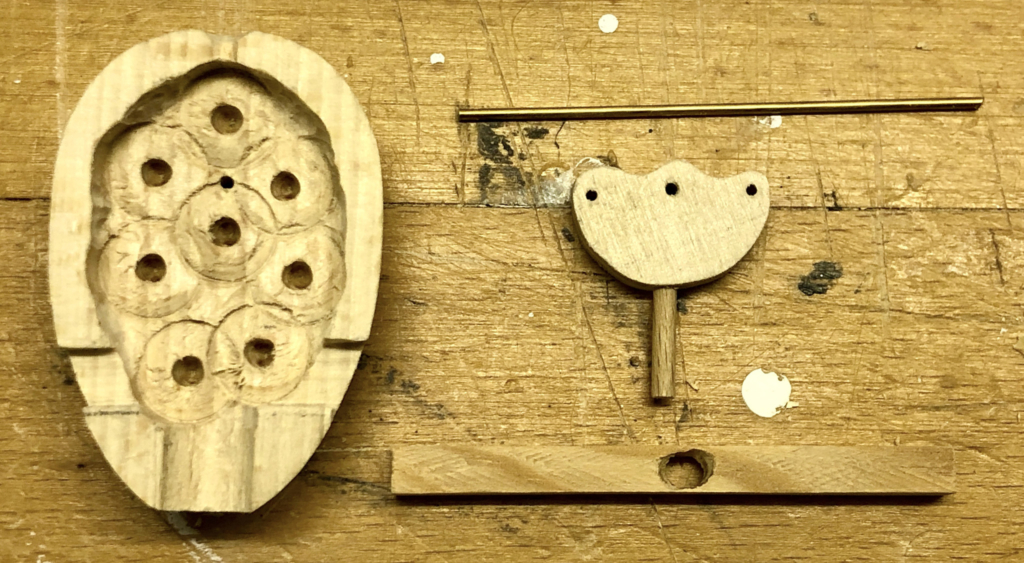
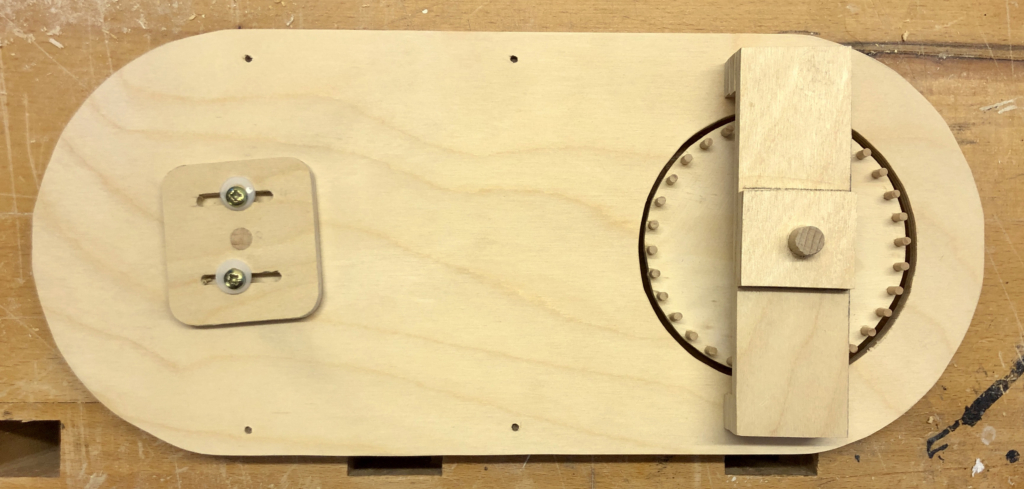
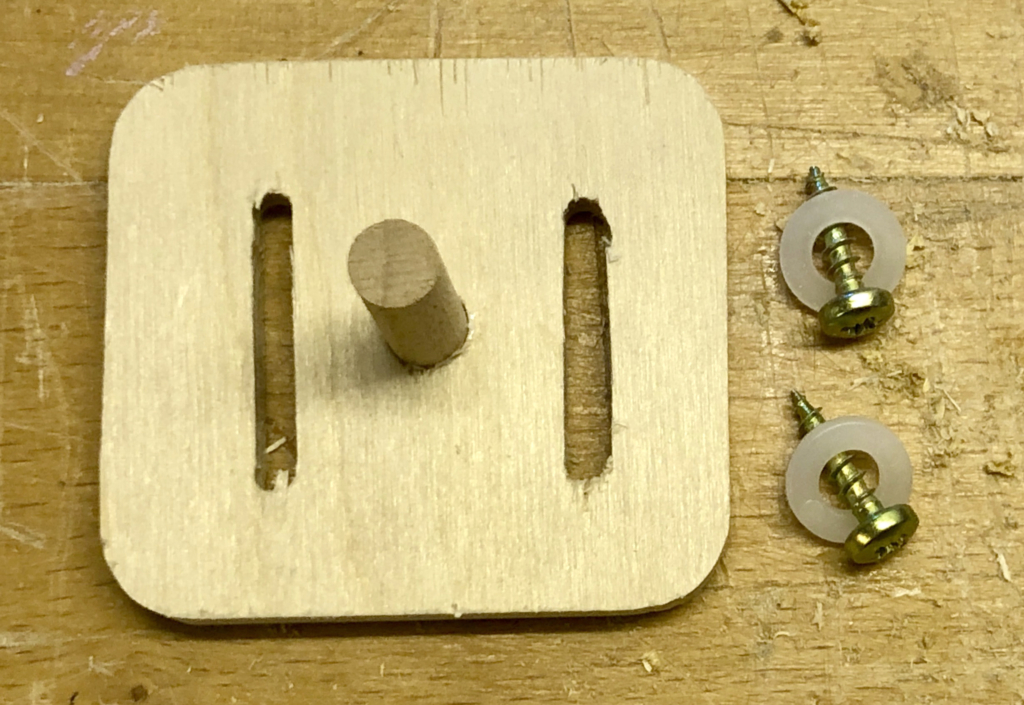
    Parts for the crank and the small pinwheel

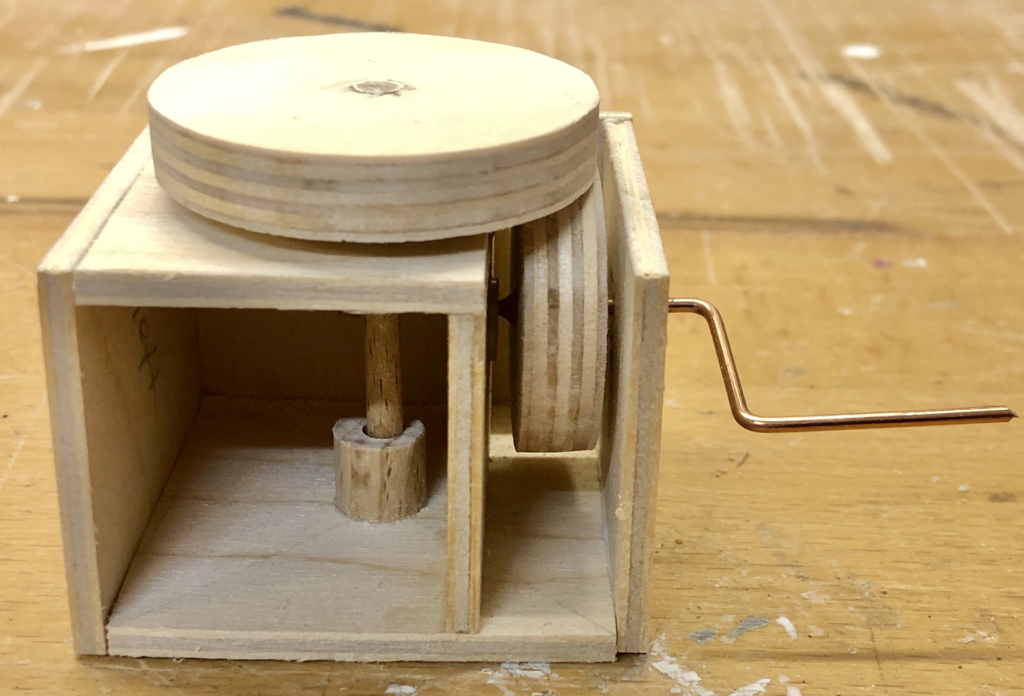
    A smaller 8-pin wheel is turned by a crank to drive the large pinwheel.

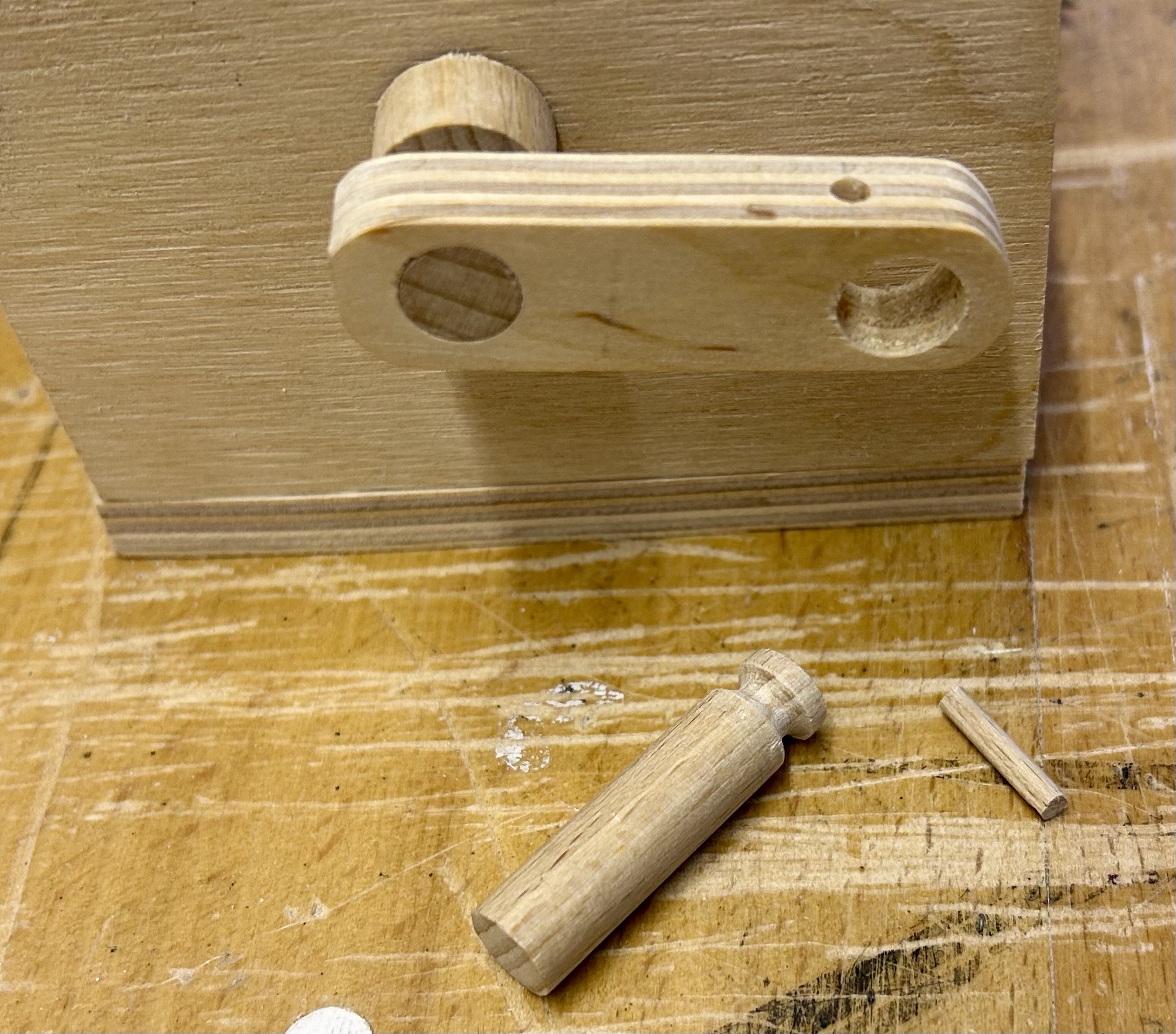
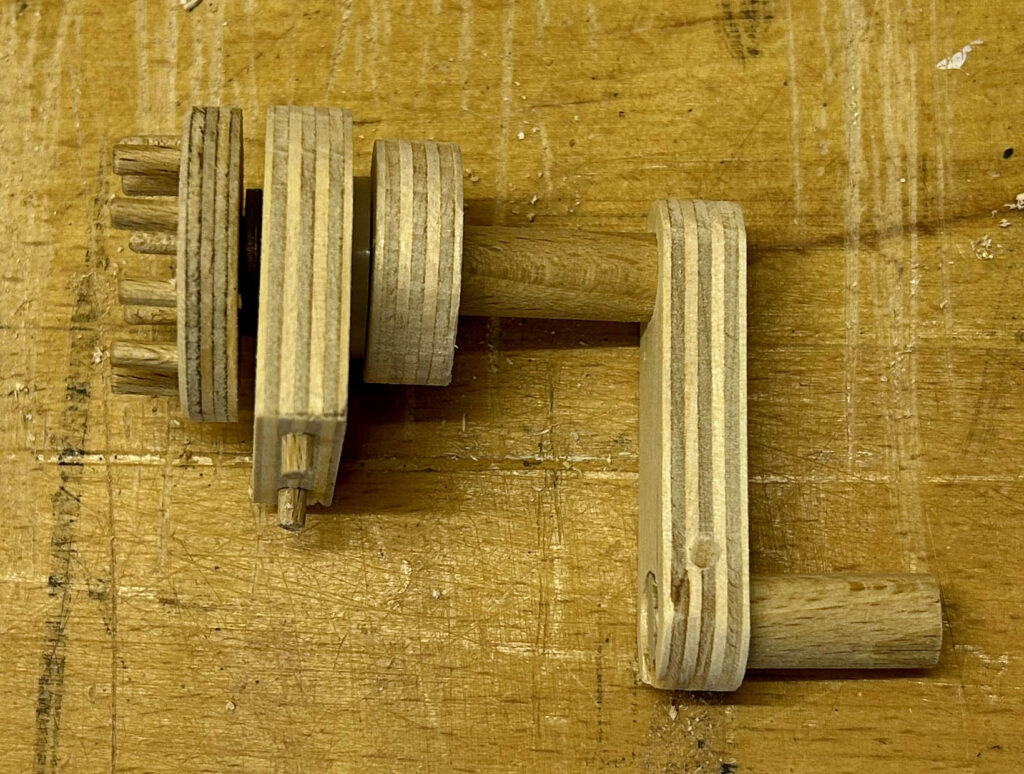
    The assembled crank

    I experimented with the position of the pinwheels until they engaged smoothly, without jamming.

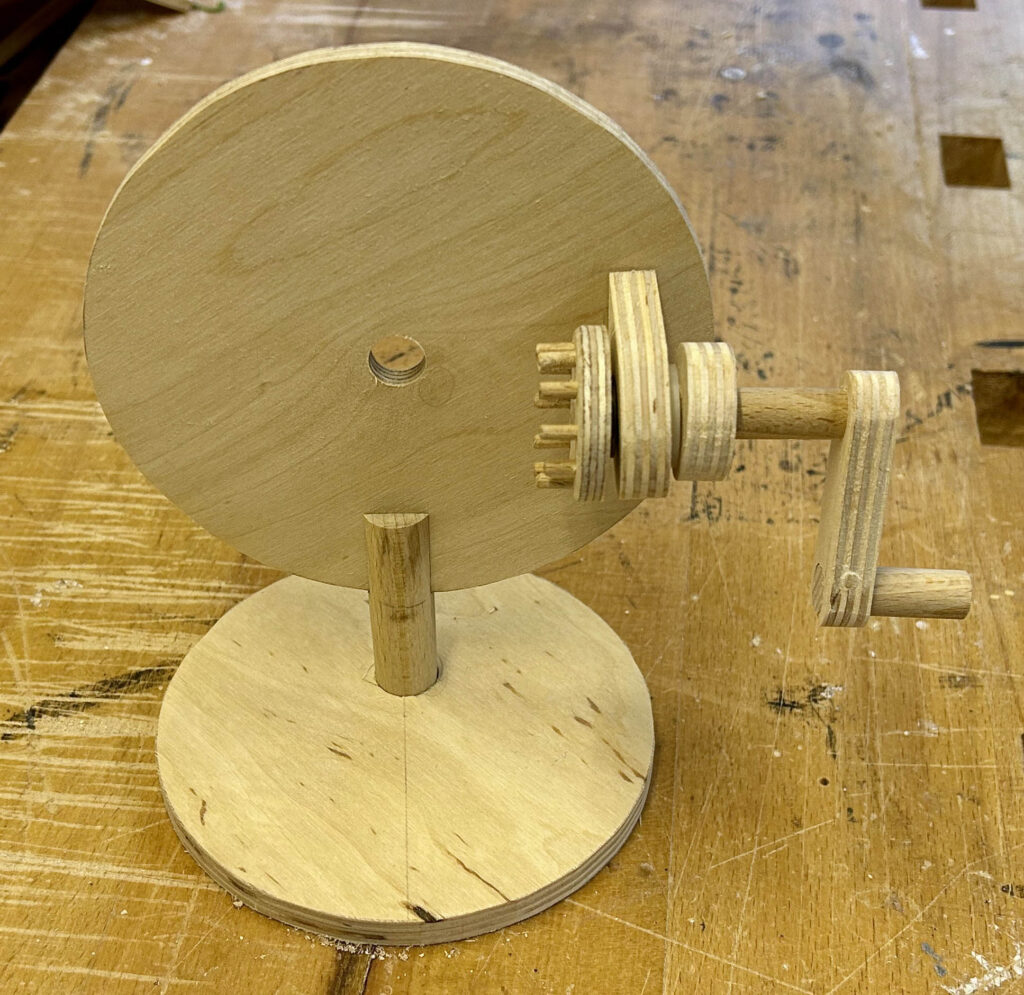
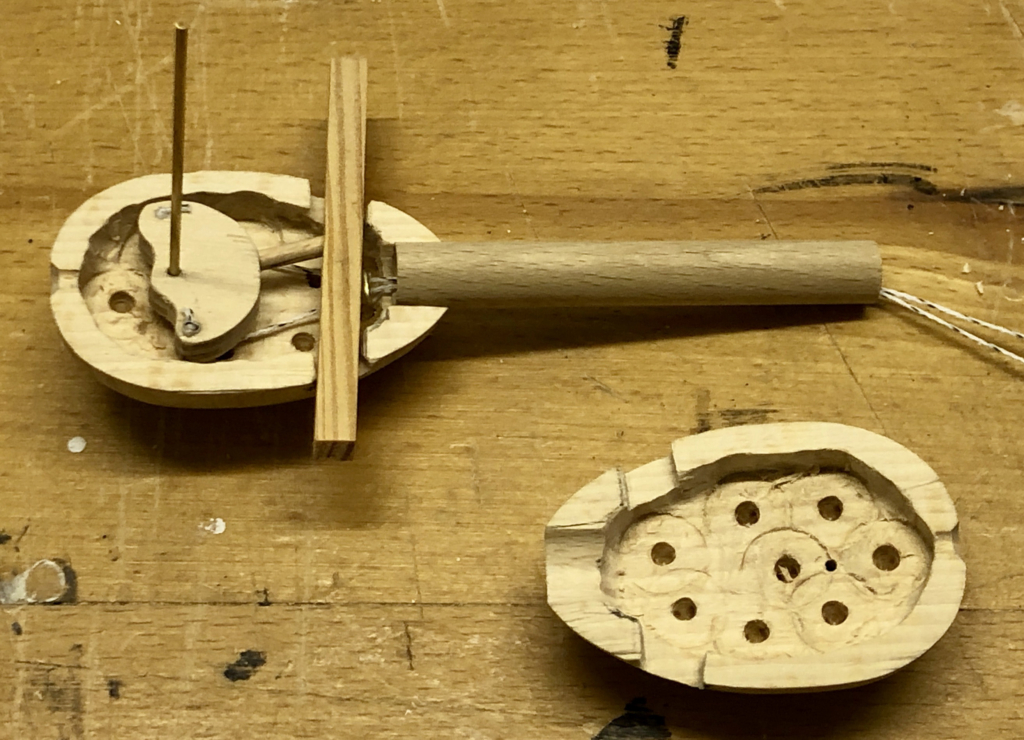
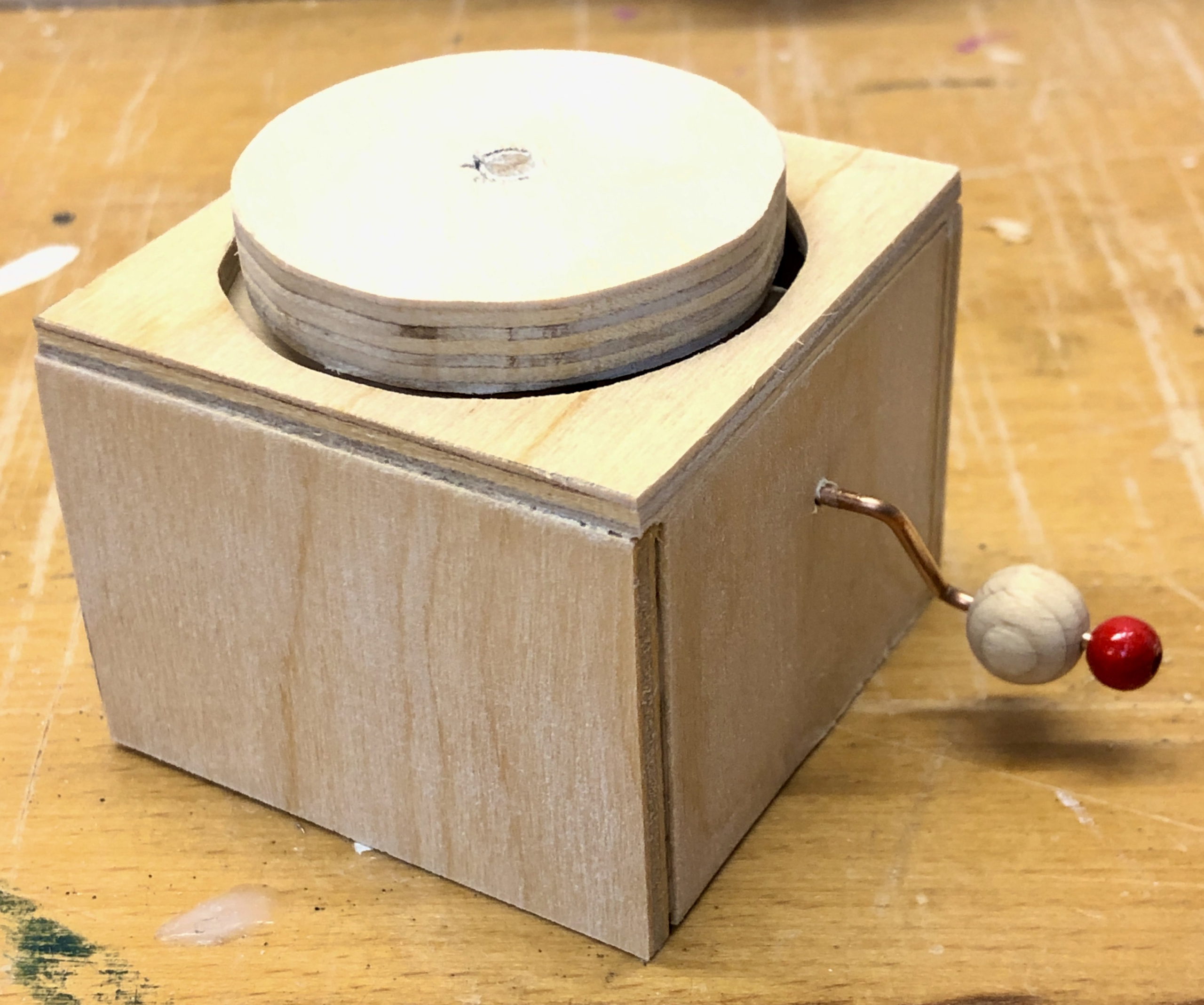
    Back with the crank mounted

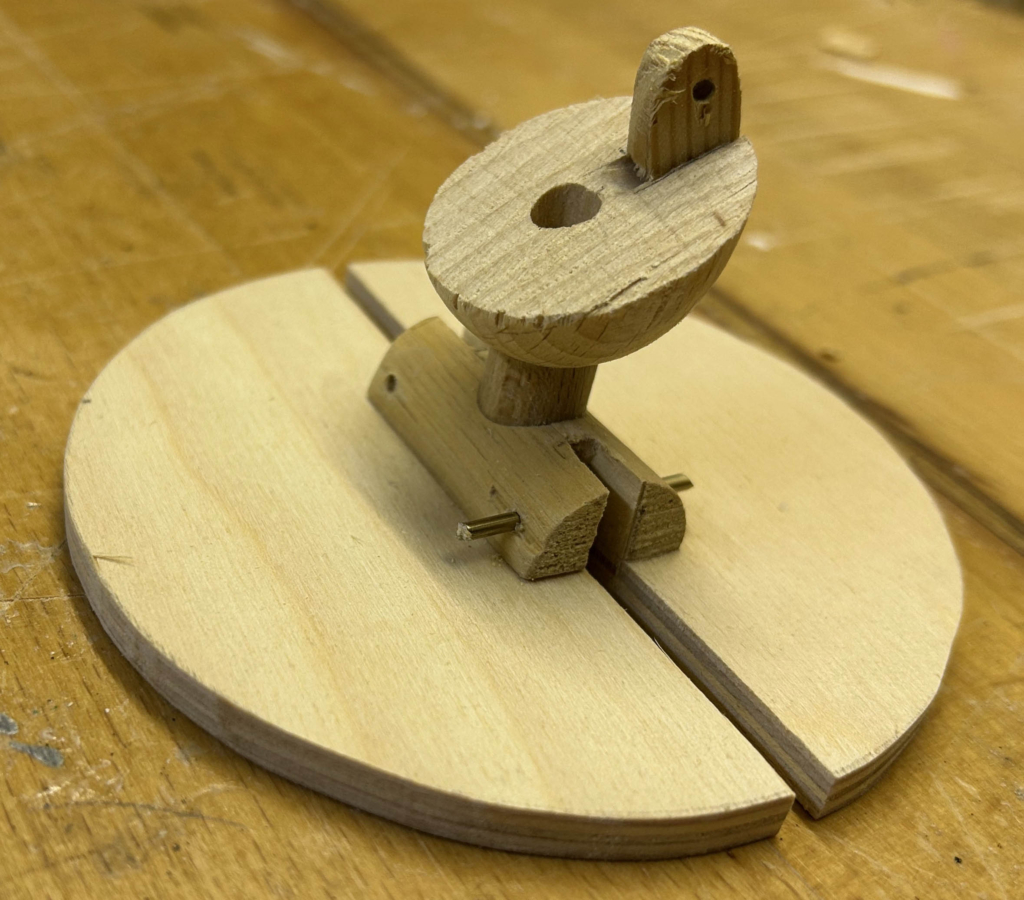
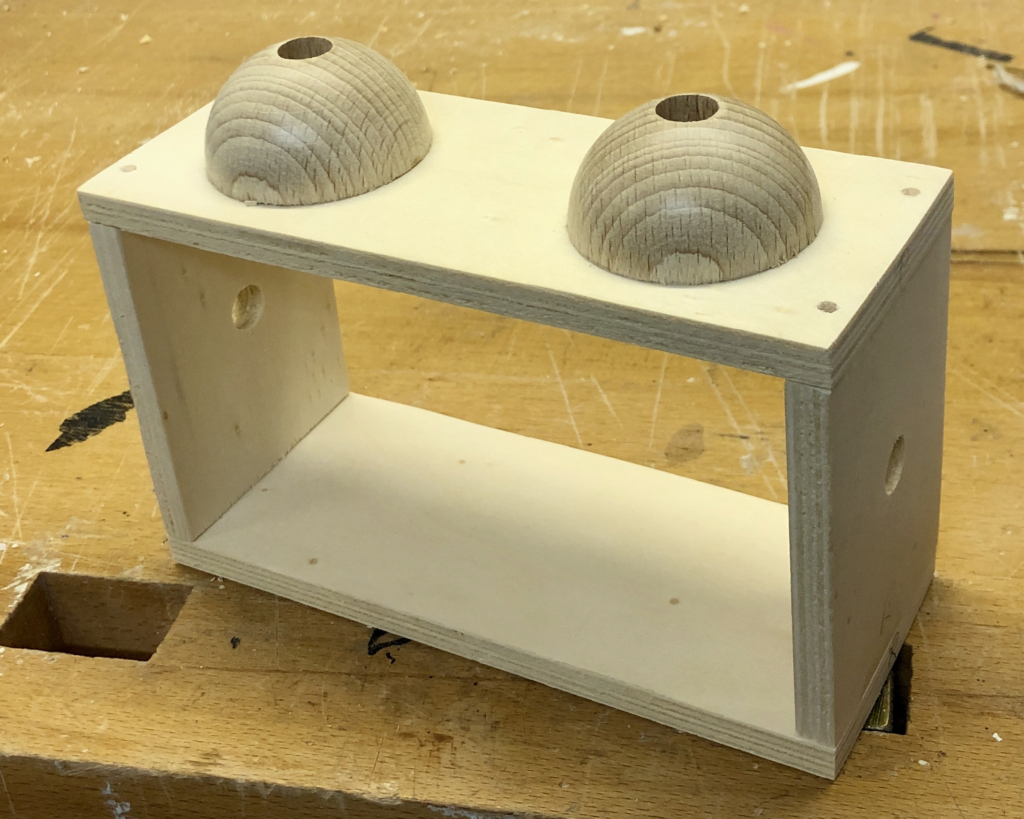
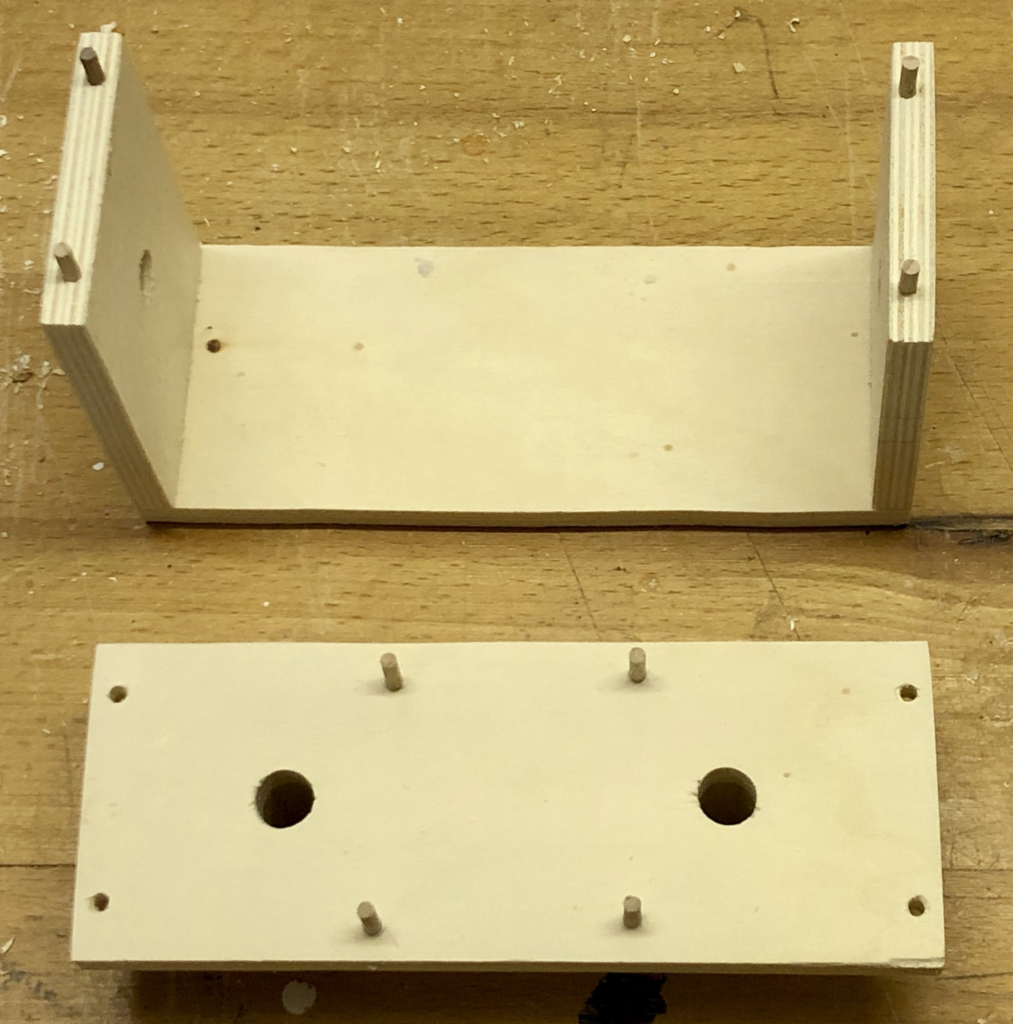
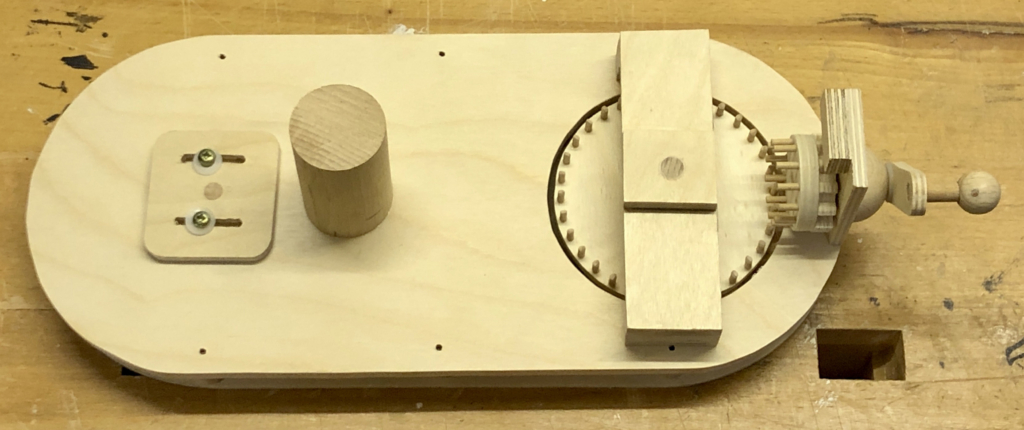
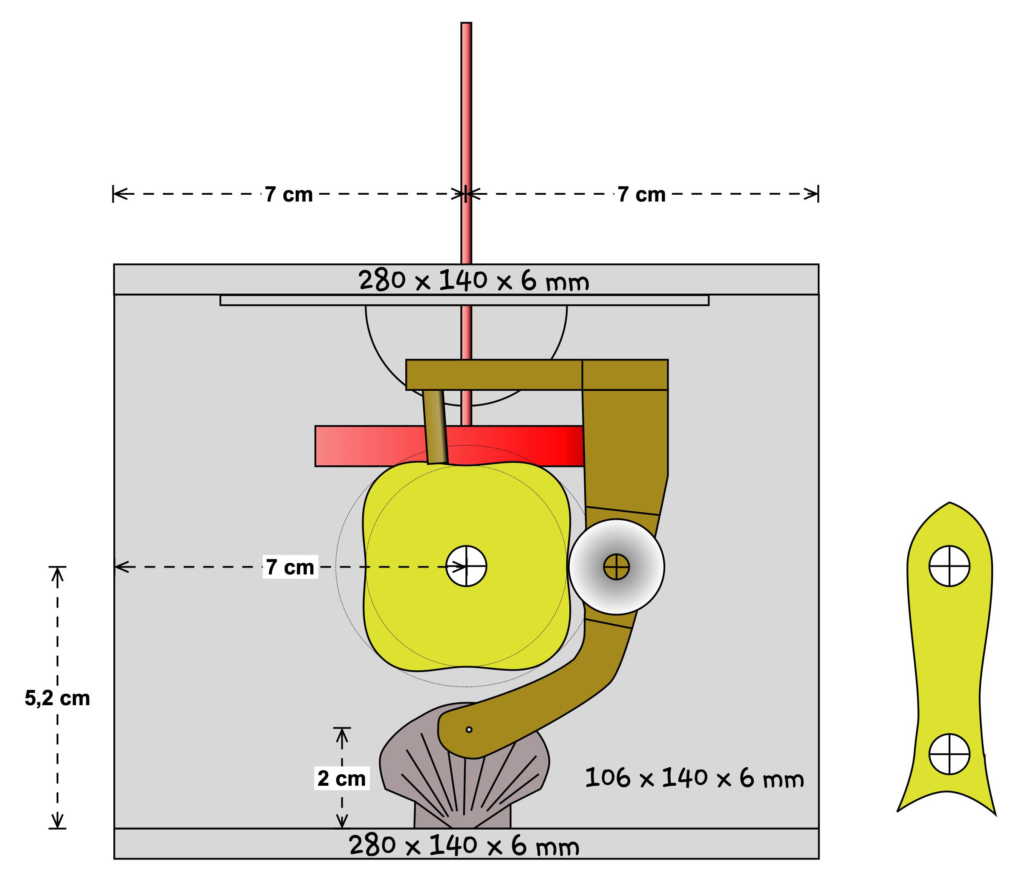
    The back is a 13 cm disc, like the front. The back is mounted vertically on a stand, which the front is not. Otherwise the rocket couldn’t fly around. The front is mounted onto the back via the 12 mm dia. dowel which also serves as the axle for the large pinwheel.

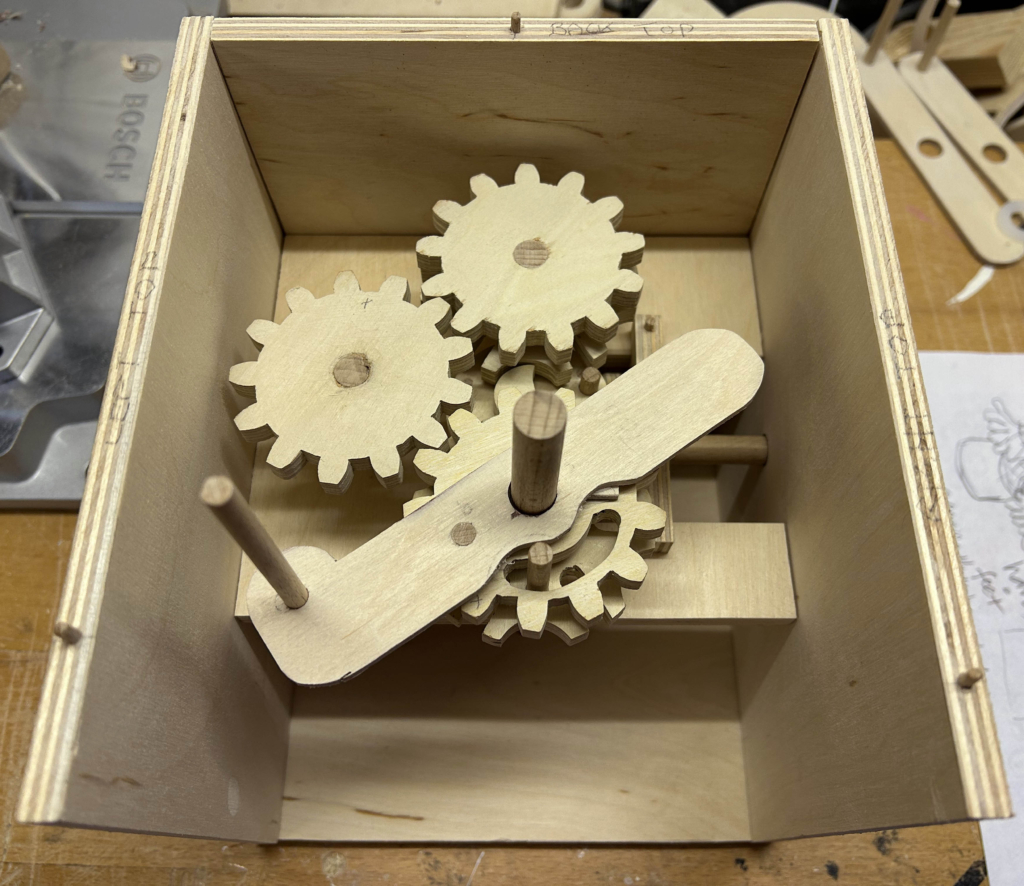
    Top view

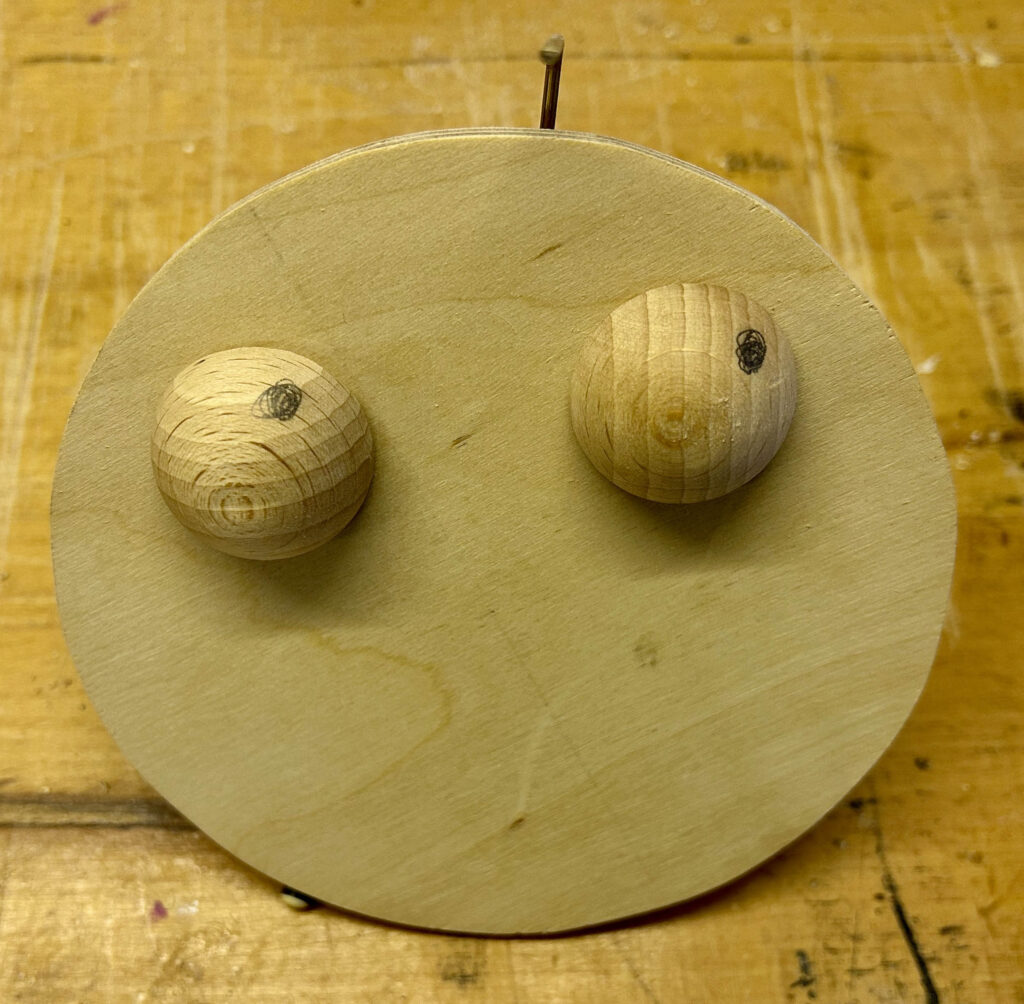
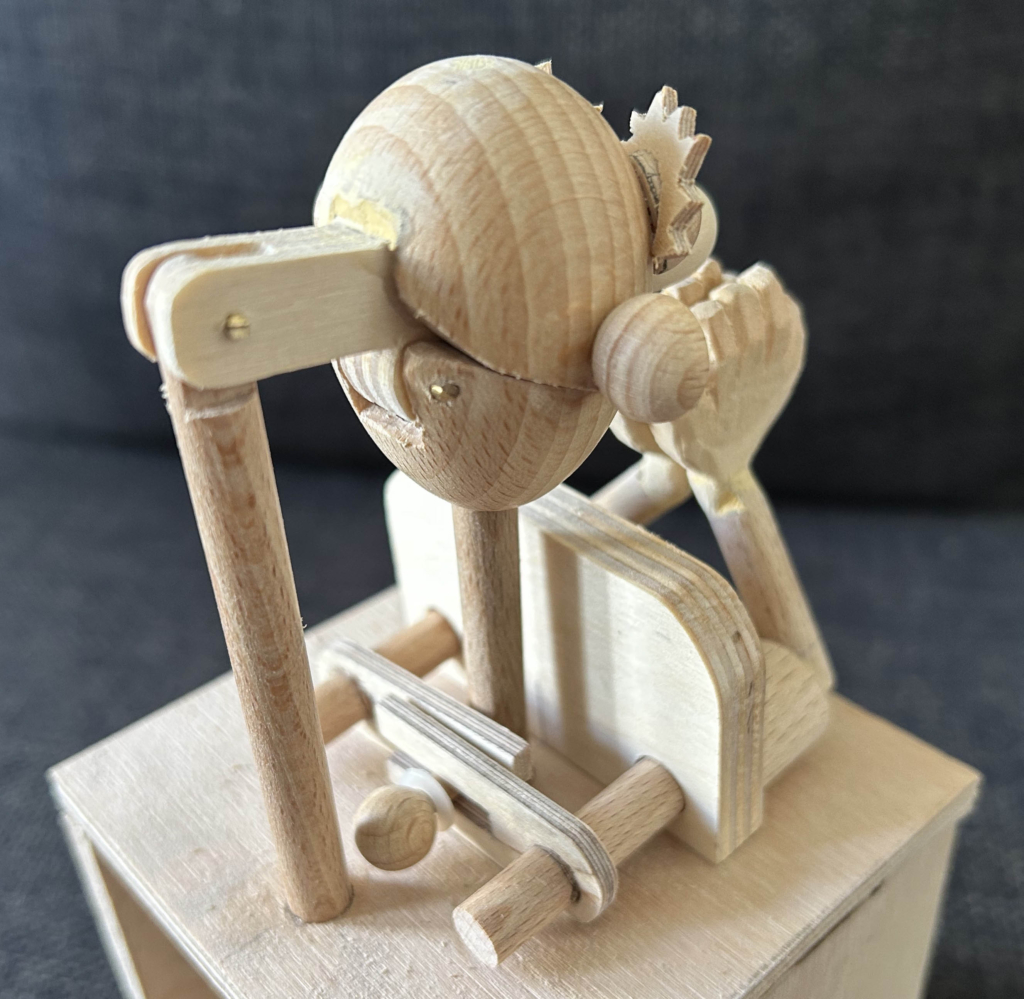
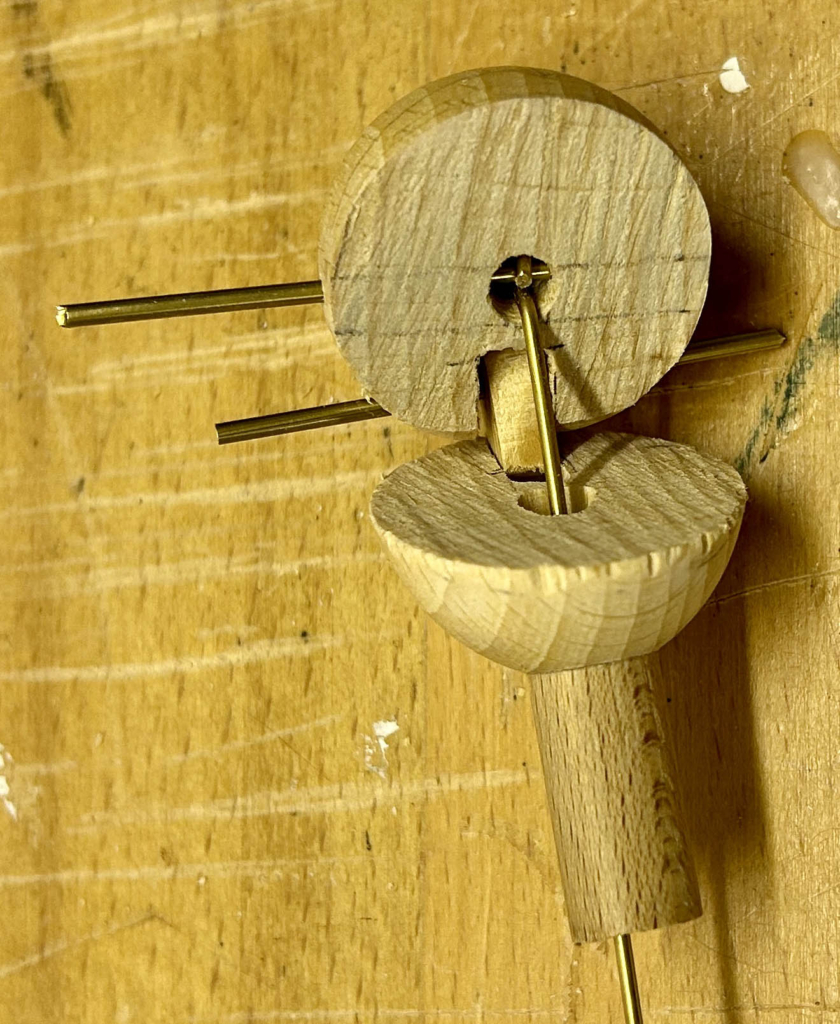
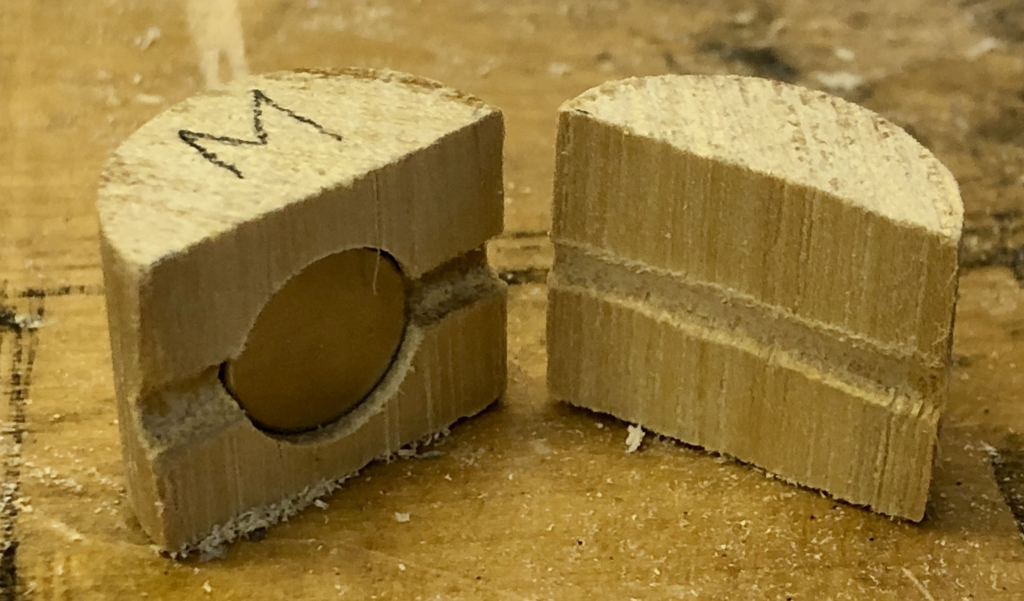
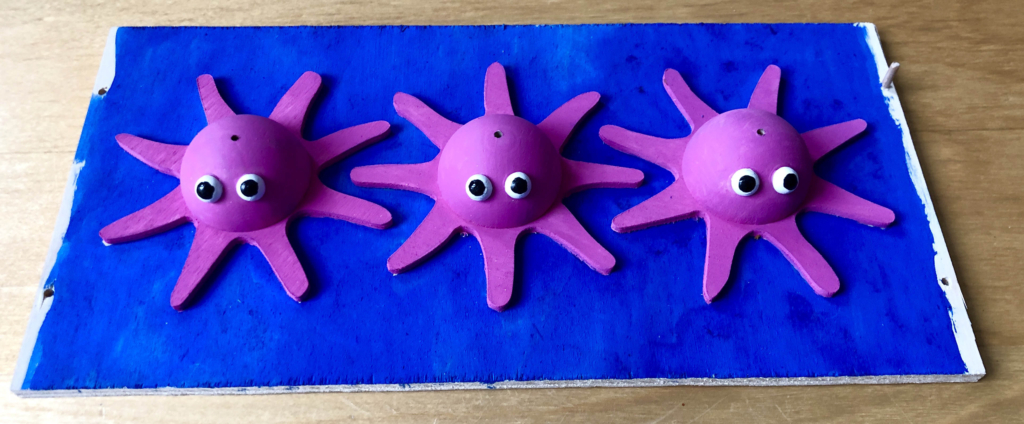
    The eyes are the two halves of a 30 mm dia. wooden ball.

    Two eyes

    A couple of washers keep the swivelling smooth.

    Painting

    I had a go at painting some craters to make the plain disc more moonlike. That didn’t work very well at all, so I asked the Internet for a nice blue moon, printed it out at the right size and glued it in place. I don’t think that Monet would approve, but then again he didn’t have a colour printer.

    Impressions

    The eyes track the rocket extremely well. I don’t know why I was suprised about that but I was. The rocket does fly a bit too quickly, so I should have used a higher ratio between the two pinwheels. The moon does however look slightly worried, as if it is thinking about that painful crash into one eyeball over 100 years ago.

    Images

    Download images here https://www.wordwise.de/Mooning_Around_Archive.zip

    Video

    Link to video https://www.youtube.com/watch?v=hyxrKdfu5d8

  • A Dapper Happy Clapper

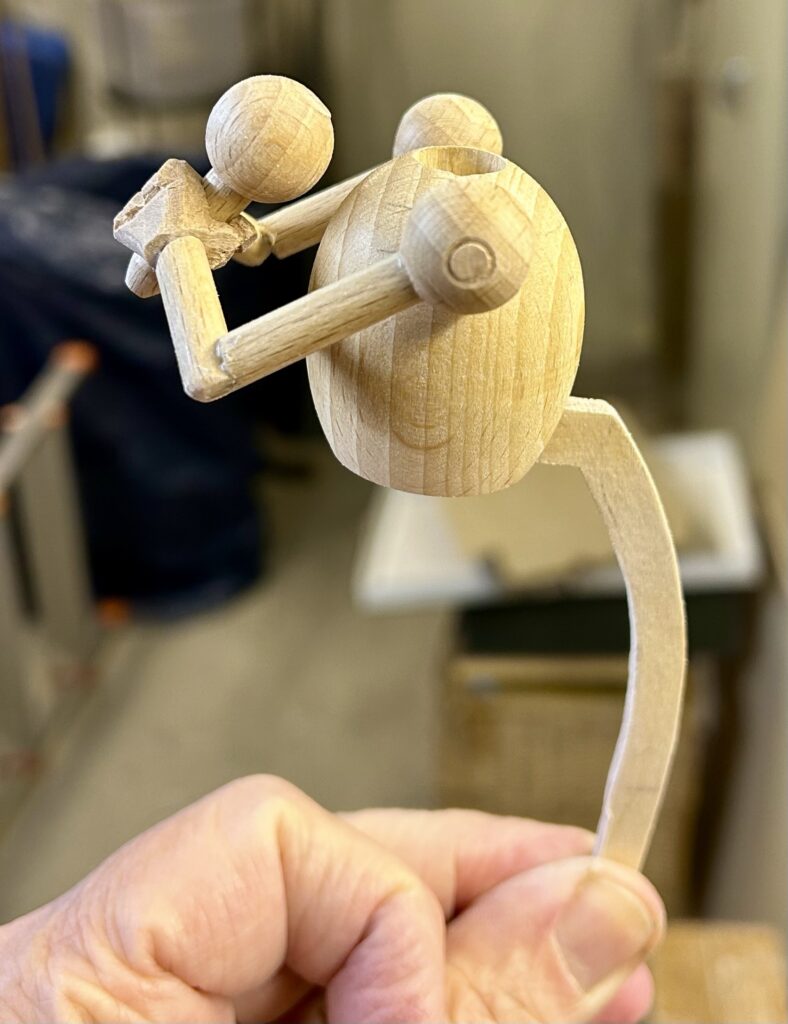
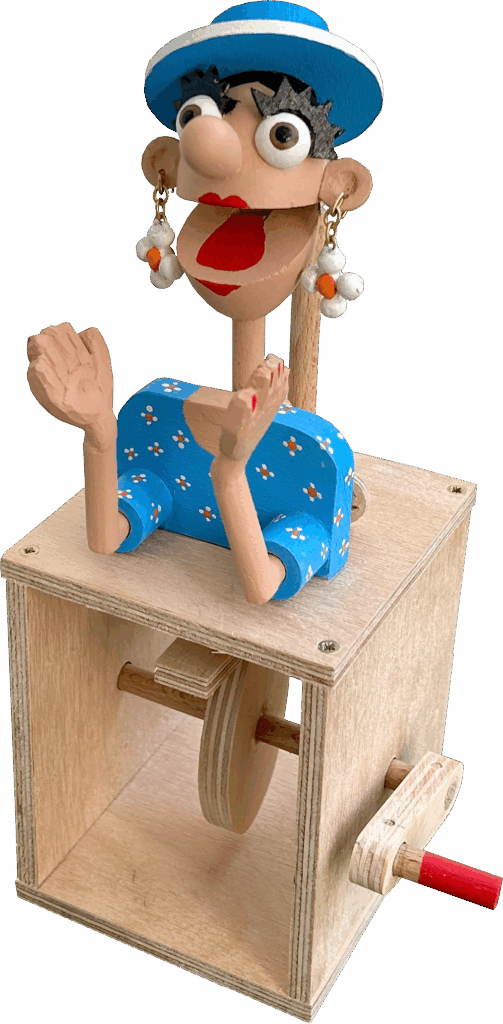
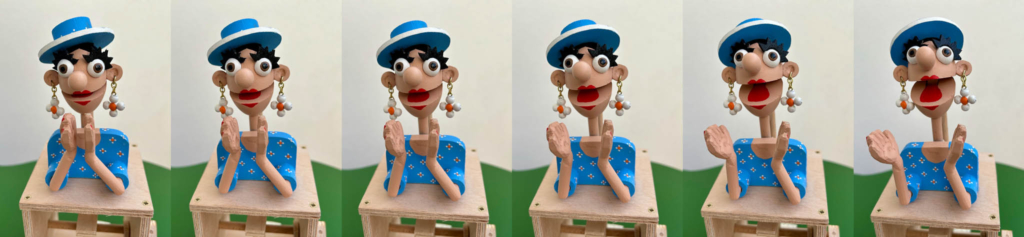
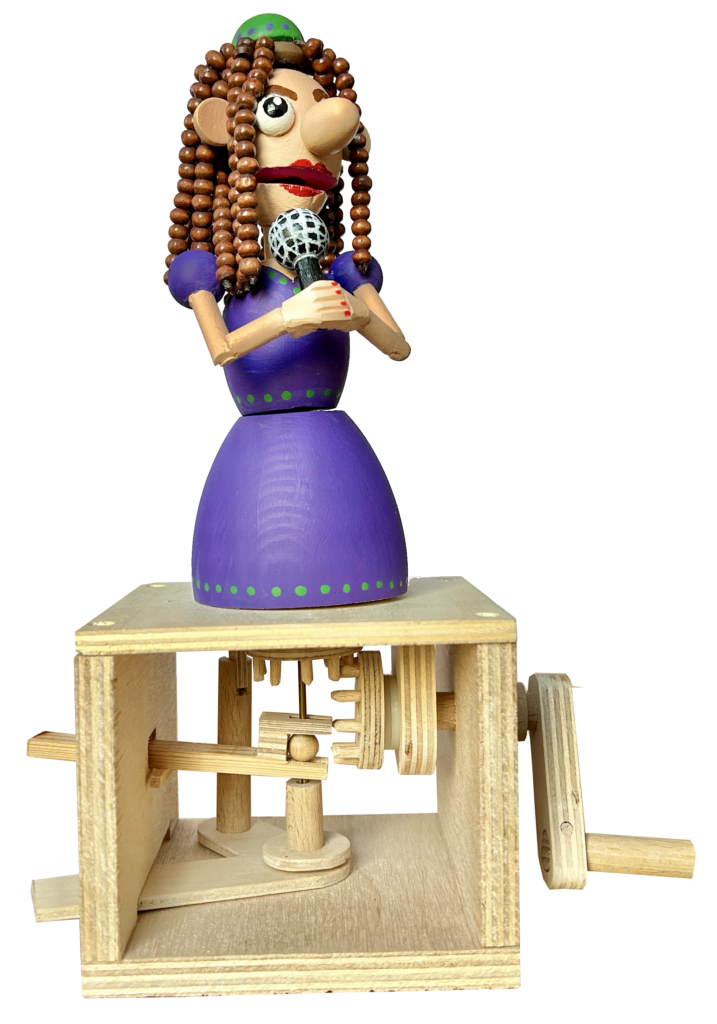
    A happy clapper

    The Requirements

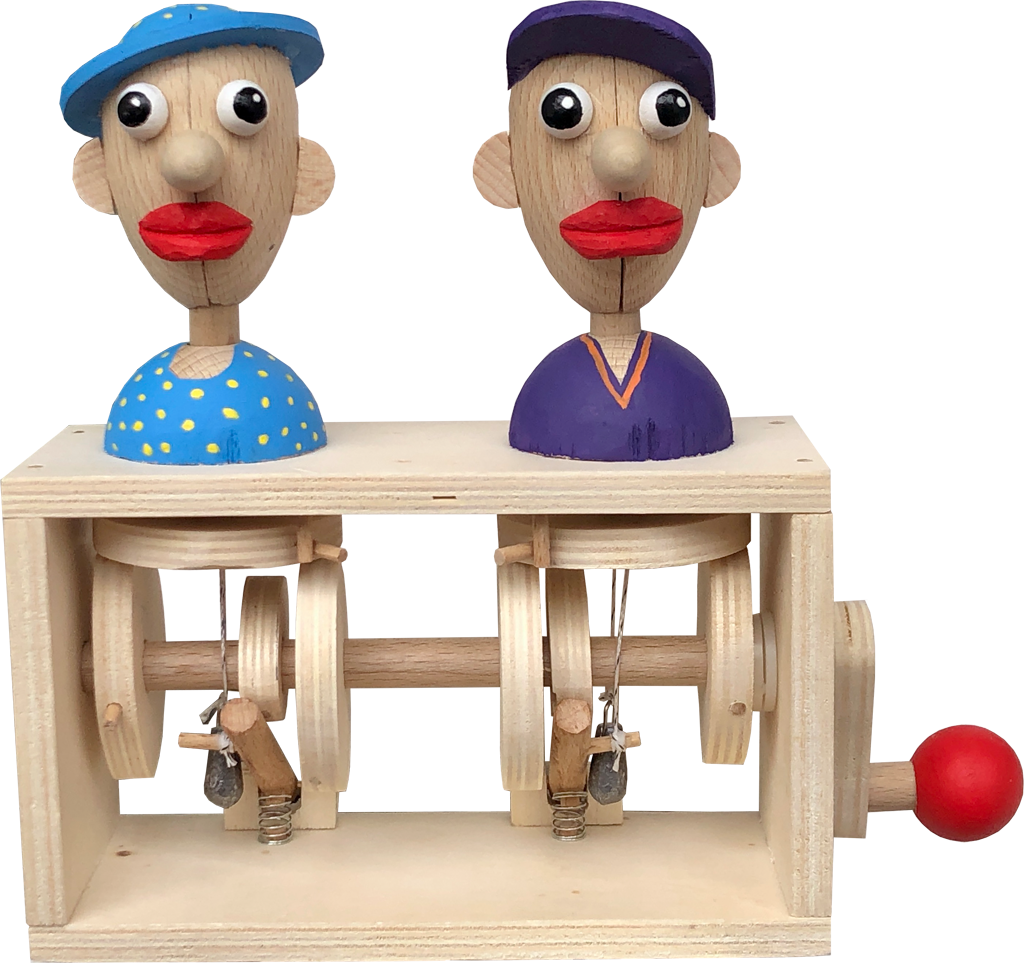
    It’s my friend’s birthday soon, and I thought that she needs congratulating on reaching the grand old age of ten! So a mechanical congratualtion would be just the job. Peter Markey did a splendid happy clapper (https://www.youtube.com/watch?v=Tx6hnNDoT50) as did Carlos Zapata (https://www.youtube.com/watch?v=M2BStPMRf9g). Per Helldorf produced a fine version called “An evening at the Theatre” (https://www.youtube.com/watch?v=tPlDv_I8FqQ) and Martin Smith made a “Variable Applause Machine” (https://www.youtube.com/shorts/aPSxc_zgnDo). The list could go on and on, but it’s safe to say that there are loads of examples out there for some inspiration, each one with its own particular flavour.

    My version had to be female and have loads of movement. I borrowed Peter Markey’s clapping mechanism and decided to keep it simple with just a single cam both moving her arms and opening her mouth.

    Making

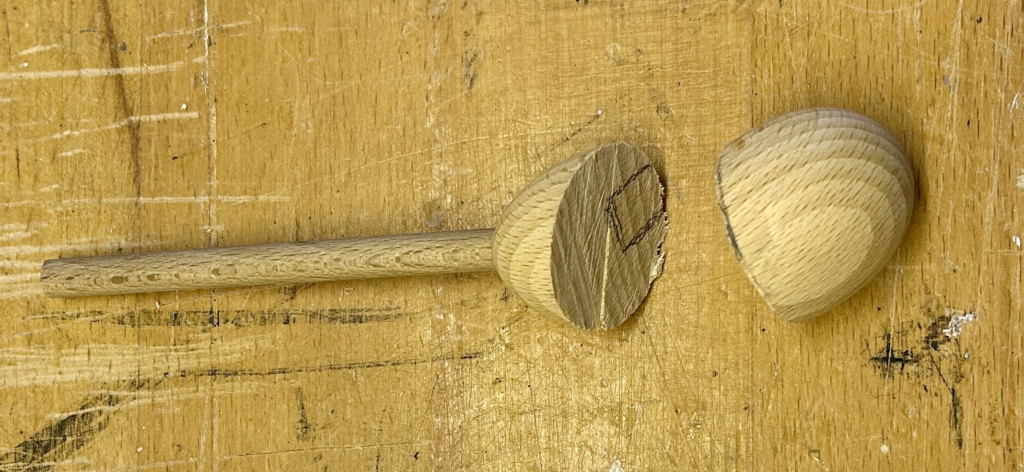
    Cutting the mouth

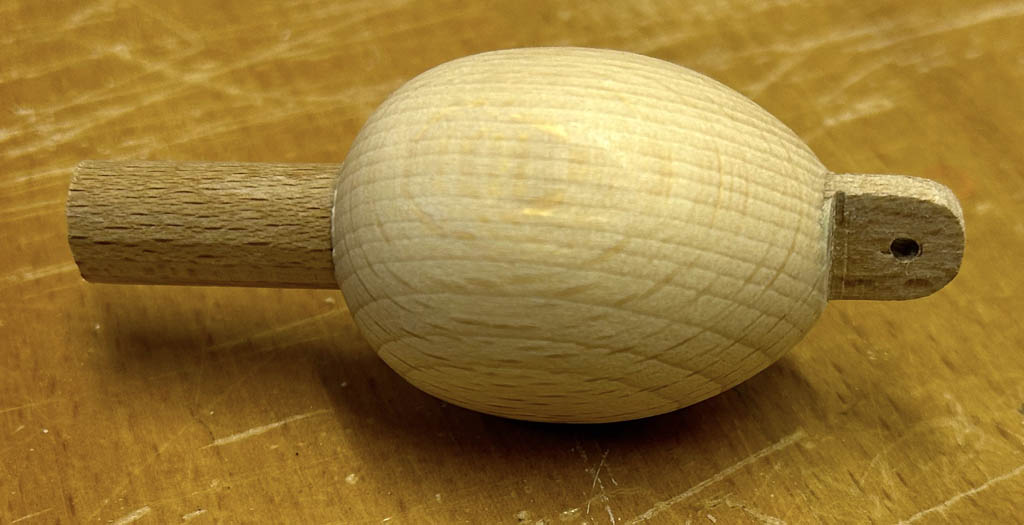
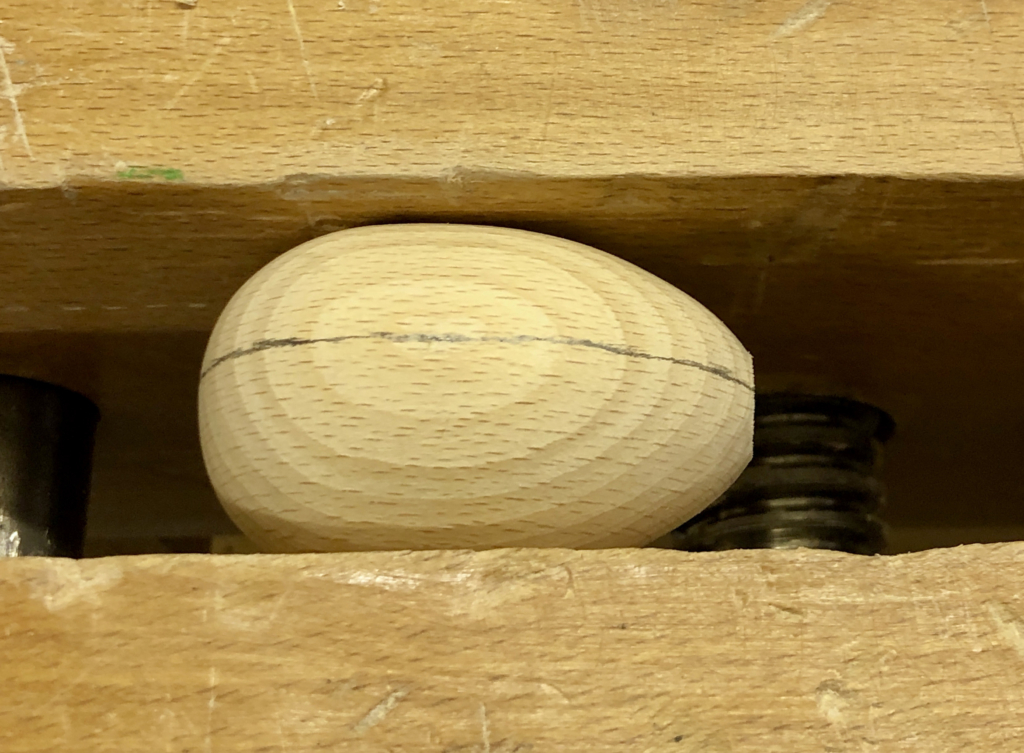
    I decided to start with the figure as this would then define the size of the base on which it stands. A wooden egg serves nicely as a head and a slanted cut gives us the widest mouth possible.

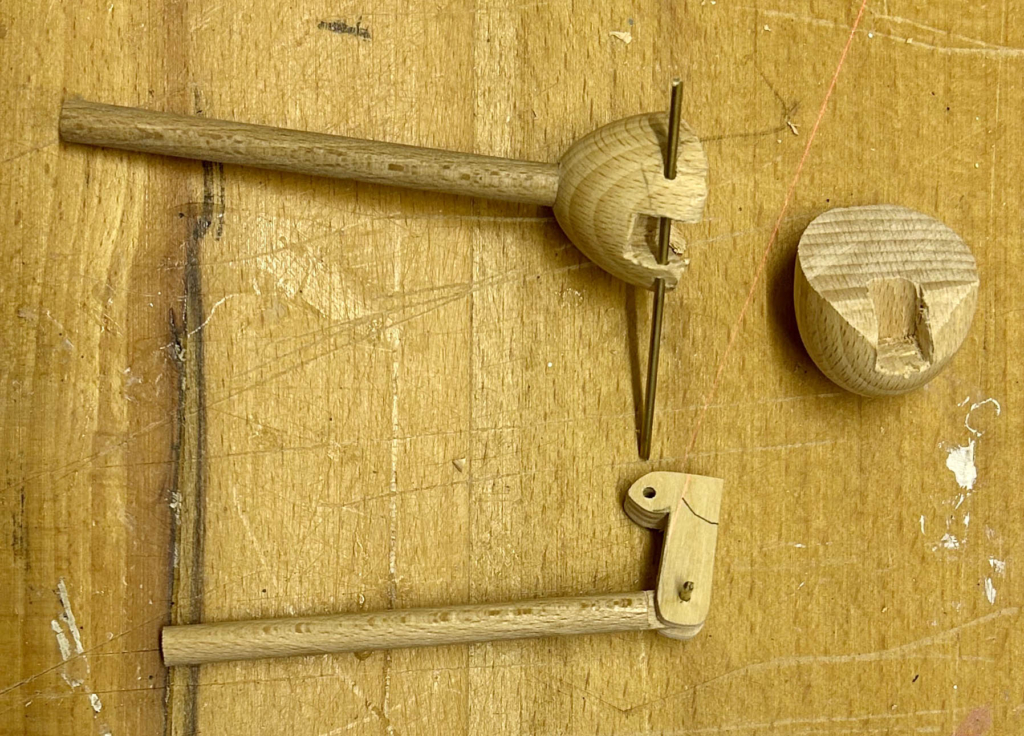
    Hingeing the mouth

    There are two pieces of 8 mm dowel. The dowel attached to the lower part of the head will be moved by the cam. The other dowel will be fixed, standing behind the clapping figure with a hinged link to the head. As one dowel moves up, relative to the fixed dowel, it pushes the head up and opens the mouth.

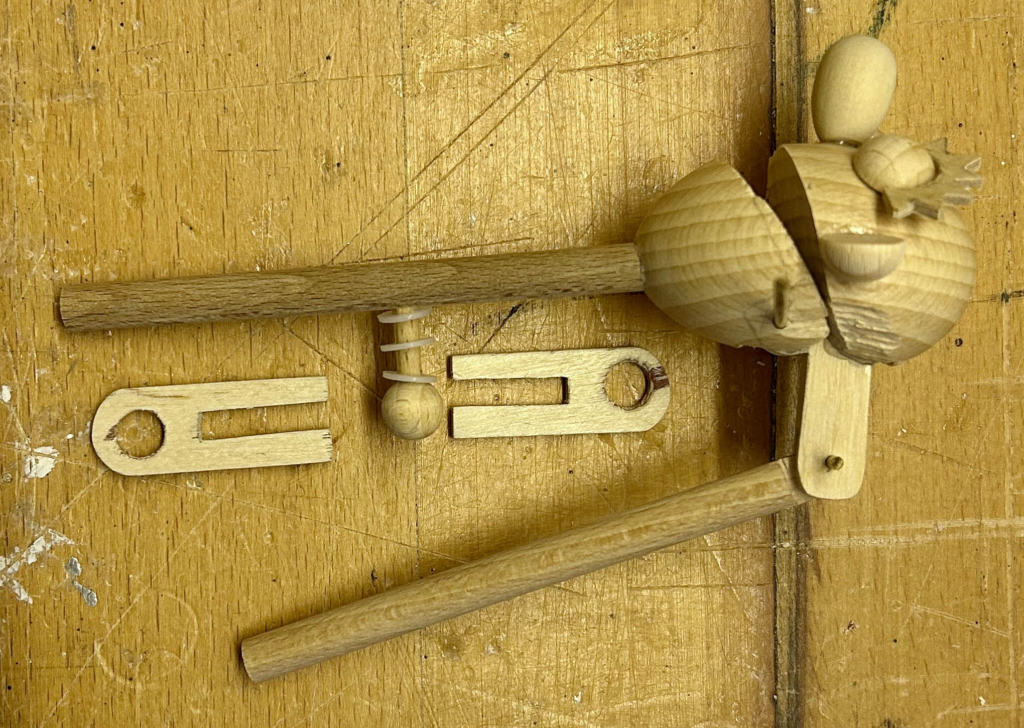
    The assembled head

    The moving dowel also has a horizontal piece of 4 mm dowel which moves the slotted links attached to the arms. As the dowel moves up it moves the slotted links and rotates the arms.

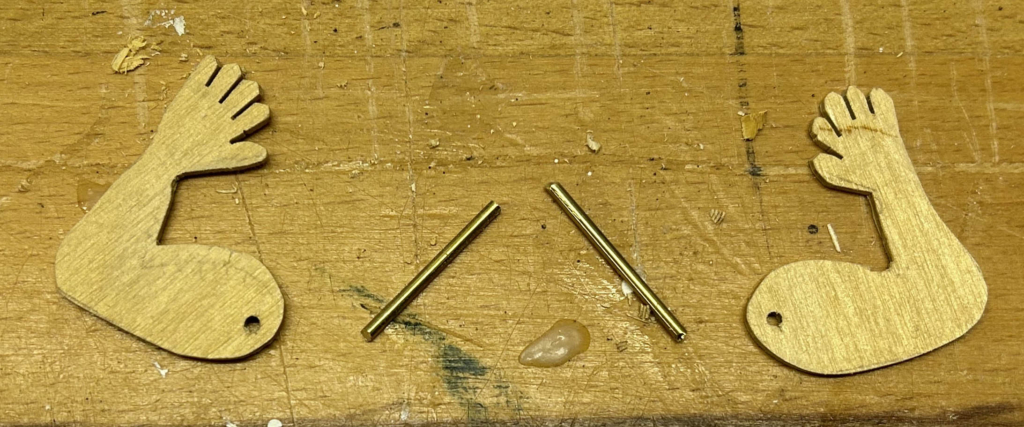
    Parts for the arms

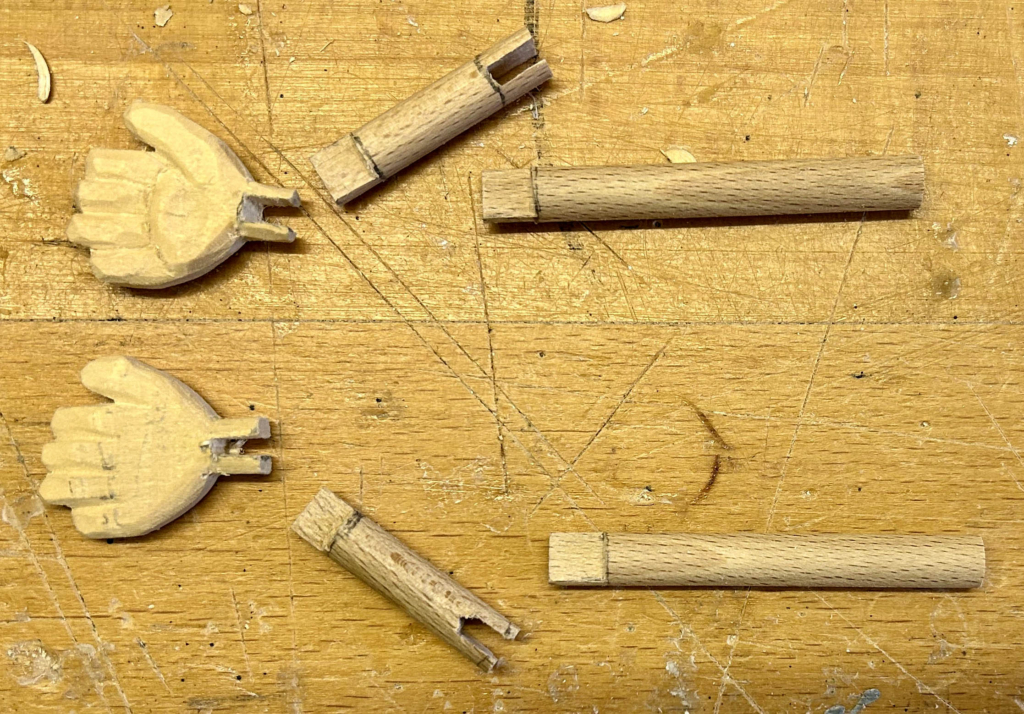
    I carved two hands using limewood and used some 8 mm beech dowel for the arms. The elbows were a 90 degree joint which is straightforward and I set the angles of the hands by gluing them while they touched, in the clapping position.

    The arm mechanism

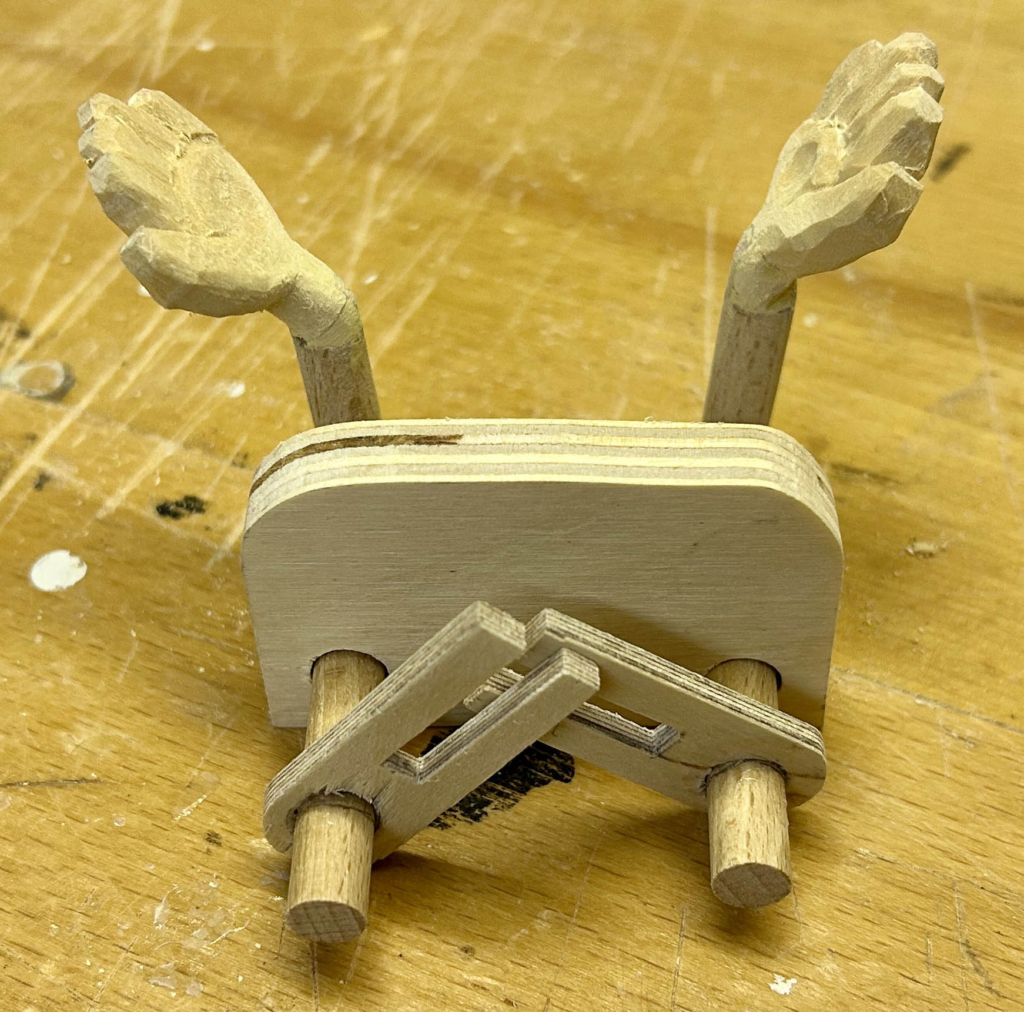
    With the hands together for a clap, I then glued the slotted linkages to be more or less horizontal.

    Arm mechanism assembled

    As the moving dowel pushes the head up, the slotted links move the right arm one way and the left arm the other way.

    Cam ready to be installed in the base

    By pushing the moving dowel upwards with my finger, I measured the travel from the initial resting point. This told me the dimensions for the cam, i.e. the difference between the minimum and the maximum radius. In my case this was 20 mm and 34 mm and I chose to have just two peaks on my cam. More peaks would mean more claps per rotation of the crank.

    Cam installed in the base

    Once I knew the size of the cam, I knew how tall to make the base. To make repairs easier, I screwed the base together.

    Painted with earrings

    After painting a smart dress and making a matching hat, I added some dangly earrings which followed the pattern on the dress. As every girl knows, dangly earrings are a great attention grabber.

    Reflections

    While she sits there unmoving, with her hands pressed together, she does look a bit stern, as if she’s waiting for something. As soon as you turn the handle, she suddenly looks delighted – maybe her horse has just won the Epsom Derby? The angling of her hands is quite human, all in all she makes quite a dapper impression, a really dapper happy clapper!

    Video

    Link https://youtu.be/iQW5ZvTvcN8

    Images

    Download here: Download here https://www.wordwise.de/Clapper_Archive.zip

  • Showing Automata in an Exhibition


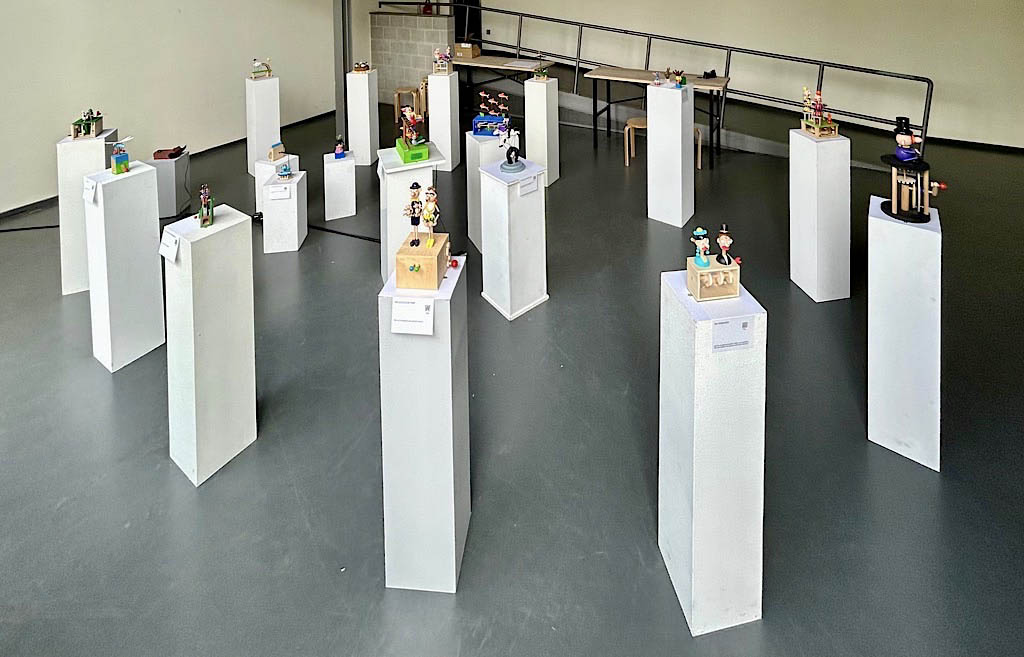
    The exhibition space in Jena, Germany

    A while ago an email arrived out of the blue asking whether I would be interested in showing some of my automata in an exhibition at the Imaginata museum in Jena, Germany (https://imaginata.de/). This museum quotes a fine motto attributed to Albert Einstein “Imagination is more important than knowledge”, which is why they called the museum Imaginata I suppose.

    I have never done anything like this before so it was an interesting challenge to see what is involved and what it would mean to me. The curator, Matthias Richter, came to Berlin and we discussed what to show, how to show it, when to set it up and when to close it down. We also discussed a catalogue, a poster, a flyer and the vernissage or opening get-together. The museum would also arrange insurance, which meant that I had to dream up some prices, although I have no intention of selling anything.

    What to Show?

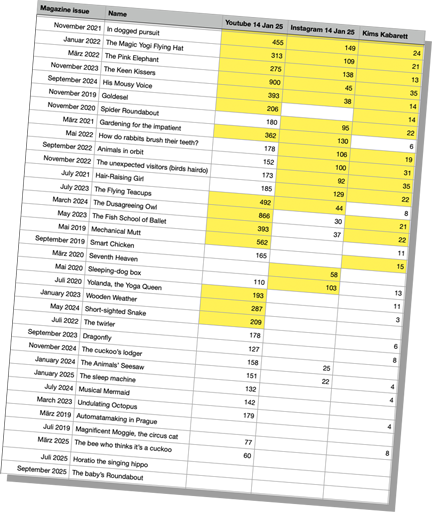
    Choosing what to show was fairly easy. I collected the statistics available from the videos on my YouTube channel (https://www.youtube.com/@EngishmanInBerlin), on my Instagram account (https://www.instagram.com/kimskabarett/) and on my Kims Kabarett blog (https://kimskabarett.home.blog). I put these into a simple spreadsheet and produced a “popularity” metric. Those at the top of the list were in, apart from those which had become birthday presents, and I added a couple of personal favourites.

    How to Show?

    Matthias suggested putting each automaton on a pedestal. Ideally heavy enough that they are not easy to accidentally knock over. My workshop is not stuffed with things like that so Matthias called on the local artists’ association in Jena and arranged to borrow their collection of pedestals, mostly white in a variety of shapes. To reduce the risk of accidents, I decided to screw everything except the very smallest automata to the top of each pedestal. I screwed two metal straps to the bottom of each work and then drilled two holes in each pedestal for the fixing screws. At the end of the exhibition I disappeared those holes with some white wood filler.

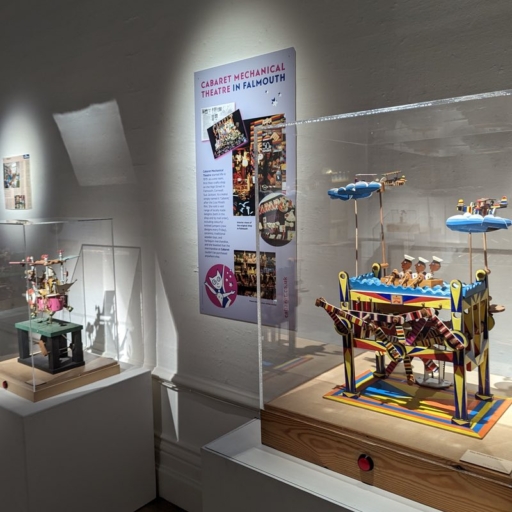
    Img src: https://cabaret.co.uk/exhibitions/

    Fixing automata to something heavy makes them easier to use as you no longer have to use one hand to hold the base steady whilst you turn the crank with the other hand.

    The photos that I have seen of the travelling CMT exhibition show each work enclosed in a perspex case on a wooden base. There is a button to turn the motor on which then drives the mechanism of the automata. This all keeps small fingers away from things that they shouldn’t touch.

    I abandoned all thought of trying to do anything as professional as that and decided to allow visitors to touch anything that they felt like, accepting that I will need to do a couple of repairs when I bring everything back to Berlin. At the end of the month, the result was 3 from 23 automata needed repair.

    • Wooden Weather – During construction I had forgotten to glue one wheel onto its drive shaft, so after much turning the wheel dropped off. This was a 60 second repair on the spot.
    • The Magic Yogi Flying Hat – A small piece of dowel intended to limit the rotation of the owl dropped out after much turning. This was a two minute repair in the workshop. With hindsight this work needs quite a lot of force to turn, so I should either have taken steps to reduce the force needed, or dimensioned the stop to cope with the force.
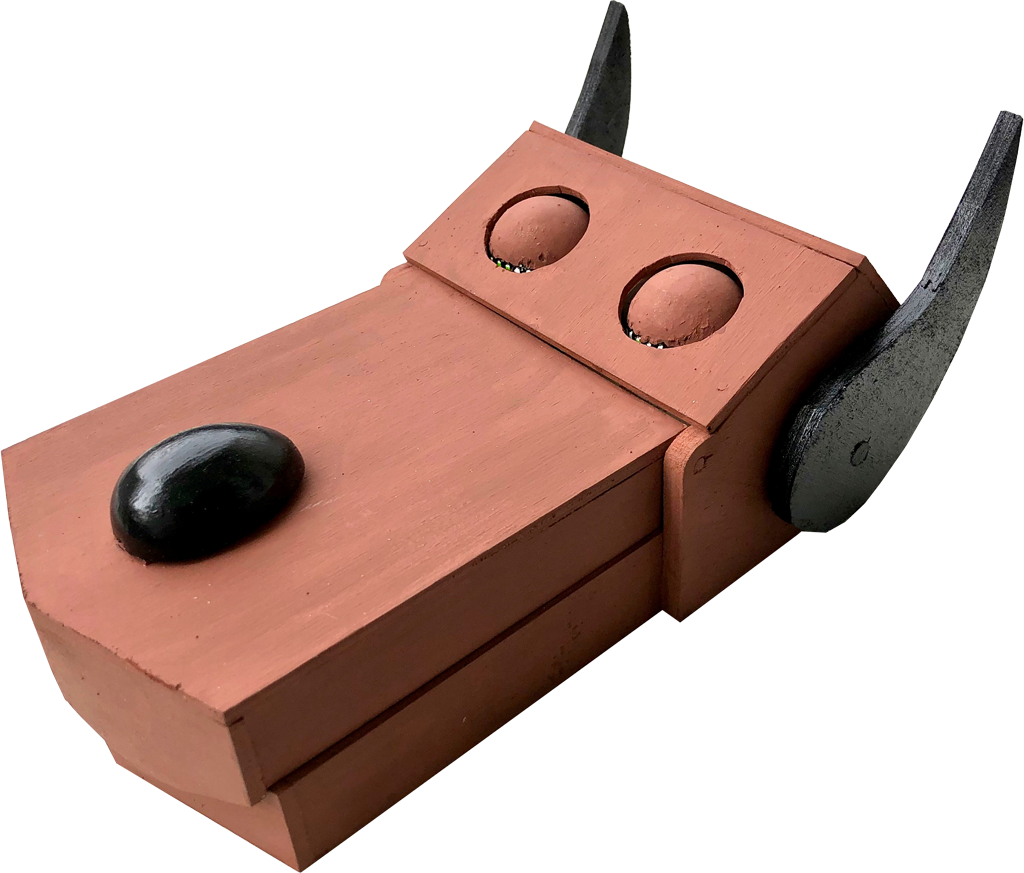
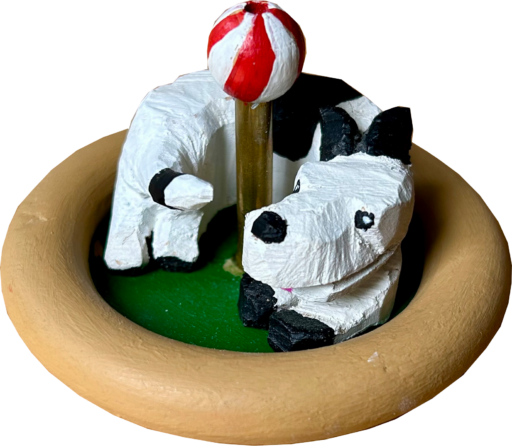
    • Sleeping Dog – I originally made the operation of this deliberately obscure to add to the surprise. Unguided, a visitor sees a dogs head with two floppy ears, closed eyes and a shiny black nose. It is not obvious that the way to open the dog’s mouth is to slide his nose towards the front of the box. Inevitably, curious hands grabbed at the ears to see if that made things happen. Furiously wagging the ears to and fro was not what I had reckoned with, so things fell to pieces. This will take a couple of hours in the workshop to fix. These days I use red paint to signal where you are supposed to operate an automaton to try and avoid misunderstandings.
    The Sleeping Dog

    I suppose the basic problem was that I had not considered weeks of intense unsupervised use as I was designing each piece. More experienced now, I might do some things differently – or then again I might not.

    The Catalogue

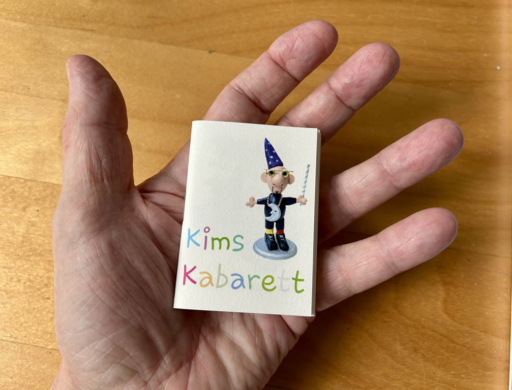
    Some years ago, I had made a small booklet, showing some of my automata from that time. When I showed this to Matthias he agreed that this sort of format would be a fun approach to take.

    I supplied images of each of the works to be exhibited and Matthias asked a young graphic artist to produce a small booklet. We also agreed to put a QR code next to each item. Scanning the code calls up a video showing the automaton concerned in action. Movement is the essence of an automaton and I thought that a video is the only way for visitors to take a real memento of their afternoon in the exhibition.

    The Keen Kissers

    Of course, I was wrong and Jana Richtmeyer, the young artist (https://studio-jayeah.de/) knew better. She took the video of the Keen Kissers and from that made the catalogue into a flip book. Falk Keuten, the well-known automata blogger (https://spielundkunstmitmecha.apps-1and1.net) went to see the exhibition and wrote “I would also like to mention the delightful little catalogue that shows twenty exhibits using photos and motion via QR code. It is also a flip book for the animation of “Keen Kissers”! This should be done for every Automata book.

    There is a video showing the catalogue being flipped here: https://www.youtube.com/watch?v=K5-dmC9VM6E.

    Visitors were asked to pay a small fee for the catalogue, not to make money, just to ensure that it was appreciated. Personally, I was as pleased as punch with the catalogue and it now has pride of place in my small collection of flip books.

    The Opening Get-Together

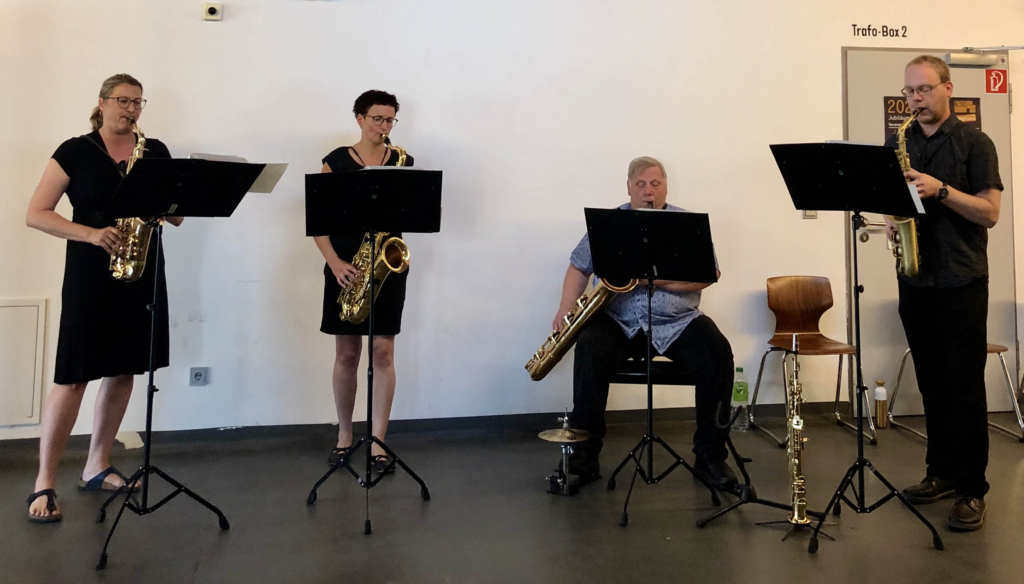
    Musicians playing for the opening

    The museum organised a saxophone group to play during the opening get-together. Along with a finger-food buffet, this created the atmosphere of a party despite the formality of a few short introductory speeches.

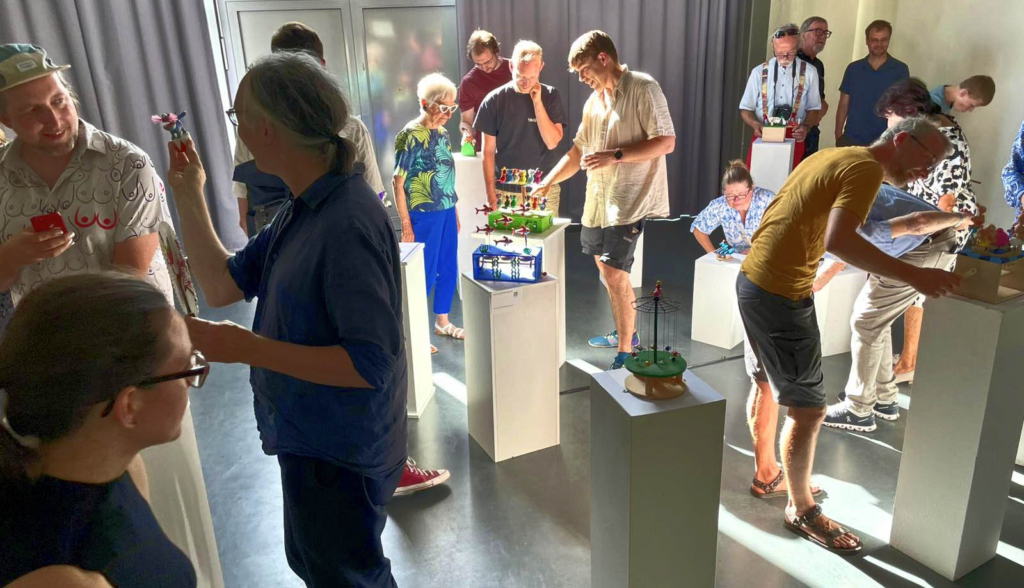
    Trying the automata

    In contrast to conventional opening events for exhibitions of paintings/sculptures, visitors were busy interacting directly with the automata, working out what is actually going on with each piece. I found this was quite good fun, instead of standing around with a glass of wine and looking but not touching.

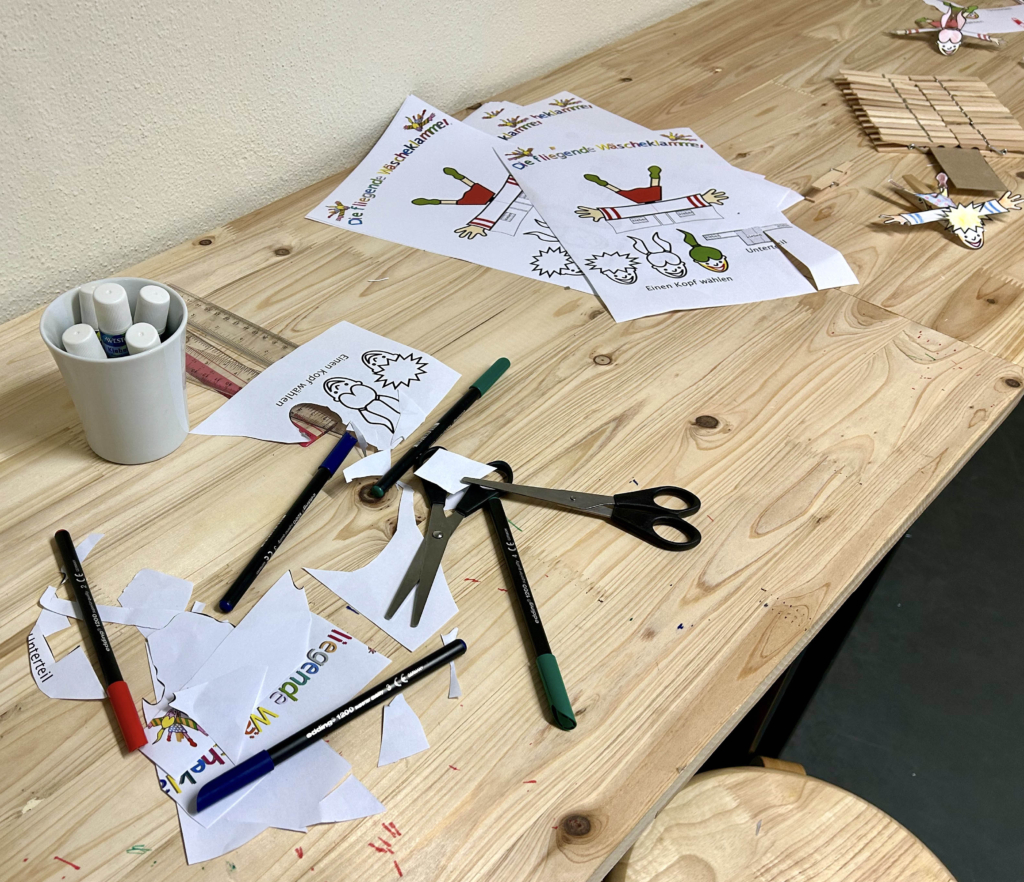
    The Corner to Build Your Own Automaton

    More interactivity for the visitors

    After the visitors have had fun interacting with the automata on display, both young and old had the opportunity of making their own, very simple automata “A Flying Clothes Peg”, on a table in the exhibition space. (https://www.youtube.com/watch?v=P8_O1J-BRIA) Hopefully this inspired a few people to see that making automata is not that difficult and to get stuck in themselves. The museum also organised a competition to encourage creativity at home. Visitors who made their own automaton were invited to send in a video of their creation and maybe win an exciting prize.

    Transport To & Fro

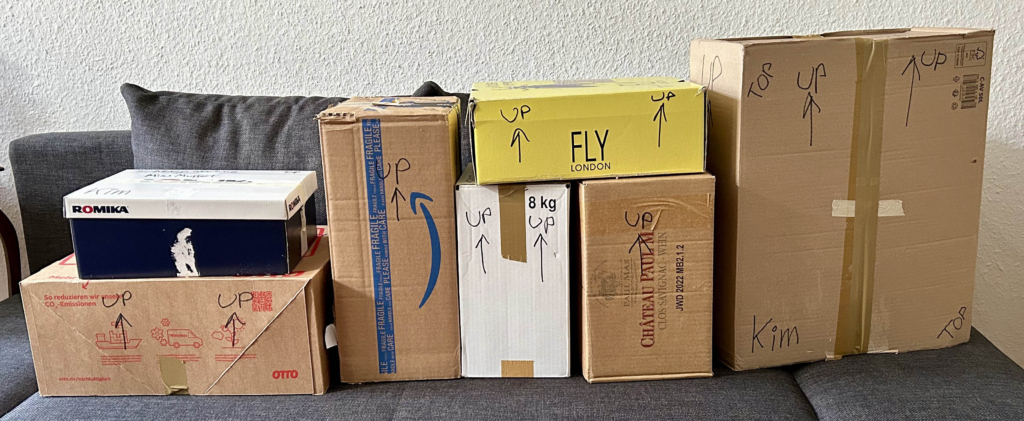
    Packed automata

    Transport was quite a challenge as everything had to be packaged so as to withstand a three hour drive from Berlin to Jena in the back of my camper van. Wrapping up in bubble wrap protected the paintwork and I filled the remaining gaps with scrunched up newspaper to try and prevent things from moving about inside the box. Turning most of my automata upside down would not be good for their health, so I marked every box with arrows to remind myself which way is up. I was concerned what vibration might do, but nothing seemed to have suffered when I unpacked. I was personally doing the handling and driving, I can’t imagine sending one of my automata by post, or via a courier service. That would really require carefully custom-made packaging for every single piece.

    Reflections

    Automata without pedestals

    Seeing my automata fixed onto well-spaced on pedestals made a very different impression to what is often a rather chaotic setup in our apartment. I always enjoy seeing individual friends interact with my automata and it was also fun seeing people that I didn’t know taking their first steps into my eccentric, fantastic world. If I was worried about how well my figures moved and how robust they are, no one else seemed bothered by that. I have tied a knot in my hanky to pay more attention to robustness in future, but I don’t regret the weaker aspects of some of my creations. I will mend what breaks and, if I have a good idea, I might improve bits here and there. All in all, I rather enjoyed the entire process.

    Images

    Download here https://www.wordwise.de/Exhibition_Archive.zip

  • A Nice Bear

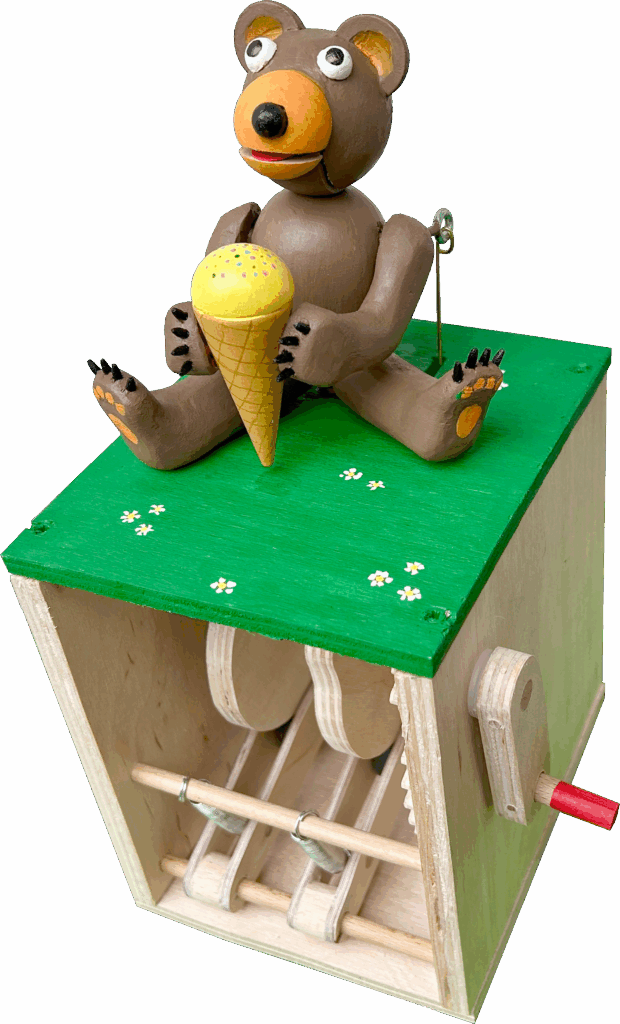
    A Nice Bear
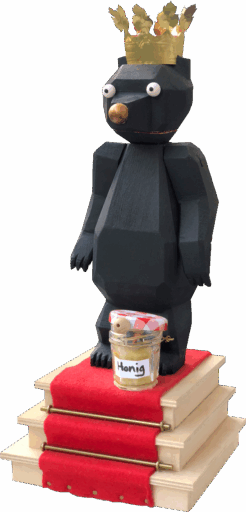
    Not a nice bear

    Why a Nice Bear?

    A few years back I made a bear modelled on the Berlin coat of arms, including a recorded sound of a rear bear roaring. To my surprise, this quite frightened children who triggered the bear’s sequence of movements by opening the lid of the honey pot. Nature has obviously preprogrammed us to stay clear of bears when they are roaring.

    When that bear’s Arduino controller went berserk and the movements uncontrollable, it thus wasn’t too painful to consign this first bear to the back of a shelf in the cellar, rescuing the controller for some future project. With that in mind, I decided that it was time to make a nice bear instead. Moving one space in the name, this becomes an ice bear. Perfect! Off to the workshop to make a bear enjoying some ice cream!

    Making the Figure

    Parts of the bear’s head

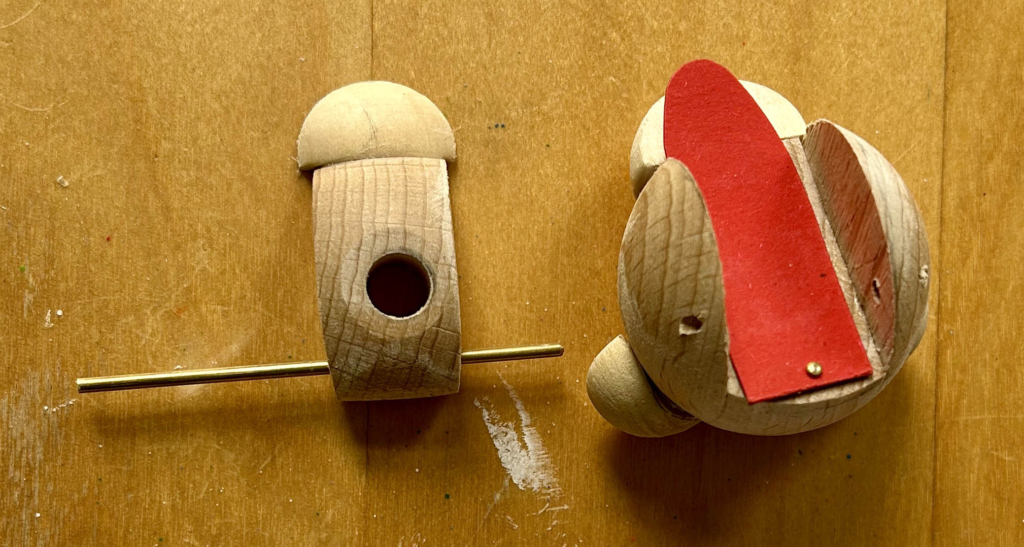
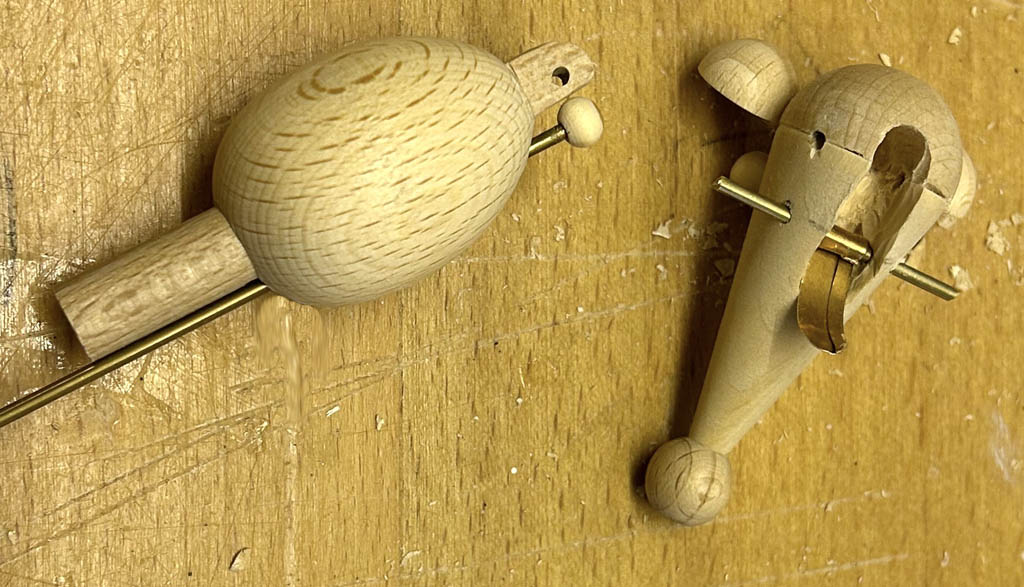
    The bear’s head had to include a moving jaw, so that she can have a good lick at the ice cream. I took a new approach to this, starting by cutting a wooden sphere into three slices. The two outer slices become the bear’s cheeks. I cut the thicker central piece into two parts – the jaw and the top of the head. To exaggerate the movement, the jaw does not move, but everything else does, pivoting around a 2 mm piece of brass rod.

    Head in two pieces

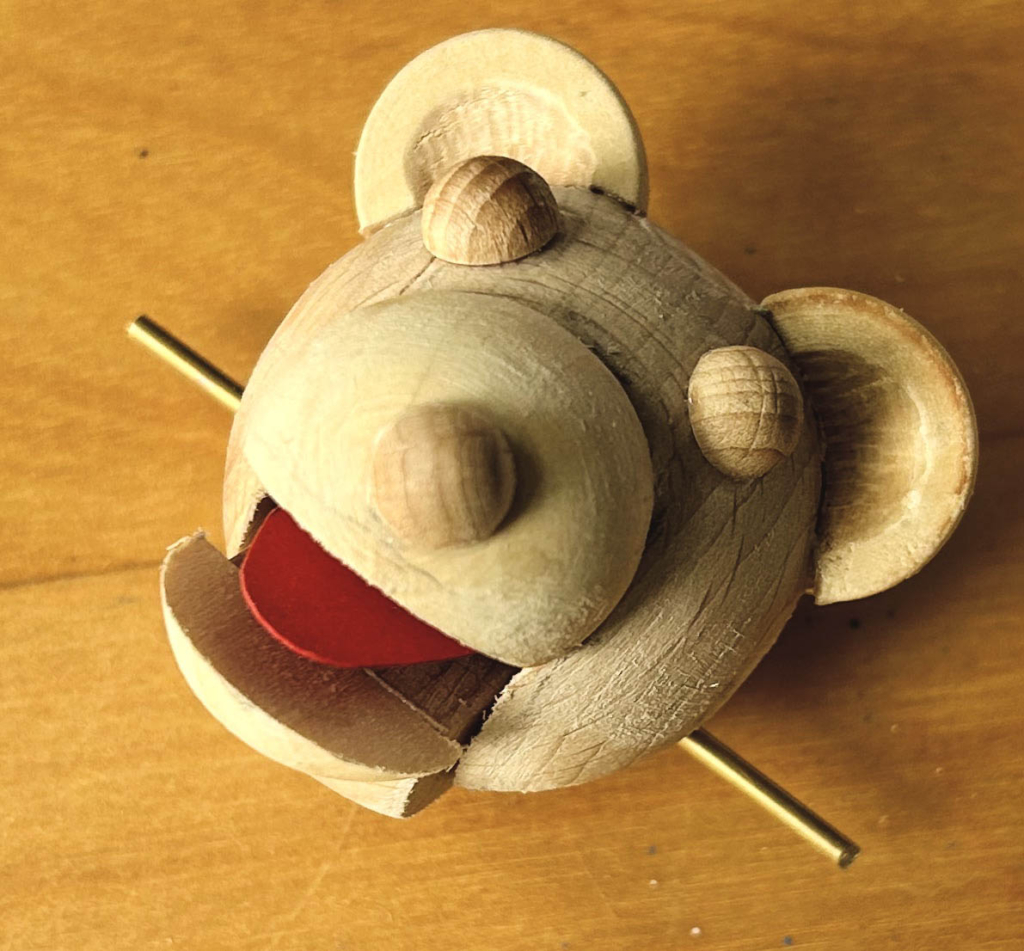
    I added a wooden hemisphere to the face, to make the bear’s snout and a piece of red card for a tongue.

    Assembled head

    Three smaller hemispheres provide a nose and two eyes. The ears are from two medium-sized hemispheres, carved into an ear-like shape. At this point, the head looks quite like a teddy bear.

    Head, body and ice cream cone

    A wooden egg serves as the bear’s body and a wooden cone from the hobby shop is perfect as an ice cream cone. The arms will be attached to a piece of dowel fitting loosely in the body.

    Modelling the legs in plastercine

    Some plastercine is handy to model the bear’s legs. They show what size to cut and carve lime wood to be glued to the bottom of the body.

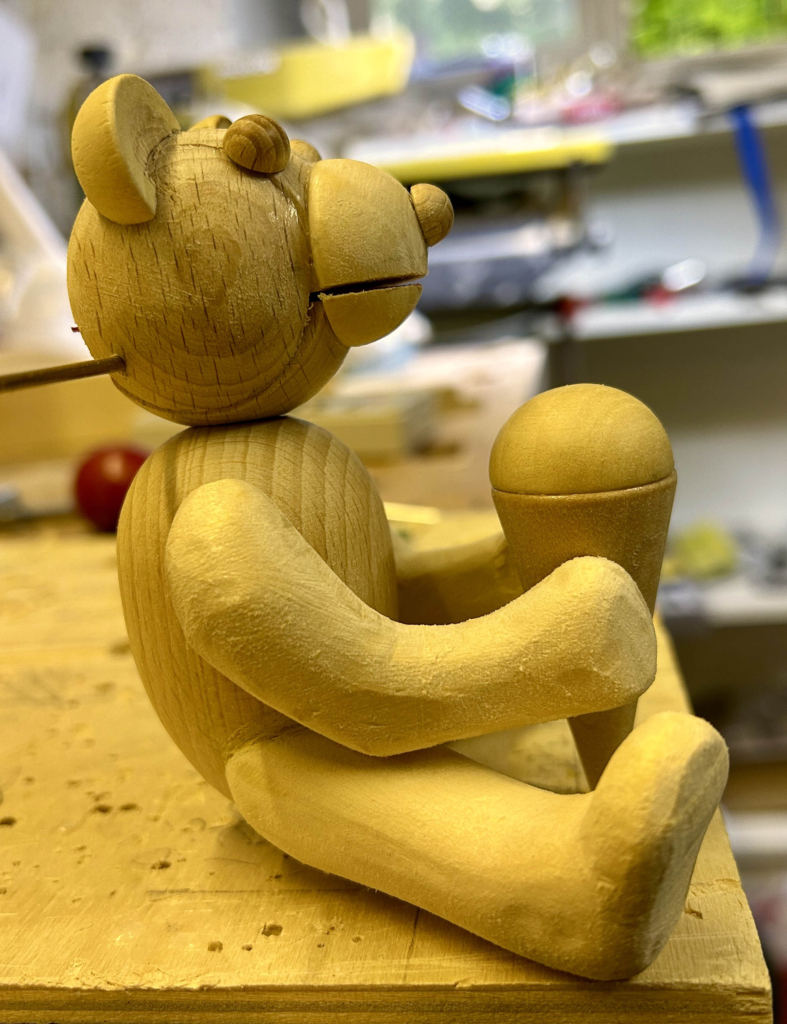
    Bear with arms and legs

    A plastercine model is even more helpful to shape the arms correctly so that they can hold the ice cream cornet. The final touch is provided by some 2 mm dowel sanded and cut to make some claws. However nice our bear is, she has to be able to defend her ice cream!

    Making the Base

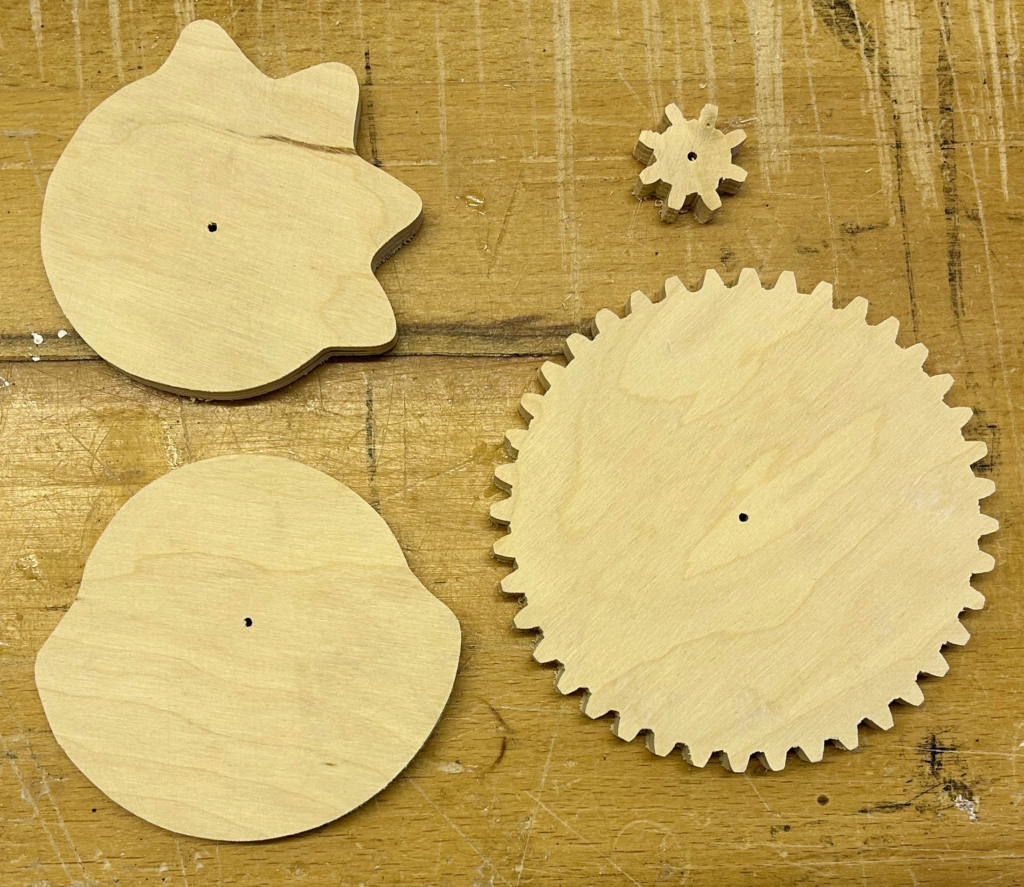
    Two cams, two cogs

    I used some software (Graphic for Mac) to draw two cams. One cam to lift the arms once per cycle, and one cam to open the jaw four times per cycle. The movement was about 1 cm per cam. I glued paper printouts to some 8 mm plywood and cut out the shapes with my scroll saw.

    For the cogs, I used the marvellous Woodgears page https://woodgears.ca/gear_cutting/template.html with 8 mm tooth spacing to make one 40 tooth cog and one 8 tooth cog. This means that you have to crank 5 times to go through a whole cycle, rotating the cams by 360 degrees.

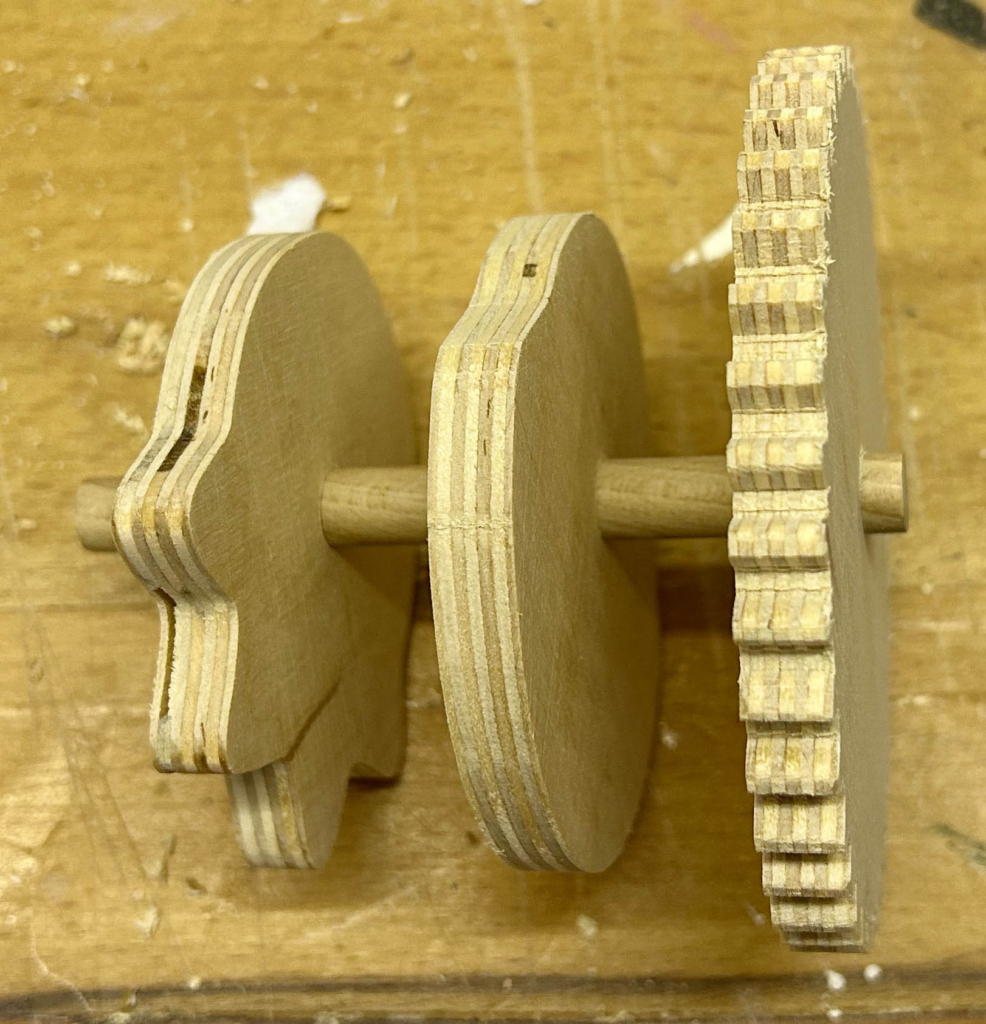
    Main shaft with two cams and large gear wheel

    Some 8 mm dowel serves as the shaft to link the cams to the largest cog.

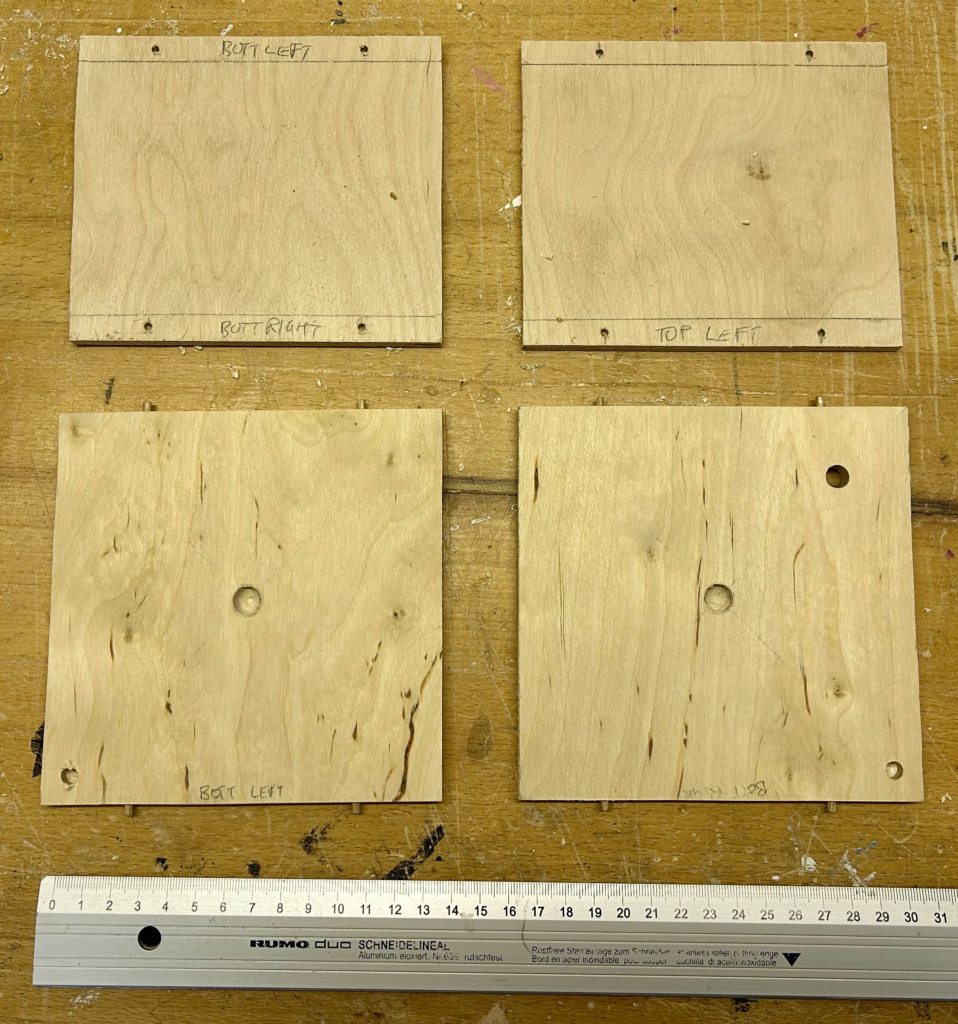
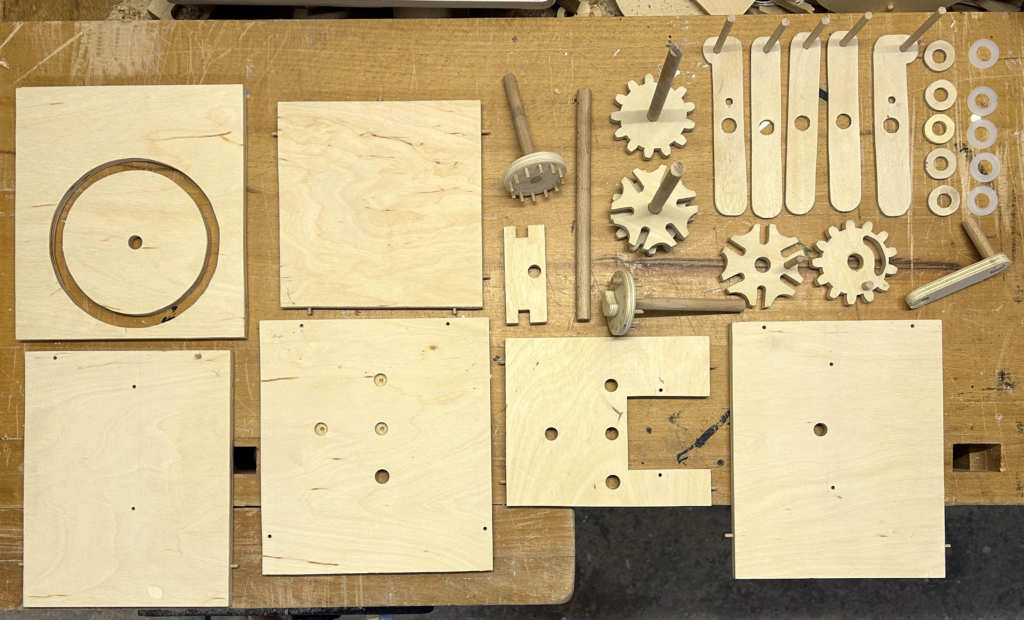
    Four parts of the box

    Once I knew how big the bear was and the side of the cams & cogs, I could size the box accordingly. To permit frequent assembly and disassembly, these parts are not glued but pinned together with 3 mm dowel.

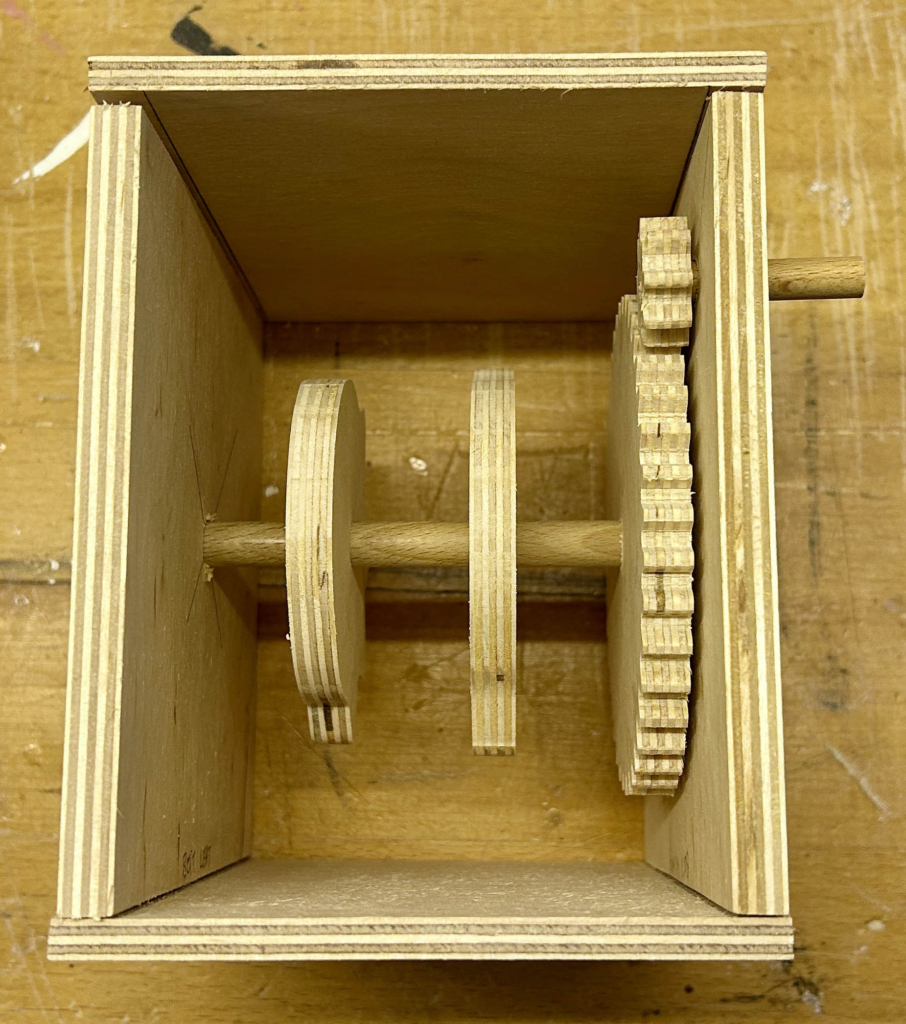
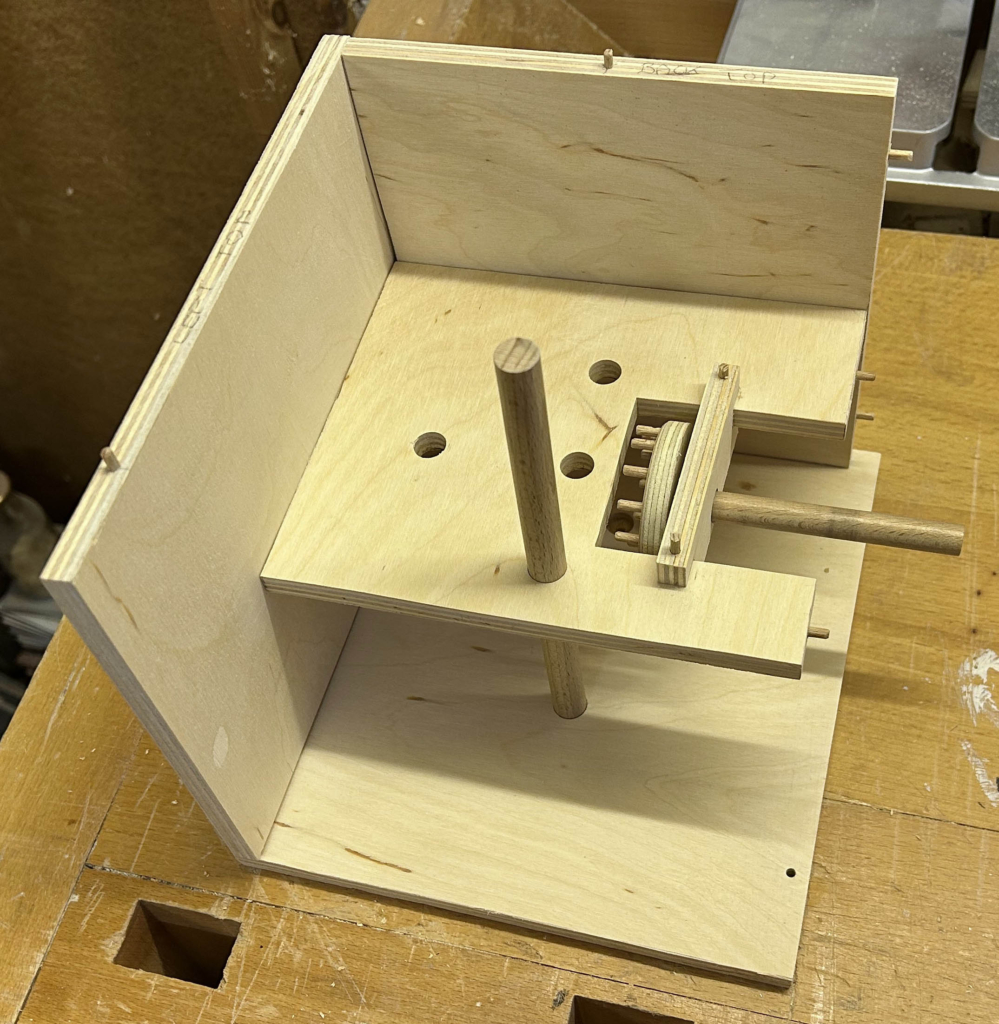
    Partially assembled base

    Things can now turn quite nicely. Now we just need the levers which are actuated by the cams.

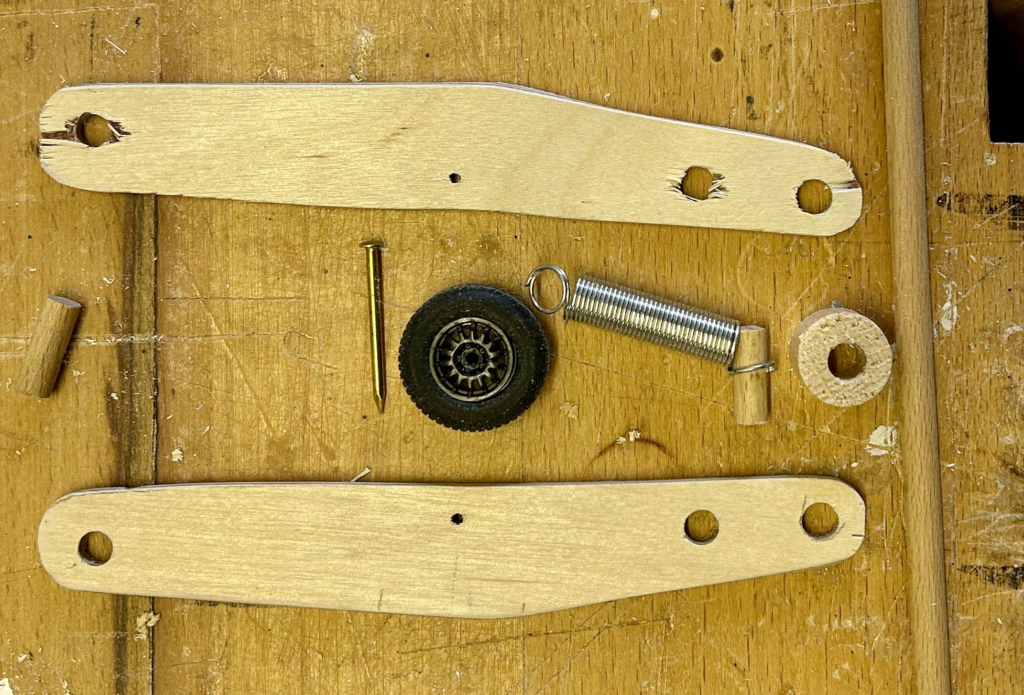
    Parts for each lever

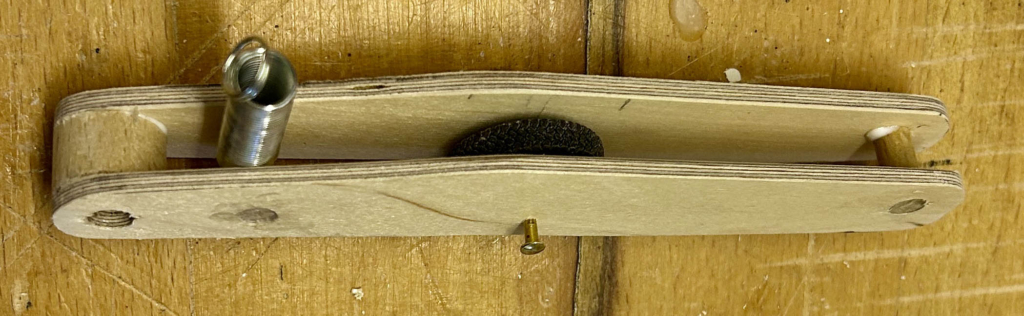
    I found some black wheels at the back of a drawer and I thought, they will do very well to run around the curves on the cams. A spring will hold the lever against the cam as it turns.

    An assembled lever
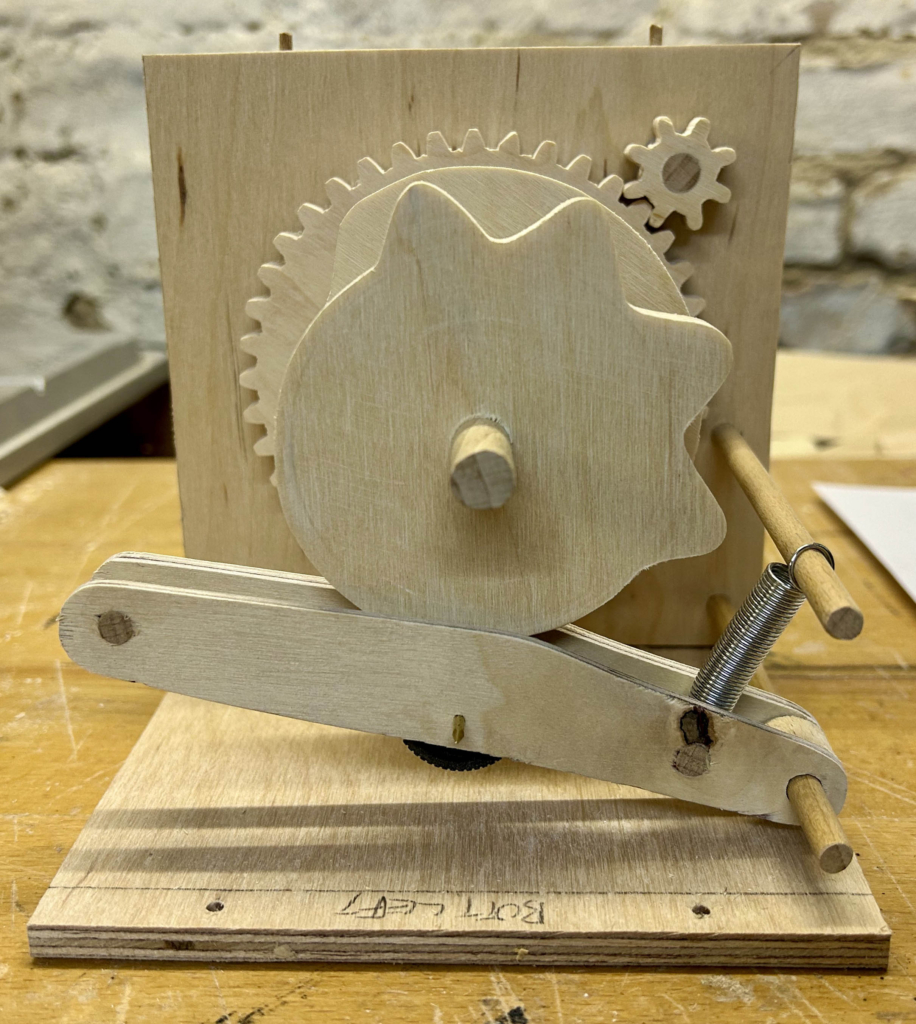
    One lever fitted

    Two more dowels have appeared in the box; one as a pivot for the levers and one to attach the springs.

    Adjusting the movement

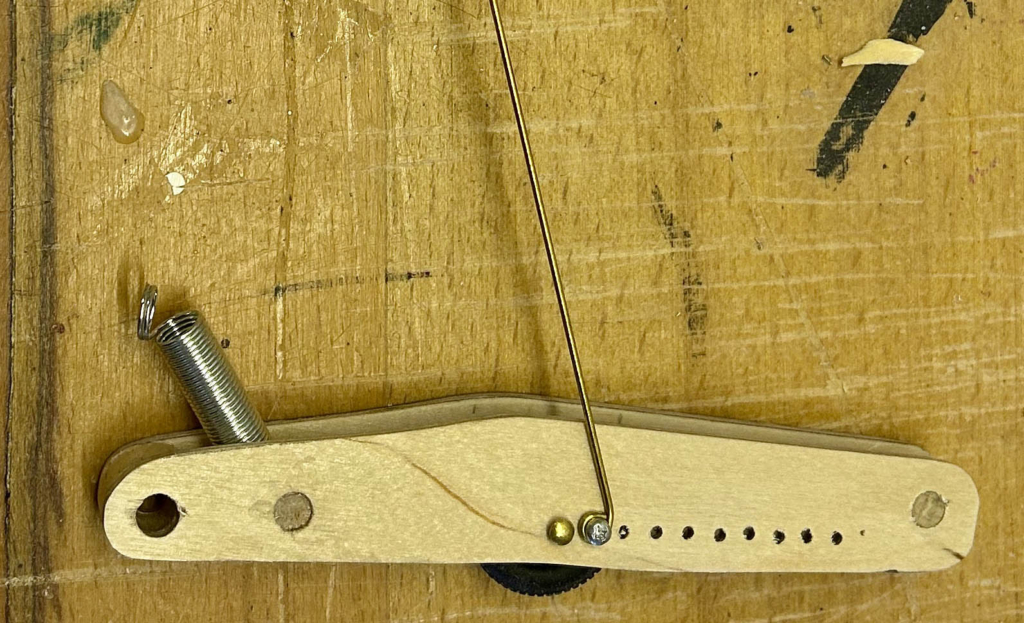
    I had guessed that the movement would be about 1 cm, where the wheel touches the cam. To adjust the actual movement, I drilled a series of holes in the lever and used trial and error to select the hole which provides the best movement. The further along each lever, the more the brass actuator rod moves.

    Actuator rods connected to the levers

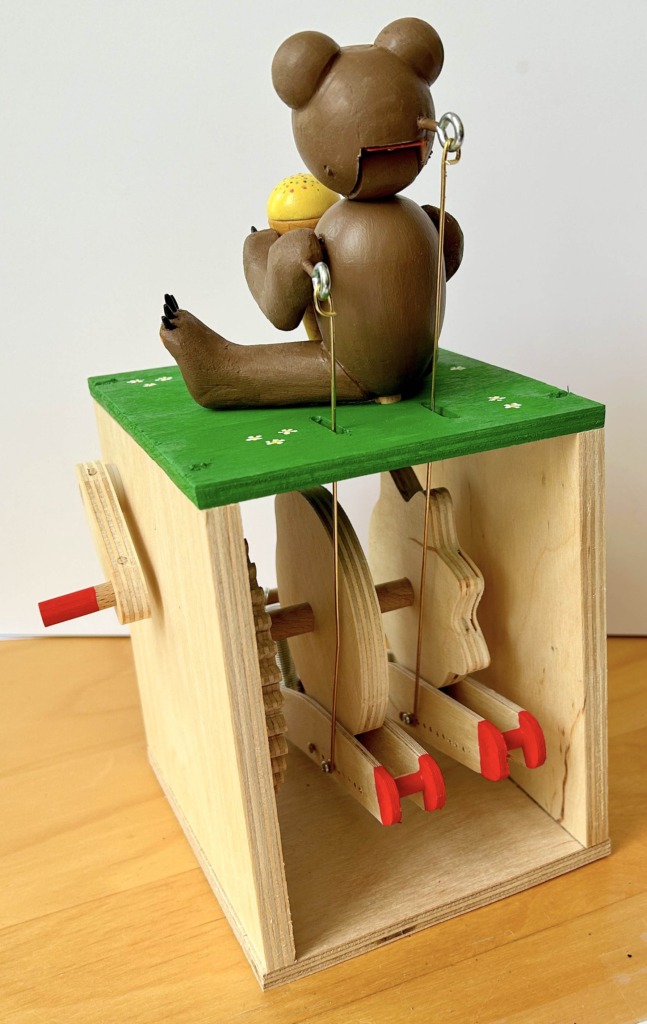
    So, as the crank is turned the cogs turn and the cams turn. The cams press the levers down which tug the brass actuator rods down. These open the bear’s mouth and lift her arms, which hold the ice cream. When the fixed sequence becomes boring, you can reach around the back and press the levers down yourself, perhaps to make the bear talk and explain what she is doing there. Red paint shows where to press.

    The last act was to screw the top and bottom of the box to the sides. Should a repair become necessary this means that dismantling should be fairly simple.

    Reflections

    I am quite pleased with how the mechanism works. The wheels which I discovered have rubber tyres, which ensure a very smooth and quiet cam action. The bear’s jaws also work well. Cutting the wooden sphere into four pieces was definitely an improvement over my previous method of using a coping saw to directly cut out the jaw. The base is however quite large in comparison to the bear. This is due to the size of the large wooden cog. I could shrink that by using smaller teeth, but smaller teeth would be more fragile. As the mechanism is intended to be part of the show, I guess that it is actually Ok for it to be that size.

    Video

    Video URL https://www.youtube.com/watch?v=RuqlEUFUb7Q

    Images

    Images

    Download here https://www.wordwise.de/Nice_Bear_Archive.zip

  • At Snail’s Pace

    At Snail’s Pace

    The Idea

    An old English nursery rhyme from my childhood came into my mind one day –

    Hickory dickory dock.
    The mouse ran up the clock.
    The clock struck one,
    The mouse ran down,
    Hickory dickory dock.

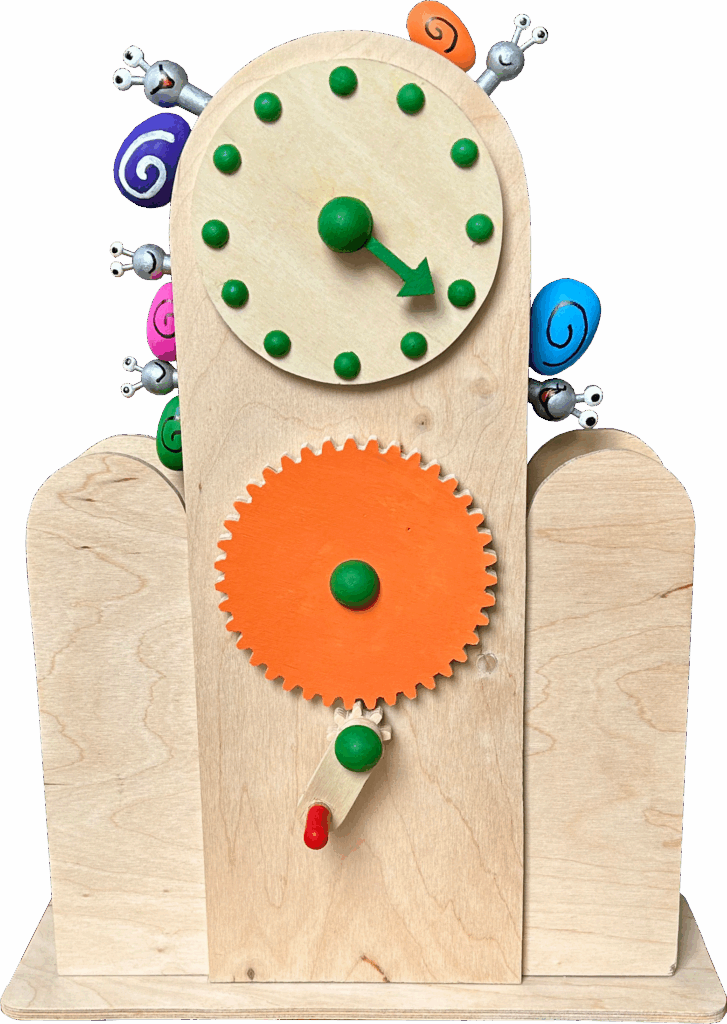
    I thought that would be fun to make, so I looked for an easy way to make a mouse run up and down a clock. Searching around the Internet, I found a page showing a wooden tank, with caterpillar tracks https://woodgears.ca/tracked_vehicle/index.html including a link to some plans, which got me started. It seems like quite a jump from a tank to a slow tour around a clock, but it is essentially a chain made of wood. Along the way, the mouse transmogrified into a snail and not just one snail, but a whole family on an outing. Being snails of course they had to glide very slowly along. Snails have the advantage of having no legs, so I didn’t have to worry about any walking movements. Snails, slimy things that they are, are also surprisingly popular amongst the children that I know. Now the scene was set and I could set about making.

    Making

    Two sprockets

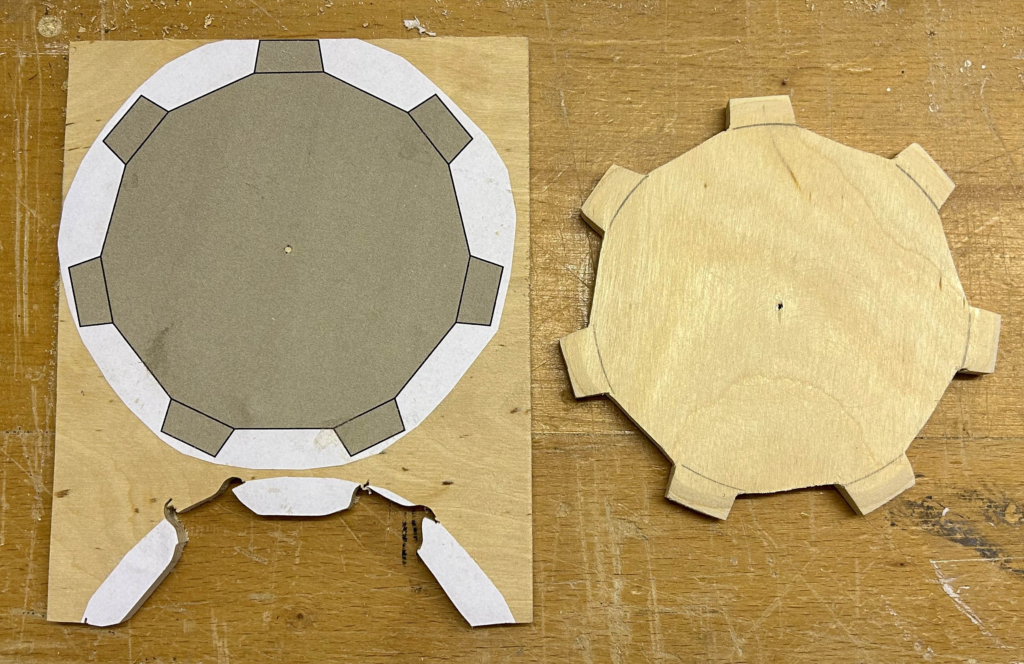
    I copied the design for the sprockets from Matthias Wandel’s marvellous Woodgears page https://woodgears.ca/tracked_vehicle/plans.html. I printed out two copies onto paper, lightly glued them onto some plywood and cut them out with my scroll saw.

    Parts for one segment of the chain

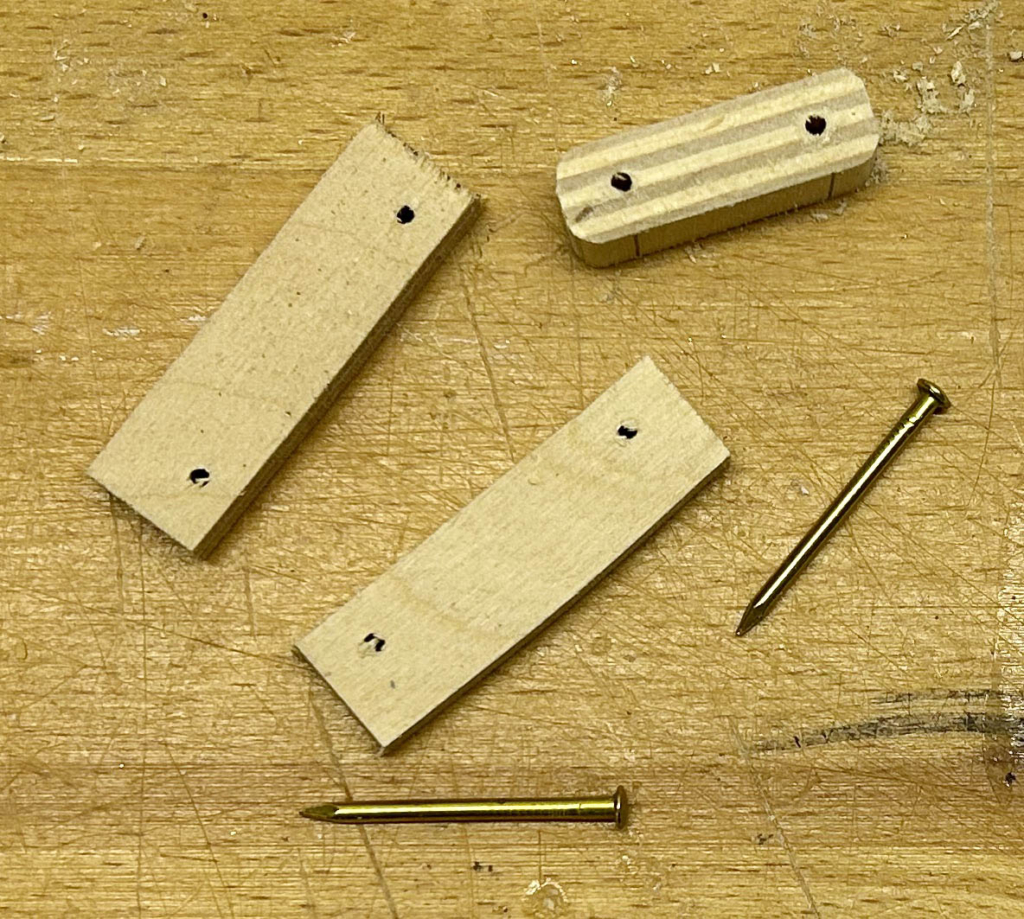
    I used the dimensions from the same plan as the starting point for the links in the chain, tweaking the values by trial & error until they fitted well onto my sprockets on the workbench. I took care to then keep the hole spacings as consistent as possible.

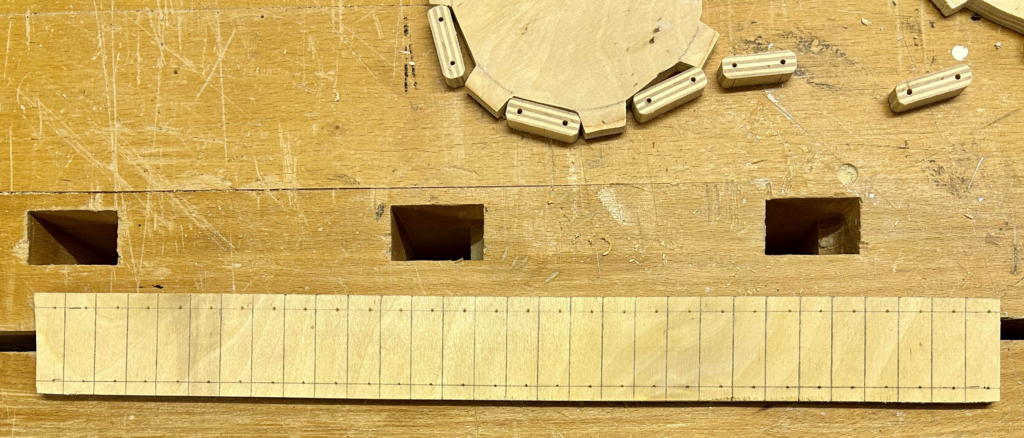
    Marking before cutting for consistent hole spacing

    30 chain segments seemed to be about right.

    Assembling the chain

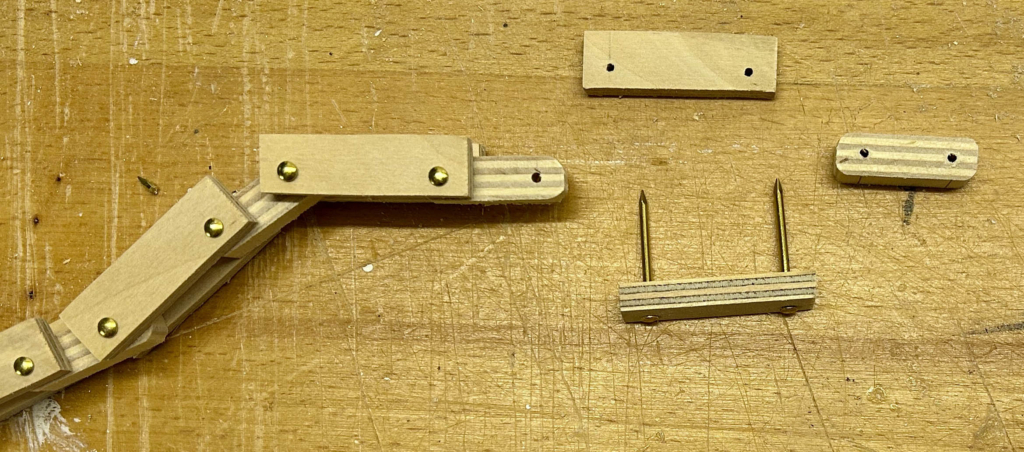
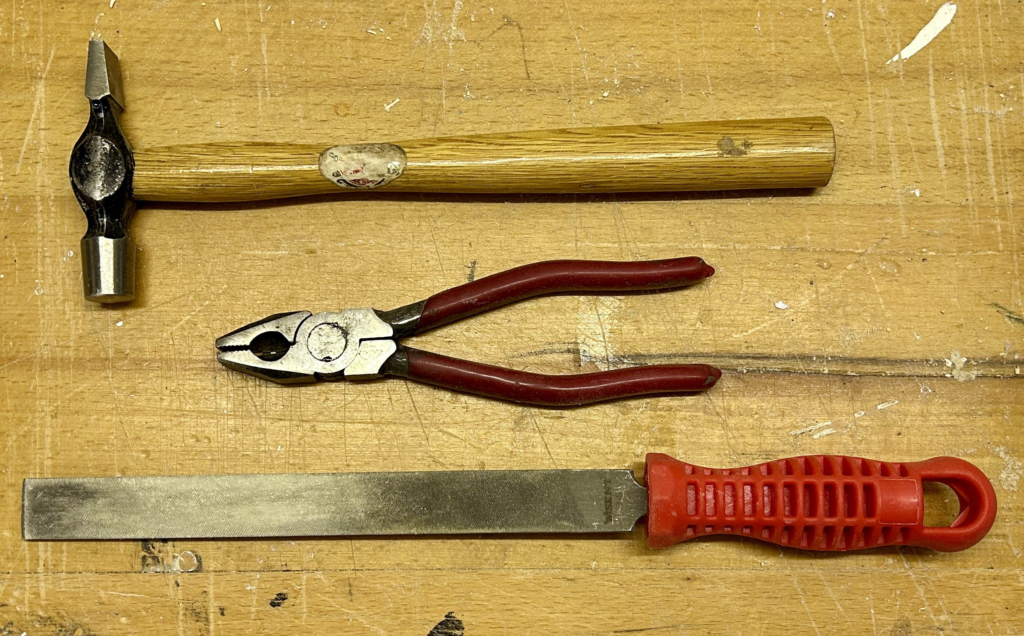
    The holes drilled in the side pieces provided a tight fit for the brass nails. Slightly larger holes made for easy movement of the internal parts of each segment, allowing the chain to flex easily. The nails were a bit too long, so I cut them down with pliers and then filed the cut end until it was flush with the surface of the wood.

    Tools to assemble the chain

    Once the chain was fully assembled, I sanded the sprocket teeth until everything seemed to move freely.

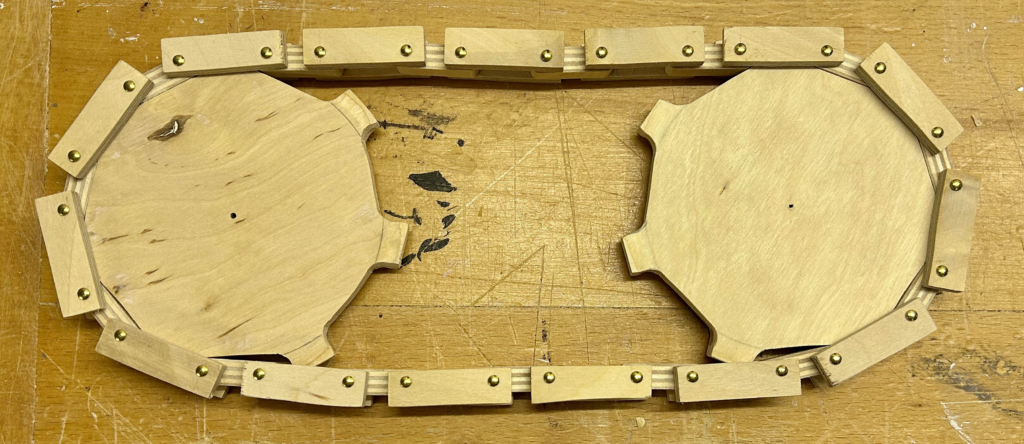
    The assembled chain on two sprockets

    It now looks like a primitive bicycle chain, but I am going to turn it through 90 degrees and use it vertically, the sprockets now fitted to 8 mm diameter dowel.

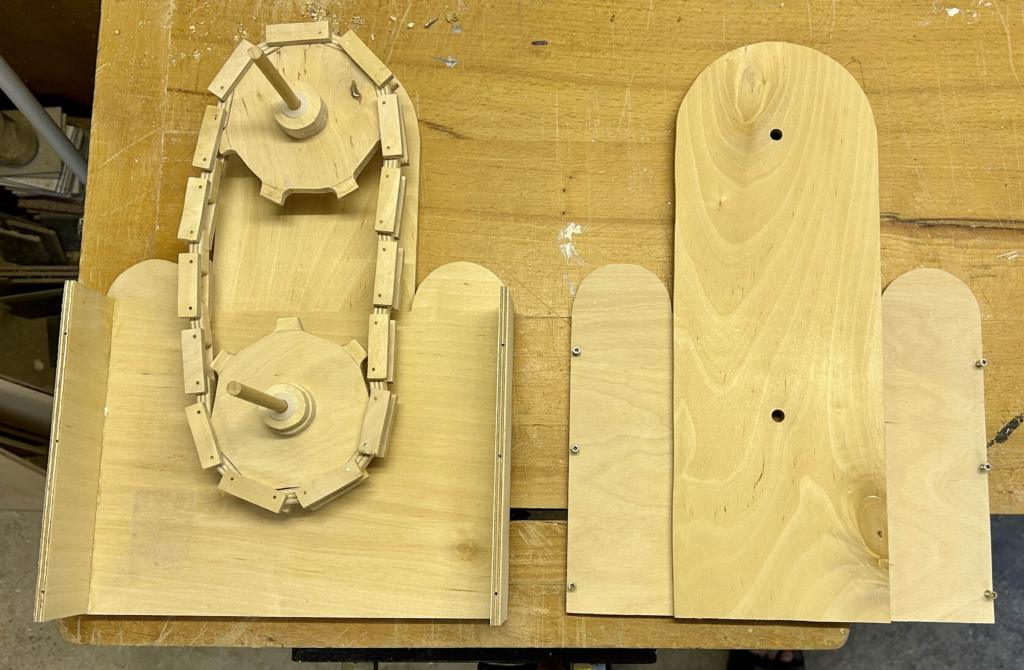
    Two halves of the clock case with the chain

    The clock case has space all around the chain to allow free passage of the snails. Once the case is closed, there is enough space for the whole snail family to wait out of sight.

    The internal drive gears

    The lower chain sprocket is driven by the larger cog, which is itself driven by the small cog. The difference in size means that sprocket turns more slowly than the small cog.

    Sprockets and chain fitted

    When I tried the mechanism at this stage, the chain moved much too quickly when the small cog was turned, so I had to slow the small cog down.

    Slowing the small cog down

    To slow the small cog, I added a large cog, outside the case, visible on the front. This external, large cog is driven by a second small cog, which is also outside and visible from the front.

    The small external cog attached to the crank handle

    This slowed things down nicely to a snail’s pace.

    The external gearwheels and the crank

    Showing external gears also reinforces the idea of a clock and adds moving interest.

    The Snails

    Making snails

    As I wanted to make a family of five snails, two big and three small, I chose a easy-to-make design using wooden eggs and balls.

    A painted snail

    With a twirl of paint, I could suggest the spiral shape of a snail’s shell. Attached to a small piece of plywood, two screws are then sufficient to fix our snail to one segment of the chain. After asking three children what it is, they all replied “a snail”, so I was happy with my minimalist approach.

    Positioning the snails to wait out of sight

    I spread the family of snails around so that they could all hide inside the case, ready to surprise a new viewer who turns the crank to make them slowly rise up the side of the clock. I thought about adding a ratchet, to limit the direction of rotation, but my first five-year-old test candidate immediately noticed the pointer on the clock face and insisted that it must turn clockwise or it wouldn’t be a real clock. Who can argue with that? So I left it so that you can turn the crank whichever way you fancy.

    Reflections

    With the second, external set of gearwheels, the snail family glide sedately out of their hidey-hole to enjoy some time at the top. There is something very comforting about their pace of life, taking things easy and being in no rush at all to get anywhere. Perhaps it’s a challenge – how slow can you go? Even on their way down from the pinnacle, they are happy that their time will come again and can patiently wait for their next turn.

    Video

    Link https://youtu.be/C2_sA1XB9_E

    Images

    Download here https://www.wordwise.de/Snails_Archive.zip

  • The Rocking Robot

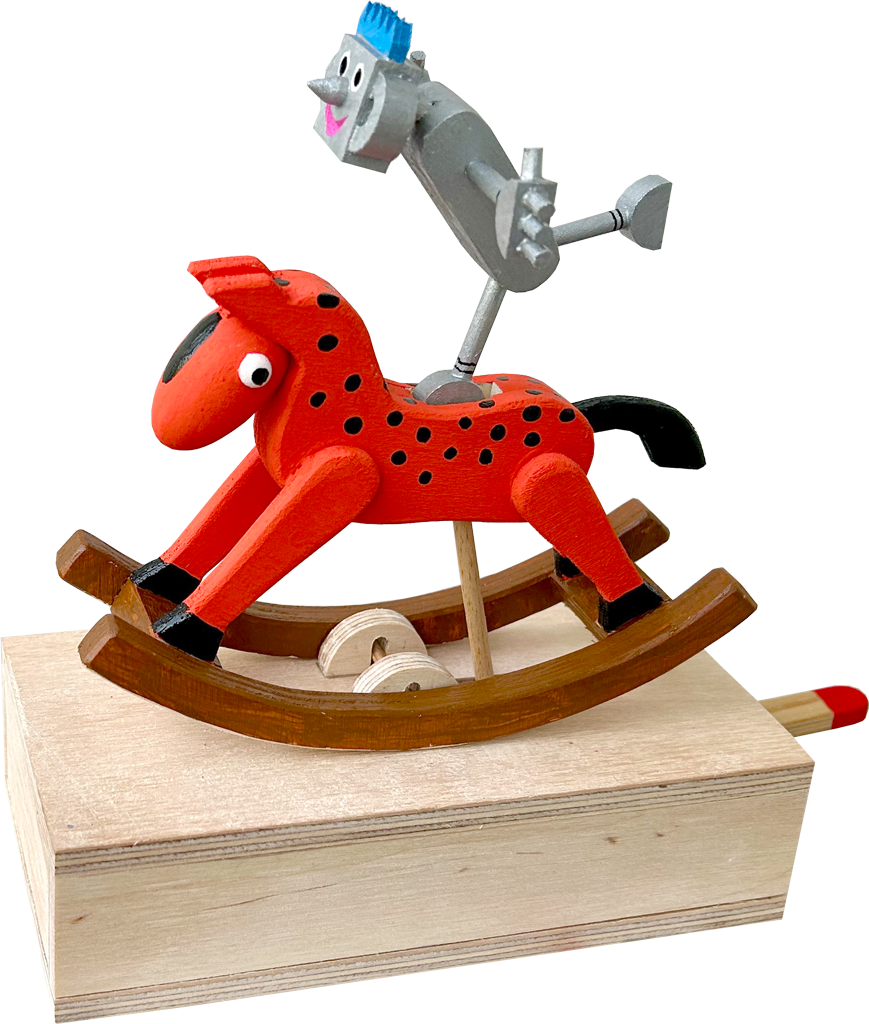
    The Rocking Robot

    Background

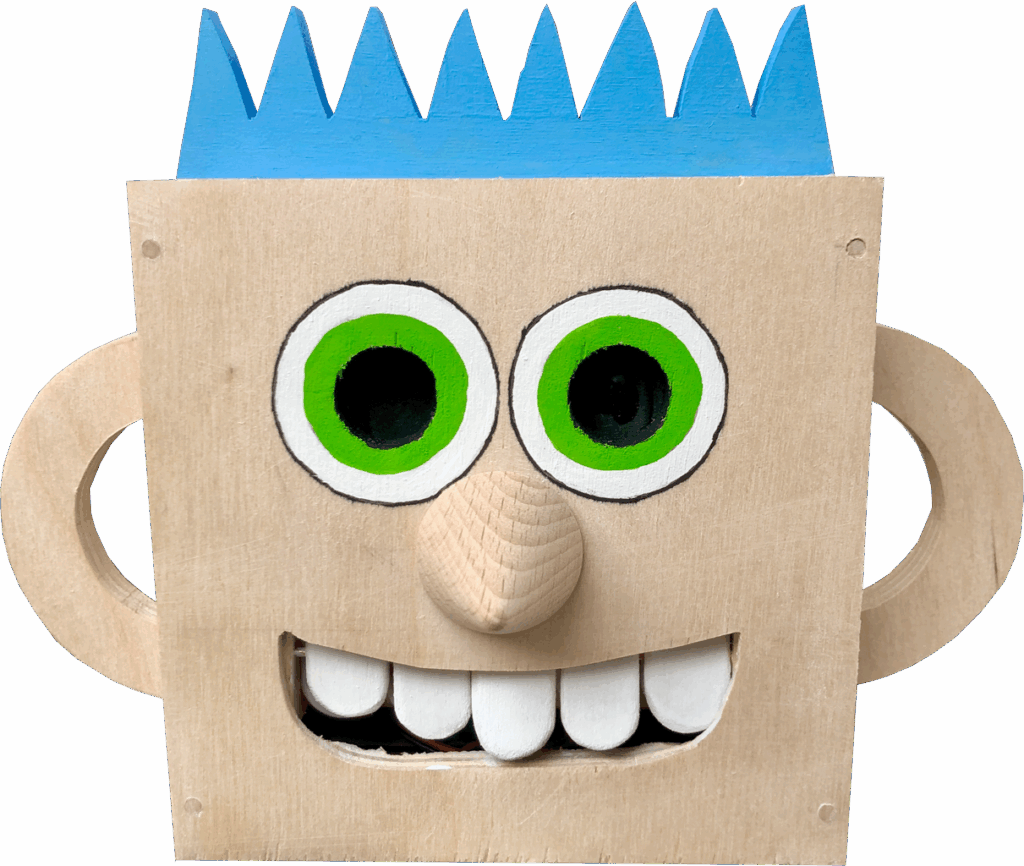
    The Music Man

    To provide music for my silent automata, some time ago I carelessly knocked up The Music Man. This isn’t an automata, you just push one of his teeth and 60 seconds of cheerful fairground organ music are played. The pupils in his eyes are actually the openings for the loudspeaker, driven by an off-the-shelf audio recorder/playback module. Each of the five teeth plays a different tune. I then thought that this actually turned out to be quite a happy character, so I decided to reuse the idea in something that actually moves.

    For the movement I thought that I would place him bareback on a rocking horse, carefully balancing on one leg, as if cantering around the ring in a circus. A rocking horse has the advantage of staying put as well as being something of a curious, historic toy. Horses may once have dominated the streets in our cities, making them obvious subjects for childrens’ toys. These days you are just as likely to see a unicorn as a horse clip-clopping its way through central Berlin.

    Making

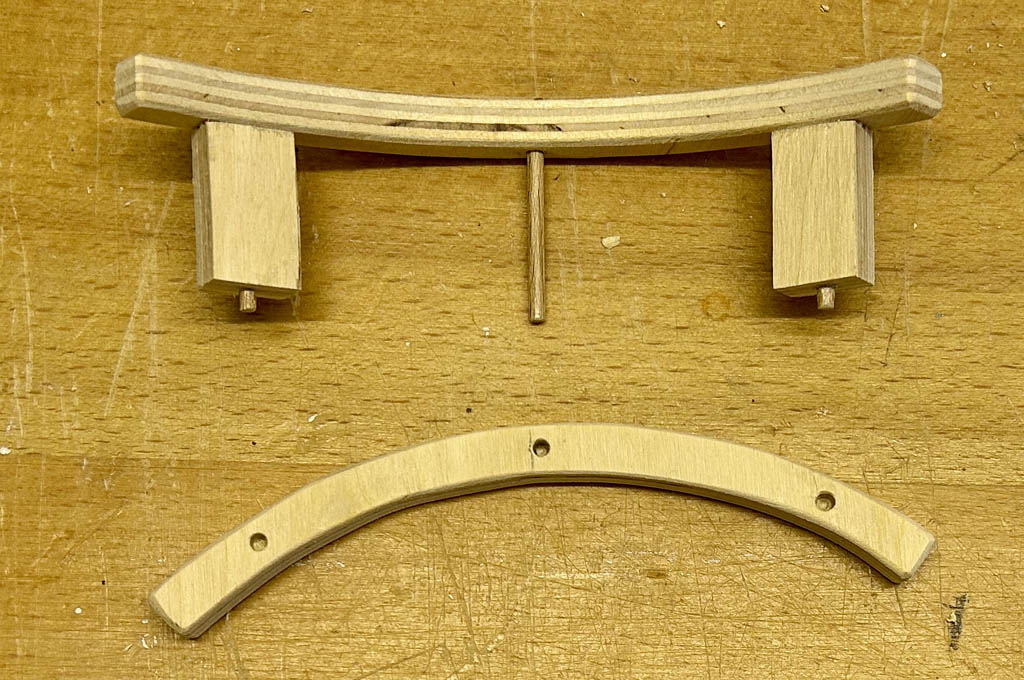
    Rails for the rocking horse

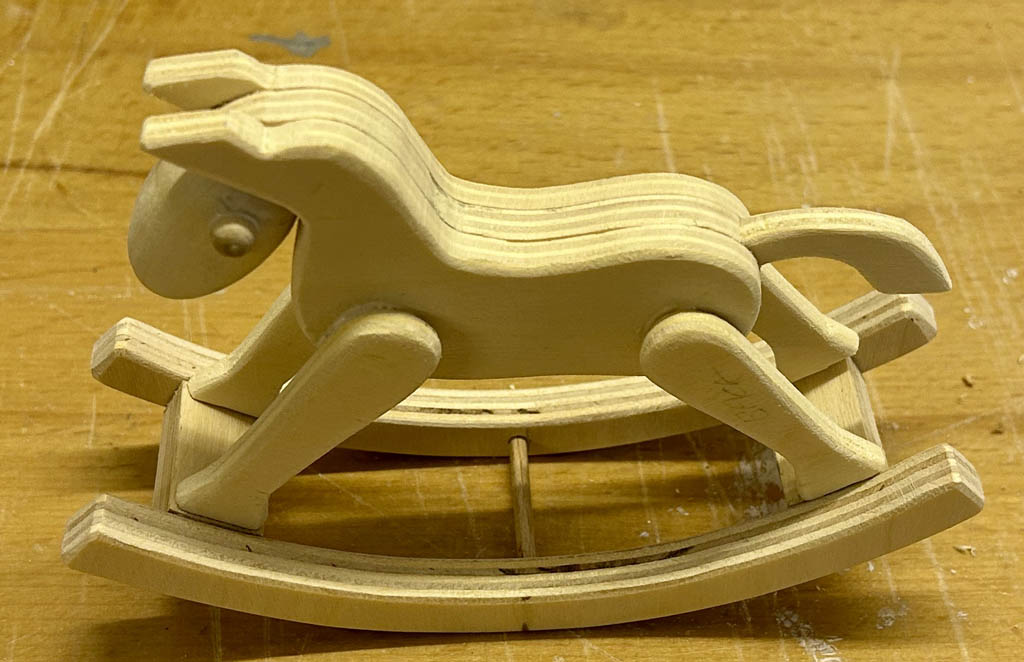
    I used a pencil compass to draw two arcs for the rails. The central dowel is to keep the horse in place in the centre of the box.

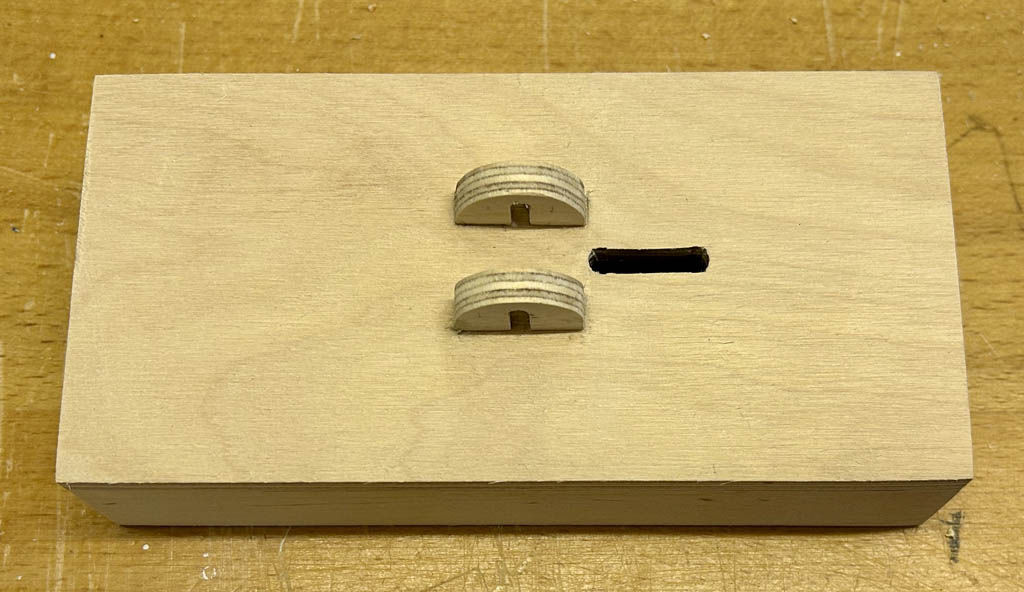
    The base

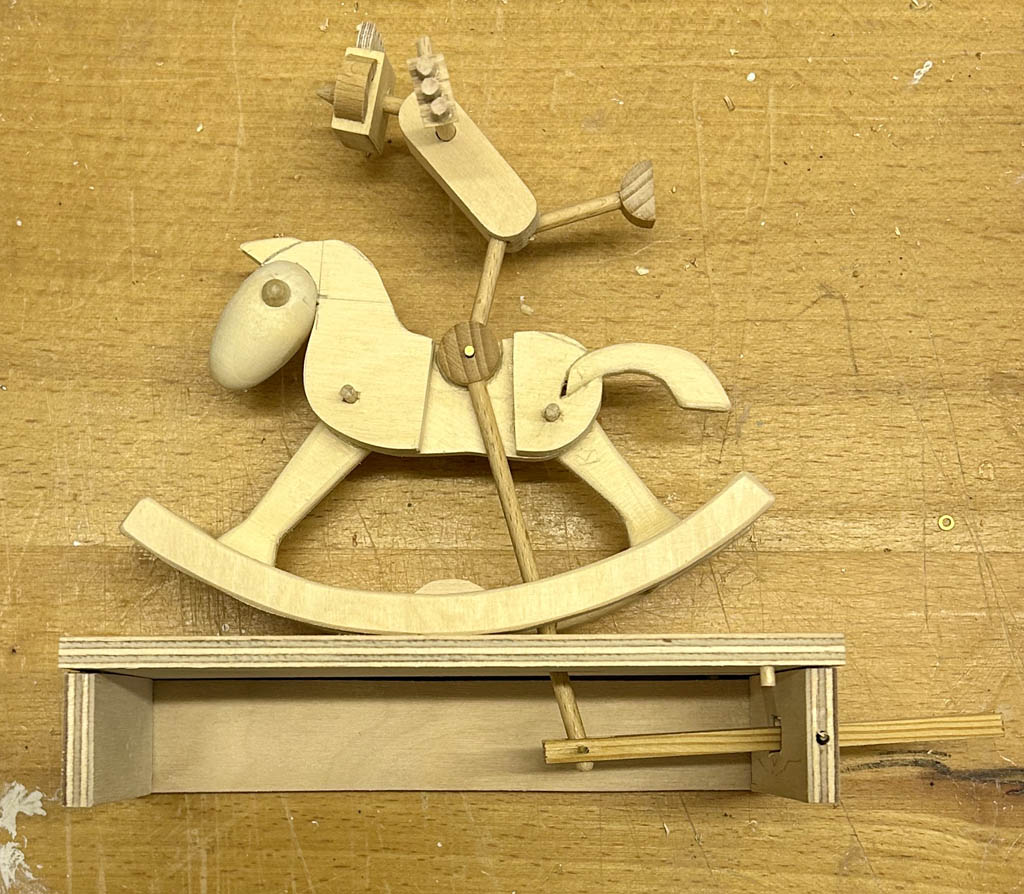
    The base has two hemicircles with vertical slots to accommodate the central dowel. As the horse rocks the central dowel moves up and down as you can see in the video. The slot is for the pusher rod.

    The assembled rocking horse

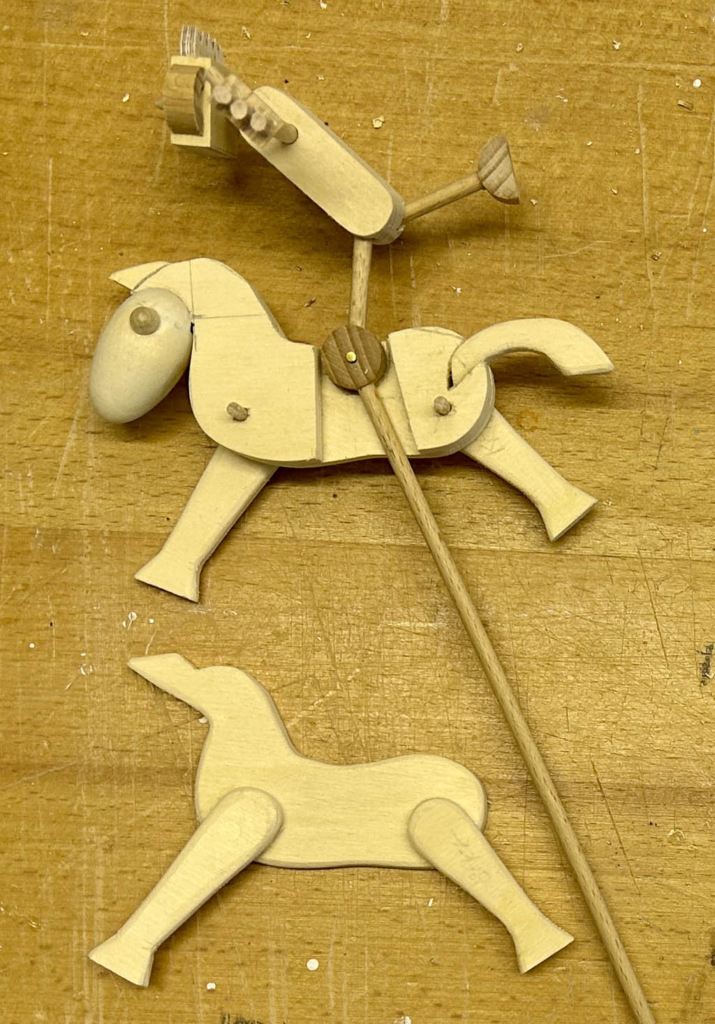
    The horse’s body is made of three pieces of plywood and a wooden egg for the head, pinned together with 3 mm dowel, making it easier to cut a hole in the middle for the mechanism.

    The horse assembly

    I originally thought that a lead weight would keep the rider standing on the horse’s back upright as the horse rocked to and fro. This proved more difficult than I thought, so I gave up that idea and linked the small robot figure to the pusher rod instead.

    Sides removed to show mechanism

    The operating lever uses hinges made from 1.5 mm brass rods.

    The End Result

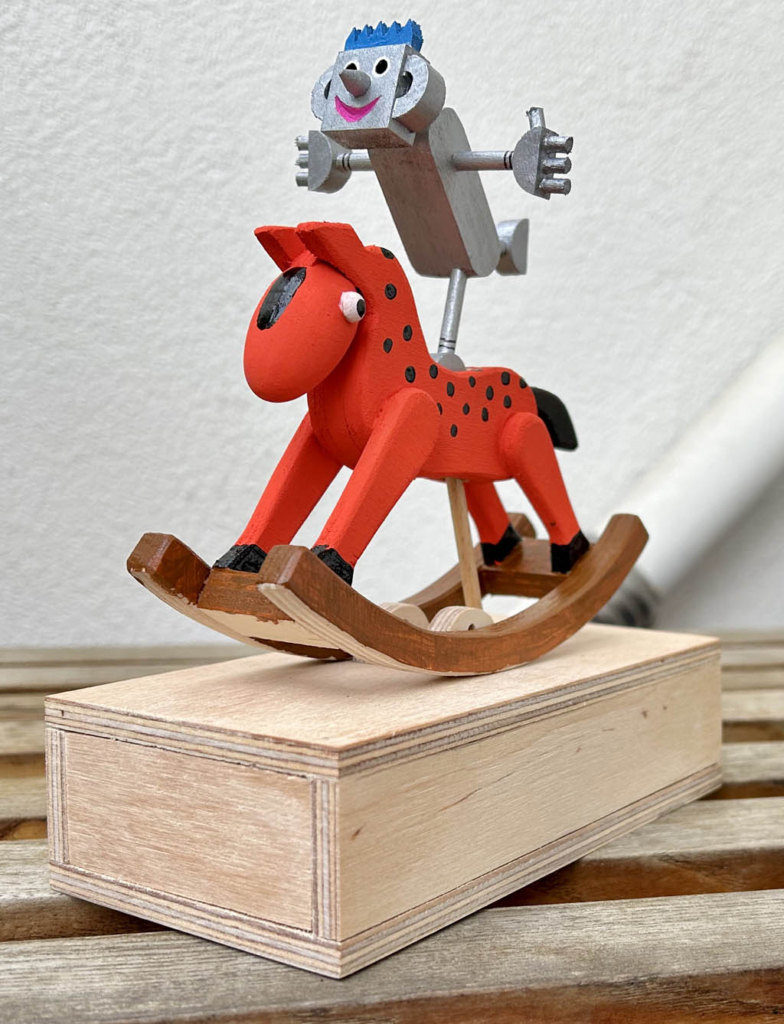
    The end result

    The horse rocks very nicely, but I’m not really happy with the movement of the robot. I would prefer the robot to respond more to the movement of the horse , as if it were human, trying to maintain its balance. Maybe some day I will have another go, using this as a reference, perhaps returning to my lead weight idea to see if that improves things. The setting is fine; the idea of a mechanical man trying bare-back riding on a rocking horse is satisfyingly whimsical.

    Video

    Link to video https://www.youtube.com/watch?v=NE_BAbGzjkY

    Download

    The image files can be downloaded here https://www.wordwise.de/Rocking_Robot_Archive.zip

  • The Flying Clothes Peg

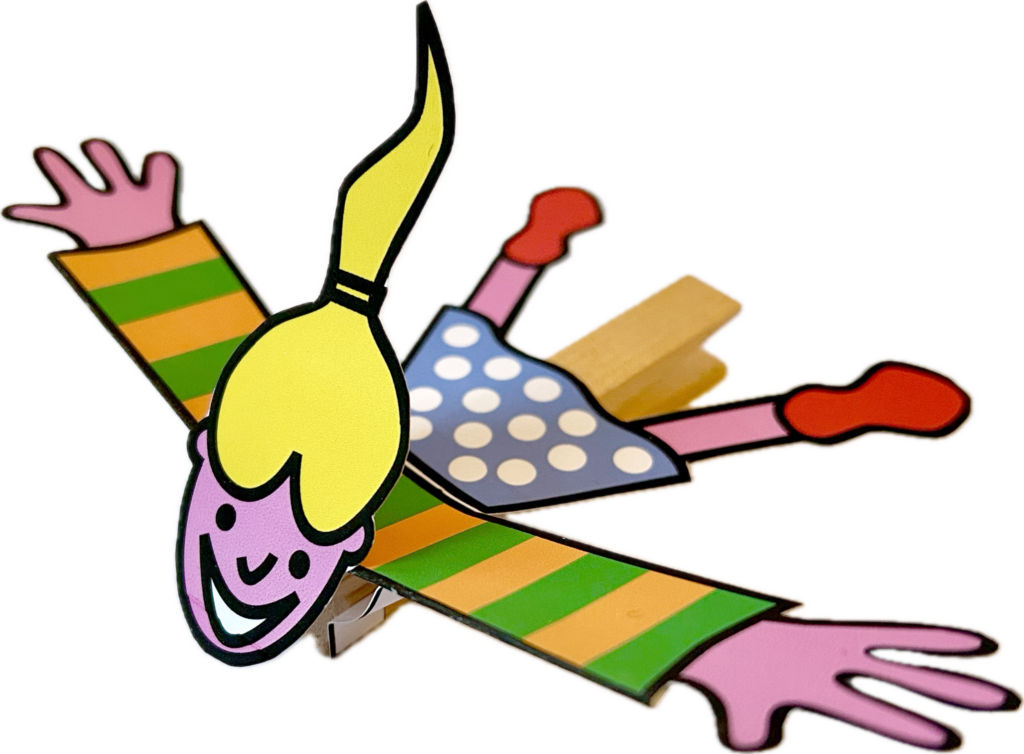
    The Flying Clothes Peg

    Introduction

    I was recently asked to produce some instructions for a moving butterfly using a clothes peg/pin to accompany a small exhibition of automata at the excellent Imaginata museum in Jena, Germany (https://imaginata.de). After the visitors have had fun interacting with the automata on display, the idea is that they should have the opportunity of making their own, very simple automata, on a table in the exhibition space. Obviously it shouldn’t cost too much, whilst showing that it’s not rocket science to get things moving, and that you can use everyday objects which aren’t too hard to find.

    Here’s what I came up with.

    The Materials

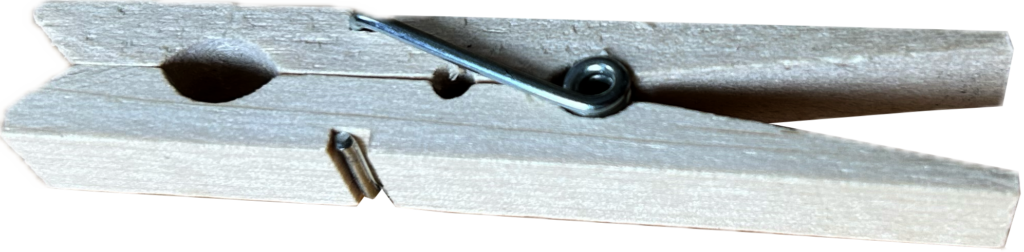
    A wooden clothes peg/pin about 7.3 cm long

    If your clothes peg is a different size, you may have to scale the pattern to match.

    A glue stick
    Coloured felt tip pens
    A stack of patterns printed on 175 g matt A4 paper
    Scissors

    The Pattern

    You can download the pattern in PDF format here (ADD LINK), or in JPEG format here (ADD LINK). If you don’t use A4 paper, you could edit the JPEG file to fit on your paper size. The same applies if you want to use a language other than English. When printing, use at least 175 g paper.

    Instructions

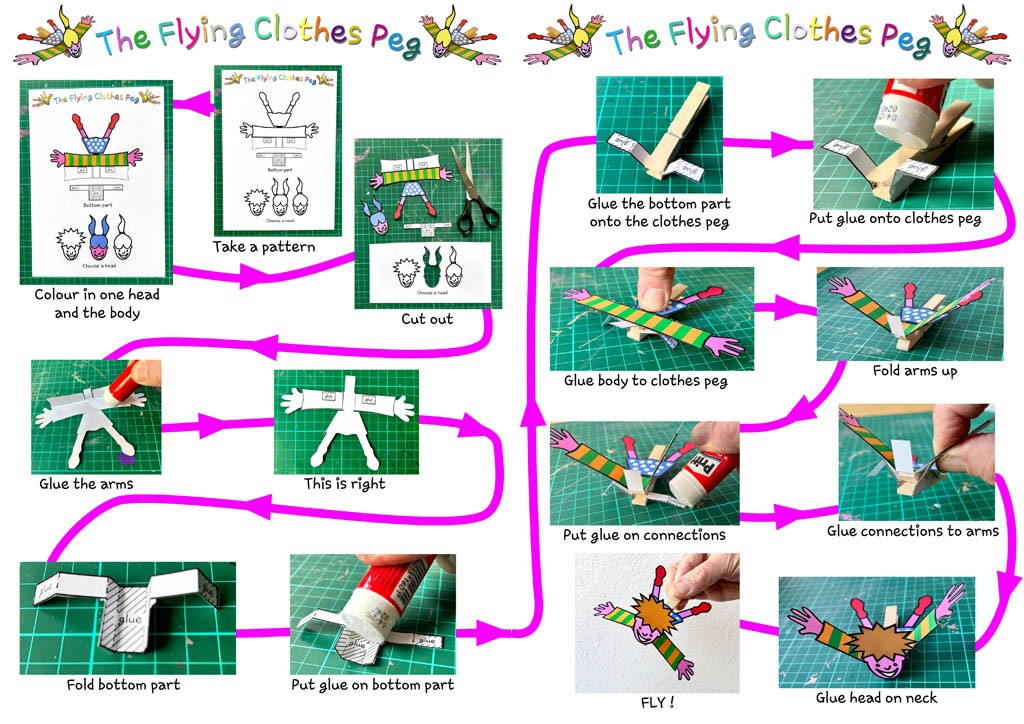
    Instructions to make a flying clothes peg

    There are two A4 pages of instructions which you can download in PDF formet here (ADD TWO LINKS), or in JPEG format here (ADD TWO LINKS). If you don’t use A4 paper, you could edit the JPEG files to fit on your paper size. The same applies if you want to use a language other than English. Note that I folded the arms to make them stiffer and flap more convincingly.

    Testing

    Before sending the instructions off to the Imaginata in Jena, I asked a 9 year old to have a go, which she was very happy to do. I had a finished example to show her and she seemed to immediately understand the idea. Colouring in the figure took a while as she considered what her best friend looked like and what colour clothes she wore. Filled with enthusiasm, she wanted to colour in both sides of the A4 pattern, holding the pattern against a window pane to be able to see the pattern through the paper. I then noticed that I should have suggested felt-tip pens instead of the waxy crayons which she had chosen herself. I doubted that the waxy surface would glue properly, so I helped her to avoid the areas where glue was required. She was happy with the finished product and decided to take it to her best friend’s birthday the very next day, together with a kit of parts for her friend to try it out herself.

    What Happened to the Butterfly?

    I was asked to make a butterfly, so what happened? Scouring the Internet before starting, to see if someone had already produced instructions, of course I found a video on Youtube. Looking at it, I thought that it was easy to make, if a bit uninteresting. The maker had also used a hot-glue gun which I considered too dangerous and messy for the young or the young at heart to use unsupervised. A glue stick seems to be a good alternative in this case, even if a few seconds of patience is required for it to stick sufficiently. So, I made a flying girl instead of a butterfly and my contact at the museum was happy to accept it, after making one himself to try it out.

    The pattern could be modified for all sorts of things. A butterfly, a bat, a dragon, a boy, a bird, a bee, a stingray, a dragonfly anything where flapping is required. I did think about a super-hero, but can you really imagine superman flapping his arms to fly around and save the world? How realistic would that be! What would you make?

    Reflections

    There is a wide range of automata, that people make using clothes pegs. Often they use bits of wire or straightened paper clips. Sometimes holes are drilled. For this design we don’t need wire cutters or a drill. An all paper design might be possible but I’m guessing that it would be more complicated. A clothes peg is also something very domestic and I think it adds a bit of charm.

    Video

    URL https://www.youtube.com/watch?v=P8_O1J-BRIA

    Download

    https://www.wordwise.de/Clothes_peg_archive.zip

  • One Cool Bear

    Inspiration

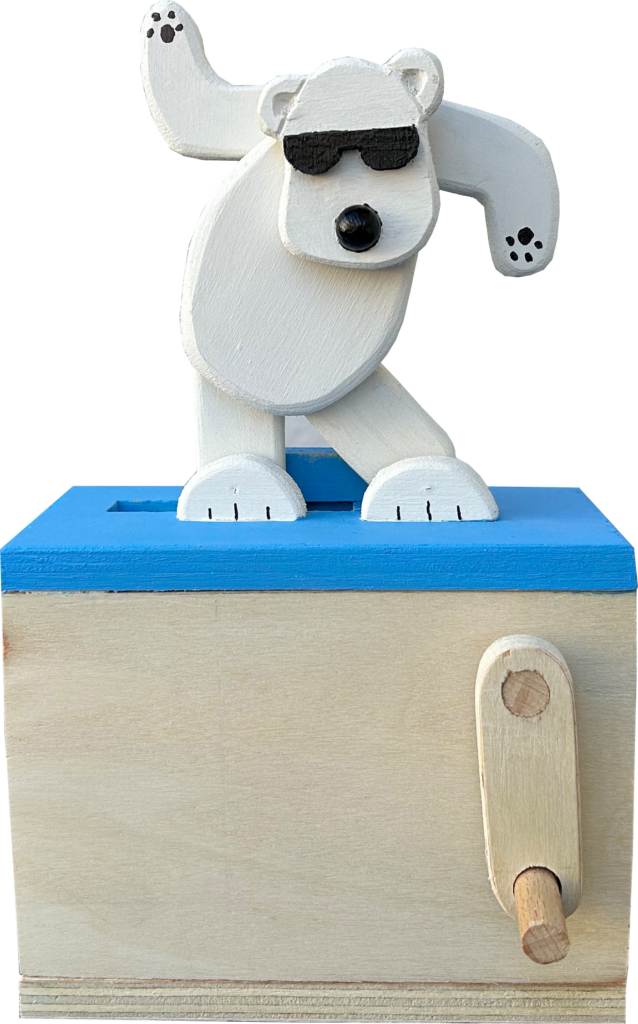
    I have often admired Peter Markey’s Guitar and dancer (https://cabaret.co.uk/artists/peter-markey/) and thought “I’ll have a go at that” but with my own particular twist. At some point, the dancer became a bear but that was OK, even if I did start humming that Louis Prima hit where Baloo the bear dances around as the monkey king Louis sings “I Wan’na Be like You” in The Jungle Book (https://www.youtube.com/watch?v=ud5J7Ye332I).

    Approach – Just go for it

    Aiming for a simple project, I abandoned the guitar player and concentrated on the dancing bear. I decided to just go for it and start making, without having a clear idea at the start of how it would work.

    A cardboard bear

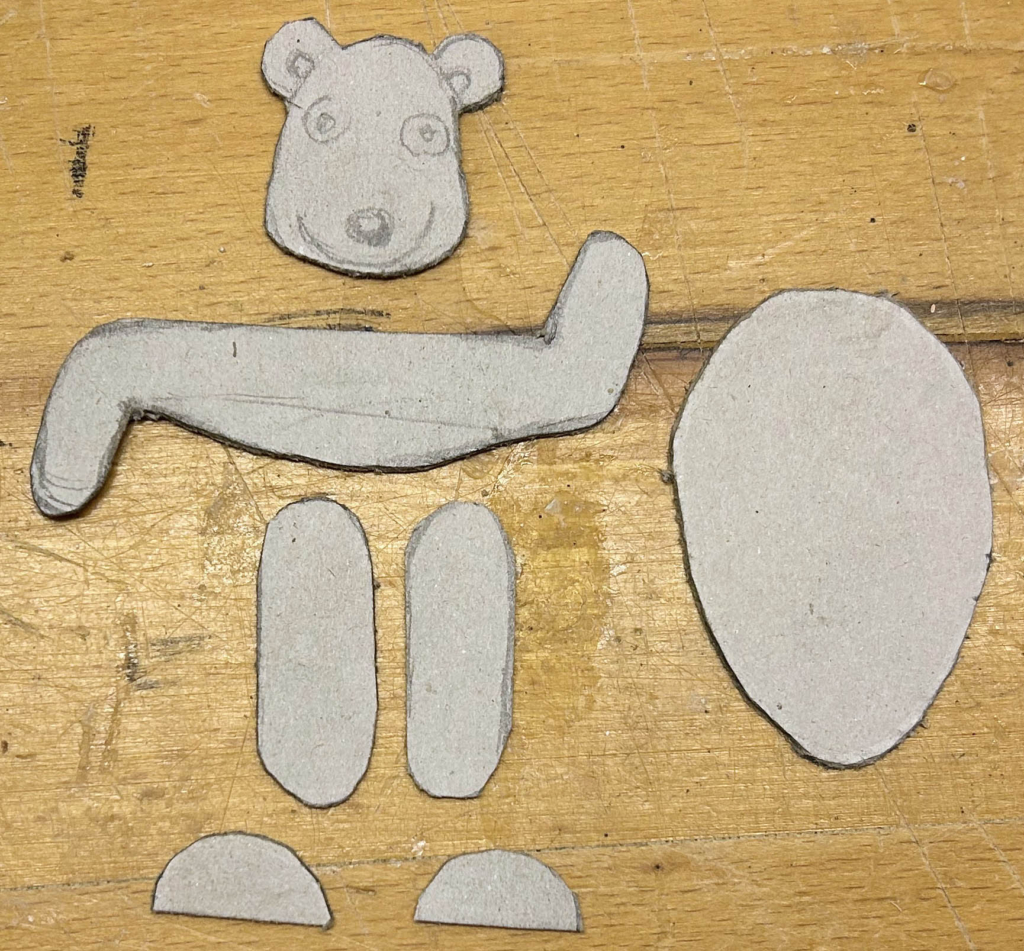
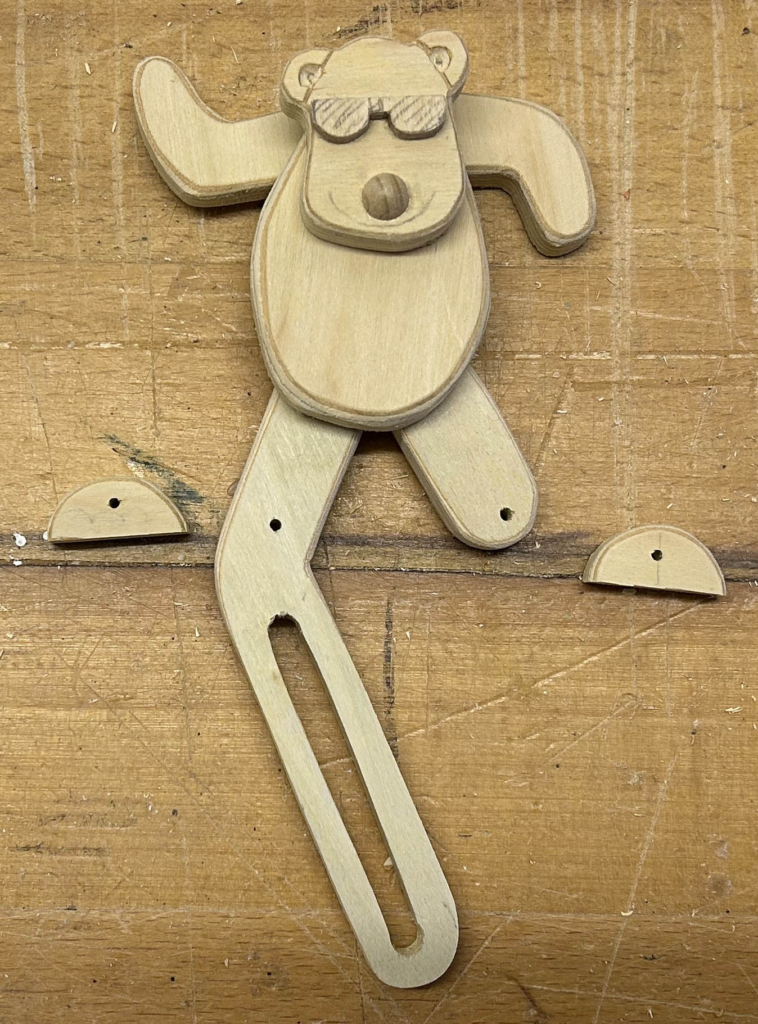
    After sharpening a pencil, I drew myself a bear on a piece of paper and then reduced it to seven pieces which I copied onto a piece of cardboard and cut everything out.

    Down in the workshop, I used the cardboard templates to make prototype parts out of MDF.

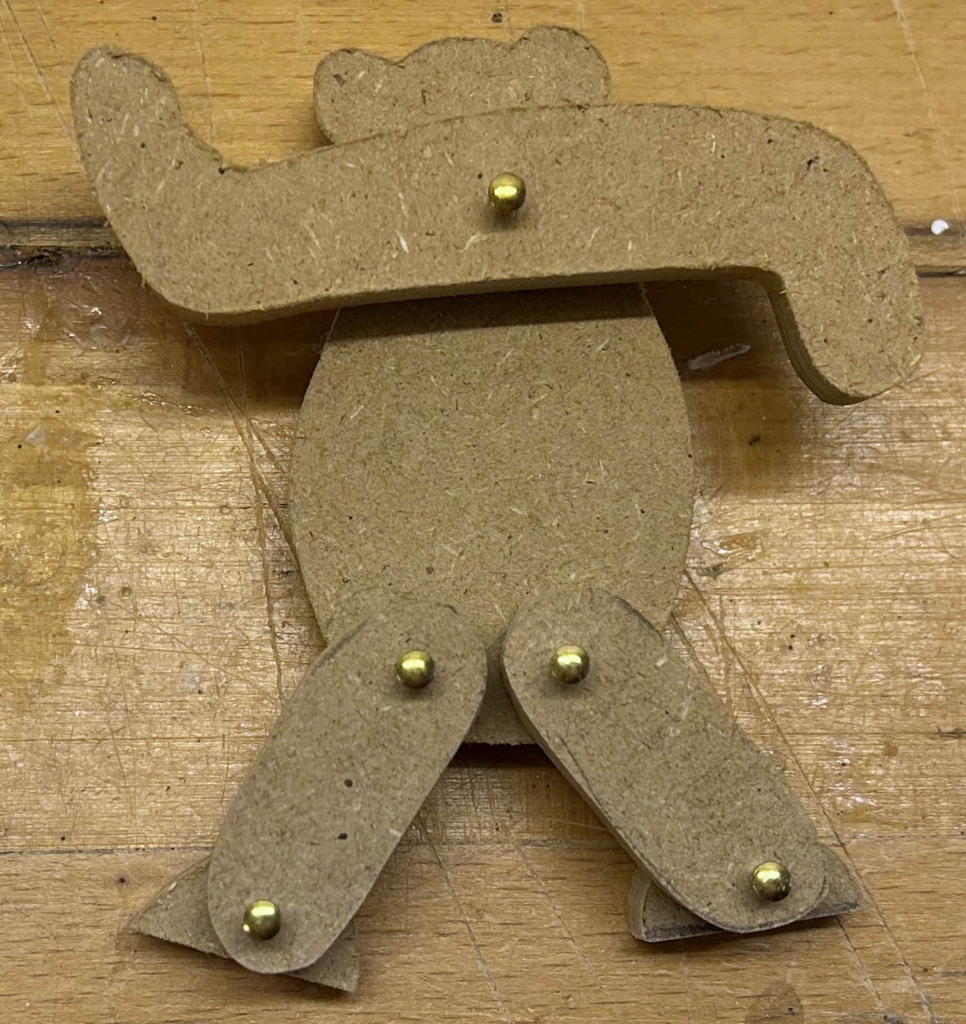
    A prototype bear

    Some 2 mm thick brass pins served well as hinges.

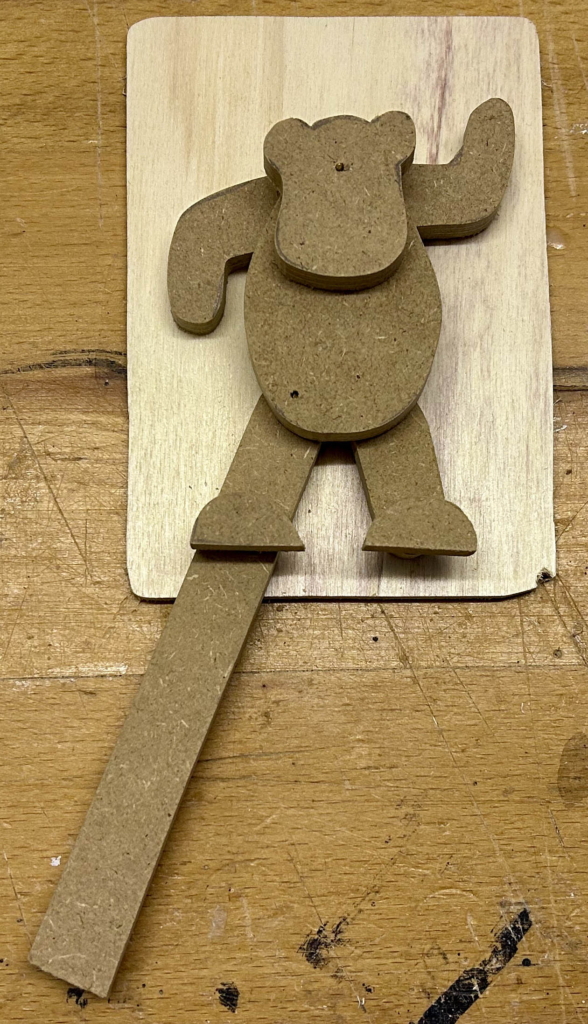
    Prototype bear

    I lengthened one leg to form a lever to get things moving.

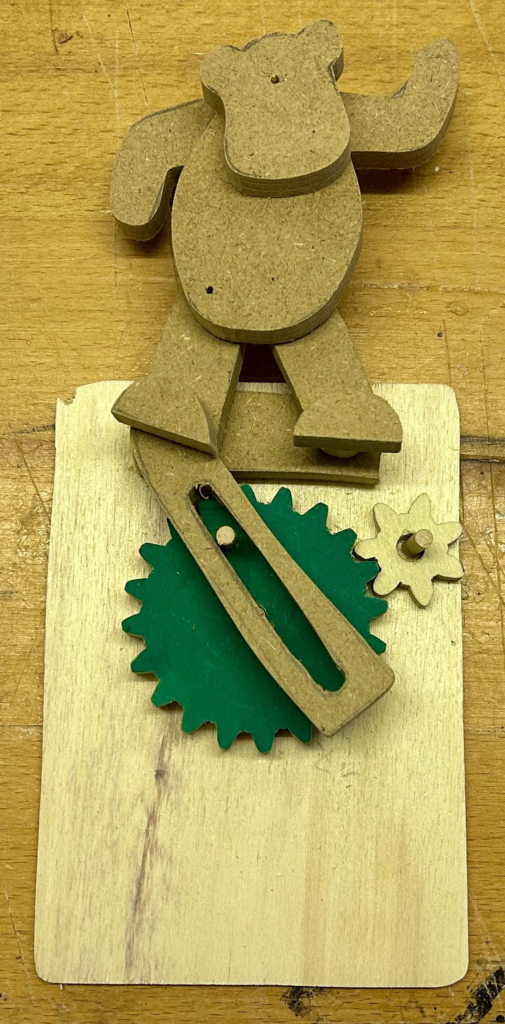
    Quick prototype assembly of the mechanism

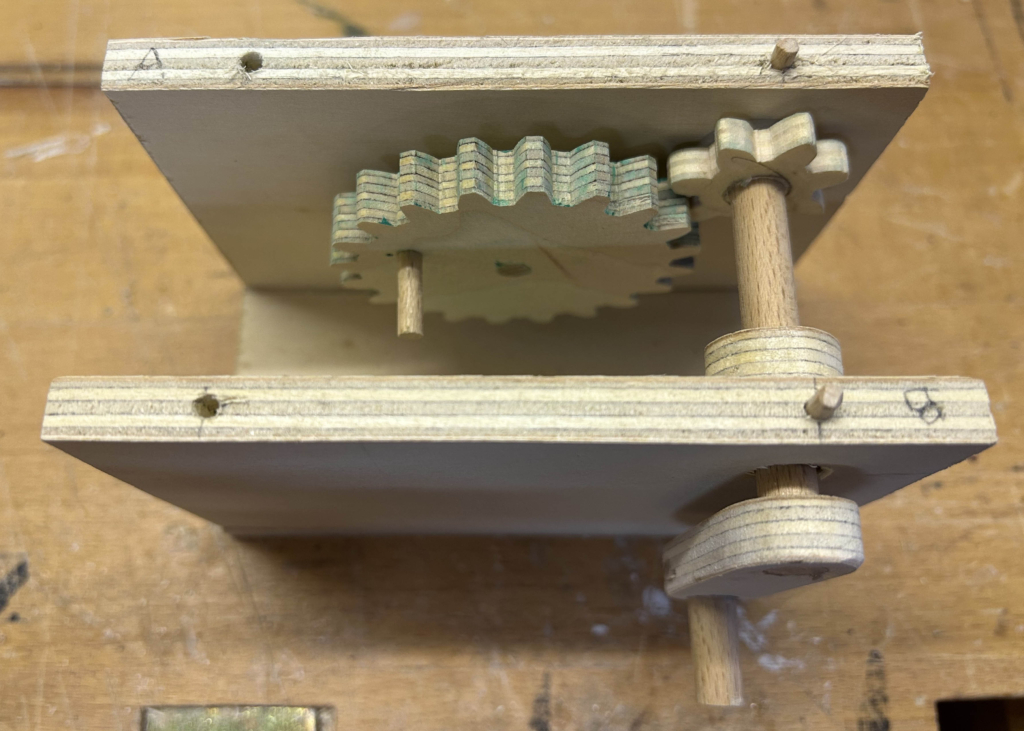
    To keep things small, I added a bend to the lengthened leg. I found a couple of cogs from an old abandoned project and fixed everything to a piece of scrap wood to check the movement.

    A bear made of 9 mm plywood

    Once I was satisfied with the movement, I used the MDF parts as templates and cut out more robust copies in 9 mm thick plywood. MDF is cheap and quick to cut, but I don’t think that it’s sensible to make moving parts from it. Cool bears wear sunglasses of course.

    A base to hold the cogs

    Taking the measurements from the prototype assembly, I made a box and added a crank to get things moving.

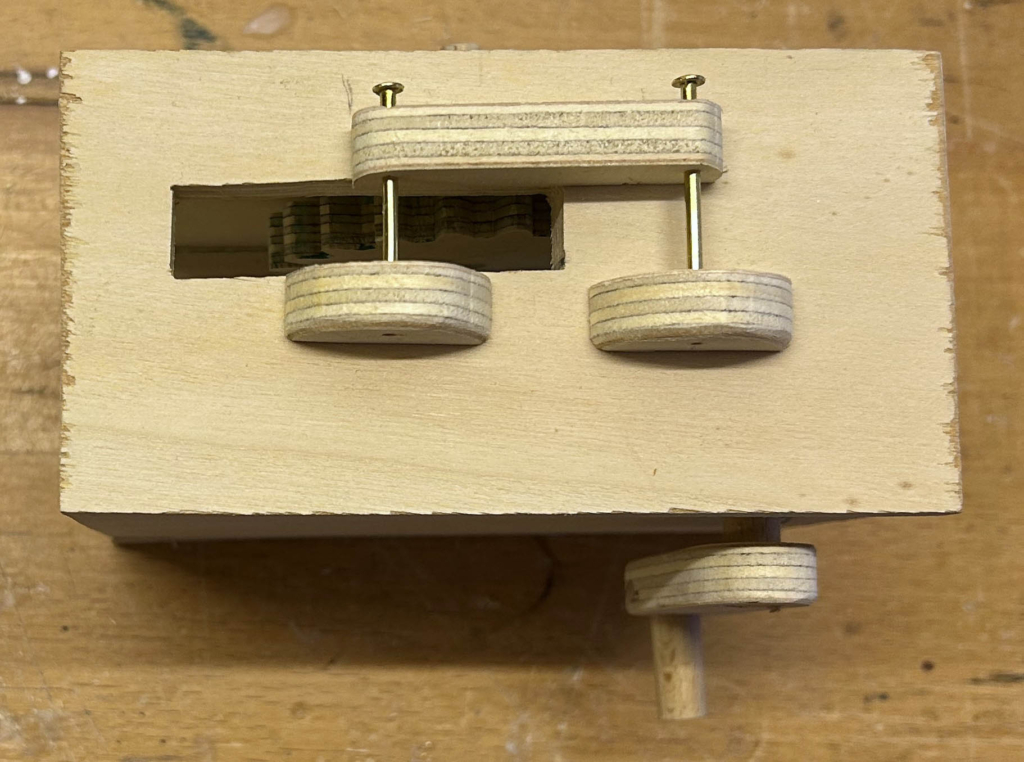
    The top of the base

    The top holds two brass pins centred in the bear’s feet. The slot is for the lengthened leg which connects to the dowel mounted on the large cogwheel as you can see in the quick prototype assembly.

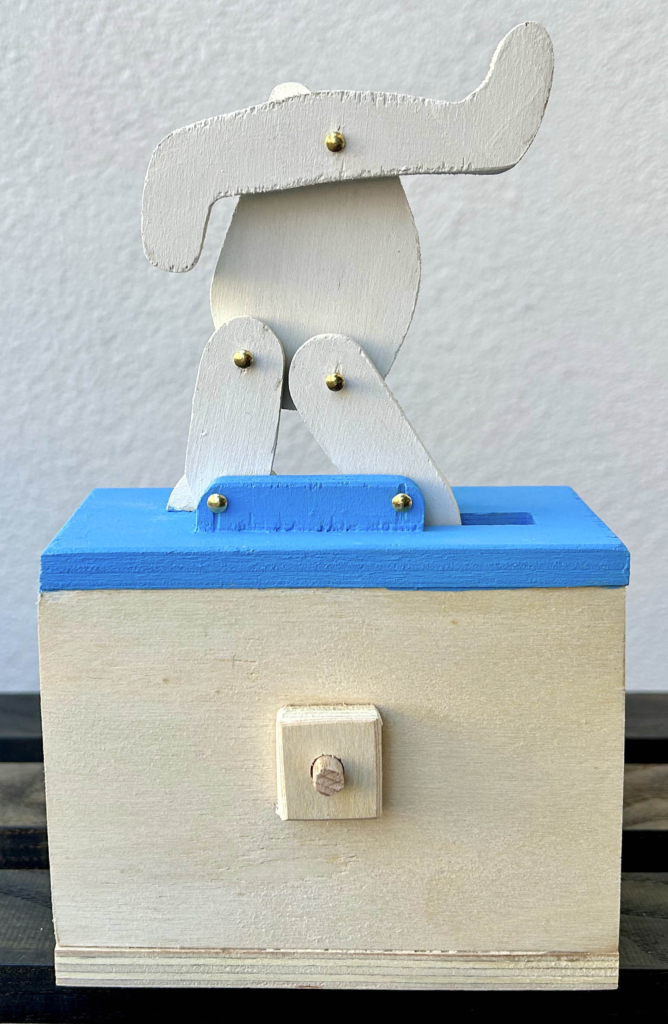
    Rear view full assembly

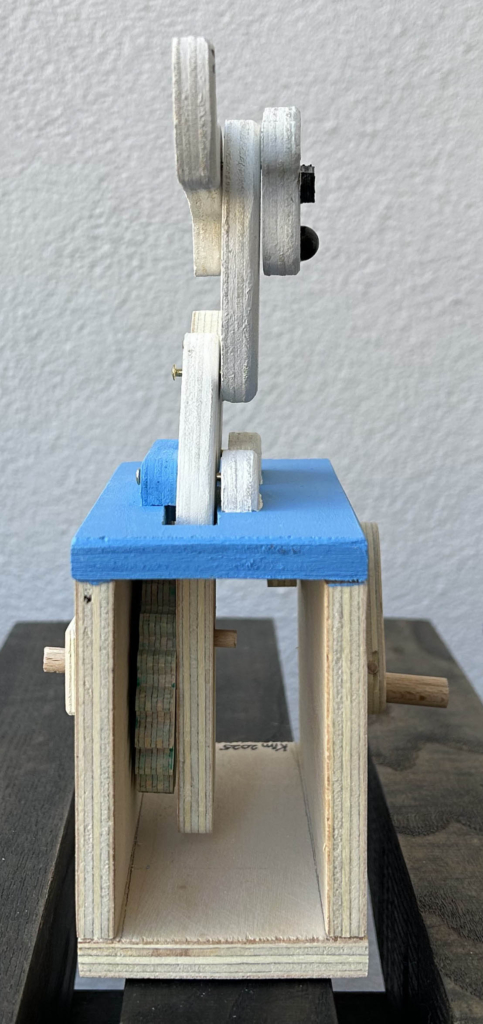
    There is a total of five brass pins for five joints. The legs and the body are move by the cogwheel via the lengthened leg. The arms are firmly attached to the low-hanging head on the front side but the pin passes freely through the body. Gravity thus moves the head and arms to maintain a roughly horizontal position. Friction makes this a bit unpredictable, making the dancing bear’s “moves” more interesting.

    Side view full assembly

    From the side, the bear’s shape is not recognisable. As the crank is at the front, this compels a user to look at the front view, which does look like a bear.

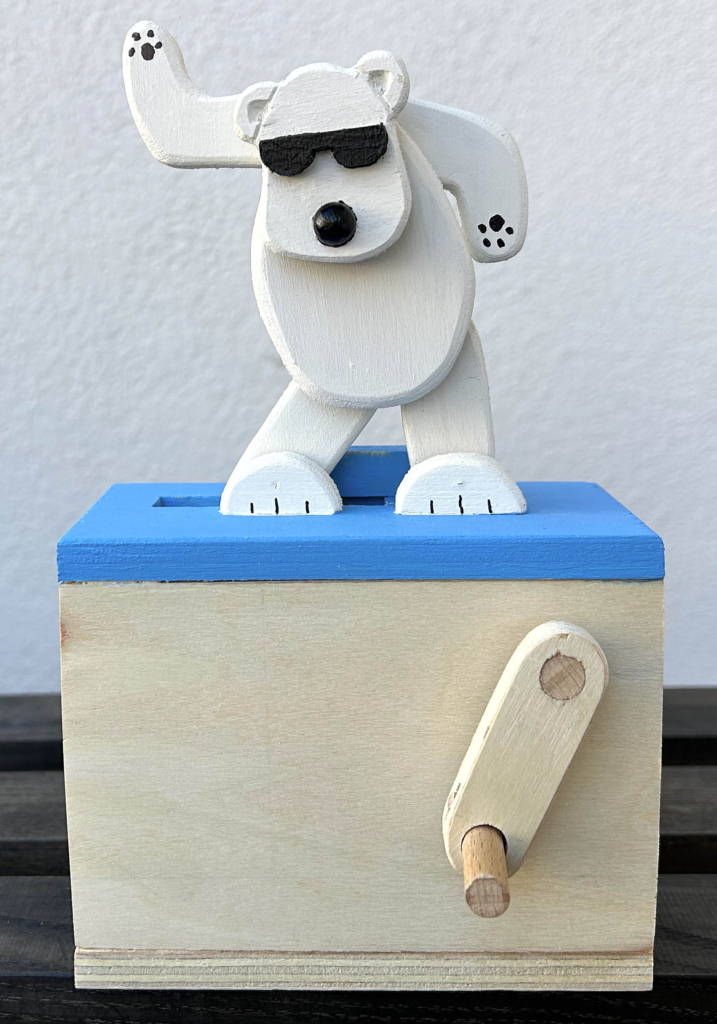
    Front view full assembly

    From the front, it looks satisfyingly bearlike, even if my first young quality control checker reckoned “that’s a funny bear!”. I can’t argue with that.

    Reflections

    You do have to turn the crank quite quickly to get the bear suitably dancing. Everyone has their own style of dancing of course, so who am I to make the rules? I just used cogs that I found lying around. Should I ever remake this I’d probably use a smaller main cog and speed things up a bit; just a bit, it is a cool bear after all.

    Video

    URL to video https://www.youtube.com/watch?v=iRLQh6L3nec

    Downloadable images

    Download ZIP package from https://www.wordwise.de/Cool_bear_archive.zip.

  • The Caterpillar Derby

    What was the Idea?

    I find the Geneva mechanism quite intriguing, so I thought it was time that I had a go with it myself. My initial idea was to make something like an inchworm or a cabbage looper, where the animal humps its back to bring up its rear legs and then stretches out to move its front legs forward. However, I was worried about the force required to lift up the body, so I went for a caterpillar that alternately stretches and contracts its body to move. A small passenger adds a little absurdity and I borrowed an idea from Lewis Carrol’s Alice in Wonderland where his caterpillar smoked a hookah. Mine smokes the portable version, a pipe.

    The Geneva Mechanism

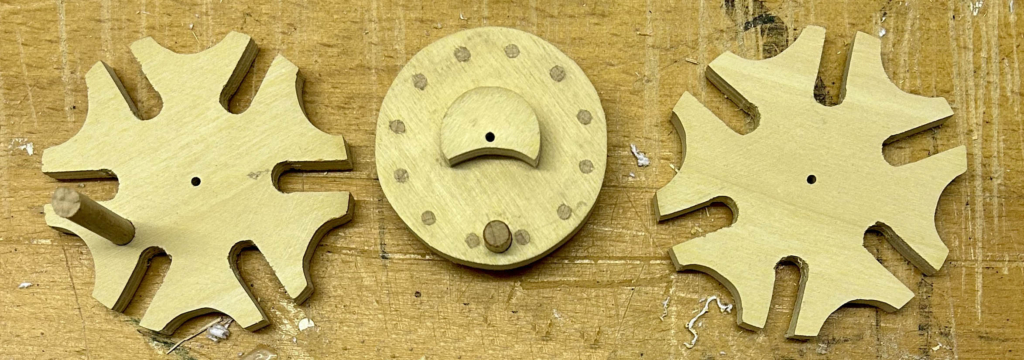
    Parts for the dual Geneva mechanism

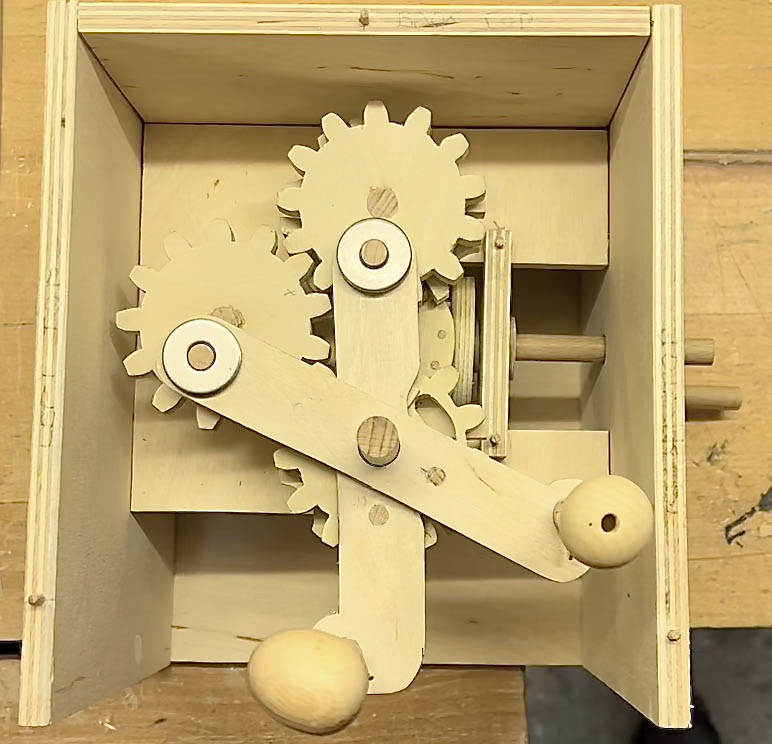
    Searching the Internet, I found a marvellous Geneva Gear Generator https://benbrandt22.github.io/genevaGen/ which I used to produce a 6-way Geneva wheel design. From this, I made two wheels and the central driving element which is mounted onto the back of a pin gear with 12 pins.

    Prototype assembly of dual Geneva mechanism

    The hand-turned axle drives another pin-wheel which engages with the central driving element. As the axle is turned the element rotates and turns the two Geneva wheels one after the other. Later on I found that misalignment occasionally occurred, jamming the movement. I fixed this by rounding off the corners where the round dowel on the driving element enters the long slots in the wheels.

    Spacing the Geneva parts

    To prevent friction from driving the wheels instead of the small piece of protruding dowel in the central element, the Geneva wheels must not rest on the central element, so I glued a wooden washer in place underneath each wheel allowing the wheels to turn freely when required.

    One Geneva wheel directly moves the front of the caterpillar via a piece of vertical dowel. The second wheel drives the caterpillar’s tail via three cogs and another piece of vertical dowel. I designed the cogs using another online tool https://woodgears.ca/gear_cutting/template.html.

    Three cogs to move the rear part of the caterpillar

    The first cog is glued to the top of its Geneva wheel. The third cog turns freely above the other Geneva wheel, not touching it at all. This cog has an opening to allow the dowel from the Geneva wheel underneath it to freely move through an arc driving the front of the caterpillar, while it has its own dowel to drive the rear of the caterpillar. The second cog links the first and third together.

    Extension Arms

    The arm to move the caterpillar’s head

    To enlarge the diameter of the caterpillar’s movement, extension arms are required. These also allow some counterbalancing to keep things horizontal.

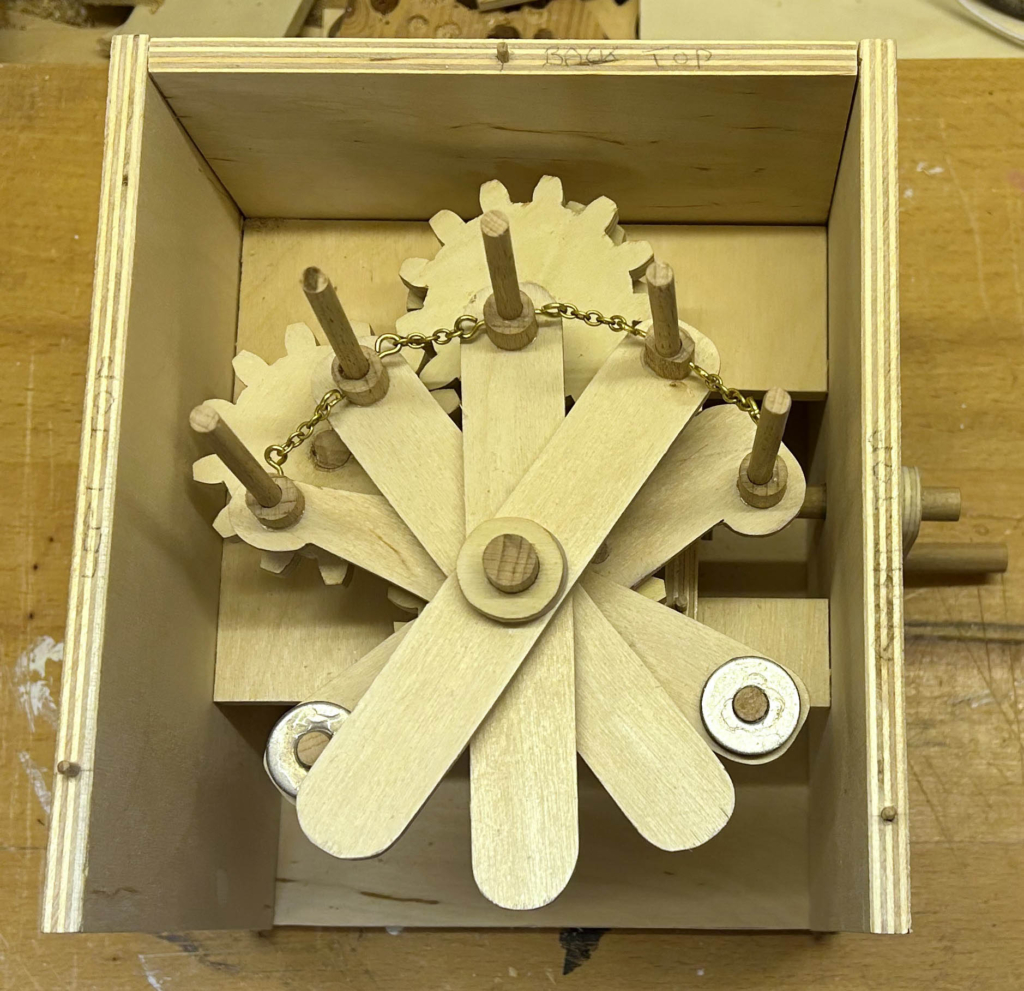
    Two arms, with counterweights, for the caterpillar’s head and tail

    With the caterpillar’s head and tail now alternately driven, there is a sort of scissoring action which first pulls the head away from the tail and then pushes the tail towards the head.

    Five arms for five caterpillar segments

    Three more arms are needed for the three segments between the head and the tail. The segments are linked together with a small piece of brass chain so that when the head moves it can pull the other segments along behind it.

    A Ratchet

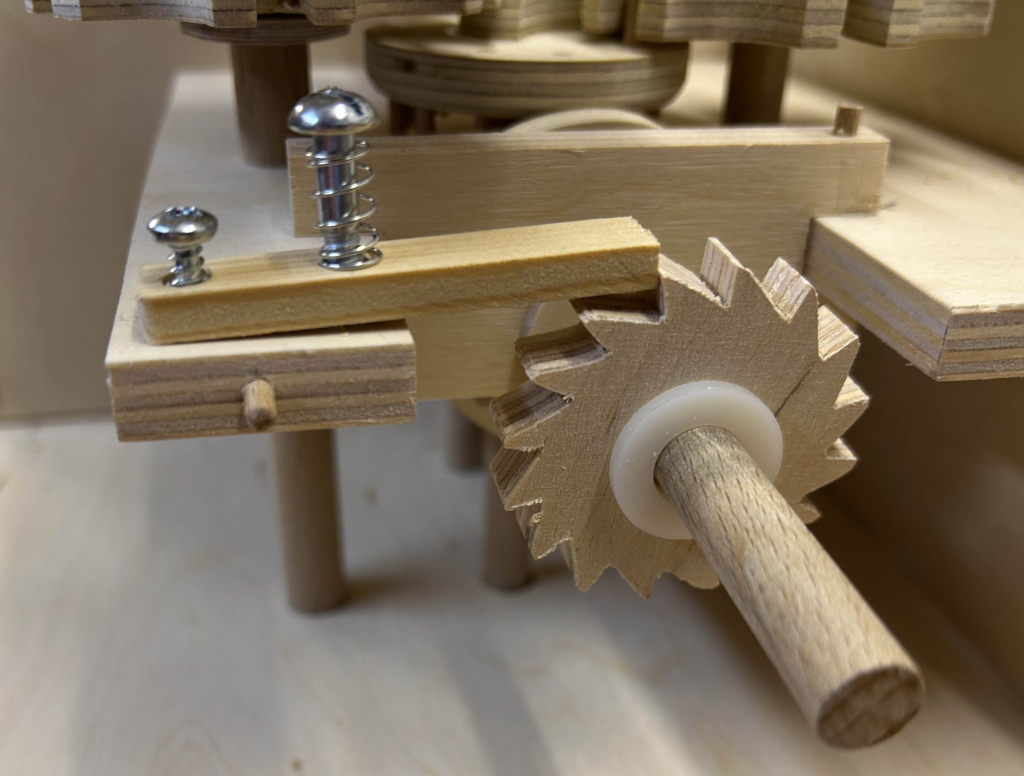
    The ratchet

    I didn’t want the caterpillar moving backwards, so I added a ratchet onto the drive shaft to prevent the crank from being turned the “wrong” way. Tightening the longer screw compresses the spring and makes things quite loud. I adjusted it until it did what I wanted without making too much of a racket.

    The Caterpillar Segments

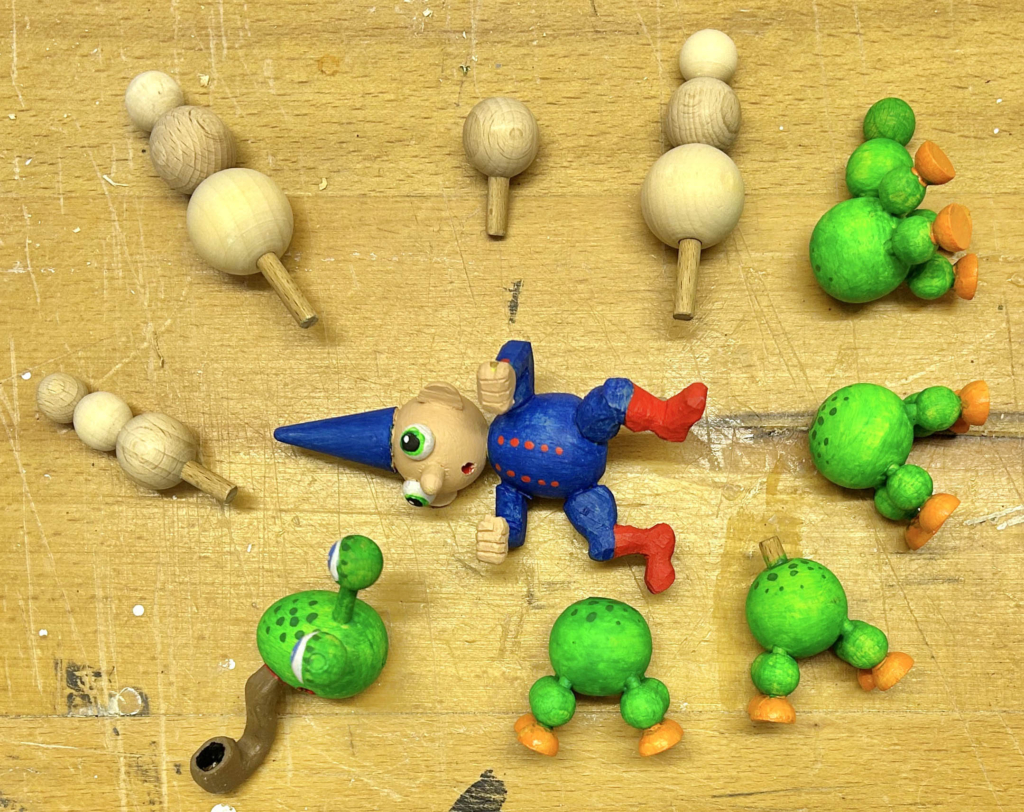
    Caterpillar segments, trees and the rider

    The caterpillar segments mostly comprise wooden balls, with a wooden egg for the head. A few trees round off our small scene.

    Making

    Most of the parts

    This project is more complex than a lot of my automata, but there aren’t really that many parts to it. I used slightly thicker plywood than usual to improve rigidity and precision. During the first assembly, I noticed that my box was too small, so I made a new, larger one and took the opportunity to tidy things up a bit.

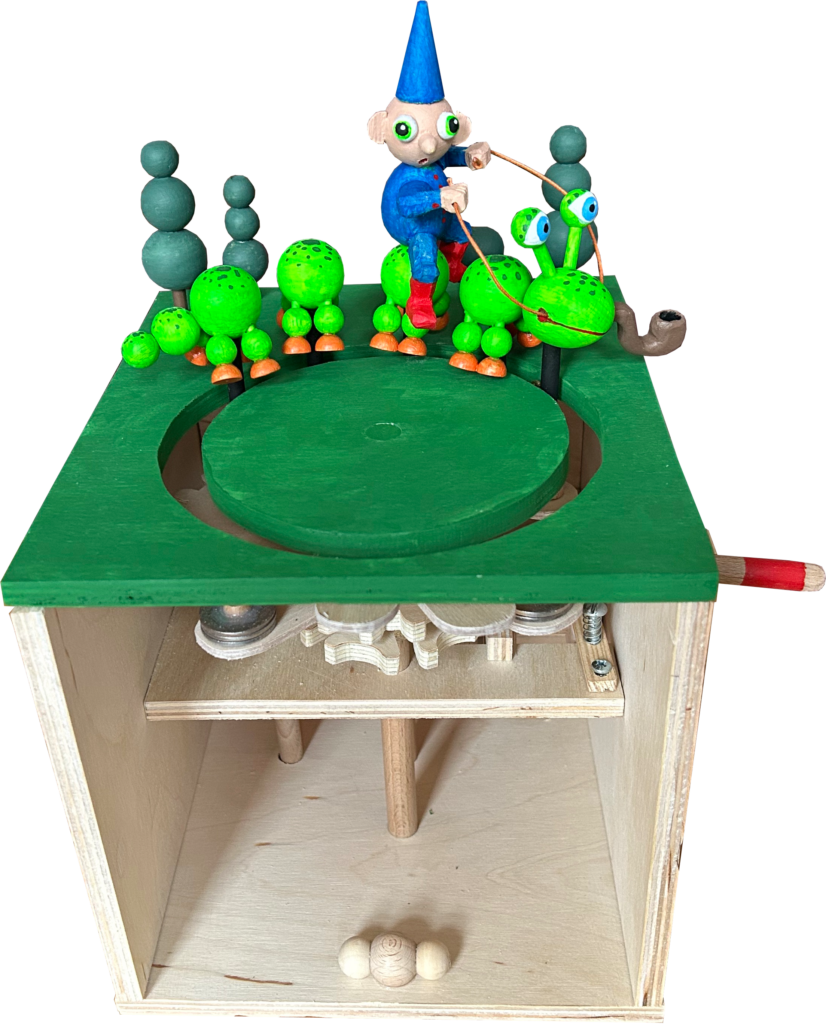
    The new box showing the pinwheel driven by the crank handle

    Note that the 10 mm diameter vertical dowel, which you can see in the photo, is fixed and glued in place. It represents the centre axle for the main mechanism. It does not move itself, the parts and the caterpillar move around it. When fully assembled the green disc is glued flush to its top.

    Too Complicated?

    Before I started, I looked around the Internet to see if anyone else had made a caterpillar automaton, I bumped into https://makerworld.com/de/models/468733#profileId-377949. This is a project for a 3D printer and, on the face of it, looks a lot simpler than mine. I don’t know whether it would work well, when made by hand in wood. What do you think?

    Still, I am very pleased with how my project turned out, it works reliably and entertains my friends large and small. It took a while to make, but that’s part of the fun in making automata, overcoming difficulties and learning more every happy hour that I spend working with my hands.

    Video

    Youtube link https://youtu.be/cBHg6OAXFjw

    Images

    Download ZIP package from https://www.wordwise.de/Caterpillar_archive.zip

  • The Baby Roundabout

    The Baby Roundabout

    What was the inspiration?

    Work by Mirek Trejtnar

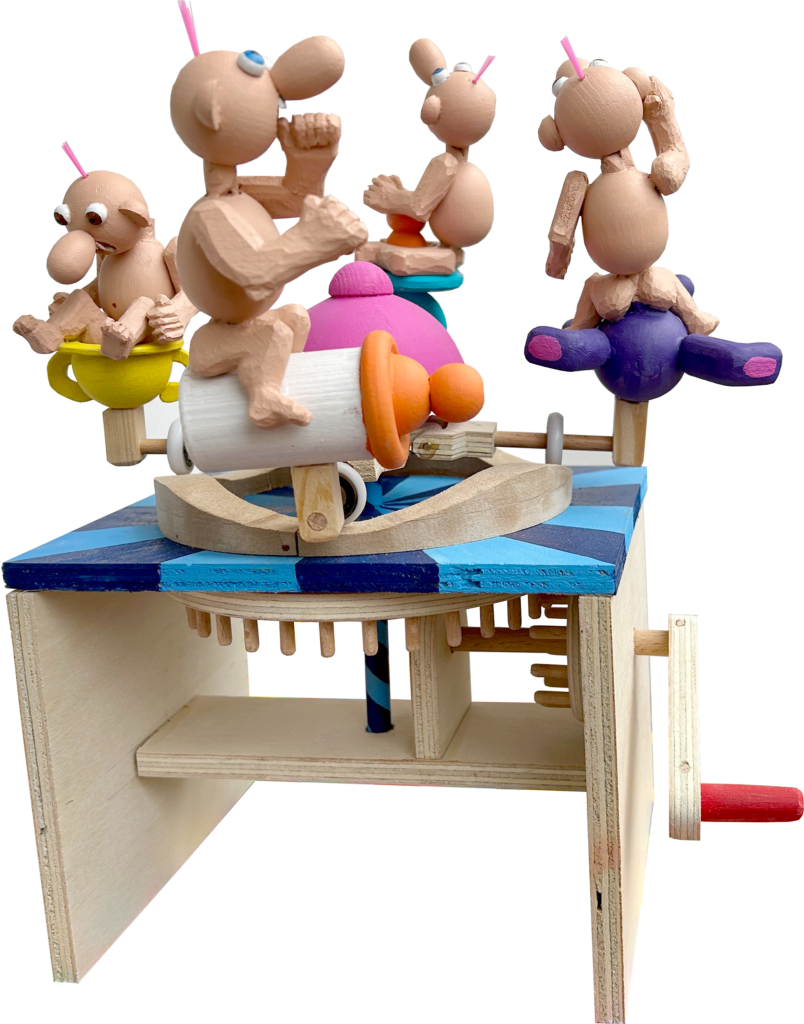
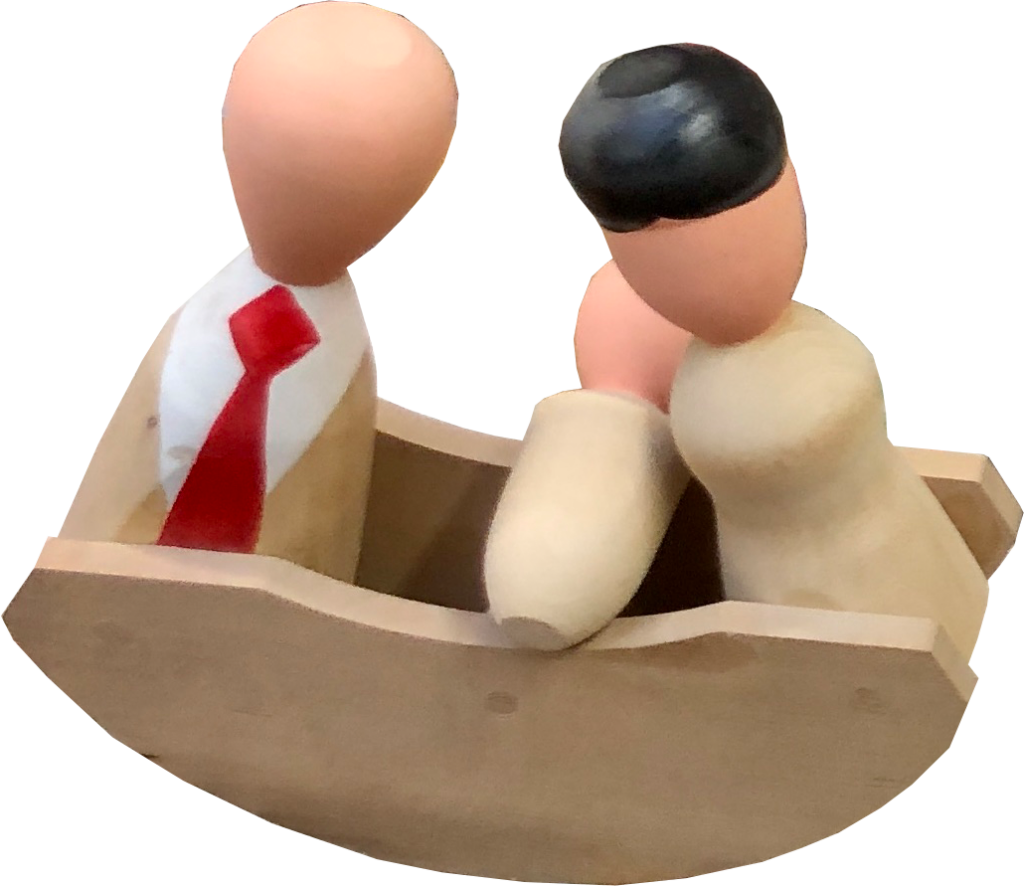
    Some while back I visited Mirek and Leah at Puppets in Prague and I noticed this piece showing two parents and their baby. As you rock the cradle, the baby rolls contentedly from mum to dad to mum to dad… You could take another view and interpret it as the stressed parents shoving the responsibility for the squalling babe to and fro. Whichever way you look at it, I thought that it was a really interesting piece and that I should have a go myself. Mirek had no complaints when I suggested that, but my version has moved quite some way away from the simple elegance of his cradle.

    What Interests a Baby?

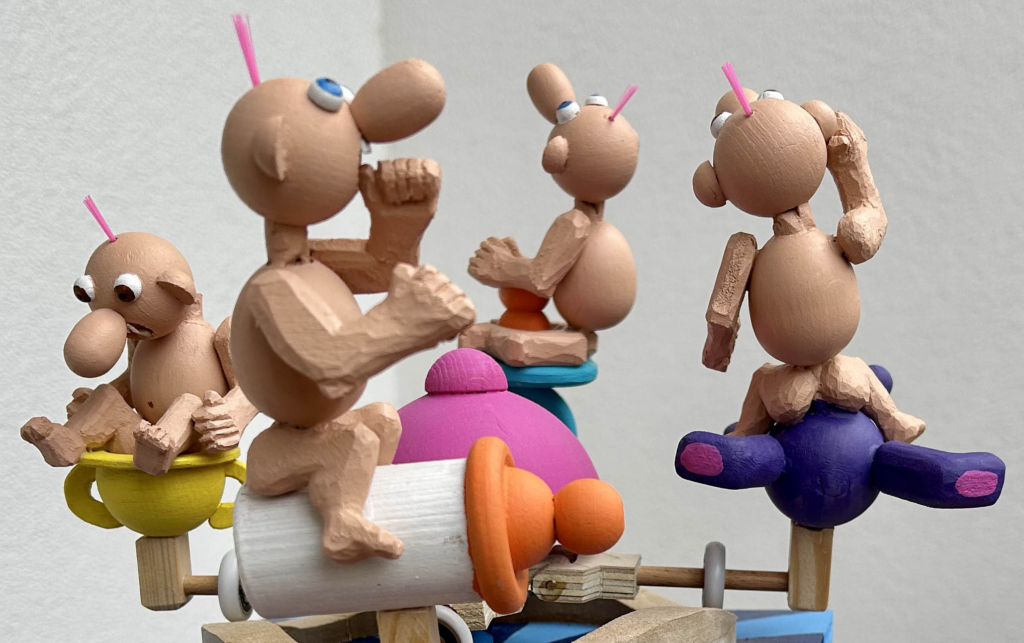
    Well apart from its parents, I came up with a short list including a milk bottle, a dummy (aka pacifier on the other side of the Atlantic), a potty and a soft toy. This gave me 4 options to play with, so I went for a carousel instead of a two-ended cradle. At first I thought that the babies could wear nappies, but then I realised that no self-respecting baby sits on a potty whilst wearing a nappy, so I put them all in their birthday suits instead.

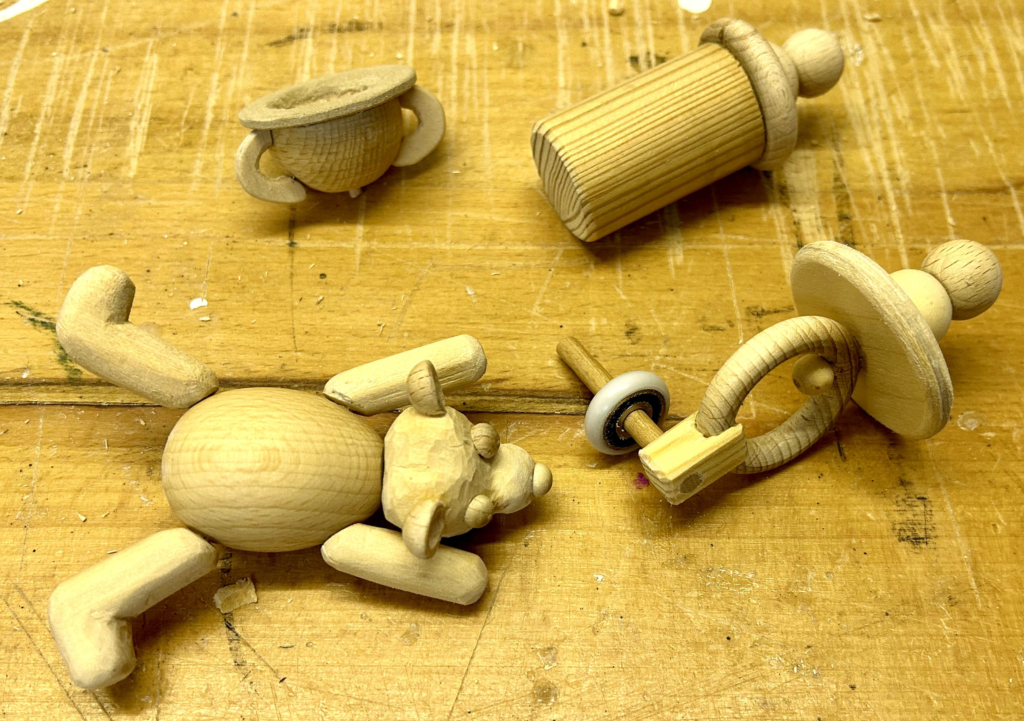
    A potty, a milk bottle, a teddy bear and a dummy

    Pinwheels

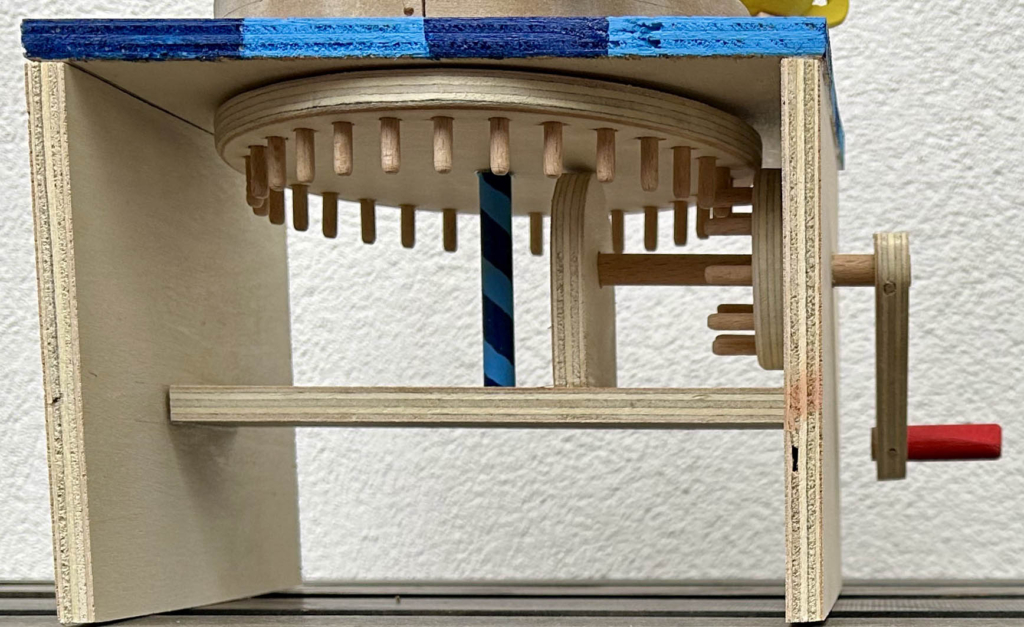
    The pinwheels under the carousel

    When someone turns the crank with its red handle, a 10-pin gearwheel turns and engages with a 30-pin gearwheel attached to the main driveshaft, painted with a spiral blue pattern. I used my favourite online wood gear generator (https://woodgears.ca/gear_cutting/template.html) with a pin spacing of 12 mm to print out paper patterns for the pinwheels. My pins are made of 3 mm dowel. Precision is very important here as the slightest pin-positioning error causes a grumbling noise as the pins engage with one another. My pinwheels usually grumble…

    The Track

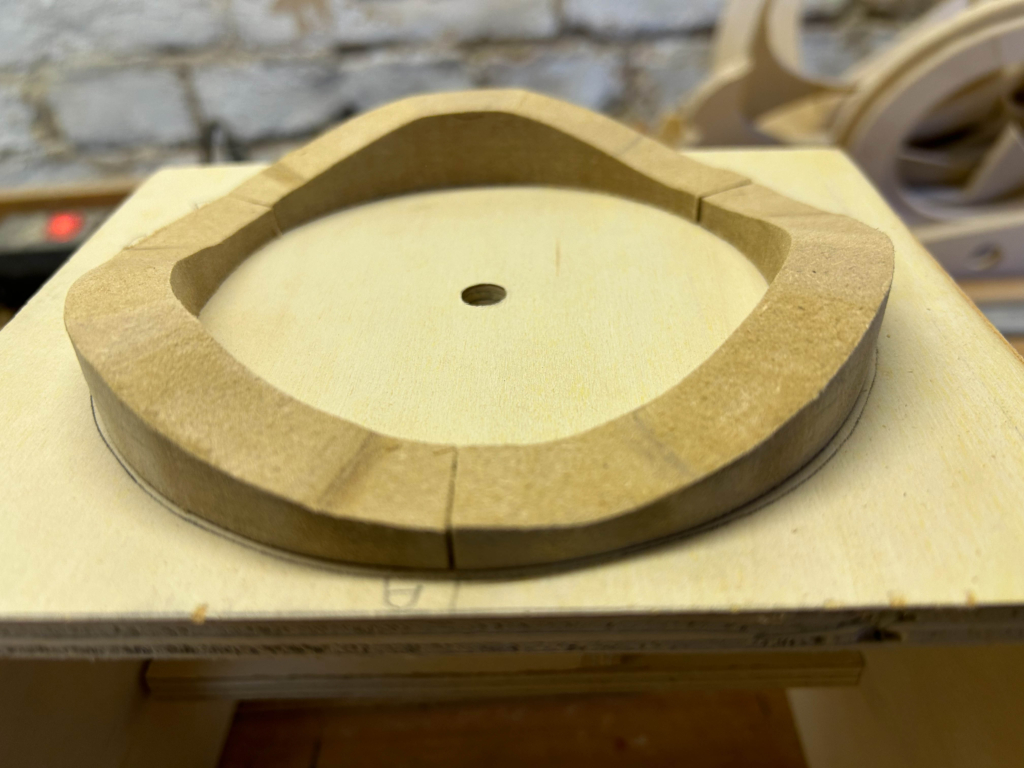
    The up and down track

    With some MDF (medium density fibreboard) I first cut a 20 mm thick ring shape for the carriage wheels to roll along. I pencilled a cutting line around the side with three peaks and troughs, to lift the carriages up and down. As MDF has no grain it’s fairly easy to cut a smooth curve. To avoid wear marks from the wheels, I didn’t paint it.

    The Carriage Driver

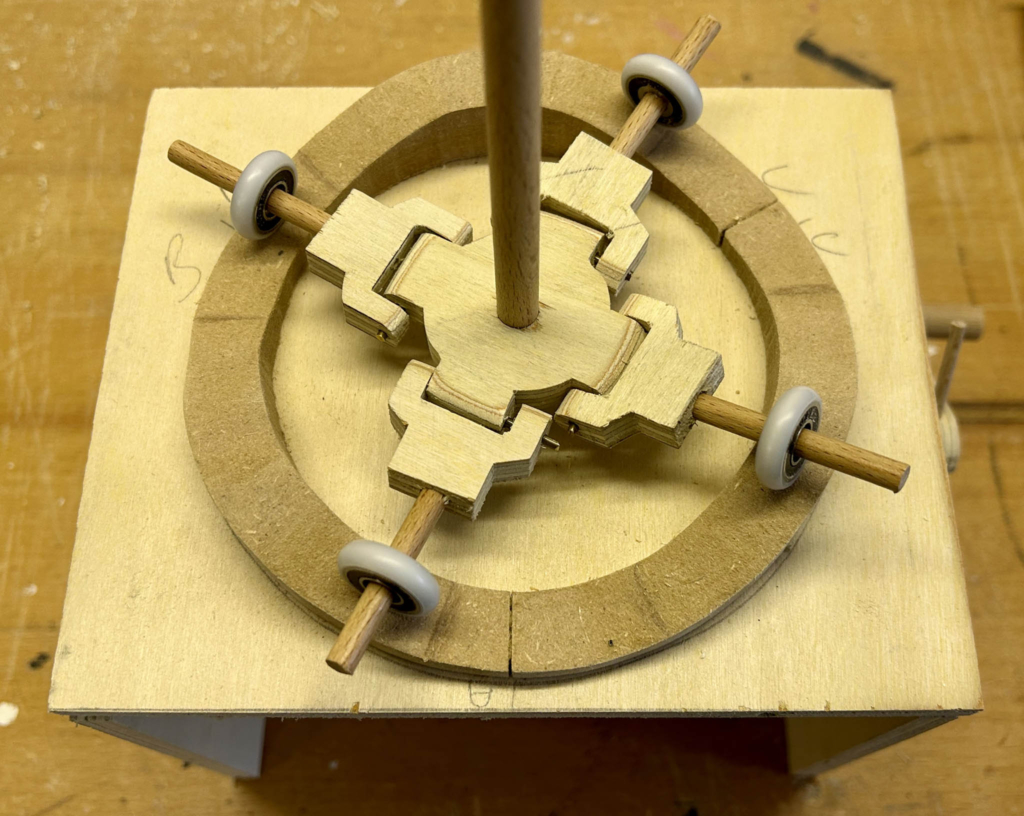
    The mechanism to move the carriages

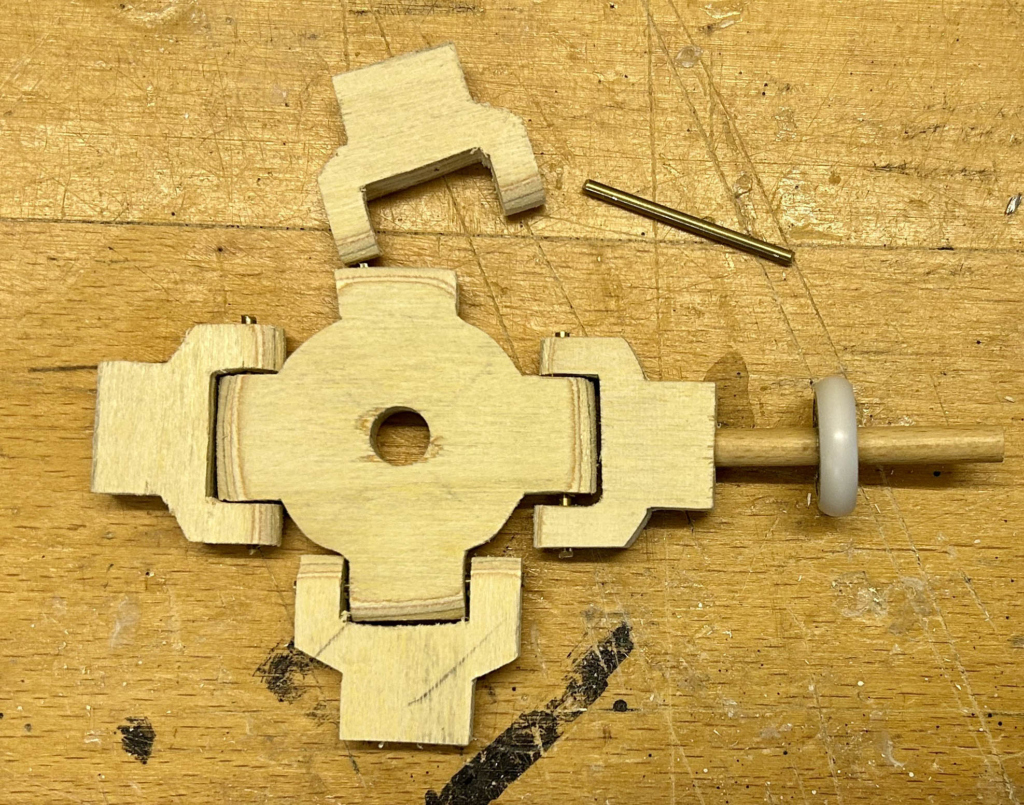
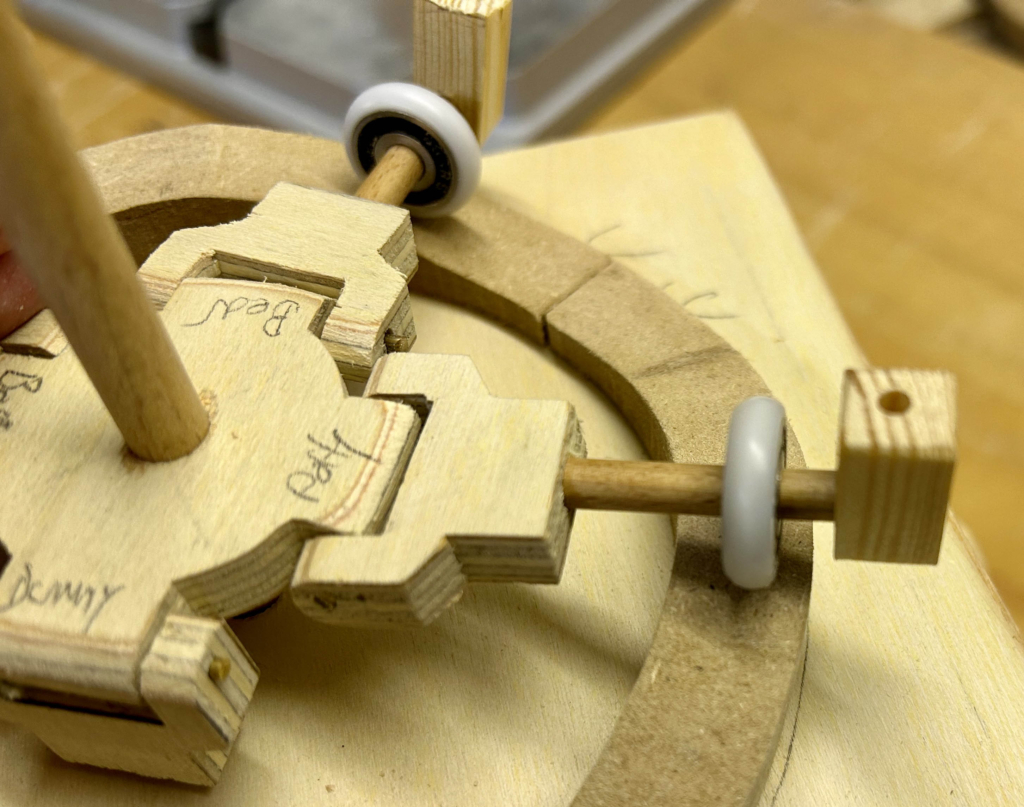
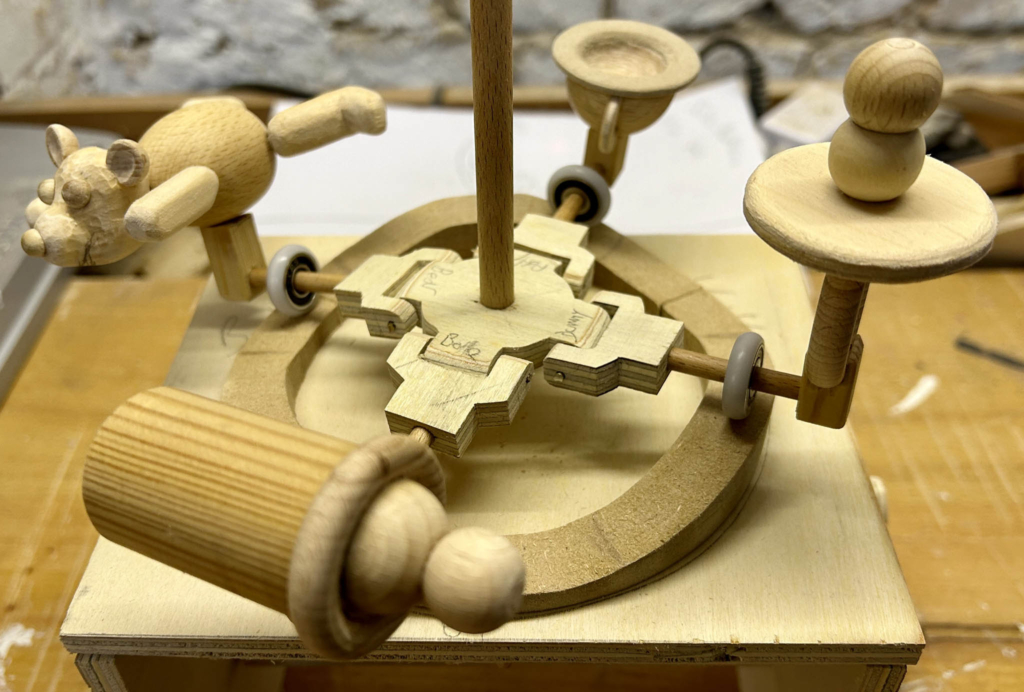
    The shaft which is driven by the large pinwheel turns a “cross”. This cross has four stubby protrusions which each hinge an arm with a wheel. Each wheel runs along the track. I found the wheels (with ball bearings) in a dusty drawer somewhere. I must have bought them from a craft shop some time ago.

    Hingeing the arms

    The hinges use small pieces of brass rod which move freely in holes drilled in the central “cross”.

    Block to mount the carriages

    Each “carriage is mounted on to a small block at the end of its arm.

    Four “carriages”

    The four “carriages” are still without any passengers here.

    The Passengers

    I was unsure what posture the babies would take on their very individualistic carriages, so I decided to leave the decision as late as possible in the assembly process

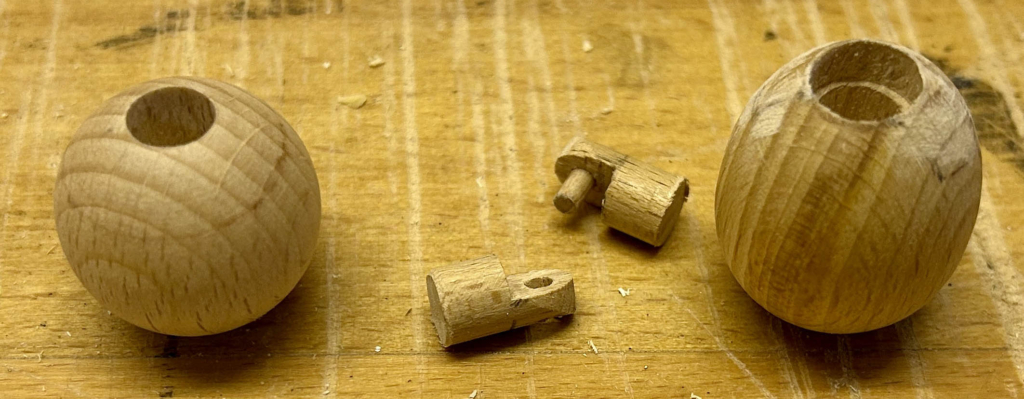
    A head, a hinge and a body

    A wooden ball serves as a head and an egg as the body. A very primitive hinge allows me to tip the head this way and that until I was happy with the pose and a dollop of glue fixes it for all eternity.

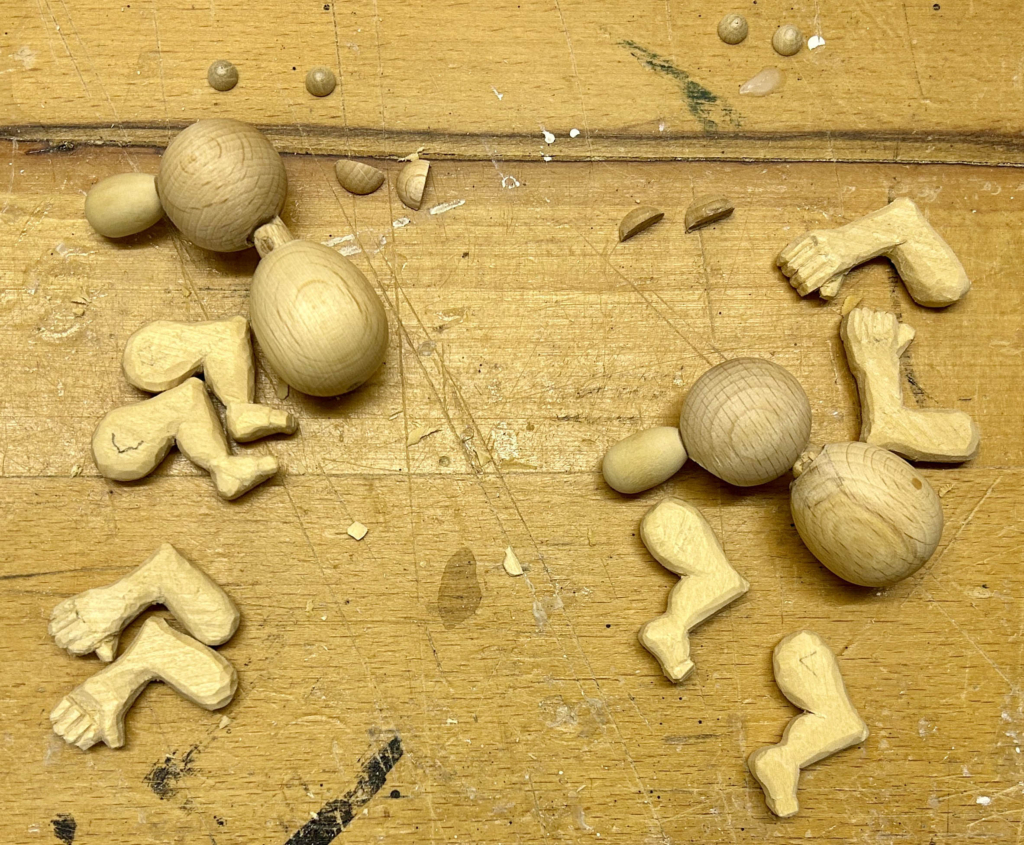
    Baby bits

    I carved arms and legs as separate entities. Only when I could see how each baby can sit on their carriage did I fetch the glue out.

    Four babies, four postures

    The babies on the milk bottle and the bear can sit astride, as if riding a horse. The baby on the dummy wraps its legs around the teat and hangs on to it for dear life. The last baby, on the potty, has half fallen in to the opening and is looking down in amazement, presumably at what it has just produced?

    The Last Touch

    The mechanism in the centre is of course a hazard for small fingers so I made a symbolic mum from a large wooden hemisphere to cover everything up, well almost everything.

    On Reflection

    There is not actually very much going on here. The main performers sit very still on their carriages. It’s a frozen tableau which just goes round and round and gently up and down. I suppose that a brand new observer will take a while to sort out what all of the various elements represent and recognition may result in a soft smile. The potty may be hard to recognise as it looks more like an antique chamber pot, so I added a reminder of what it might contain by painting it yellow. Whatever else, I will be quite content with a soft smile.

    Video

    Link https://www.youtube.com/watch?v=r0h0uePFiyY

    Images

    Download ZIP package from https://www.wordwise.de/Baby_archive.zip

  • The Bee who thinks it’s a Cuckoo

    Motivation

    Recently I watched a video (https://www.youtube.com/watch?v=h_MHgkZKJGU) about the incredible Thomas Dambo building another giant troll in the forest near Rouen, France and I noticed that his troll is wearing a birdhouse around its neck. He explained that, when he was a rapper, he made necklaces with a little birdhouse for himself. “Great idea” I thought, I’ll pinch that and add some movement to make it my own. It is also coming up to birthday time for one of my friends so it will make a good present too!

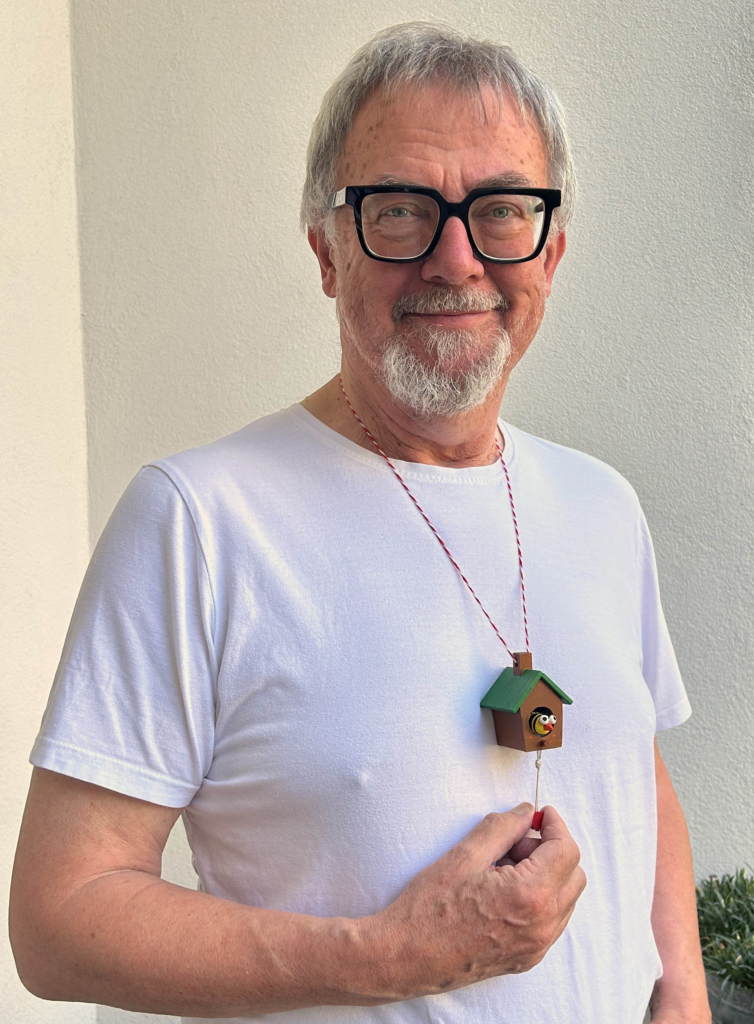
    A wearable automaton – who could ask for more?

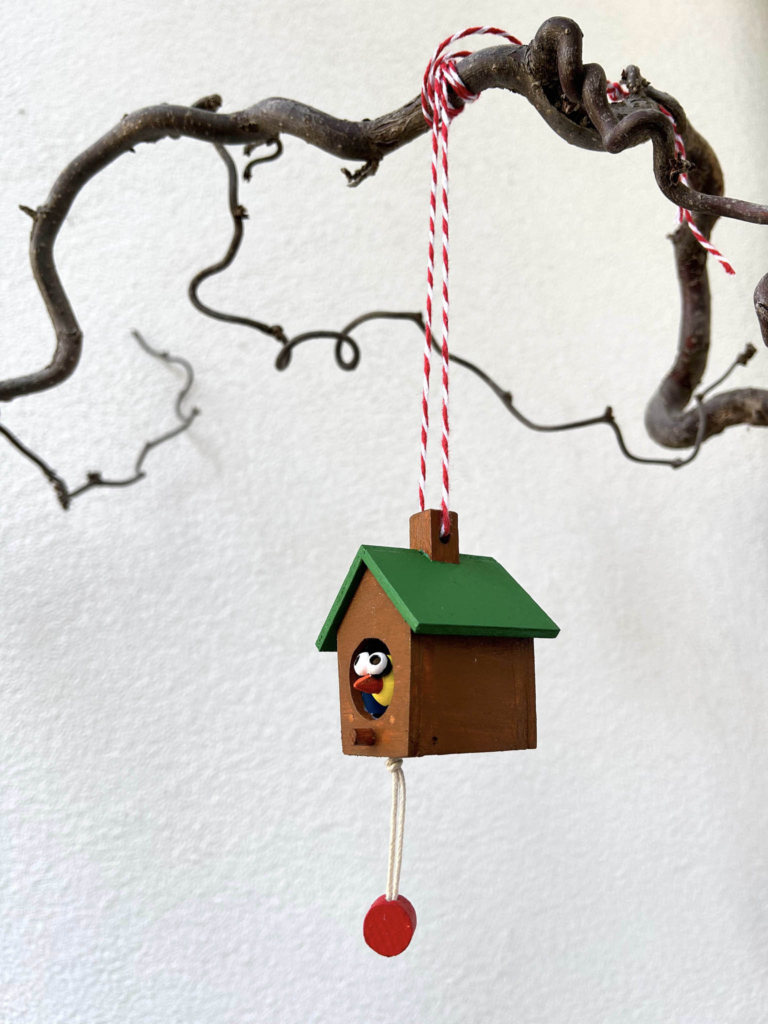
    A wearable automaton

    An automaton hanging from a branch

    What’s the Story?

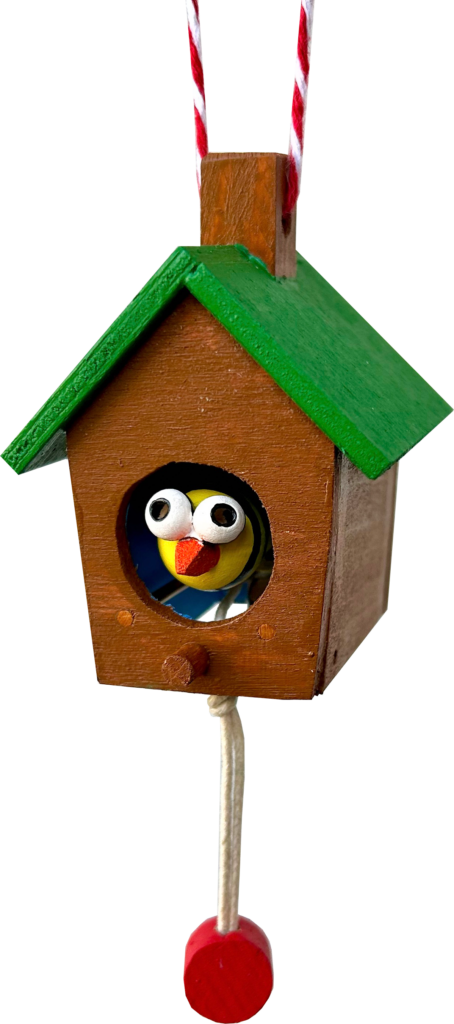
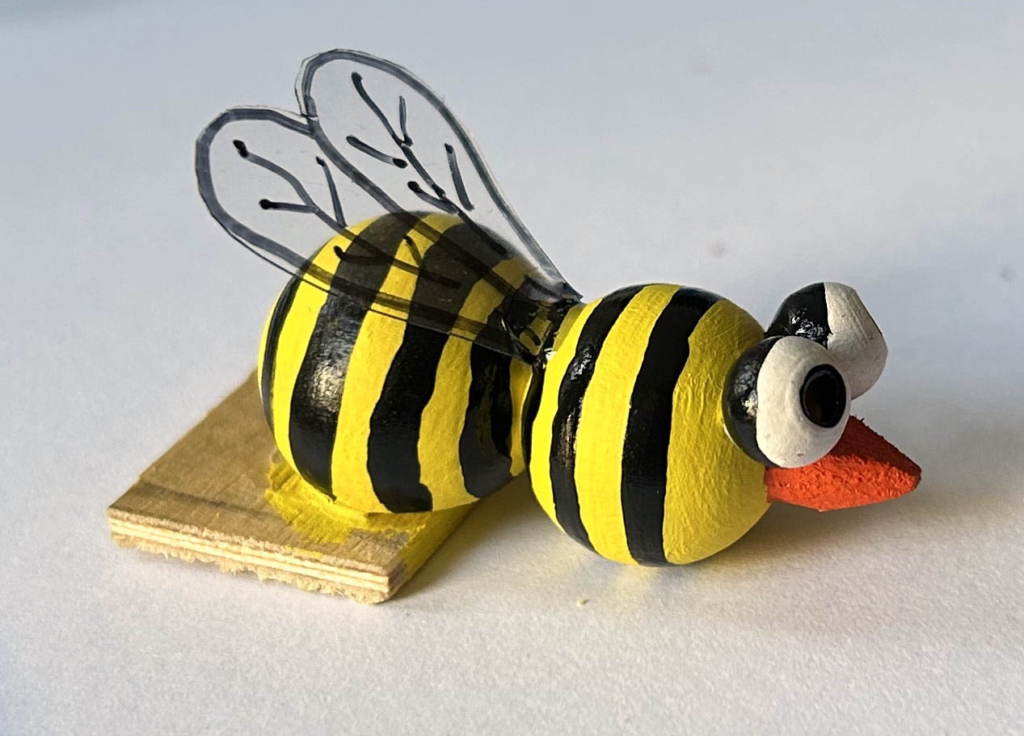
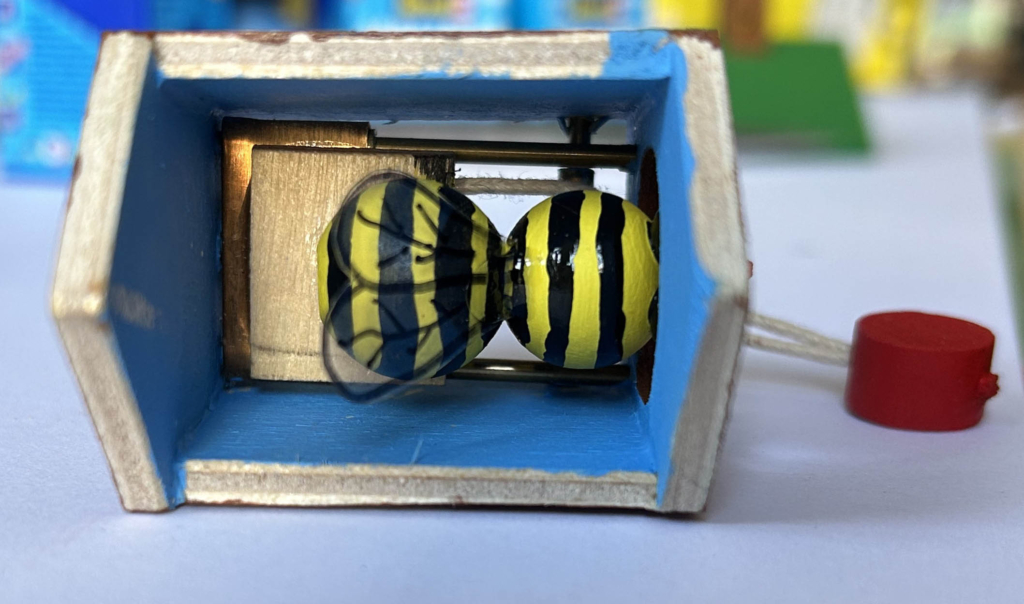
    Just making something move isn’t that interesting, a story is required, even if it’s just a teensy weentsy one. You can see what looks like a cuckoo clock’s pendulum hanging at the bottom. Giving this a tug makes the occupant of my little house stick its beak out of the door. But is it really a beak? When the figure comes out, black and yellow stripes reveal it to be some sort of bee. First impressions can be deceptive.

    So now I have a story – it’s a funny bee that is convinced that it is really a bird, a cuckoo. It has made itself at home in something reminiscent of a Bavarian cuckoo clock and, when the pendulum is pulled at the right time, it does its duty, pops out and, instead of “cuckoo” it goes “buzzz-buzz”.

    Making

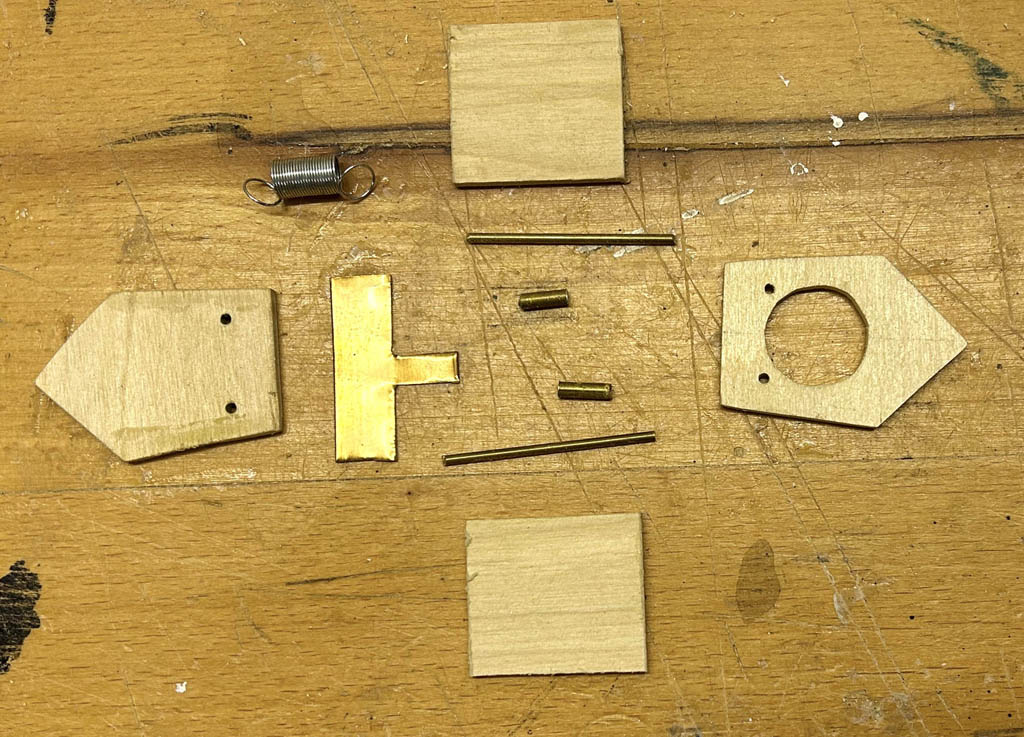
    Some parts for the bee-house

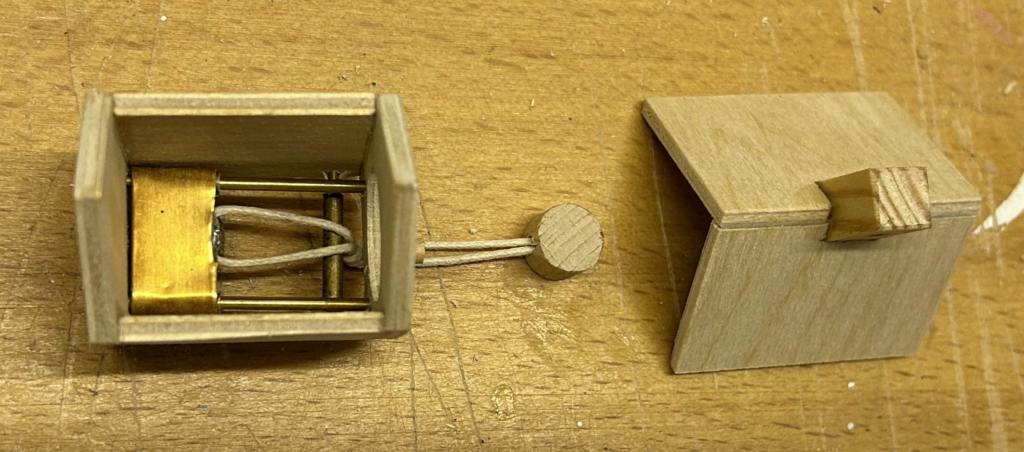
    The house is made of 3 mm plywood, and stands 54 mm tall (not counting the chimney). To allow the movement forwards and backwards I used two brass rods along which two small pieces of brass tubing slide very easily. Some thin brass foil cuts easily to form a carriage which links the two tubes and holds one end of a spring.

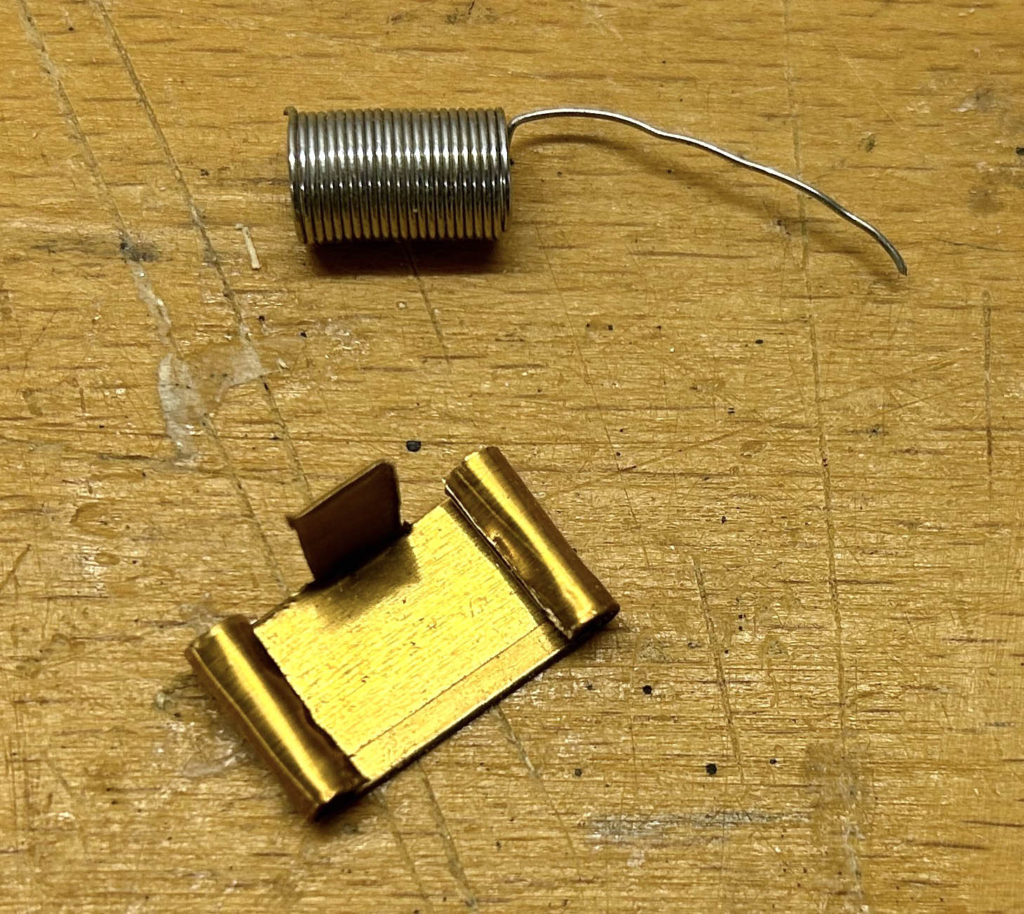
    The metal foil carriage bent around two pieces of tubing, to be soldered together

    The tab folded up 90° at the end of the carriage holds one end of the spring and soldering it in place makes sure that it stays put.

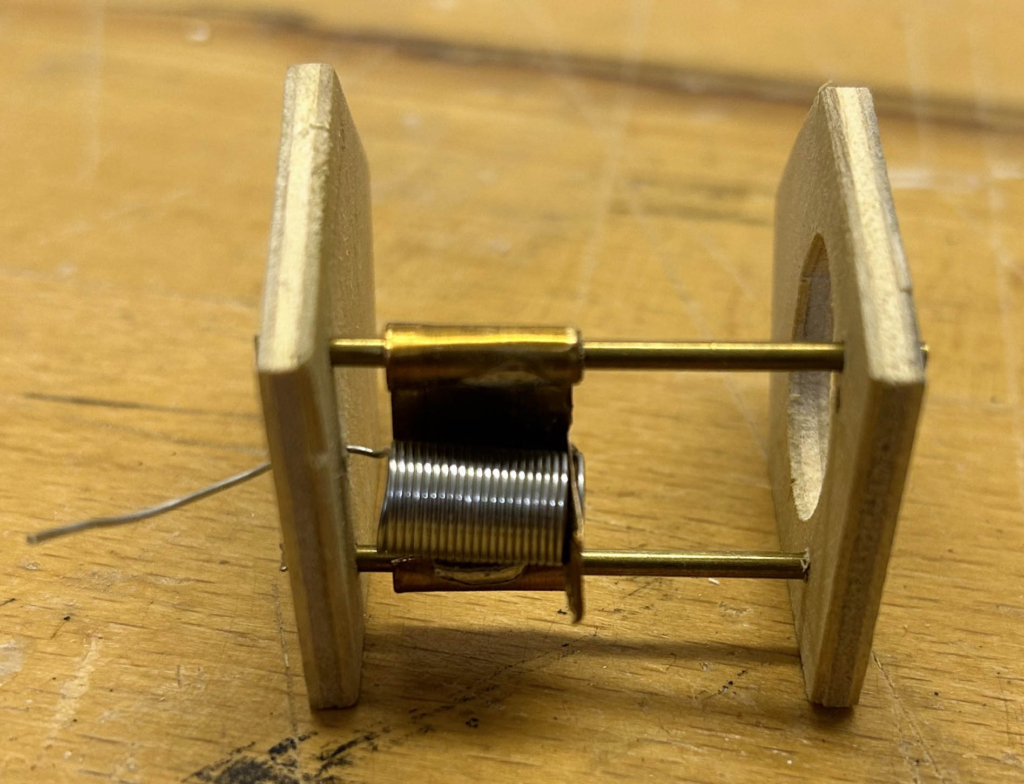
    Carriage mounted on rods & spring soldered to the carriage

    The “loose” end of the spring passes through a hole in the rear wall where it is glued (2-component epoxy resin) in place.

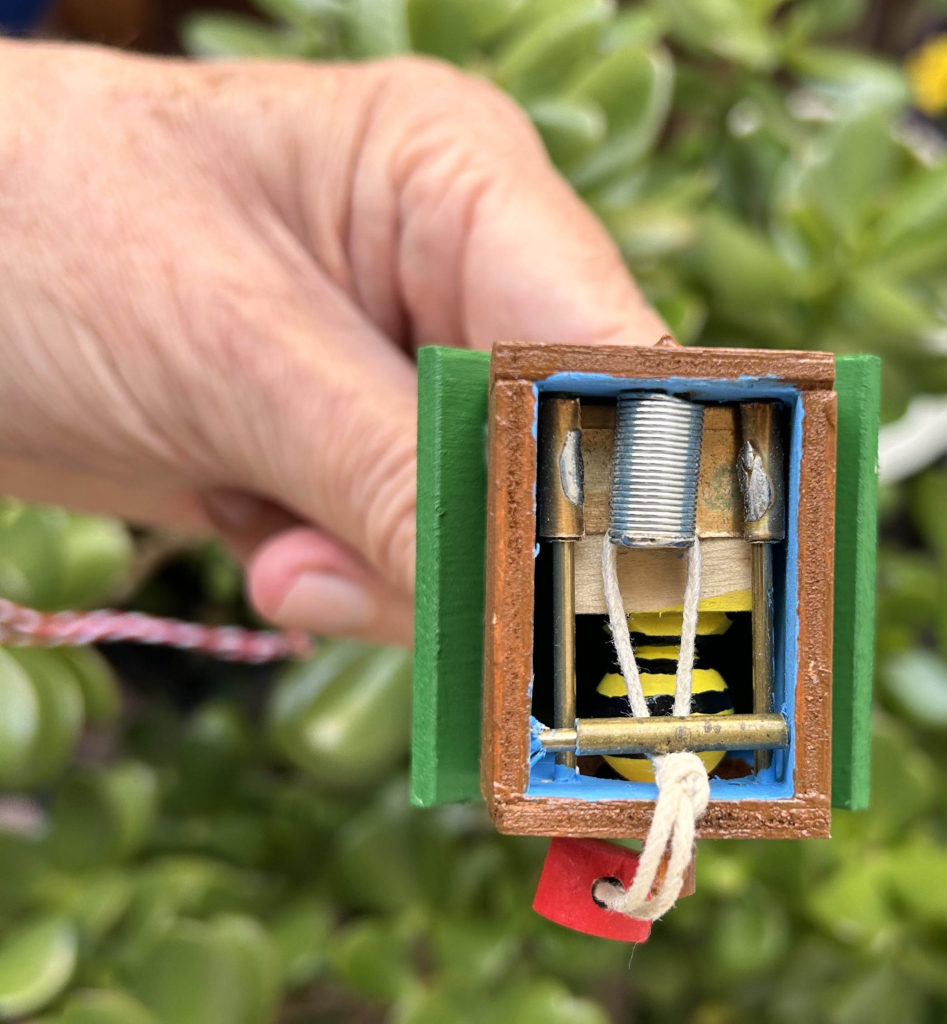
    A roller for the pull string

    To convert a downward pull into a forward movement a roller is handy. This is again made up of a solid brass rod with a loosely fitting tube slid onto it. I suppose that you could just use a plain rod, without a tube, but there would be more friction.

    Note that the roof has a chimney in the middle. This is not just to keep things cosy inside, it also serves as a good place to thread a coloured cord through, to use as a necklace.

    The bee ready to be glued to the carriage

    The bee has to be fully painted before it is glued into the confines of its house. The wings are scarcely visible once installed, but what is a bee without any wings?

    A top view of the bee now glued to the carriage
    The open bottom showing the curious how it works

    Soldering

    Soldering is not hard. You need an electrically powered soldering iron and some solder. The very small parts concerned here don’t take long to heat up and to melt the solder until it flows along the surface. There is something called flux in solder which assists the soldering process. As the solder melts it produces quite acrid fumes which are best avoided or blown away from your nose/eyes. Things get hot of course, so try not to burn your fingers! Alternatively you could try glue, but make sure that it doesn’t get in the wrong places and gum up the movement.

    Reflections

    This is a relatively simple and quite small project and the motion is also fairly straightforward. If the viewer doesn’t immediately understand the story, some showmanship is helpful. Making the pull-cord swing to and fro while calling out “tick tock” reinforces the impression of a clock. When pulling the cord to make the bee reveal itself, a suitable musical “buzzzz buzz, buzzzz buzz” shows how the bee is doing its best to play the part of a cuckoo.

    Video

    URL https://youtu.be/fBPiTorWxkU

    Download

    Download the image files here – https://www.wordwise.de/Beehouse-archive.zip

  • Swedish automata Makers

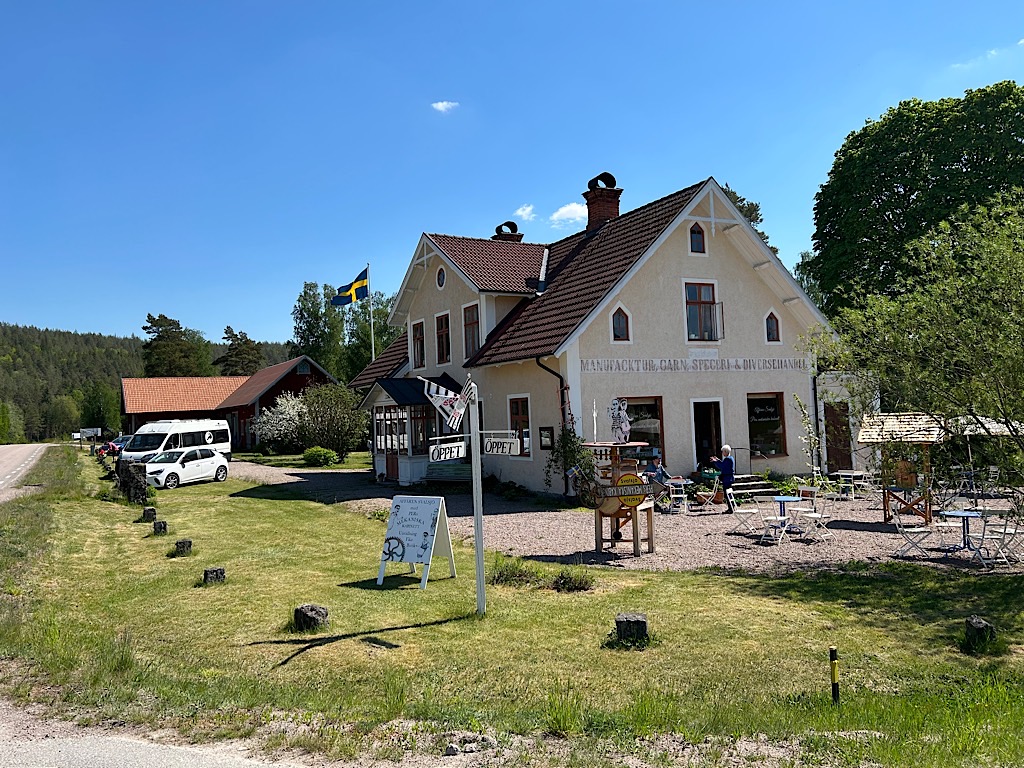
    A visit to Per Helldorff

    One day a video of an automaton made by Per Helldorff popped up on one of my Internet feeds. As Per explained when we eventually managed a visit, a previous visitor to his „mekaniske Kabinett“ made a video of his three-armed cup and ball trickster and quietly posted it onto YouTube (https://youtu.be/m9daxtL90XY?si=UqjMThCtTdzuSRQe) This went viral and, last time I looked, it had been viewed 1.3 million times. To his amazement, Per was then contacted by a Japanese TV network for permission to broadcast the video across Japan. He just wondered “how on earth did that happen?“

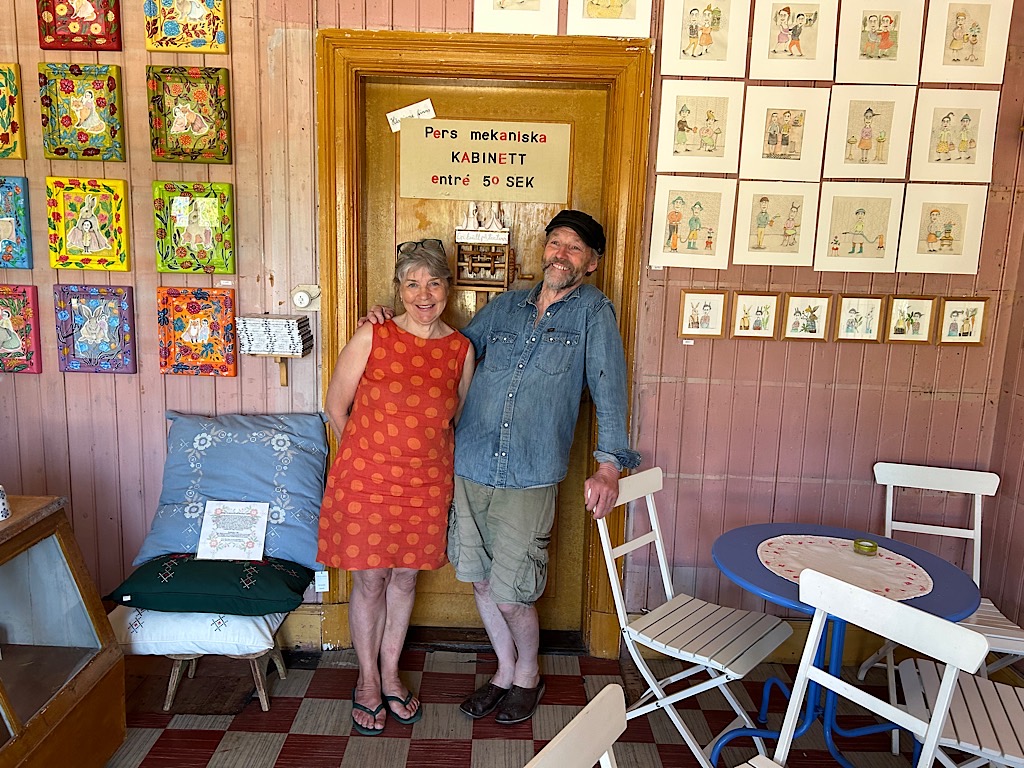
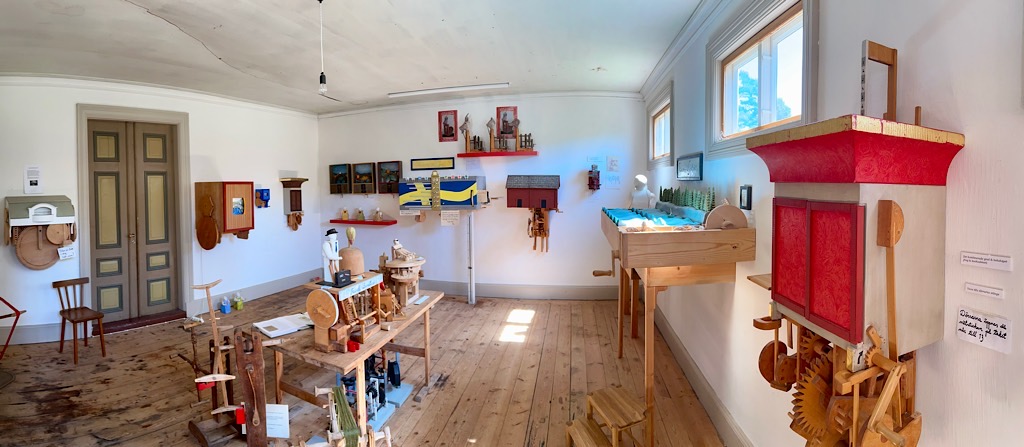
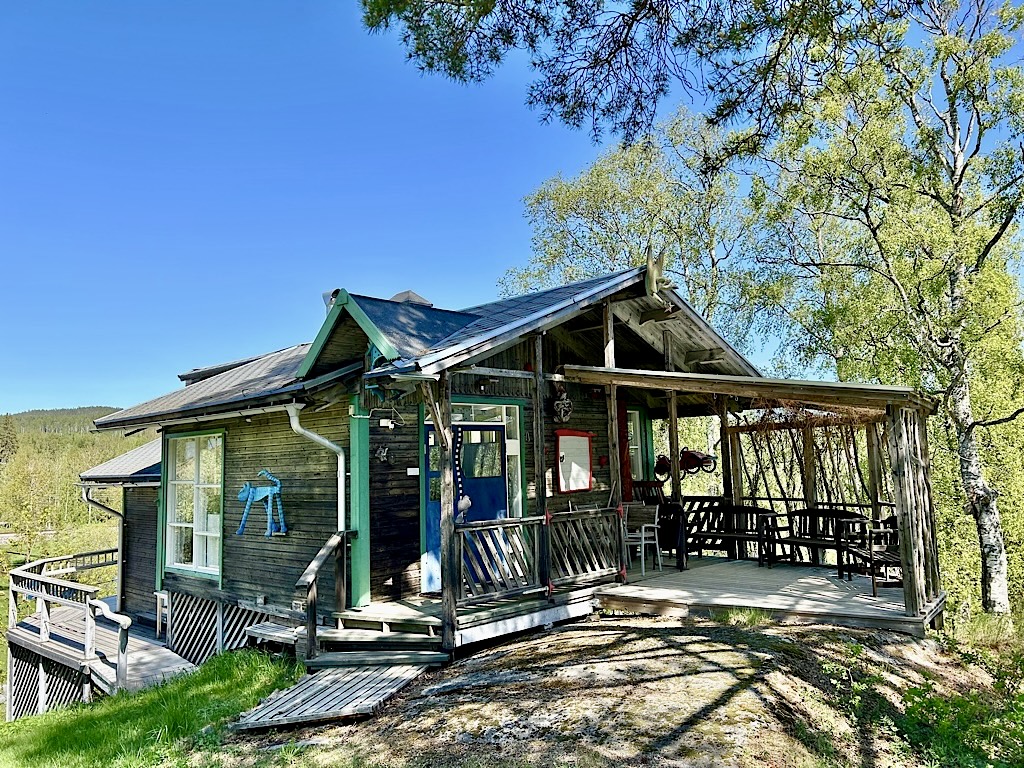
    Per and his wife Anna live on a quiet crossroads in a tiny hamlet in the Swedish countryside. One room serves as the exhibition space and another as a small shop. Anna‘s nettle soup is legendary as one Swedish visitor told me – „we come here just for the soup“. We didn‘t come for the soup but to see Per‘s creations.

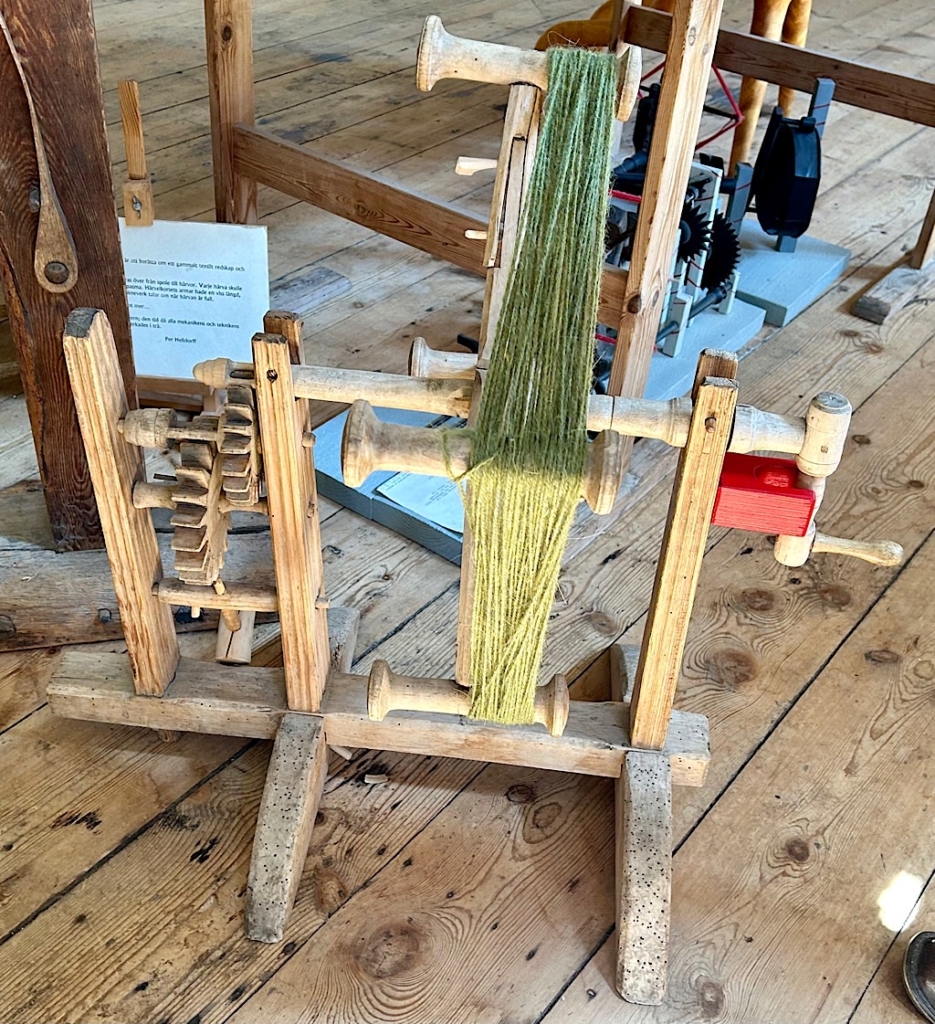
    Per started by explaining his inspiration, showing us this historic wool skein counting machine. A woollen thread is wound onto the four arms as a handle is cranked. When the handle has been cranked a set number of times a wooden hammer hits the frame to signal that the required count has been reached. A royal Swedish edict from long ago specified severe punishment for anyone selling skeins of wool with less than the specified number of loops.

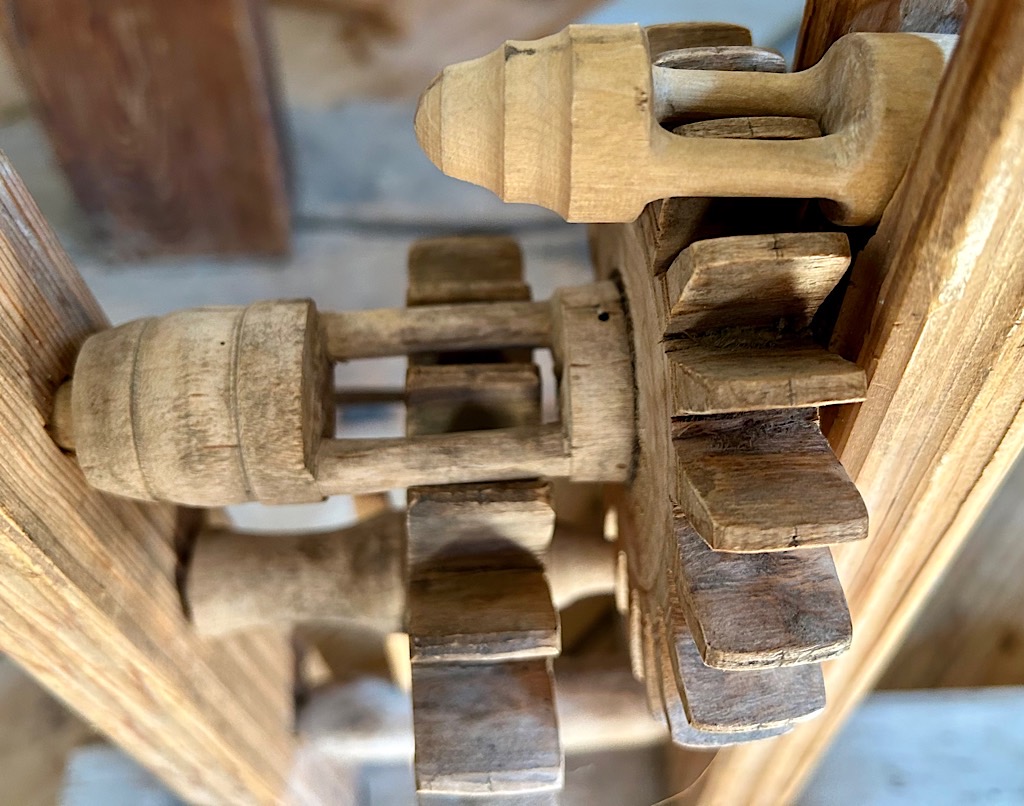
    Looking closely at this old mechanism, two of the shafts have been carved to produce what Per called a „two-toothed cog“. This is a very pragmatic solution to slowly drive the large cogs. Using an „ordinary“ cog, a minimum of about 9 teeth is required to avoid the mechanism jamming. This traditional solution means that you can merrily work the crank on some of Per‘s automata and things happen at a considered, controlled pace.

    Per‘s applause machine, or „a visit to the theatre“, is very popular as you can see in this video (https://youtu.be/OveTB2C0rp8?si=zQImbyJZIn_0tV9C) from one of the occasional courses that Per organises. Barry Falkner made his own version too (https://youtu.be/hW7V6__G1lQ?si=DD_NaFKeOQ4gsaMc).

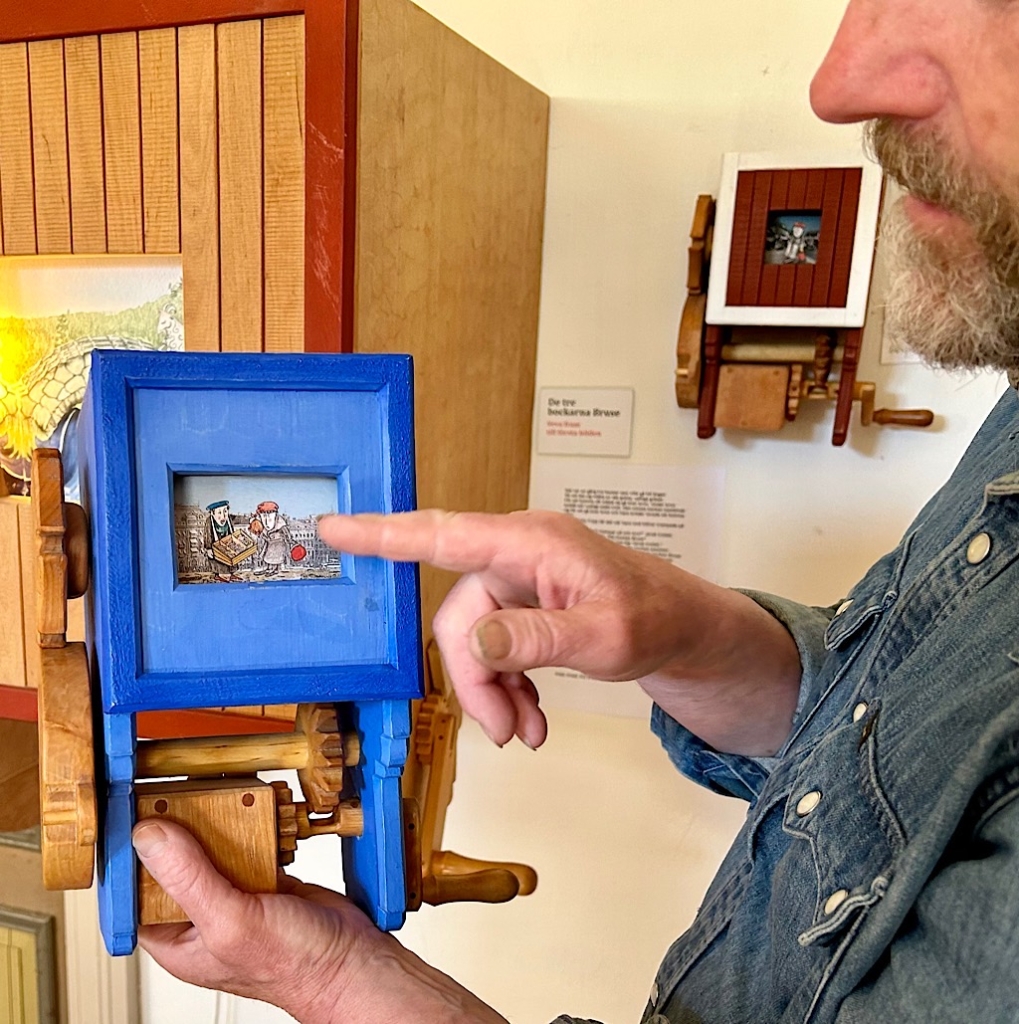
    Per explaining one of his automata based on the Geneva mechanism

    Working together with Anna, Per explored the Geneva mechanism (https://youtu.be/vrK7kTY2NJo?si=ahe_1prgJNi-GcpU). Anna painted the pictures while Per worked on the mechanism.

    Anna and Per Helldorff at the entrance to Per’s mekaniske kabinett
    Part of the exhibition

    Per has worked with wood since he left school. He didn‘t receive any training, he just learned it all by doing it himself. Now of course he’s a skilled craftsman. When an injury restricted what he could manage, that was when he moved towards automata making. His sense of humour and creativity really distinguish his work. He doesn’t do drawings so, when someone orders an existing automaton, patience is required while he copies the original in his workshop.

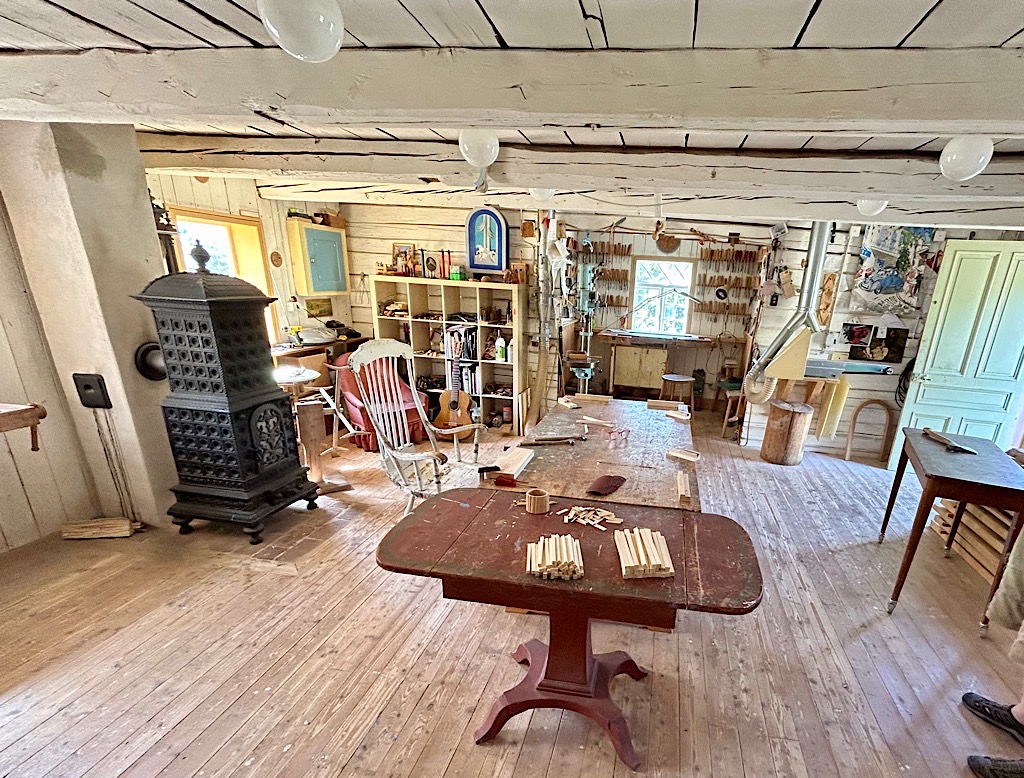
    Part of the workshop

    The English part of Per and Anna‘s website – https://www.helldorff.se/english

    I mentioned that I knew of no other automata makers in Sweden and Per asked if I knew of Tomas Skimutis. I hadn‘t heard of him so another visit was now on the cards.

    A visit to Tomas Skimutis

    Tomas Skimutis decided to build his own gallery. Was he a master carpenter? Well no, he wasn‘t he worked in graphic design.

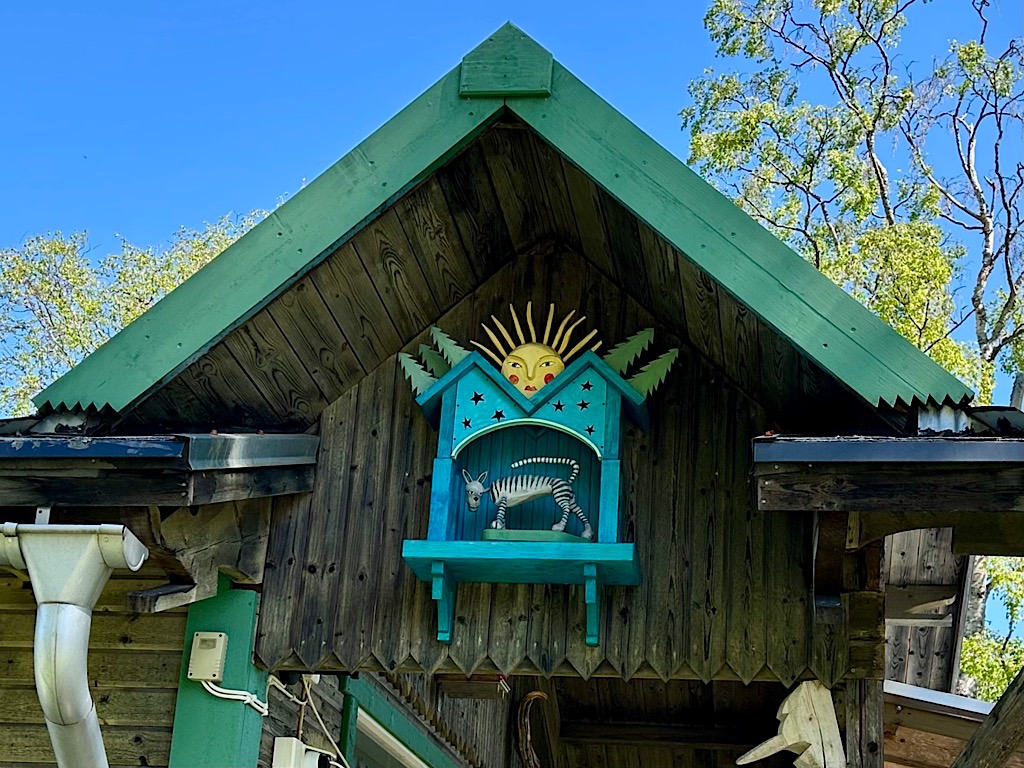
    Over the entrance to Tomas Skimutis‘ gallery

    Things were a bit chaotic inside as preparations were in full swing for a summer exhibition.

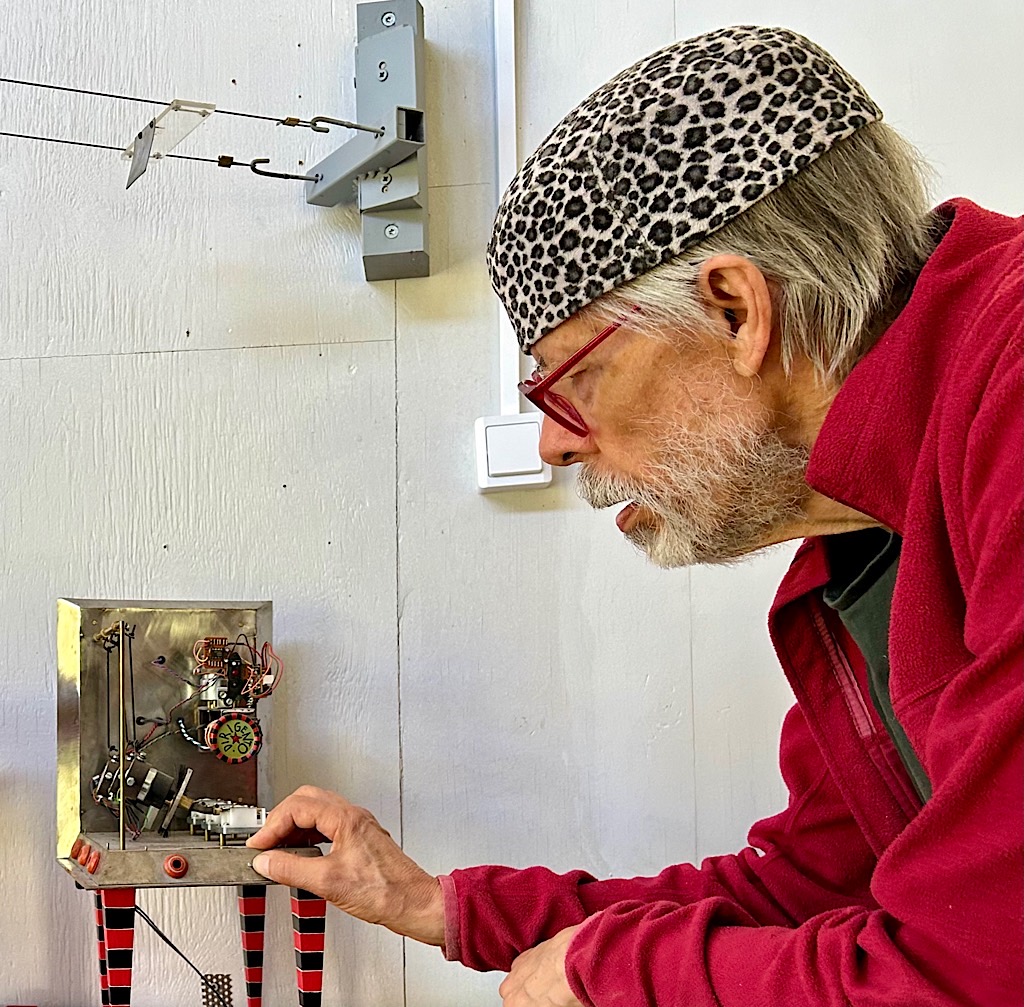
    Tomas demonstrating one of his works

    Still Tomas was happy to show us around. His projects are very varied including small pieces of furniture, occasionally including electrical/electronic bits and pieces, here and there with a handle to turn.

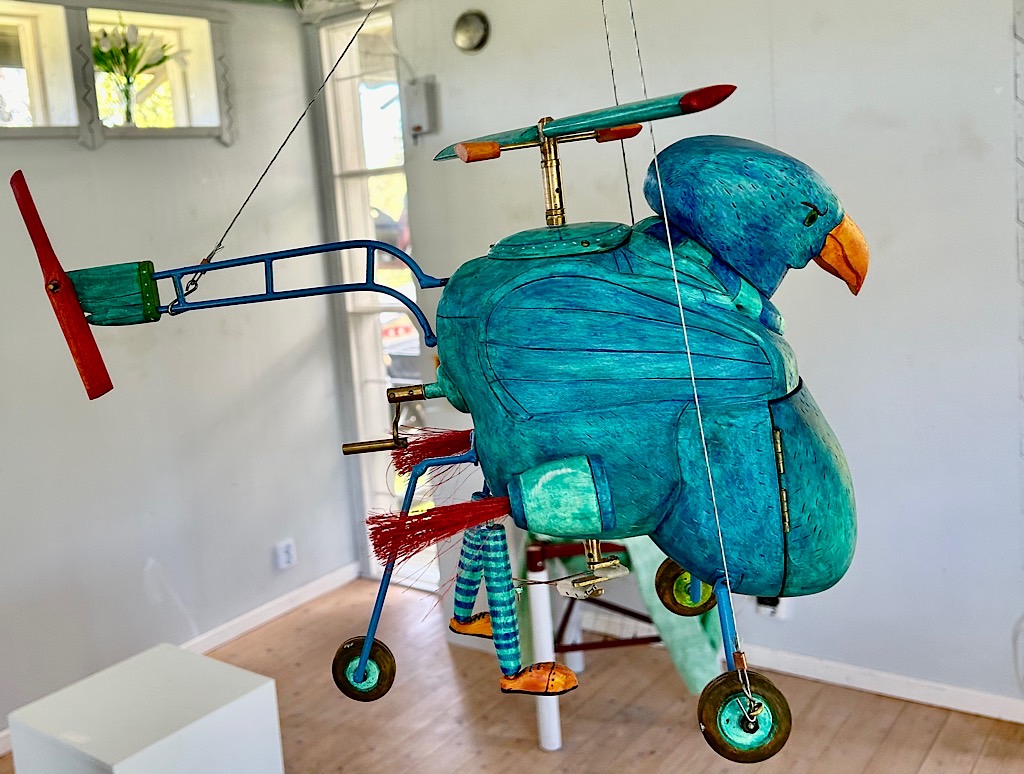
    This bird-helicopter combination was a lot of fun. Tomas pushed a button to make it descend slowly down from the rafters. There is a crank to turn the helicopter blades, but you have to detach the lifting wires to allow the rotor to spin.

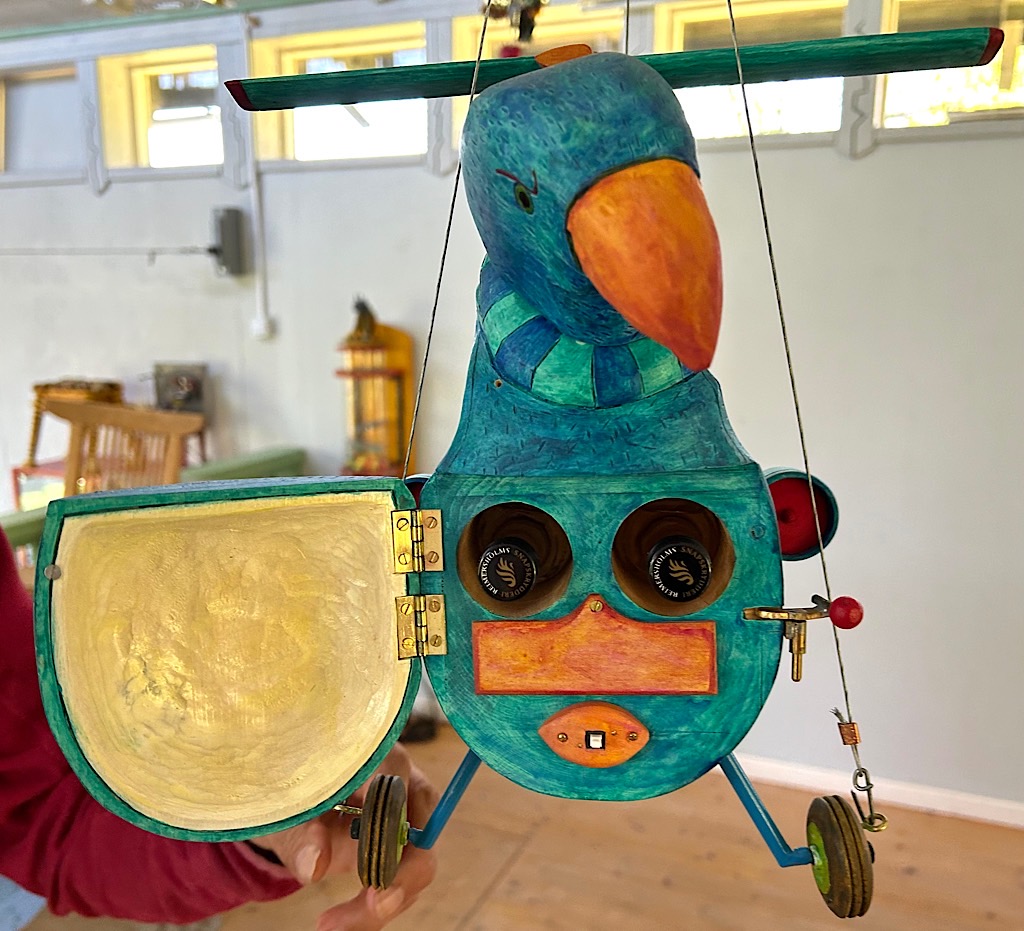
    Opening the bird‘s chest reveals more secrets, such as the two small bottles of Swedish liquor stored inside. Not constrained by any rules or specifications, Tomas just added whatever he felt like and who can argue with that!

    Another piece shows a contestant in a dancing competition twirling in front of a judge. This is hand-cranked but includes music from some sort of electronic player and some flashing lights to show the score.

    This detail from a much larger piece shows a man up in the attic listening to wax cylinder recordings. Pushing a button starts both the music and the movement of the man‘s arm as he cranks away.

    As we had simply rolled up unannounced, although we saw quite a bit, a lot of things were not yet on display. Tomas promised that there would be lots more when his exhibition opens this summer 2024. If you can‘t make it, take a peek at the videos on this page http://www.skimutis.com/5/5.html and get ready to be amazed.

    Website http://www.skimutis.com

    Facebook https://www.facebook.com/tomas.skimutis

  • Horatio the Singing Hippo

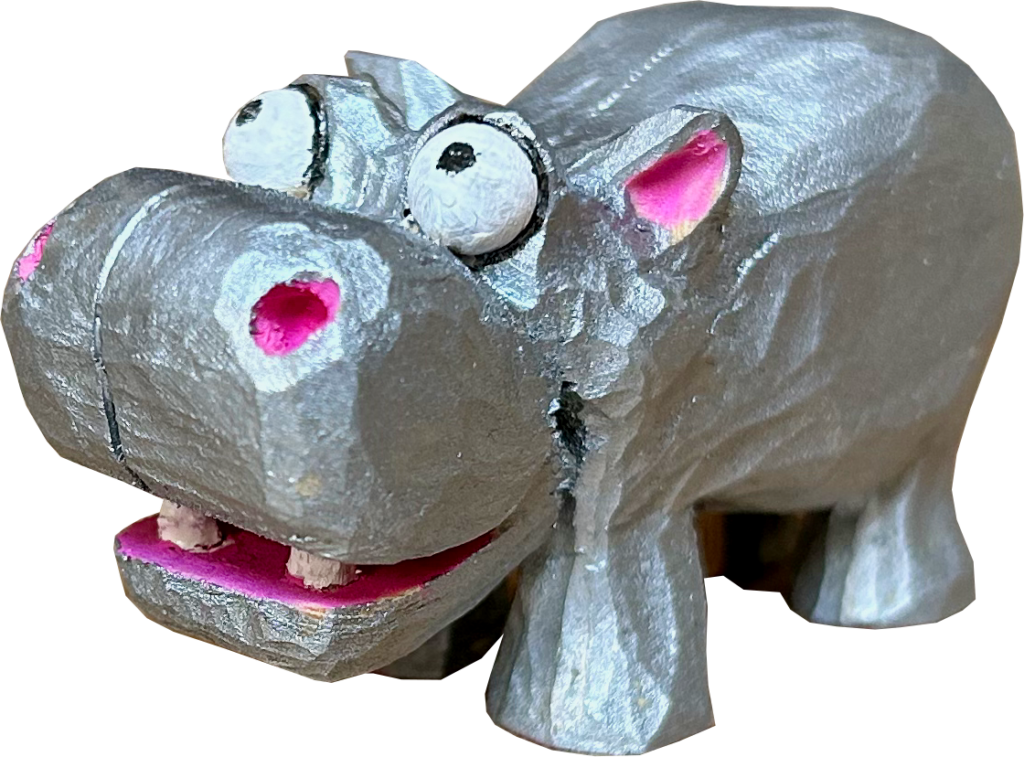
    One day I woke up with an old song rattling around my brain with a merry chorus of “mud, mud, glorious mud…”. When I looked it up on Youtube I was reminded that it was actually called The Hippopotamus Song (https://www.youtube.com/watch?v=4zpDF3Py7r8). So of course I had to make a hippo. A hippo that might sing too.

    The Design Brief

    This is a very simple project which is mostly a carving job with the minor addition of a moving mouth.

    Making

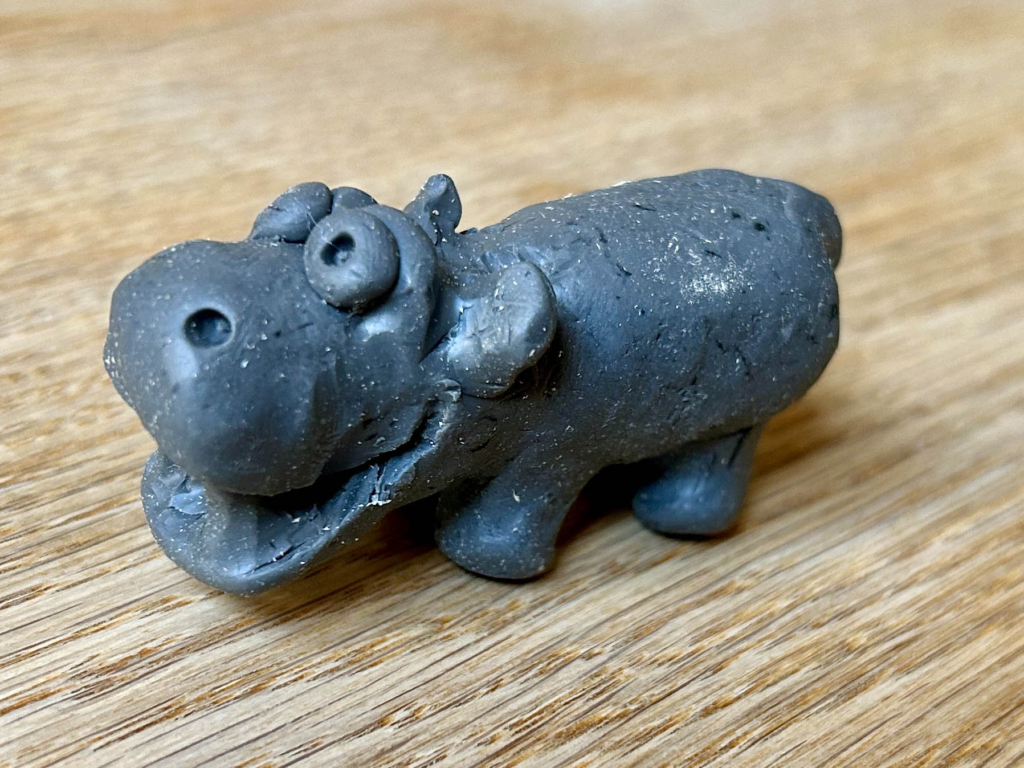
    Before starting to carve I made a maquette in plastercine. The first thing that I noticed was that a large head is heavy and the whole thing tips forwards if the front legs are too far back. It’s always handy to discover things like that before investing a lot of work in carving. I have also decided that grey plastercine is very dull and I will choose something more cheerful next time I go shopping for plastercine.

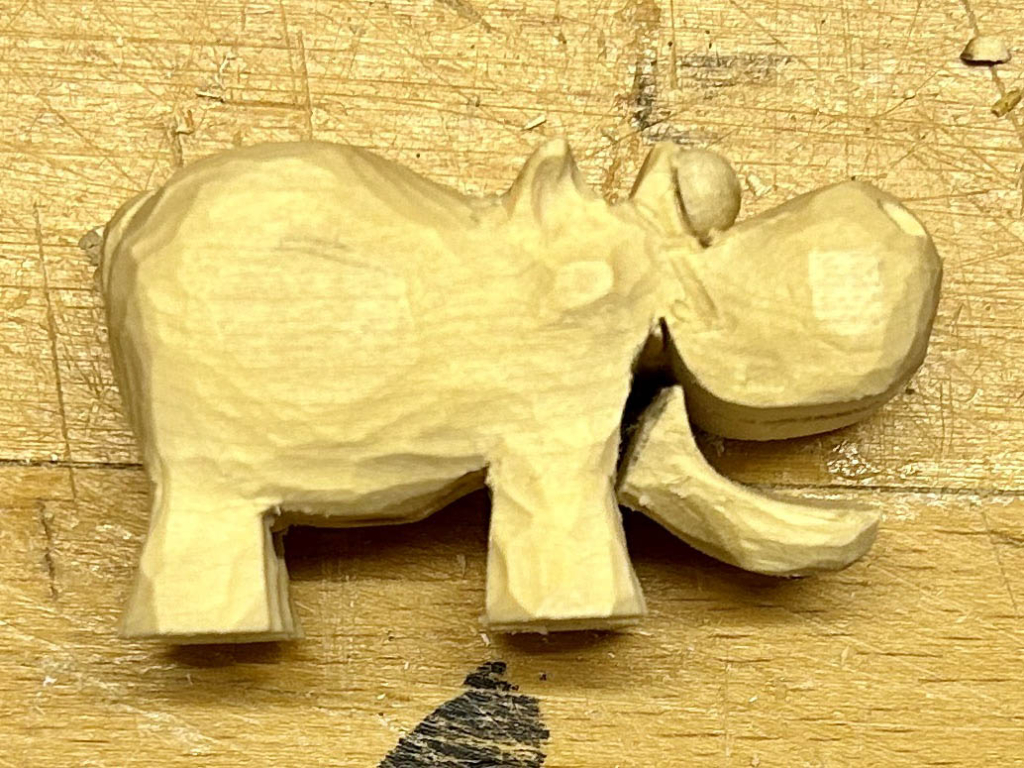
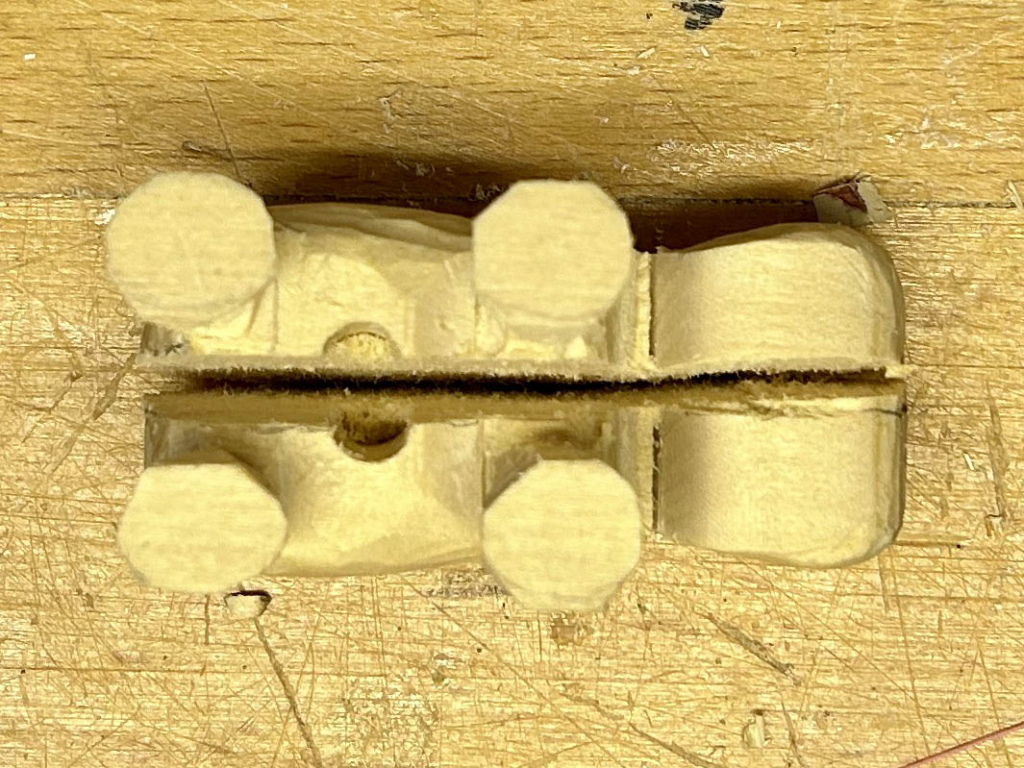
    I carved the hippo in one piece, about 6 cm long, and only then cut the lower jaw out. This makes sure that the jaw will close nicely.

    To be able to make space for the mechanism, I then cut the poor hippo in half.

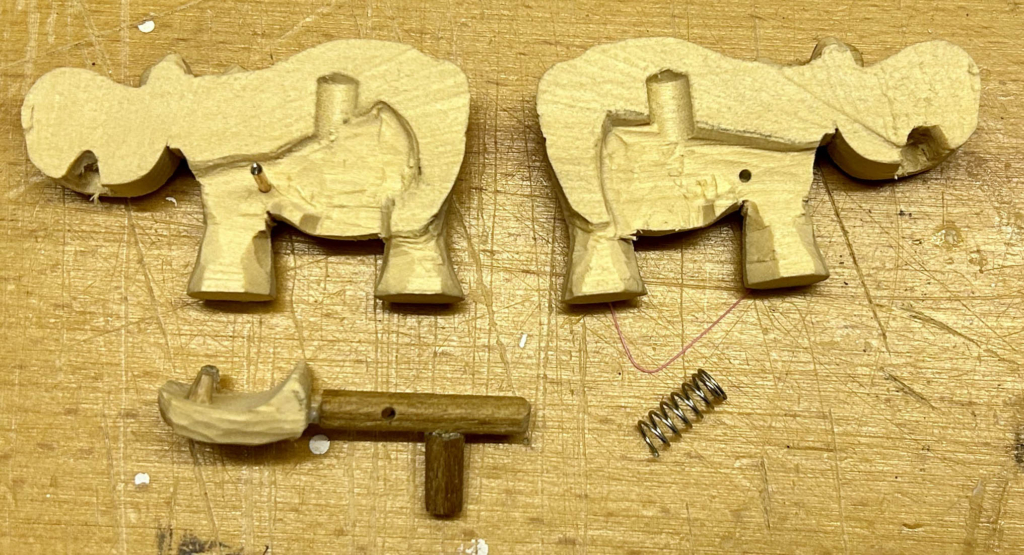
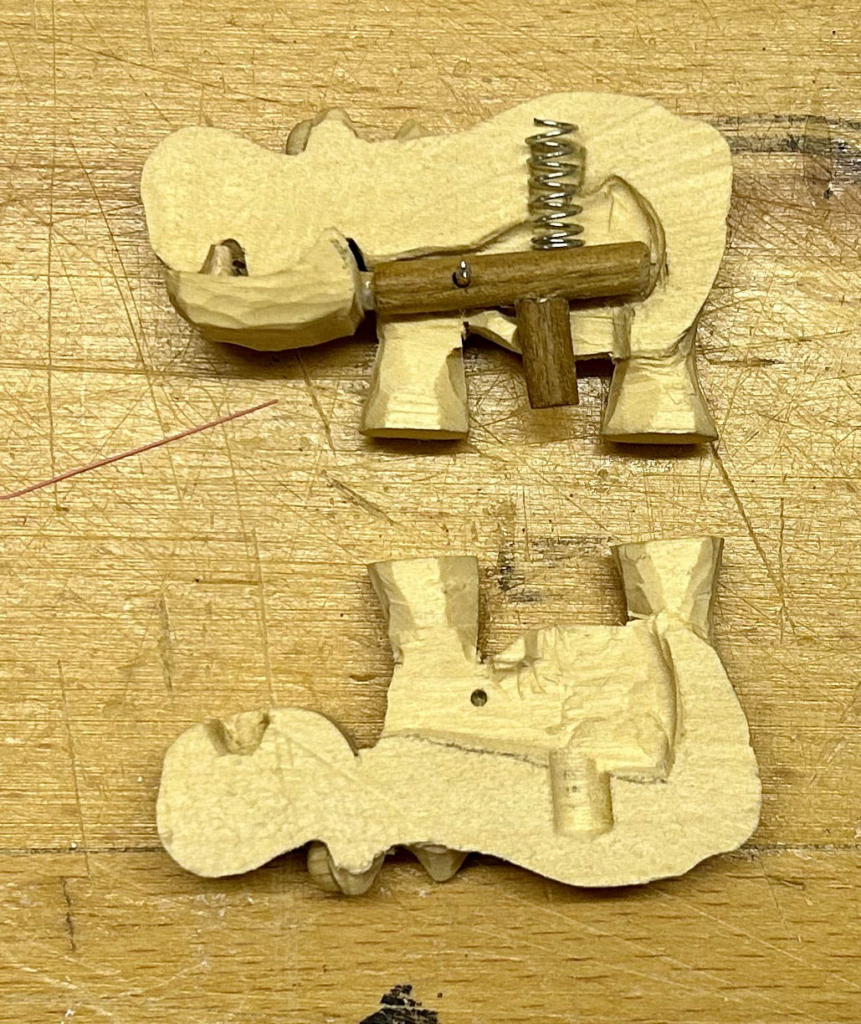
    Inside the hippo, I had to make space for a spring and space for the lever to move. The axle on which the lever turns is simply a piece of brass rod. The lever is glued to the lower jaw.

    With the lever in place you can see that I also made space for the teeth as the lower jaw comes up. You press the protruding part of the lever up to open the jaw. When you release the lever, the spring pushes the lever down to close the jaw. Once I was certain that everything moved easily, I glued the two halves together and got my paintbrushes out.

    Reflections

    The mechanism here is very simple and could be used to make all sorts of four-legged animals talk. As the operating lever is hidden underneath the body it’s not immediately obvious that anything moves. This adds to the surprise as you pick the figure up and demonstrate it to your latest visitor.

    Video

    Youtube link https://youtu.be/dw-3GsOCQP4

    Images

    https://www.wordwise.de/HippoArchive.zip

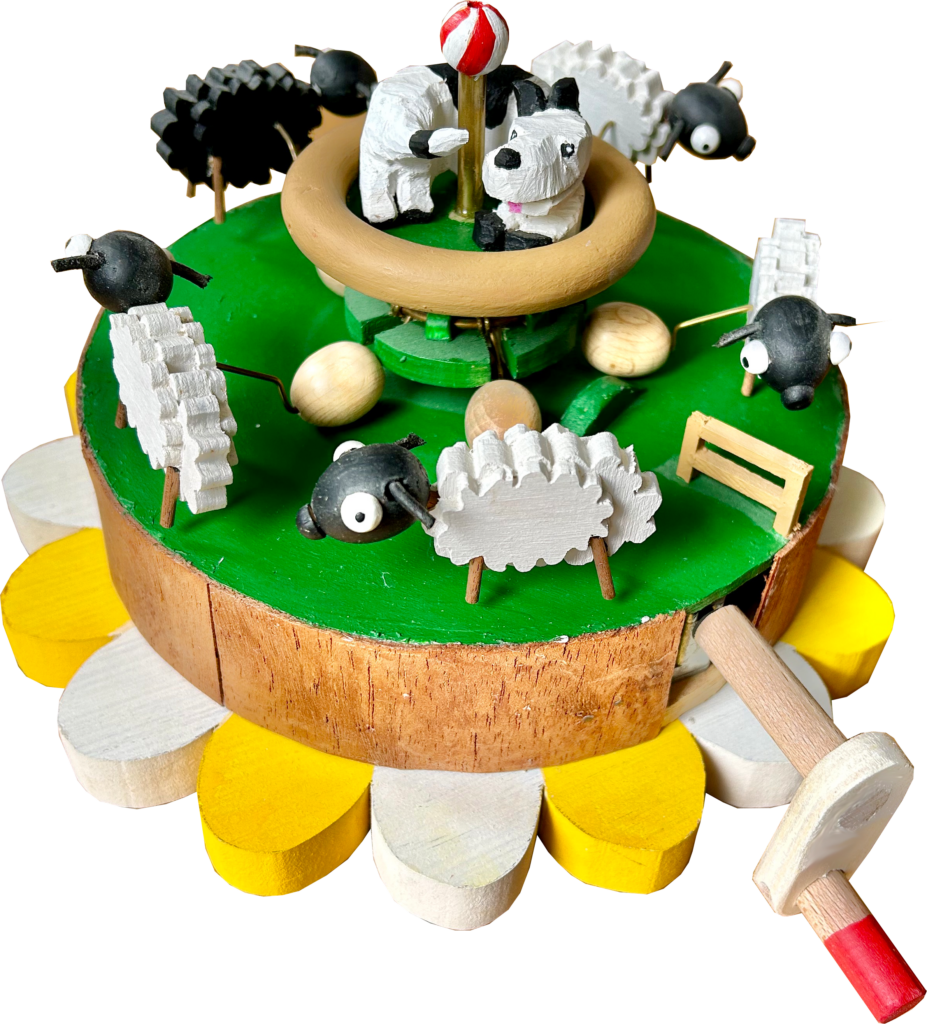
  • The Shleep Machine

    Long, long ago, as a 10 year old boy in in the sanatorium in Davos, Switzerland, my pals and I used to sing Brahm’s lullaby (Wiegenelied) every night before the lights were turned out and we were then supposed to sleep. Imagine my delight when, many years later, I found a music box that played this tune. I have never had problems sleeping, but I had learned the centuries old idea that counting sheep is supposed to help you to nod off. Put these two parts together and I had the basics for an automaton, for a Shleep Machine.

    The Sheep

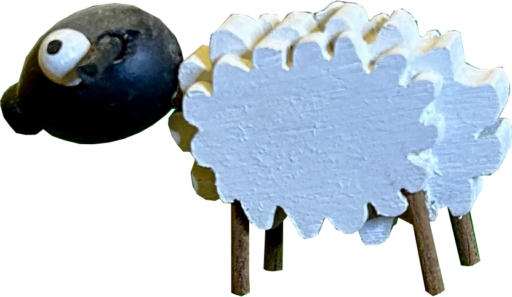
    Carving woolly sheep seemed like a lot of work to me, so I improvised by using a scroll saw to cut some cloud shapes out of plywood. Glue three clouds together with 3 mm dowel for legs, add an egg for a head with a leather shoelace for ears and a sheep is born.

    The Mechanism

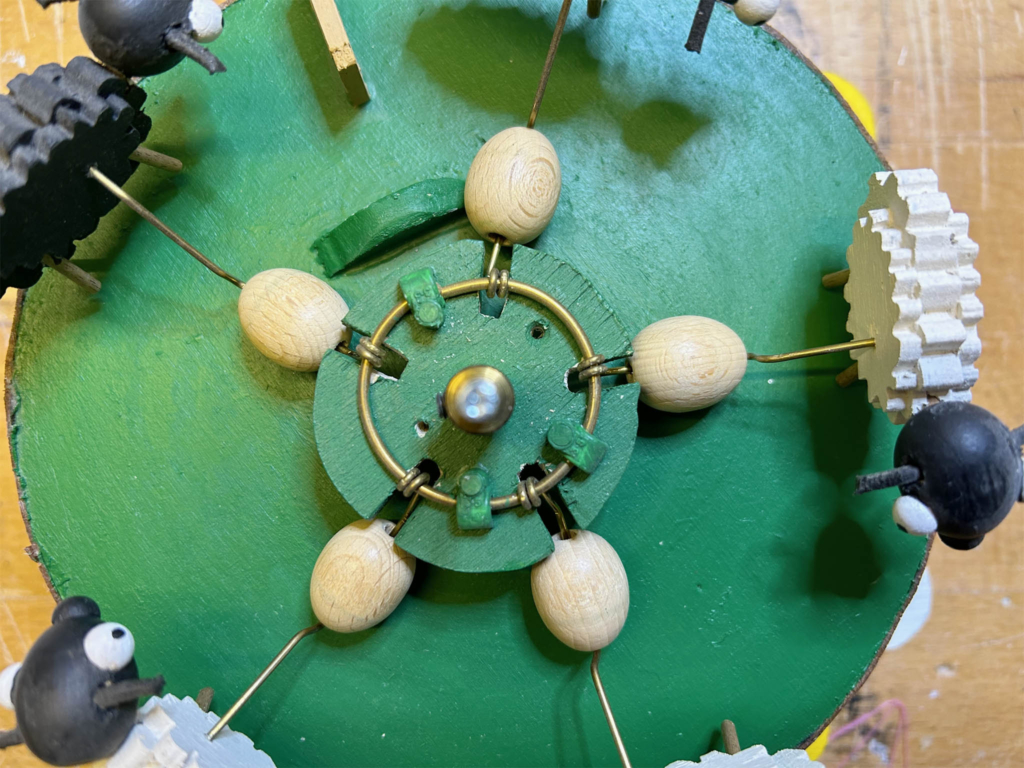
    I used some old Meccano gears that I found in my junk box to join the external crank to the vertical axle in the centre. Turning the crank makes the axle rotate. I inserted the music box mechanism between the crank and the gears to play Brahms’ music as the sheep go round and round.

    View from above with sheepdog removed

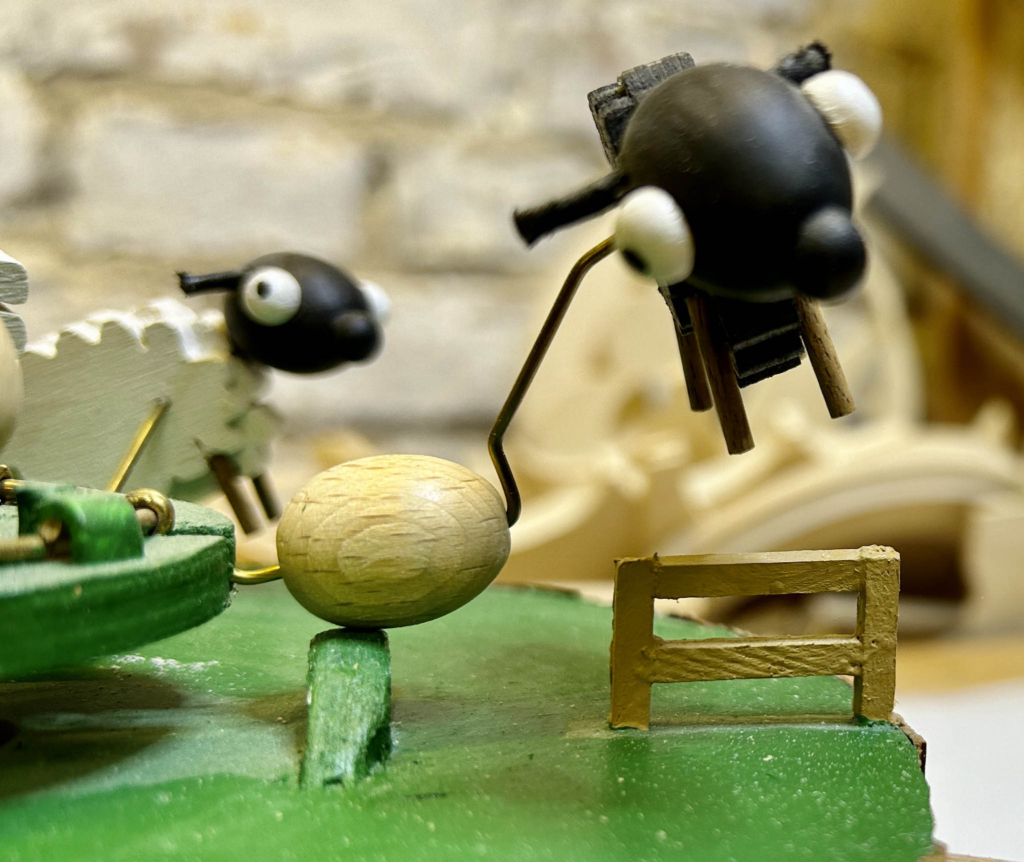
    I attached a wooden disc to the vertical axle with five slots cut into the disc – one for each sheep. Bent brass rod then forms a very simple hinge for the connecting arm to each sheep. Each connecting arm passes freely through a small wooden egg which serves as a wheel. As the centre axle turns, the wheels keep the sheep high enough so that their feet don’t drag on the surface. As each sheep approaches the gate, there is a bump in the path of the wooden egg, which makes the sheep jump up and over the gate.

    How the sheep jump over the gate

    The Sheepdog

    Sheep are often looked after by a sheepdog. In this case the sheep are extraordinarily well-behaved, always going round and round precisely the same circle. This is very boring for the poor dog, who is left with nothing better to do than to chase his own tail. This is not connected to the main mechanism, so you have to give the red and white ball a twirl to start the action.

    Reflections

    No one has yet fallen asleep while using this, so I guess that it makes it a failure. As a ten year old boy the song was usually successful in getting me to drop off. I suppose the nurse turning the lights off helped too. Maybe I’ll try that next time someone has a go with my Shleep Machine.

    The Video

    URL https://www.youtube.com/watch?v=PqDHAnrgt9Q

    The Images

    https://www.wordwise.de/ShleepArchive.zip

  • The Cuckoo’s Lodger

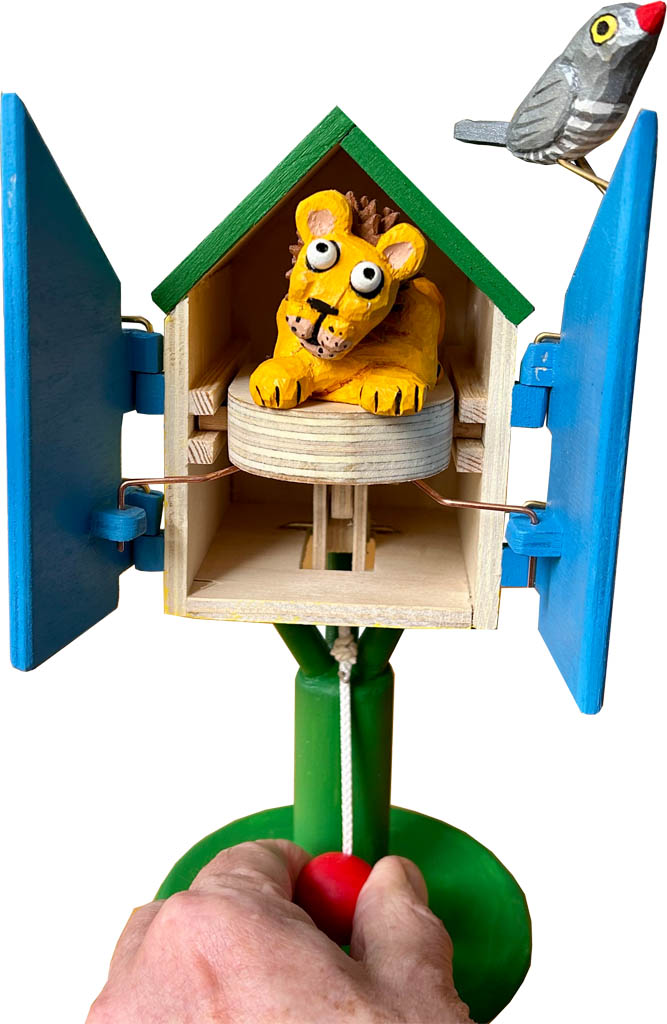
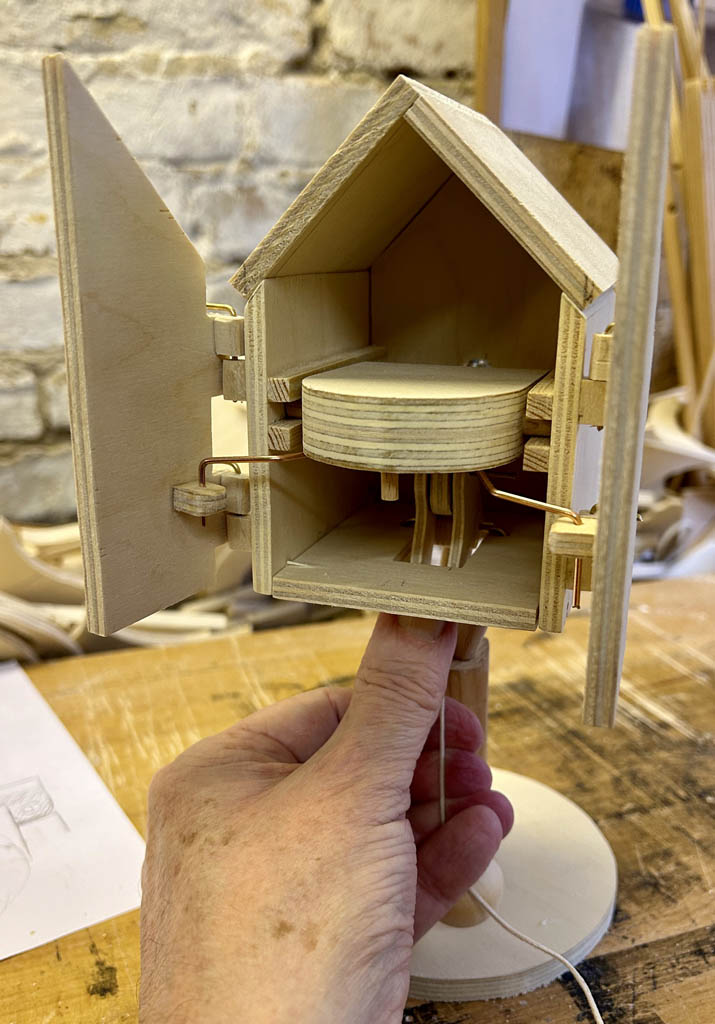
    One winter’s day I decided to try something based on a cuckoo clock. I didn’t really want to make a clock, the interesting bit for me is the door which opens to let a cuckoo briefly appear and sing their song. The doors are usually very small to leave room for the clockwork mechanism. Without the clock, I could make the doors bigger, perhaps offering space for someone bigger than a cuckoo. A cuckoo appearing when the doors are opened is what everyone expects, so of course I couldn’t have that and I went through a range of options until I finally settled on a lion.

    Why a lion? Well in 2013 the amazing Carlos Zapata built a beautiful automaton called “Nero The Lion” which you can admire in this video (https://youtu.be/aMLTes4d3CY?list=UU7dQA67JQJOKKraMgbdG5gQ). On his website (https://carloszapataautomata.blogspot.com) Carlos explains that, In the 1920s, a lion was on the loose in Birmingham (UK) for 3 days until it was recaptured using a football net from Aston Villa, my local football club as I was growing up. His automaton provides a dramatic reconstruction of the event and provided me with some inspiration.

    The tableau shown when my doors open is much simpler. There is one surprise as the doors open and that’s it. The rest is up to your imagination. Maybe the bossy lion has taken over the cuckoo’s home? Perhaps the cuckoo is considering whether to lay its egg in this luxury home? Maybe this illustrates the long-lost Aesop’s fable of why cuckoos no longer build nests, choosing instead to cheekily leave their eggs in other birds’ nests, haunted by the memory of finding a lion in their home in the trees? Or maybe it just shows what might happen when a cuckoo returns after popping out to fetch a pint of milk?

    The Movement

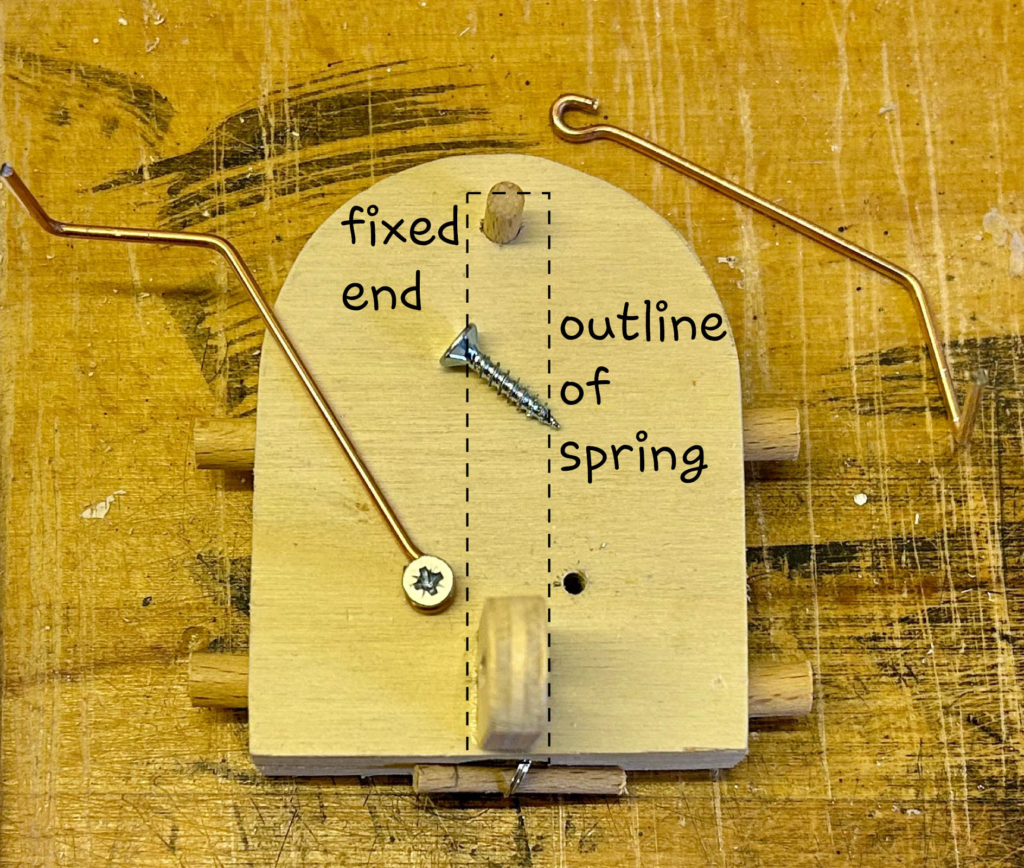
    I decided on a downward pull to move the carriage forwards while opening the doors. A long spring is to close the doors – I just had to find somewhere to put such a long spring.

    Making

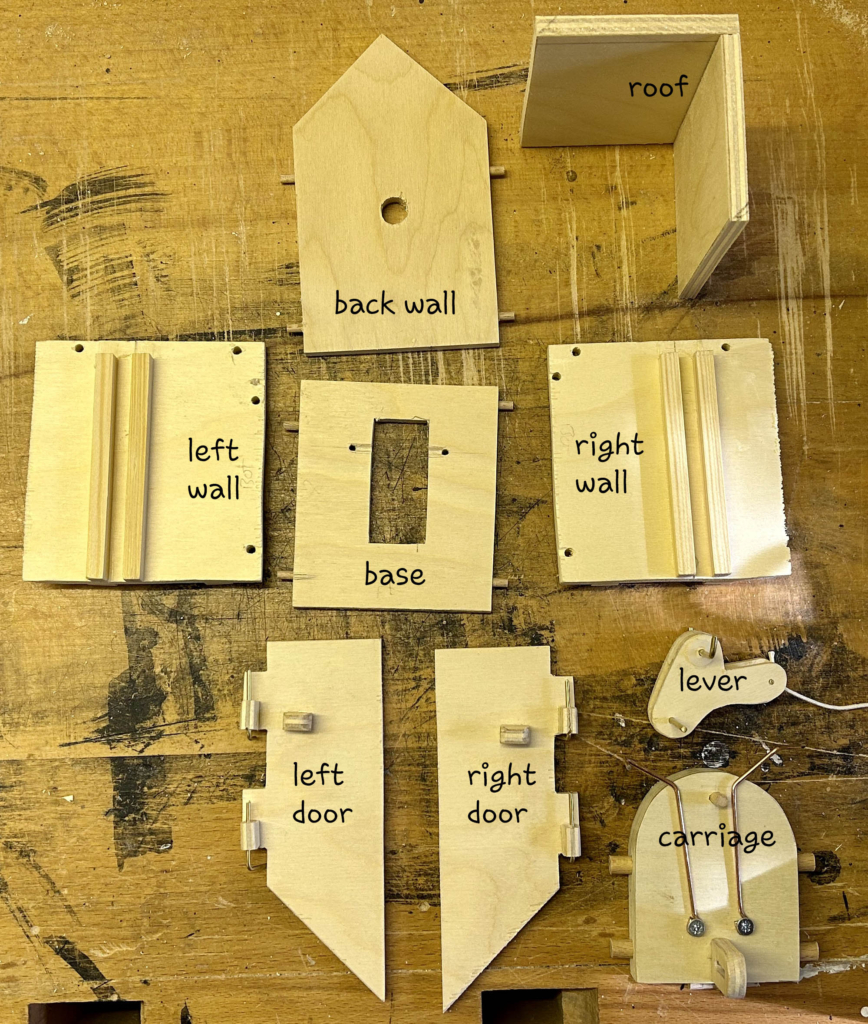
    Parts for the house

    The walls of the house have guides for the carriage.

    Carriage with its spring

    A hole is drilled for almost the full length of the carriage to take a long spring. One end of the spring is fixed with a piece of dowel at the round end of the carriage. The other end of the spring passes through the hole in the back wall to be attached to the house. At the left and right sides of the carriage you can see the protruding dowels which run in the guides. The brass rods are responsible for pushing the doors open as the carriage moves forwards.

    Lever mechanism

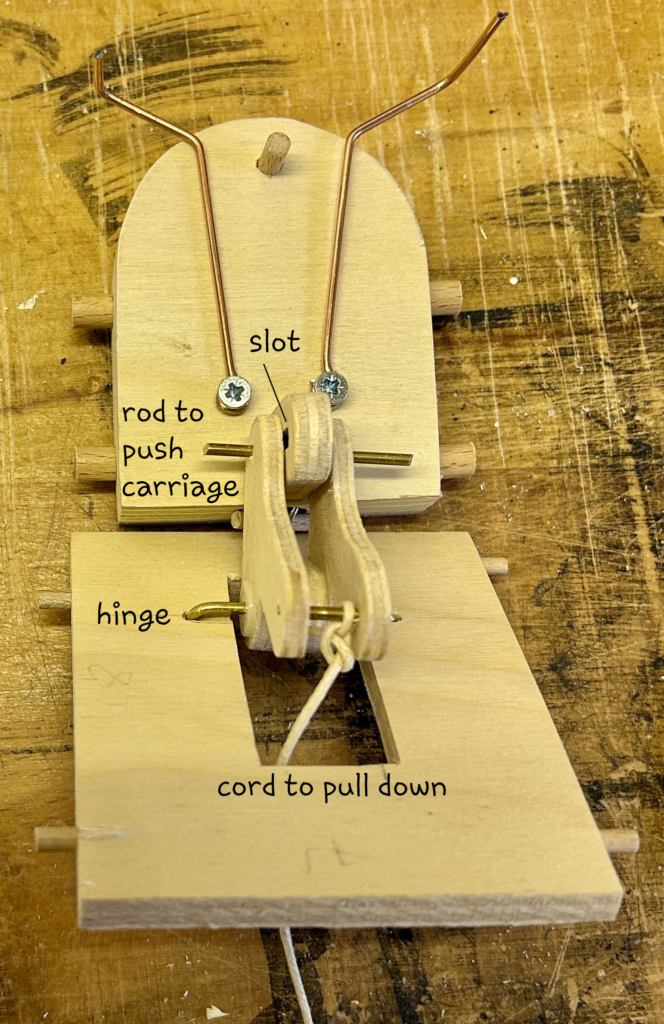
    Pulling the cord down turns the lever around its hinge which pushes the carriage forwards. As the rod moves along an arc around the hinge, a slot is needed in the carriage to allow for the (unwanted) up and down movement while pushing the carriage forwards.

    Assembled mechanism

    The hinges for the doors are simply made up of brass pins passing through two pieces of wood. The pieces of wood do rub together, adding friction to the movement. This turned out to be of no consequence as pulling the cord downwards generates plenty of force and the friction is not noticeable.

    The Tree

    Parts for the stand

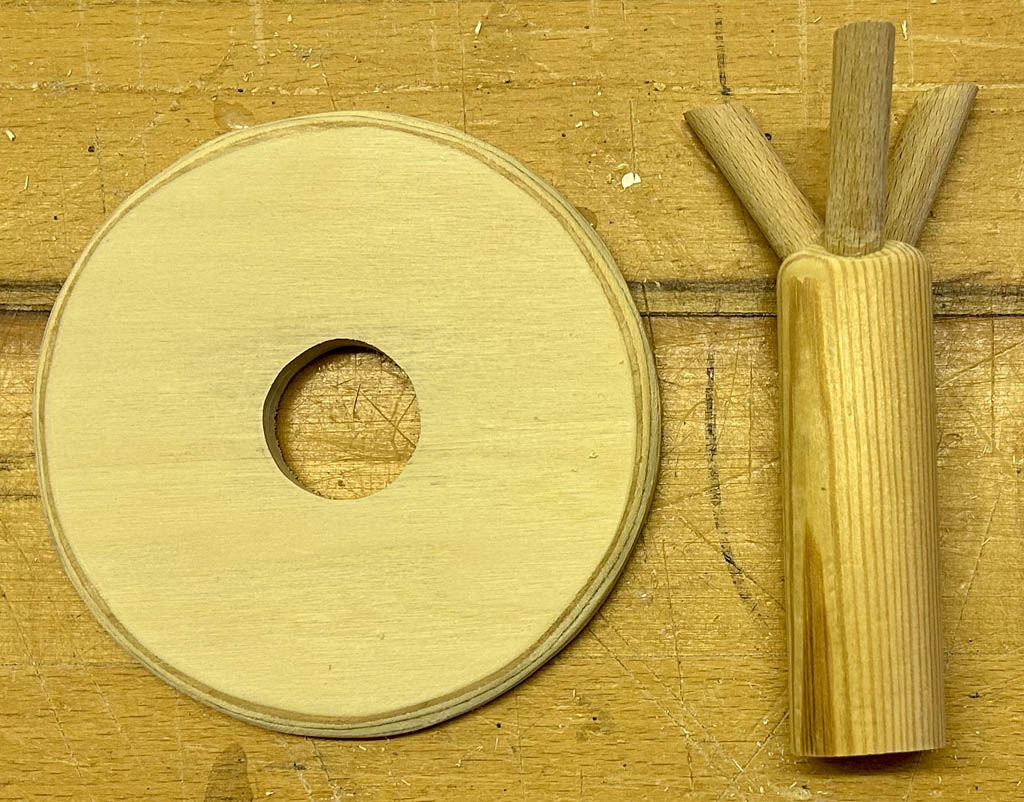
    To be able to pull downwards and thus open the doors, some space is needed underneath the house, so I made a stand suggesting a tree.

    Carving the Figures

    Making a plastercine model first makes sure that the size is right. Otherwise, as the figures don’t have moving parts, it is then just a carving job.

    Reflections

    The moving carriage seems quite thick. Maybe it would have been better to use gravity (e.g. a lead weight) to pull a slimmer carriage back into the house. On the other hand, having lead weights hanging around doesn’t look so good either.

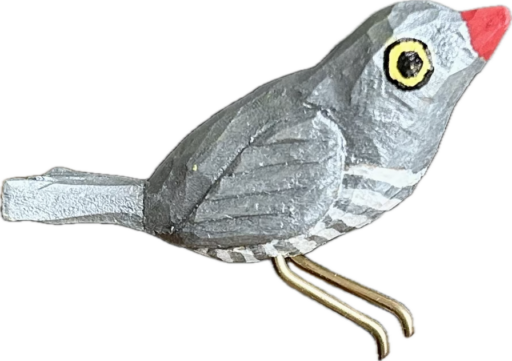
    I did consider making the cuckoo nod as the doors open – as in some conventional cuckoo clocks. I decided against the additional complexity. Perching it on the door seemed just fine to me, as the door opens, the bird swings around with it.

    When I showed this to my young tester, she delighted in removing the lion and replacing it with a long succession of other lodgers. The principle remained the same – the surprise of seeing who is inside as you pull the cord and the doors open.

    Images

    Download – https://wordwise.de/Cuckoo_Archive.zip

    Video

    Link to video https://youtu.be/WfWfa8WP4gA.
  • The Musical Mermaid

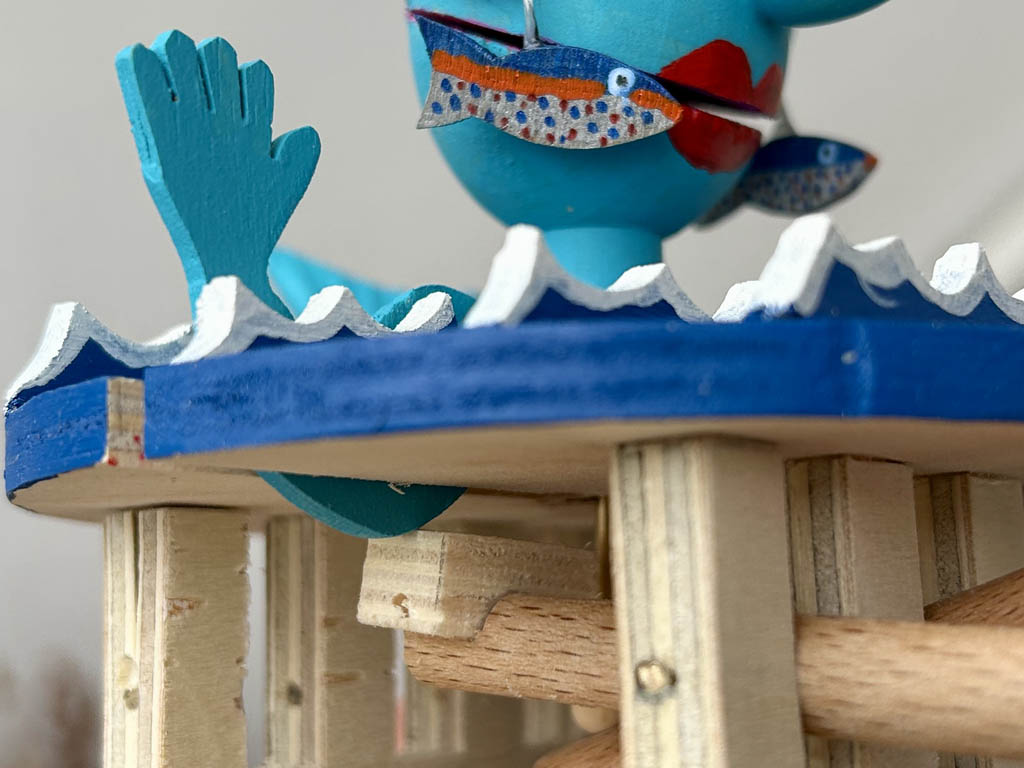
    My idea for this small seductress started life as someone chatting away on a mobile phone until she eventually metamorphosed into a musical mermaid. Along the way she lost her body, gained a tail and took on an unhealthy pallor. My first idea remains – of having the largest mouth possible, simply operated by a lever. Two additional levers permit her to wave enticingly as she sings her siren song to lure unwary sailors into sea wreck and ruin. Although we can’t see what she is wearing beneath the waves, a stylish starfish keeps her hair in check and some fishy earrings show her status as queen of the surf.

    For a change, there is no handle to crank to make a fixed sequence of events happen. Instead there are three levers and it is entirely up to the user to decide what happens in which order. The challenge is to think of a suitable song, sing it yourself and, as you sing it, to manipulate the levers for best effect. I was encouraged by recently spotting Puppets in Prague talking about table-top puppets. While my figure is not as sophisticated as Mirek Trejtnar’s, real mermaids do not actually have any legs, so I felt it was legitimate to hide all of the complicated bits out of sight under the water. Not that it is complicated, it is quite simple really and it did not take too long at all to make. Maybe there are ideas here which you could use in your next project?

    Making the Head

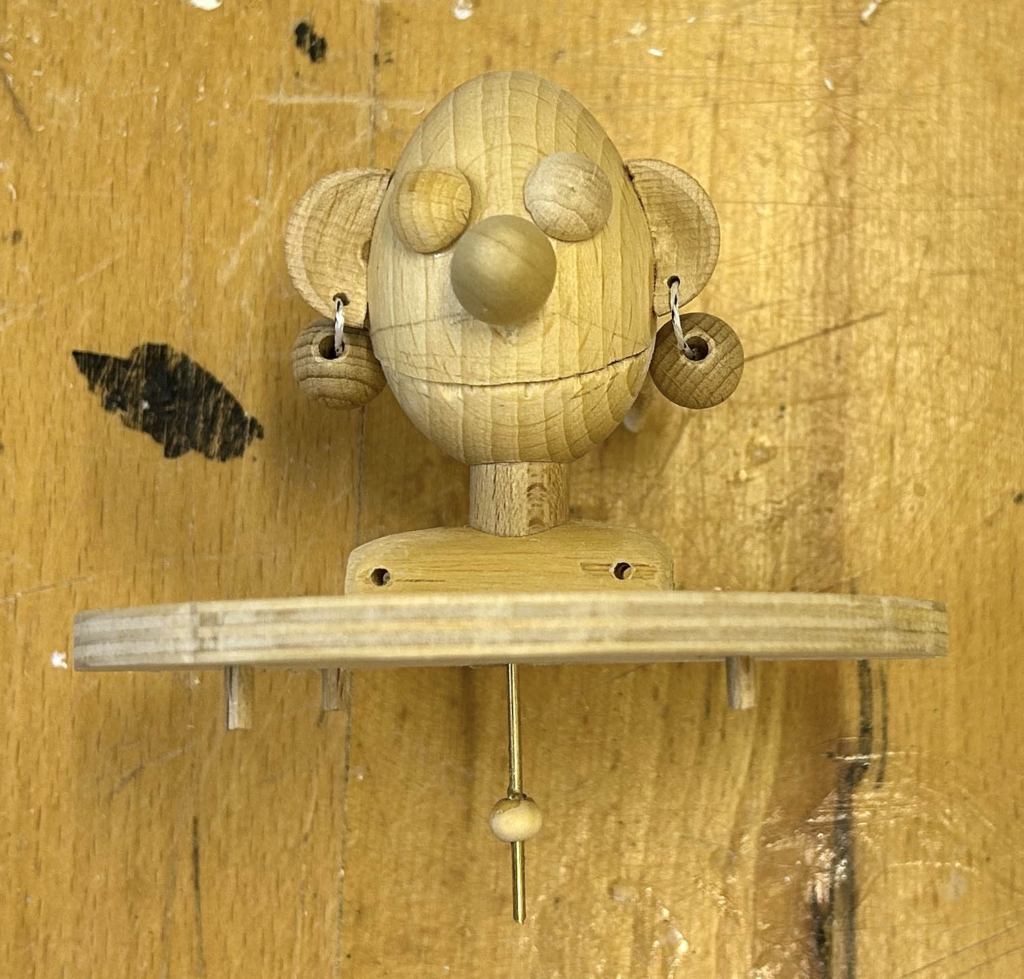
    Uncut head with the neck in place

    As wooden eggs are egg-shaped, it helps a lot if you first carefully drill a hole in the base and then glue a piece of dowel in it. As dowel has straight edges, the 10 mm diameter dowel shows the orientation of the 50 mm long egg much more clearly. The dowel is much easier than the egg to clamp firmly in a vice, thus holding everything steady while drilling and sawing.

    However, before cutting the egg diagonally to make a mouth, I drilled a 6 mm hole through the dowel and into the egg. This hole will then take the pusher rod which opens and closes the mouth. Also before cutting, I drilled two 2 mm holes horizontally through the egg. One to take the brass rod which hinges the two parts of the head together and the other to take a brass rod which hinges the pusher rod that come up through the dowel.

    Disassembled head showing the hinge allowing the mouth to open
    The assembled hinge for the two parts of the head

    The jaw is held quite still by the neck dowel. Making the mouth the full width of the head and moving the upper head instead of the jaw means that the movement is accentuated and everything is more dramatic, larger than life.

    The pusher rod ready to be connected

    The pusher rod is attached to the upper part of the head via a simple hinge. The horizontal rod passes through the loop in the end of the pusher rod, thus making a connection which can both push up and pull down. The pusher rod passes through a generous hole in the dowel so that, as the head rises and tilts back, taking the loop with it, there is enough play to prevent the pusher rod from jamming.

    The pusher rod connected

    Making the Base

    Top and bottom of the base plus the mermaid’s shoulders

    A 10 cm diameter base seemed about right and a chunky piece of dowel serves well as shoulders with a 10 mm hole for the neck.

    Top part of base

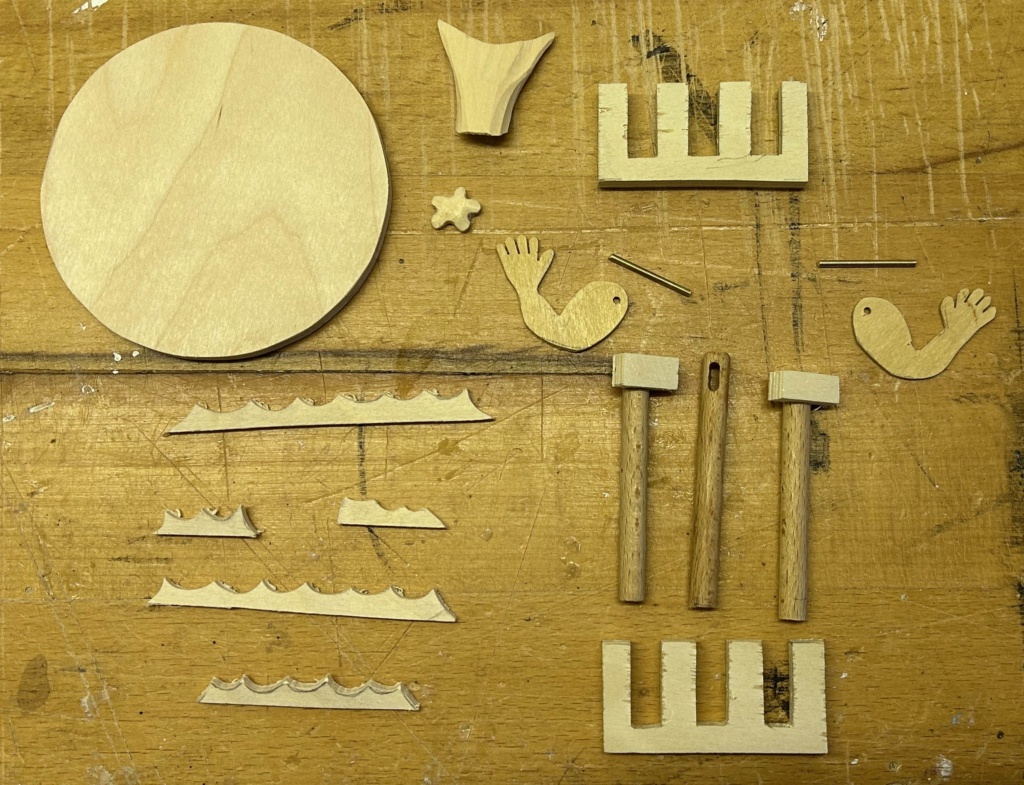
    To allow the nymph’s arms to rise up out of the water, 4 mm slots provide plenty of space for the arms made of 2 mm plywood. The ugly slots are largely hidden by gluing waves right in front of them.

    Arms cut from 2 mm plywood

    The arms hinge on 2 mm brass rods and, once assembled, they need a bit of fine tuning to make sure that the levers apply force in the right direction i.e. upwards but also slightly outwards.

    Miscellaneous parts

    In the miscellaneous parts photo you can see three levers: one to push the right arm up, one with a slot to open the mouth and one to push the left arm up.

    Head with rod to push mouth open

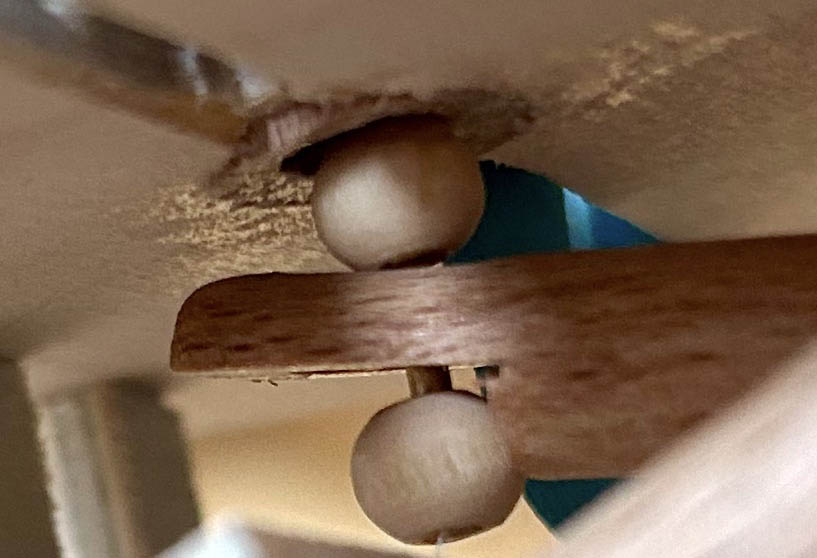
    A small wooden sphere glued to the rod allows the slotted lever to push up and open the mouth.

    Second ball on rod to retain connection to lever

    Once fully assembled, a second small wooden ball prevents the rod from slipping out of the slot.

    Lever raising an arm

    The levers to raise the arms are a bit simpler, they just push on the elbow and rely on gravity to pull the arm down.

    Reflections

    Our mermaid started off with pearl earrings. At first, that seemed quite maritime chique, but wasn’t very interesting once I had painted things. Replacing pearls with fish made her much more mermaidy, even permitting some colour coordination with the starfish.

    While generally enthusiastic, my first eight year-old tester complained that the mermaid’s hair was too short. Mermaids are usually shown with long, flowing locks. I’m afraid that my mermaid has opted for a more sensible, modern, easy-care cut.

    Video

    Video link https://youtu.be/G5r6pDQa3g4

    Images

    Download available under https://www.wordwise.de/MermaidArchive.zip

  • His Mousy Voice

    The Idea

    First ideas

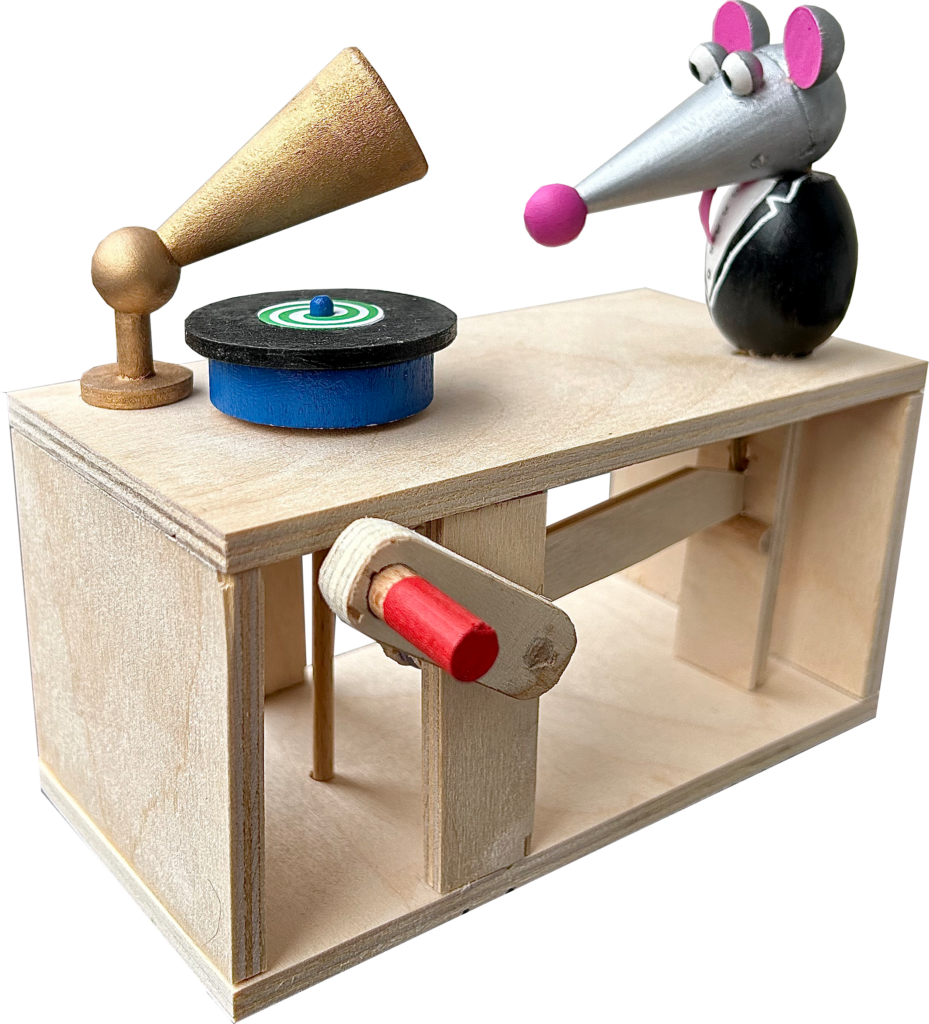
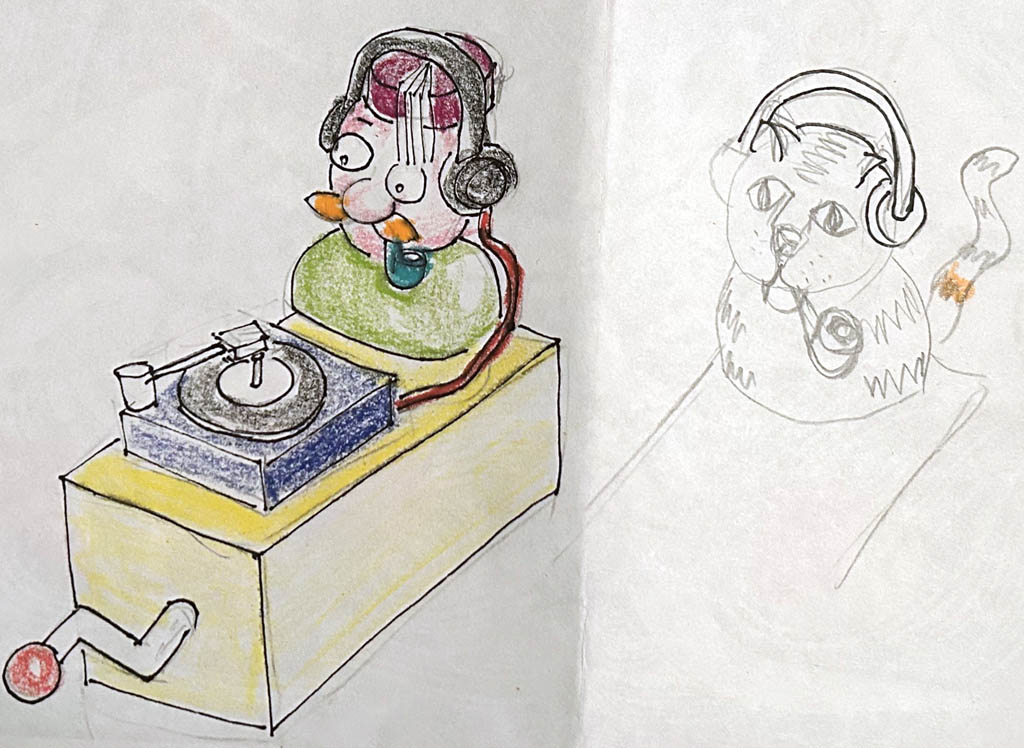
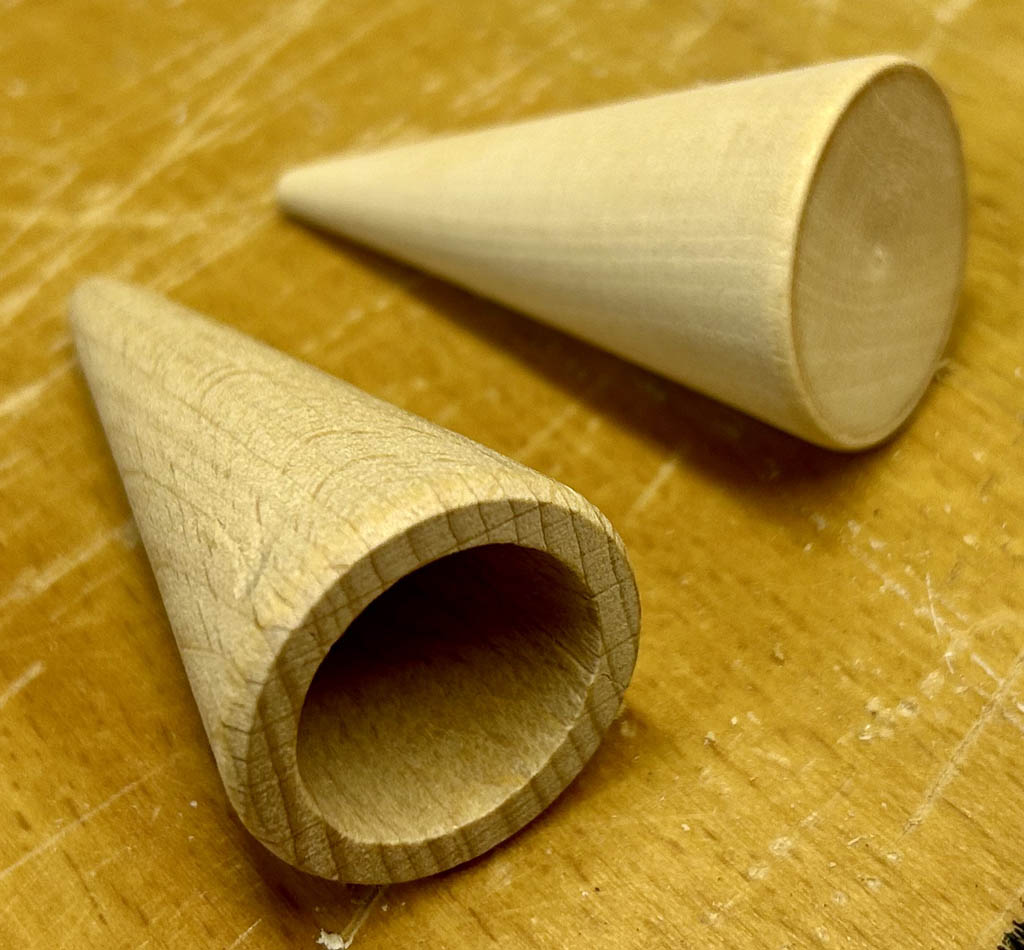
    One fine autumn day, idly contemplating how fast technological development makes things redundant, I first thought that it would be entertaining to see if my smallest friends would recognise a record player. Then I thought about “cool cats” listening to jazz music. Finally, I was tidying up in the workshop and I found these two cones, which reminded me that record players didn’t always include amplifiers but were once wound up with a crank, driven by clockwork and just used a horn to make the sound louder.

    Two cones from the craft shop around the corner – one hollow, one not

    I thought that he second cone wasn’t the right shape for a dog’s head (as in the logo for His Master’s Voice), but it does serve very nicely as the nose for a mouse, so I was now ready to start making.

    Making the Mouse

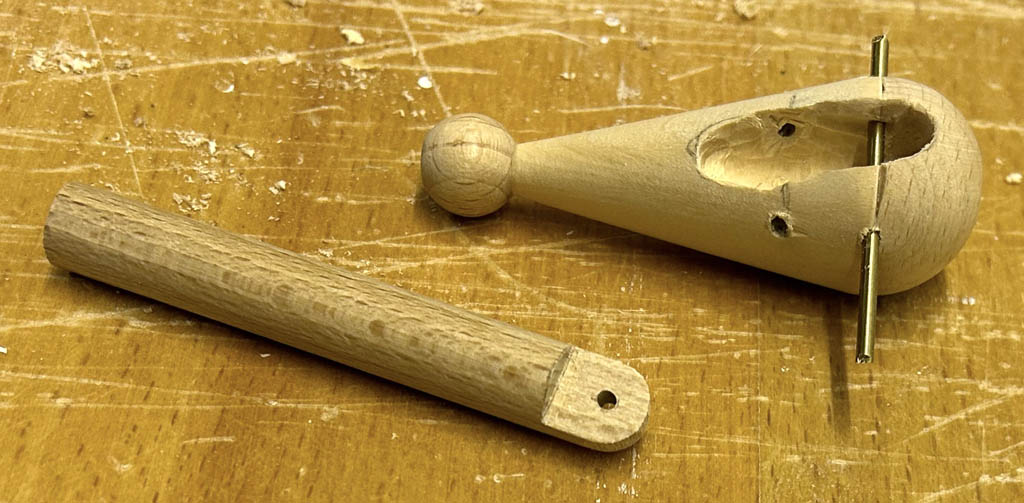
    The mouse’s head with its pivot

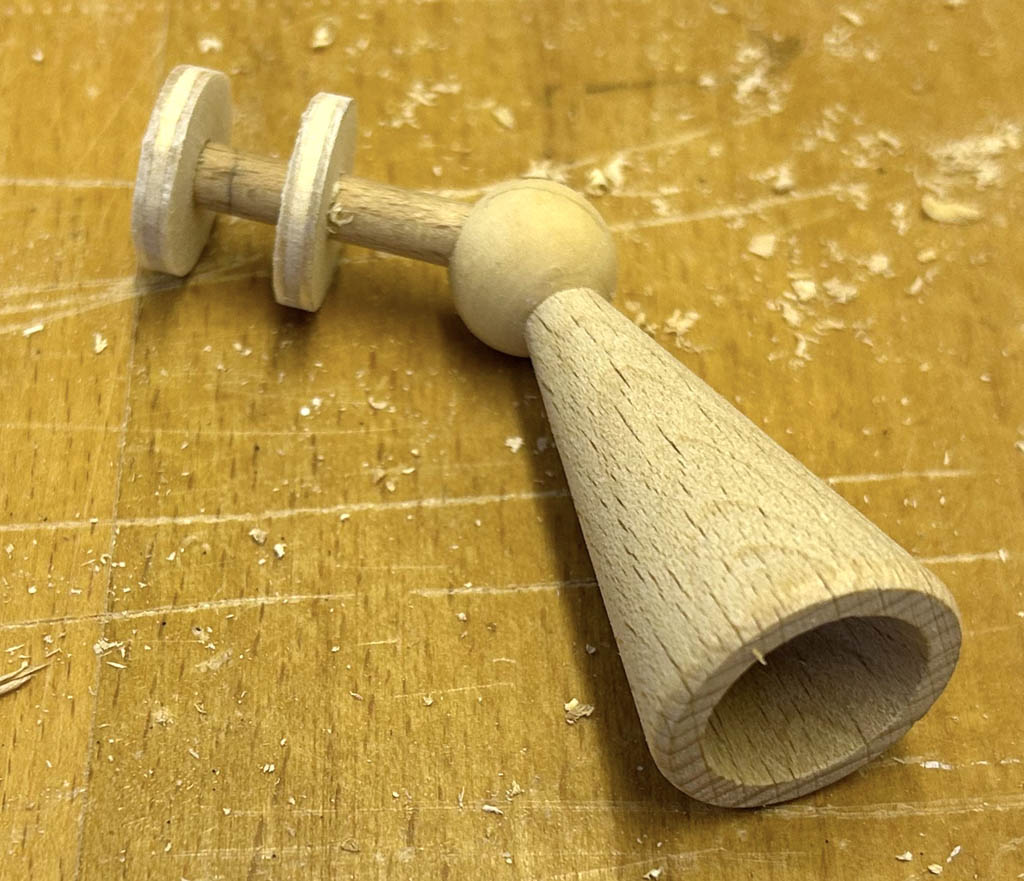
    I glued a hemisphere to the flat end of the cone to make it more head-shaped. A small wooden ball on the pointy end turns into a mousey nose, just waiting to be painted pink. A piece of 10 mm dowel provides the pivot, to allow the head to move up and down in time to the music. The hollow carved into the head makes space for the pivot as well as for a tongue, hinged on a second piece of 2 mm diameter brass rod.

    The mouse’s body

    I drilled a 10 mm hole through a wooden egg to accommodate the pivot dowel, which also serves to fix the body to the base

    The mouse ready to assemble

    Right next to the 10 mm dowel, I drilled a 3 mm hole to take a 2 mm diameter brass rod which will push the head up. To prevent the rod from snagging in the head, I glued a small wooden ball onto the end with 2-component epoxy resin. To make the mouse’s tongue I used tin snips (sturdy metalworking scissors) to cut a piece of brass foil.

    Making the Horn

    The horn

    The horn came more or less ready-made from the craft shop. I just added a ball to fix it to the dowel which holds it next to the turntable. To allow the horn to be pointed in any direction it is not glued directly to the base, just to the two wooden discs which keep it in place while allowing free rotation.

    Making the Base

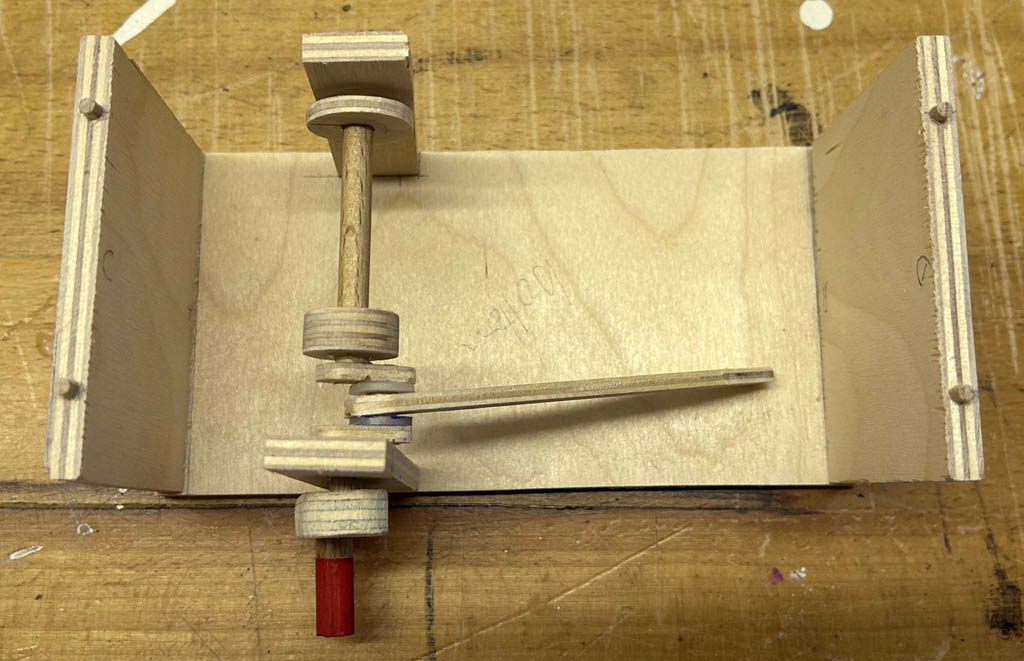
    Top view of base showing the drive shaft

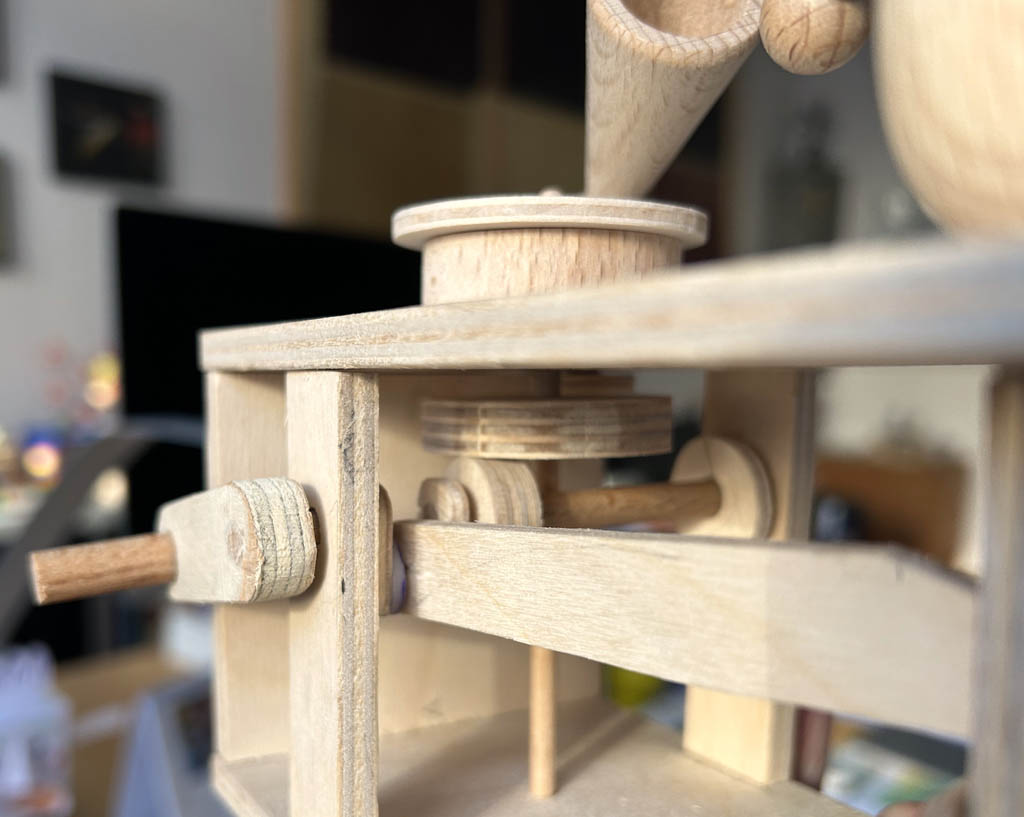
    The base is a box, open at the front and at the back, with two pillars to support the drive shaft. The drive shaft has a crank to move the horizontal bar left and right.It also has a small wheel to friction drive the turntable mechanism.

    View of the fully assembled drive shaft

    The side view helps to understand how the drive shaft works. Turning the handle at the left rotates the drive shaft which drives the turntable mechanism via the small wheel. The crank mechanism moves the horizontal bar to the left and to the right.

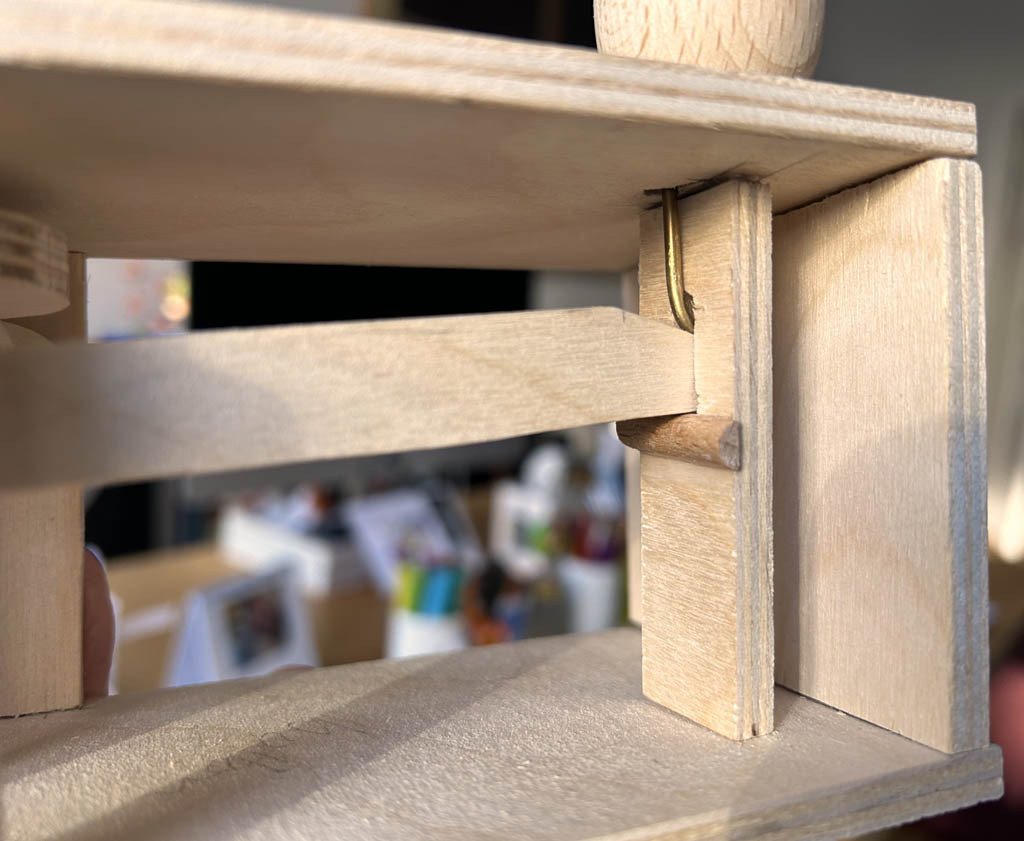
    The pusher mechanism to lift the head

    As the wooden horizontal bar moves left and right, the slope at the right-hand end pushes the brass rod up to lift the mouse’s head and then allows it to come down, followed by the head.

    The turntable mechanism and the mouse’s head pusher

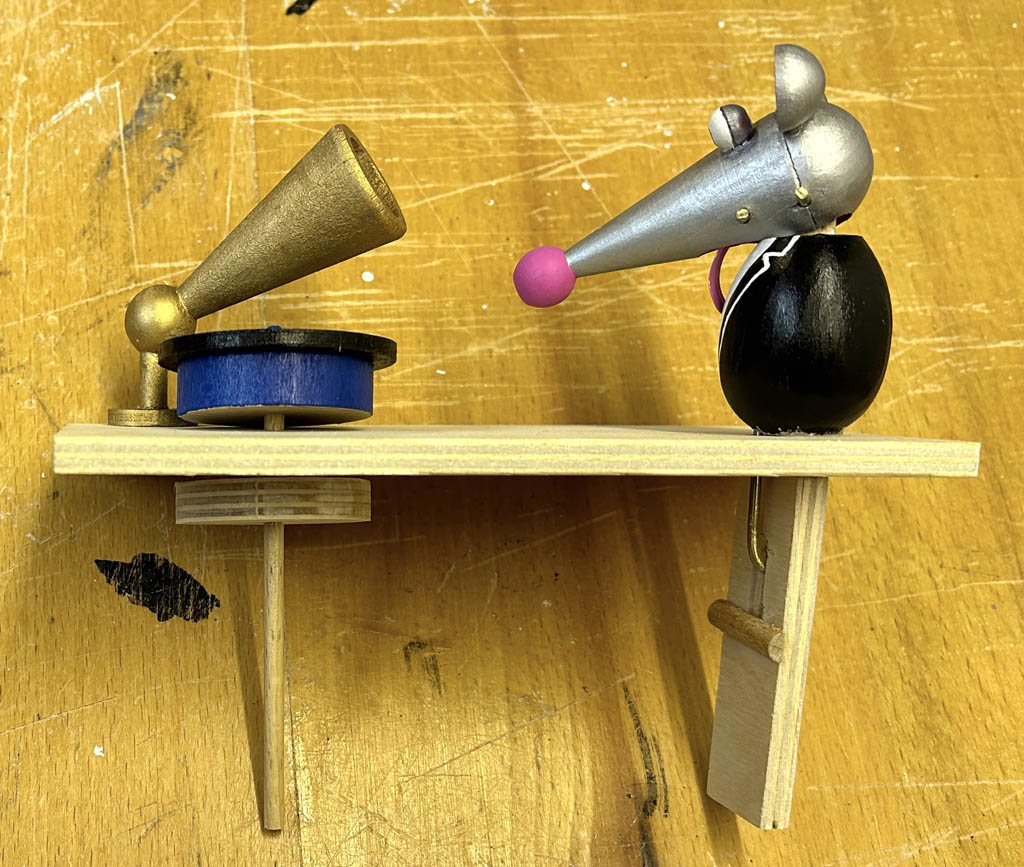
    You can see that the turntable mechanism is just two discs connected by a 5 mm diameter dowel. The dowel turns in a hole in the bottom of the base, thus keeping the dowel vertical and the discs horizontal.

    The mechanism to push the mouse’s head up is a piece of brass rod, its bent end moving within a slot. As the horizontal bar moves to the right in the slot, it acts like a wedge, pushing the rod upwards.

    First Reactions

    My five-year-old friend wasn’t quite sure what to make of it. When I tried explaining a little she asked “why can’t I hear any music?” Which I suppose makes it an automata destined for folk of a certain age who have enough tunes in their head to make it up as they go along. Maybe Al Jolson singing something from the scratchy sounding wind-up gramophone period or, in my case, “My baby just cares for me”, which has a good rhythm to nod along too.

    Reflections

    I’ve left a lot off in this piece. The mouse has neither hands nor feet. The horn has no visible connection to the the record on the turntable. There is no audible music. Imagination is required. The mechanisms are pretty simple, but enough to tell a small story and maybe raise a nostalgic smile from those old enough to remember. I hope you like it.

    Images

    Download from https://www.wordwise.de/Mouse_Archive.zip

    Video

    Link https://youtu.be/bziuKaCSKpE

  • The Disagreeing Barn Owl

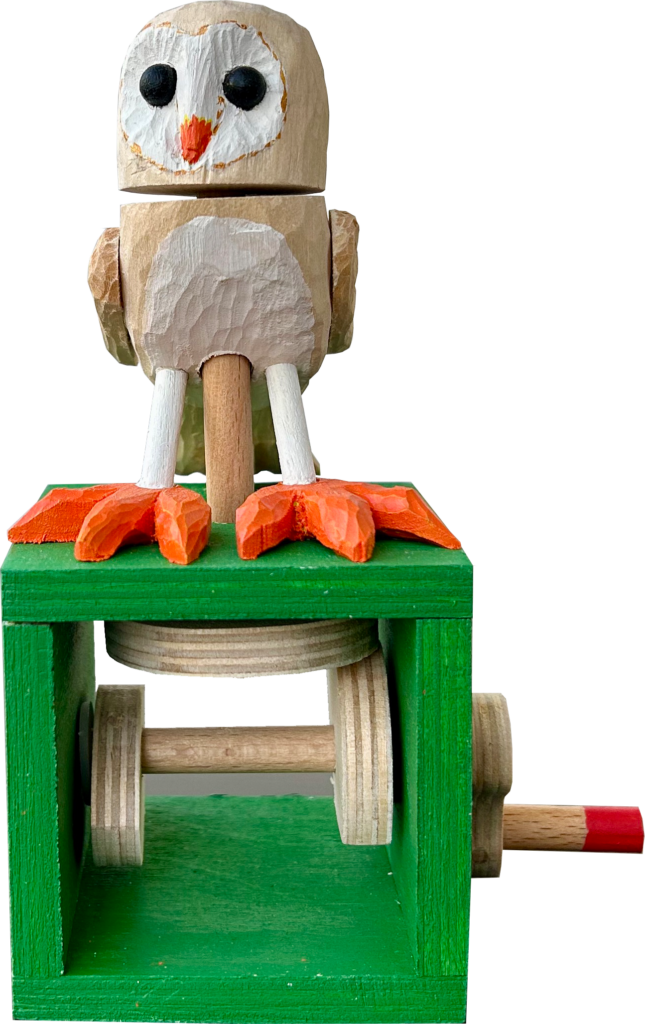
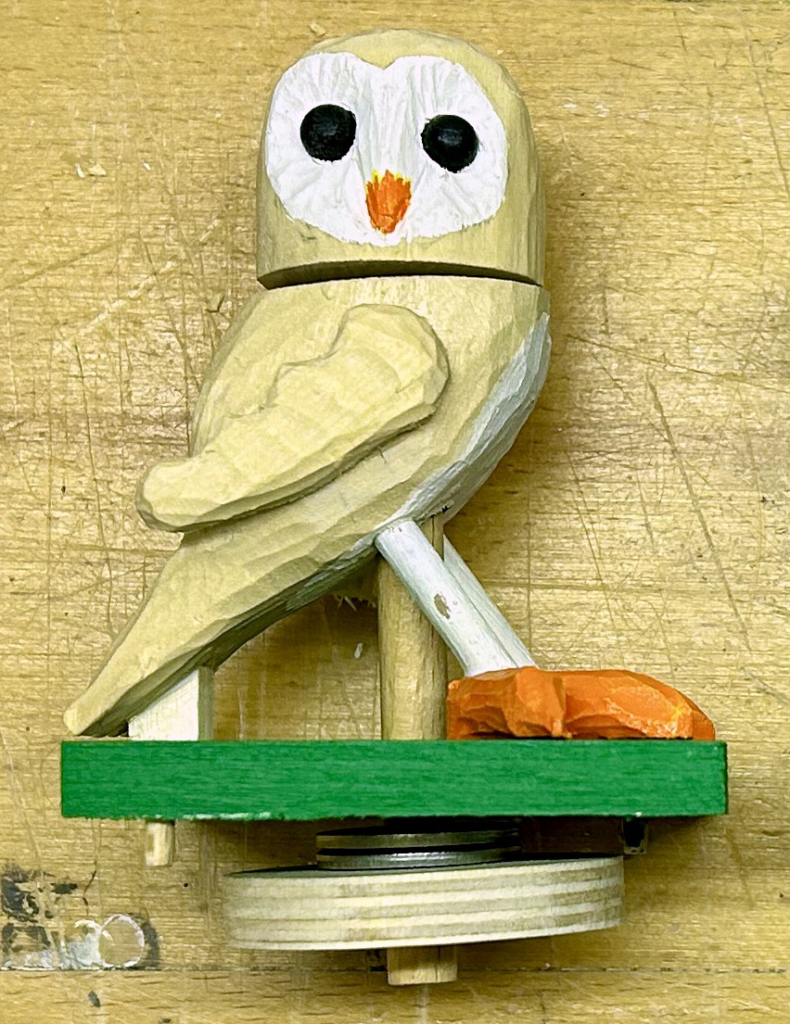
    The Disagreeing Barn Owl

    My small friend’s birthday was due and I thought it about time to make her a simple automaton of her own. There is an owl on her school rucksack so I decided to make an owl for her desk. Owls are famous for being able to turn their heads through a wide range, which meant that I didn’t have to think too long about the required movement. I found a couple of nice examples on the Internet, two from Carlos Zapata (one older http://carloszapataautomata.blogspot.com/2012/01/small-barn-owl.html and one newer https://www.youtube.com/watch?v=dcnn2QUscbY&t=20s) and one from Paul Spooner (https://cabaret.co.uk/product/the-owl-and-the-pussycat-by-paul-spooner/). This owl is not disagreeing with anything in particular, it’s just keeping its eyes peeled for any juicy mice in the vicinity.

    Design Constraints

    Intended for an eight-year-old, it has to be safe, robust and easy to operate. That’s why I rejected brass rods in favour of chunky wooden dowel. It is also why I broke a habit and didn’t put a red ball on the end of the crank handle, just painting it red instead.

    Making the Owl

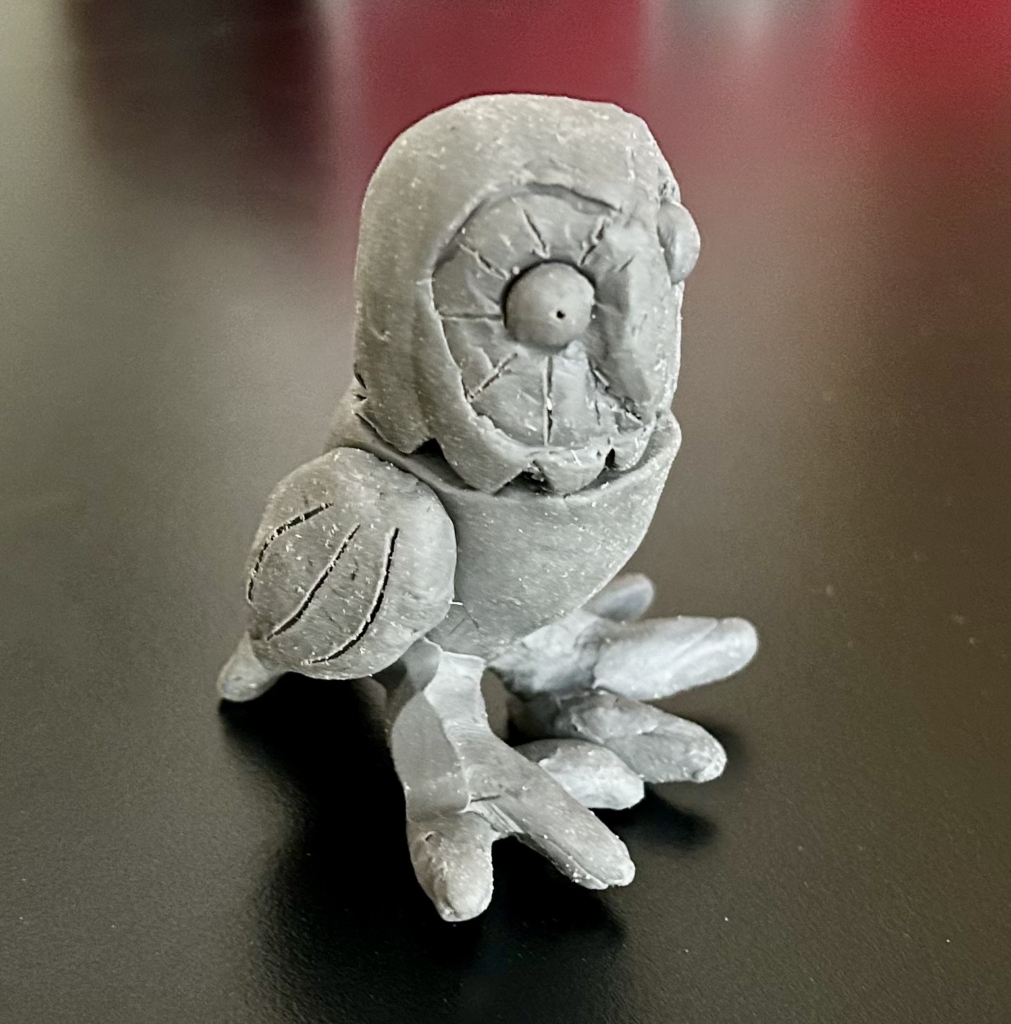
    Plasticine maquette

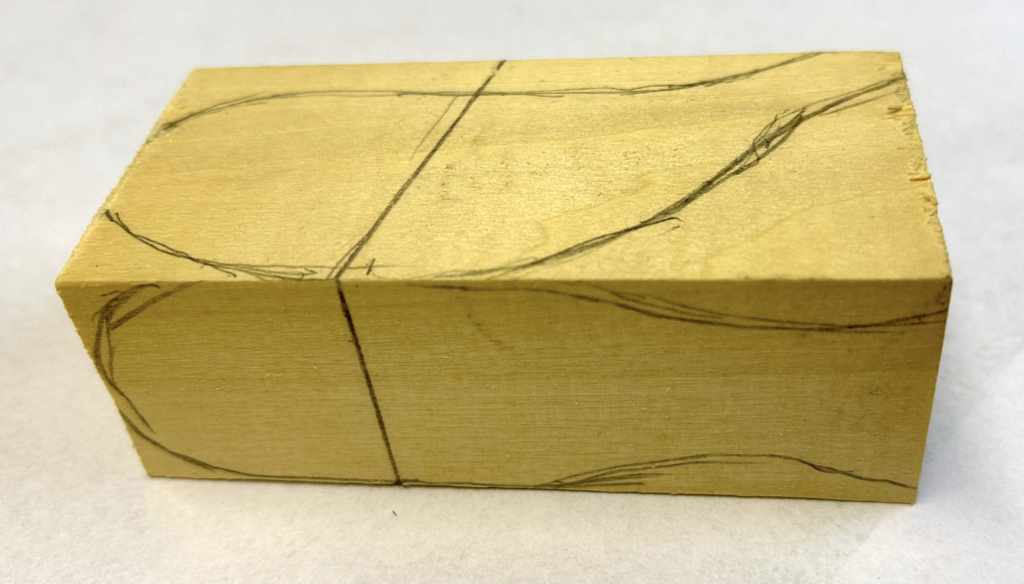
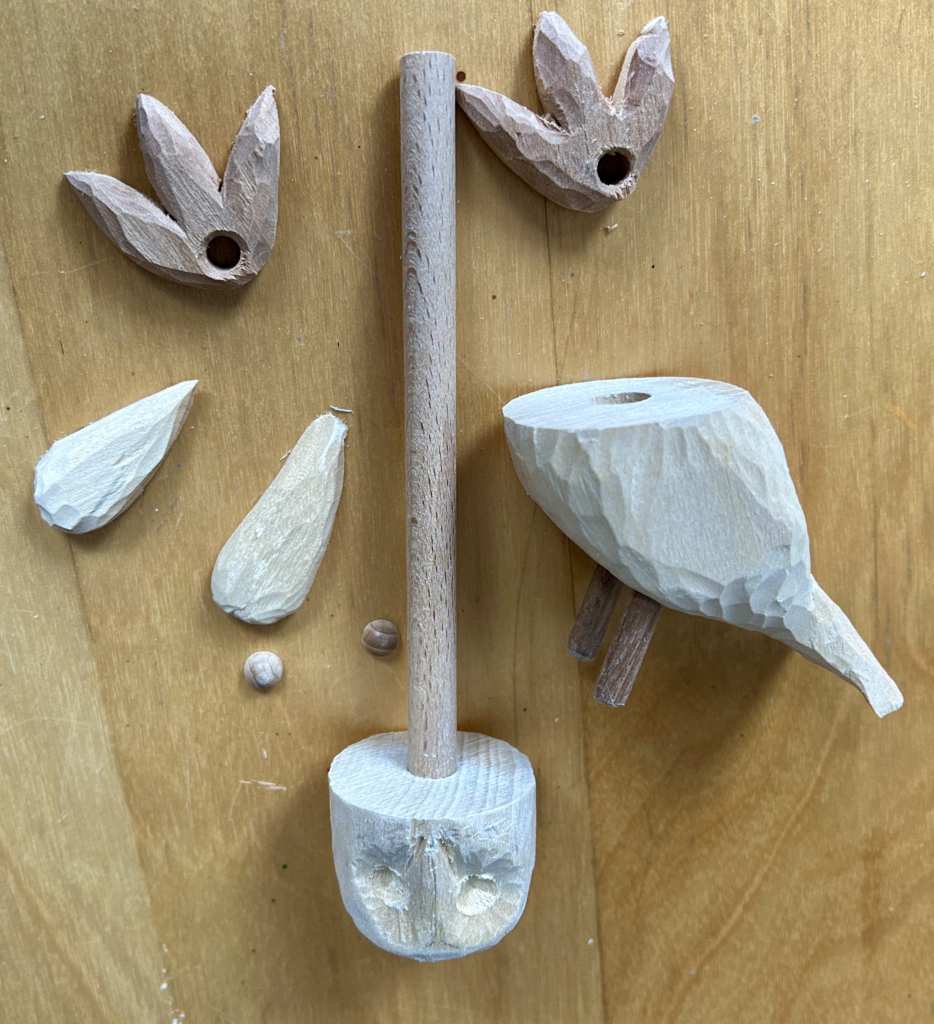
    After making a model owl in plasticine, for the body I chose a suitably sized piece of limewood and marked the outline onto two sides. As the owl’s body leans forward, the cut between the head and the body has to be tilted so that it will be horizontal when the body is held in its tilted position by the legs.

    Marking for for scrollsaw cuts

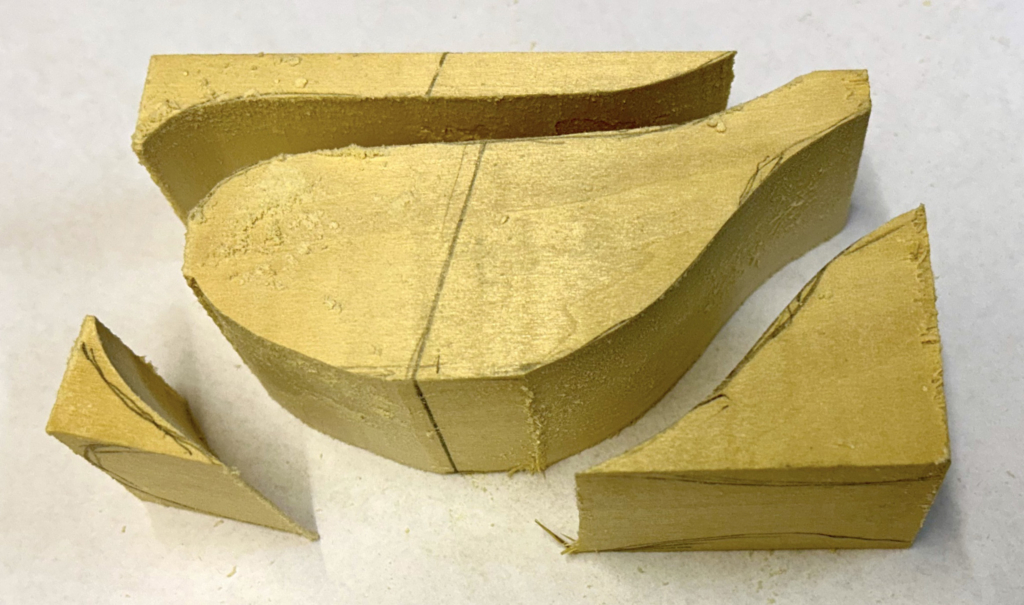
    A scroll saw will cut out the basic shape.

    After first scrollsaw cuts

    As you can see, the first set of cuts remove the side markings, so you have to redraw them on the surfaces which are now curved.

    Marking replaced for second scrollsaw cuts

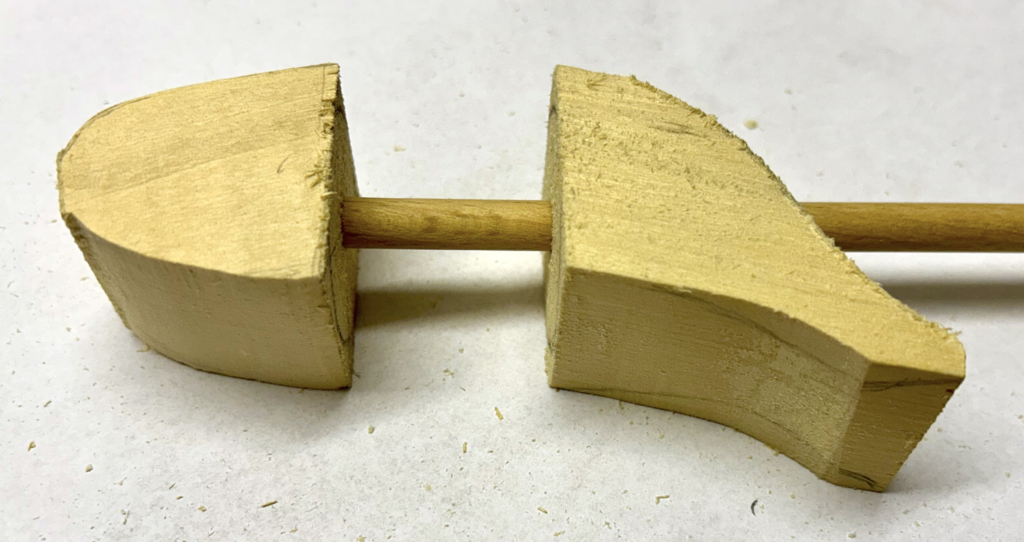
    For the shaft which turns the head, It is a good idea to drill the holes while two faces of the body are still parallel to one another, that means before making the second set of cuts along the markings which you had to redraw on the curved surfaces.

    Roughly carved owl

    When carving, the bottom of the head and the top the body must be cut to a circle with the same radius so that, as the head is turned, nothing protrudes outside of the body.

    Owl with its drive wheel and shaft

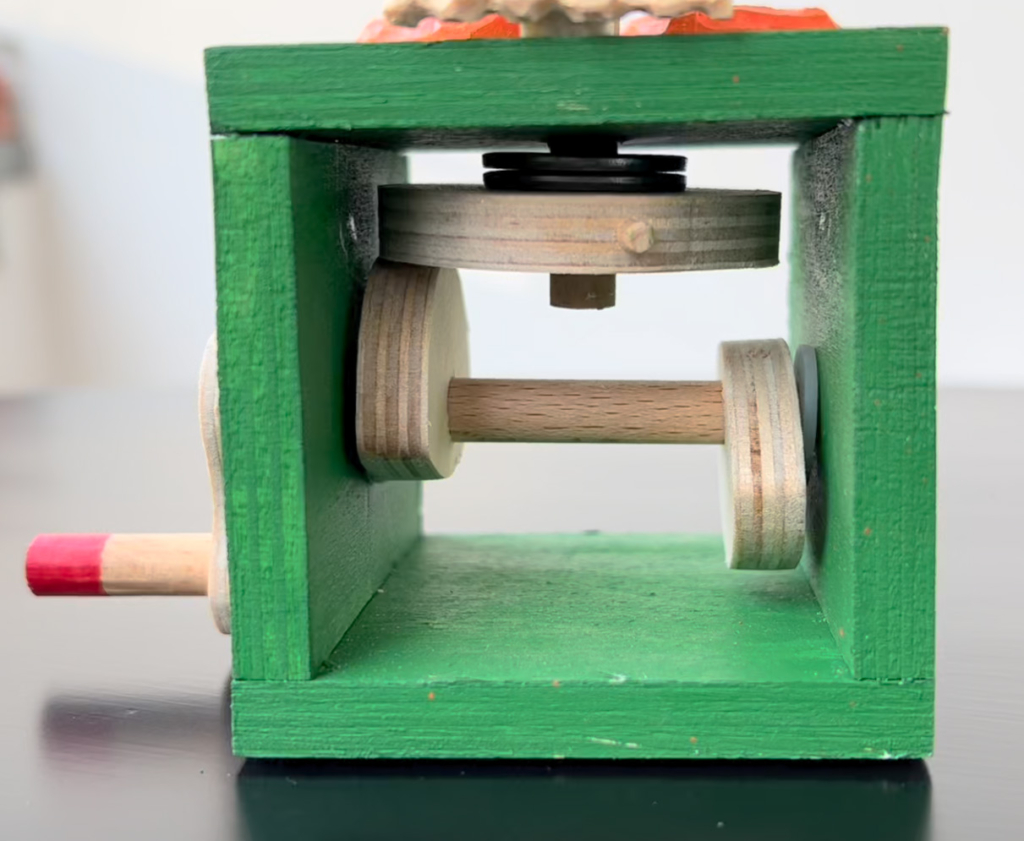
    An 8 mm diameter dowel is fixed to the head and passes freely through 8.5 mm holes in the body and the top of the base box to the drive wheel fixed to the bottom of the dowel. A couple of chunky steel washers increase the weight, pushing the drive wheel more firmly down onto the two cams.

    Making the camshaft

    The camshaft and two cams

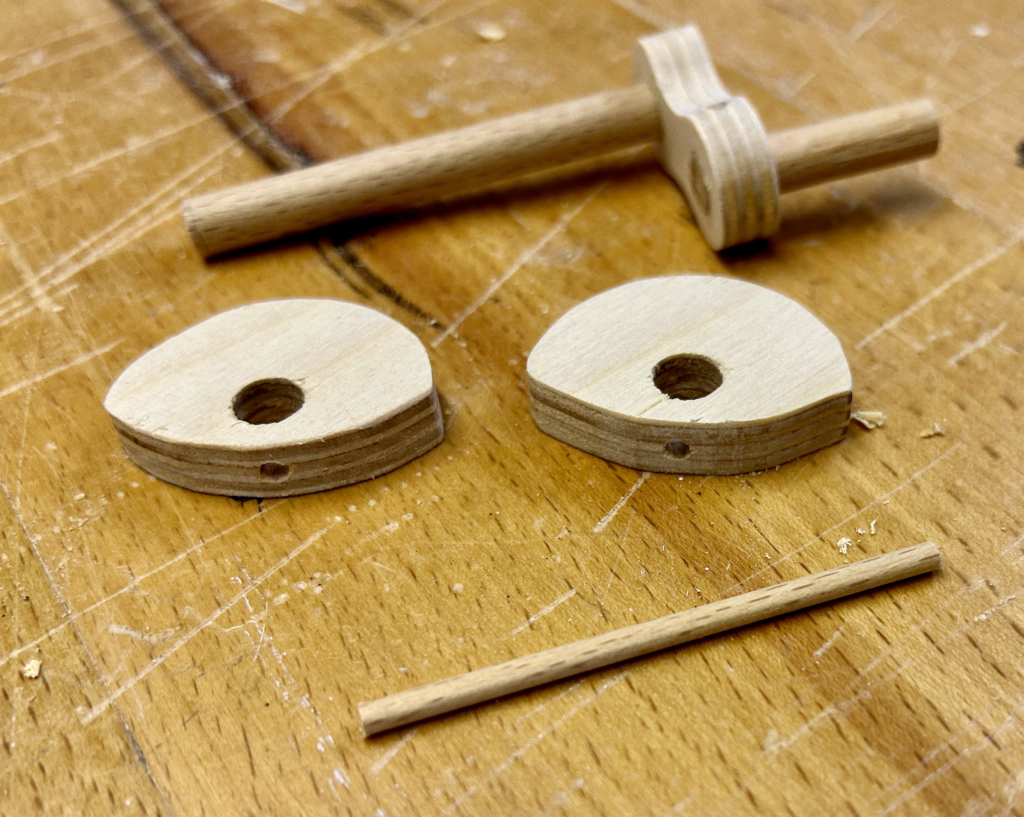
    I used 8 mm dowel for the camshaft and the handle to crank it. The two cams mounted onto the shaft are identical, taking turns to move the drive wheel via friction. Either one or the other of them is always in contact with the drive wheel so that the owl’s head stays more or less at a constant height, just rotating – first one way and then the other. A small piece of 3 mm dowel pins each cam onto the camshaft.

    Assembled camshaft

    To keep it simple, I placed the cams close to the side of the base, just separated from the walls by nylon washers, ensuring ease of movement.

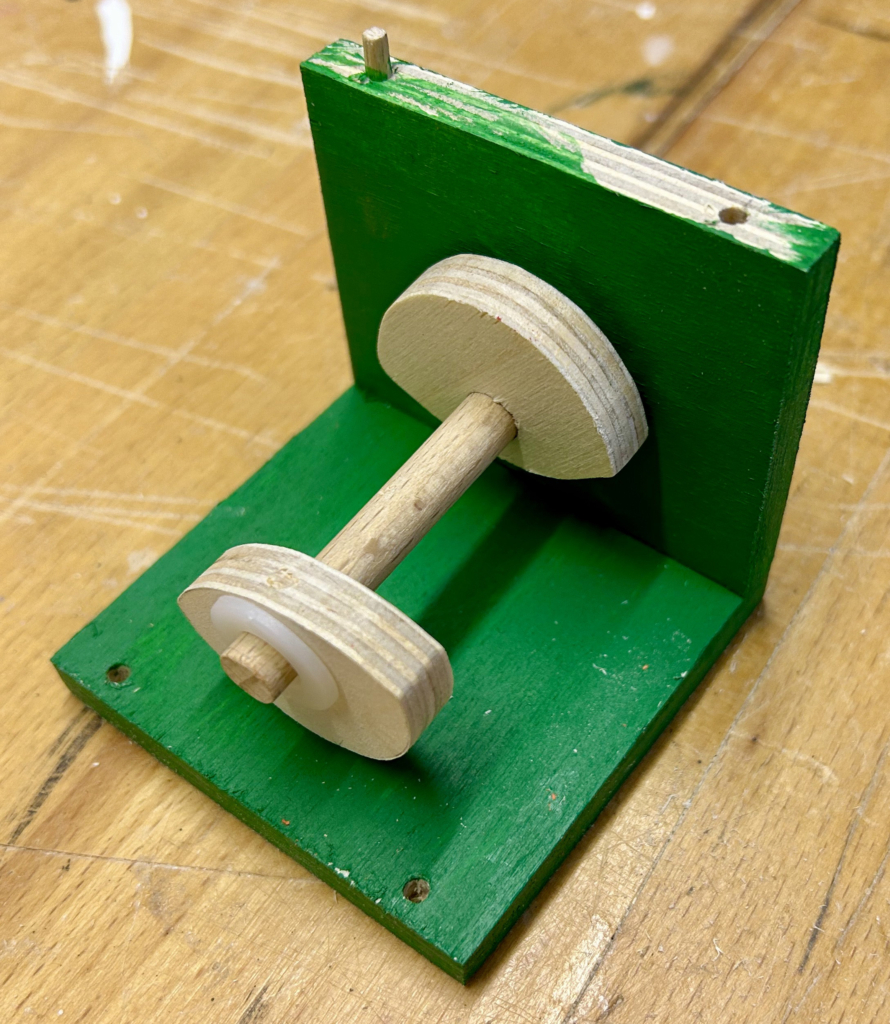
    Fully assembled base

    Looking at the base, you can see that the cams rub against the outer edge of the drive wheel. The transmission ratio here is about 1 to 1 so that the owl’s head turns by about 180° before it changes direction. If the cams were positioned closer to the centre, it would be possible for the head to turn by more than 180°. Owls can apparently turn their heads through 270 degrees, but I was happy with about half a turn, limited by a 3 mm dowel pin inserted into the outer edge of the drive wheel. When this pin touches either side of the base, it prevents further rotation.

    Making the Handle

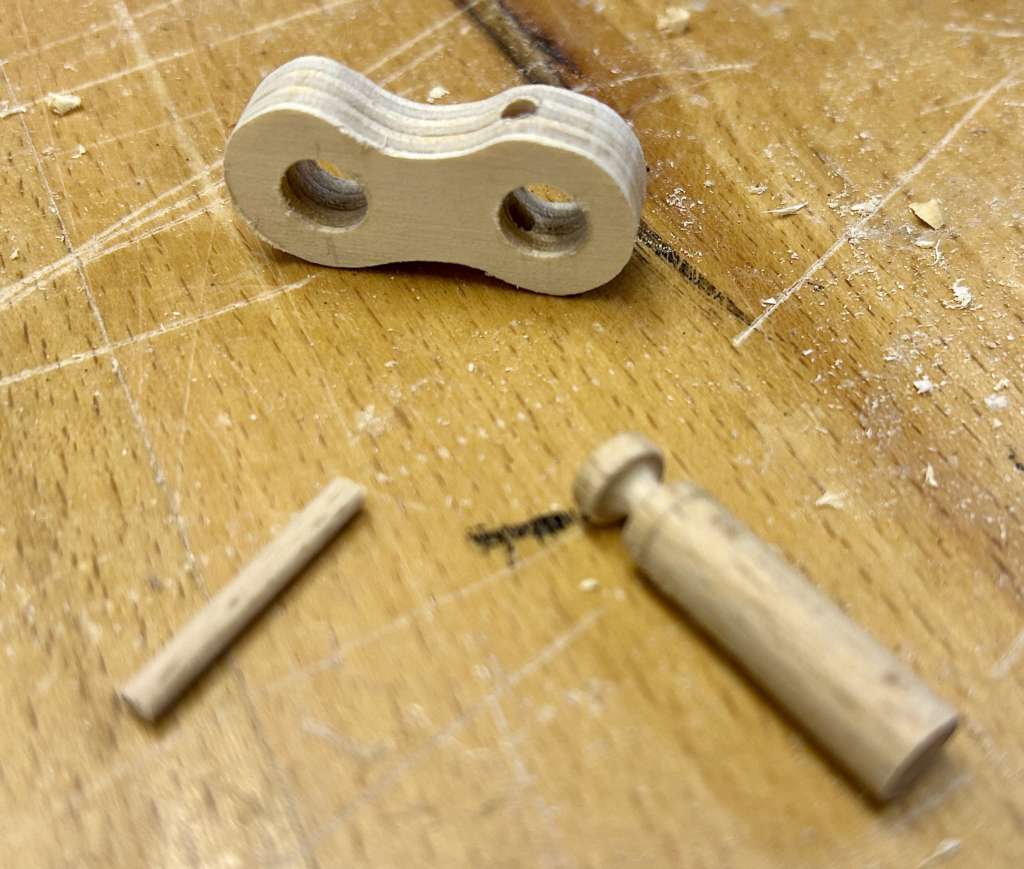
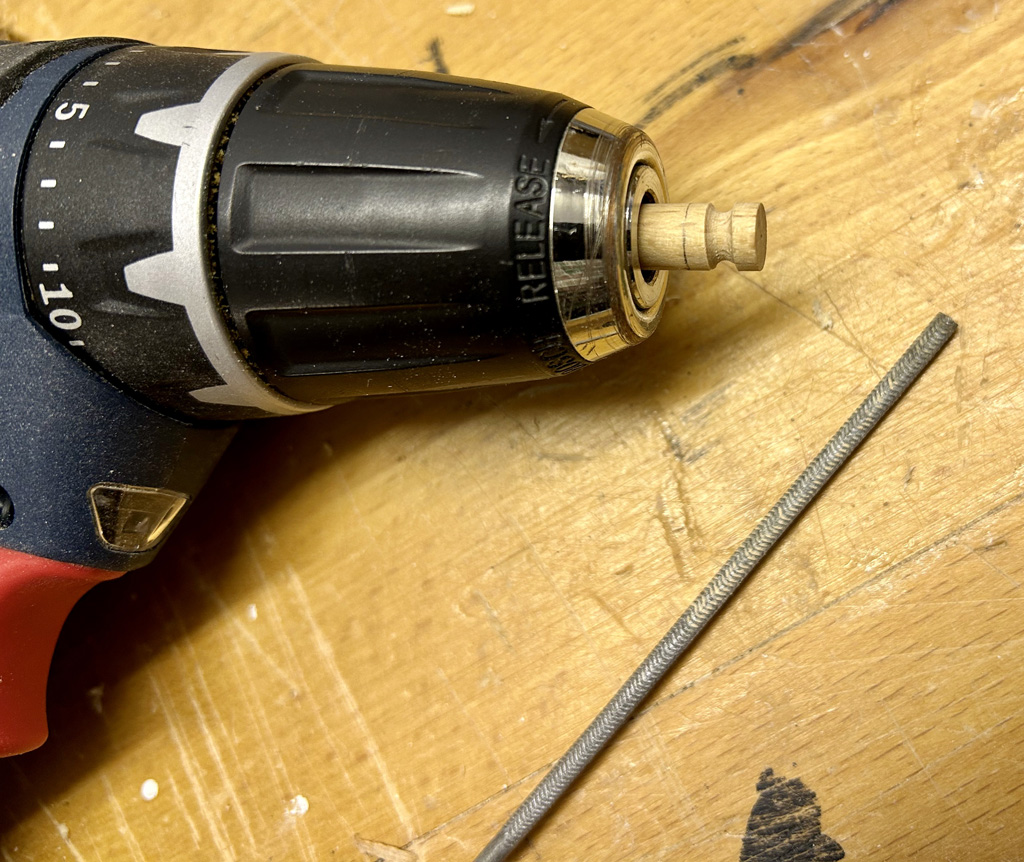
    Parts for the crank handle

    In the past, I have put a ball on the end of the handle and arranged for it to slip freely when rotated. This time I thought “forget the ball” and make the handle itself slip freely. Both ideas mean that you do not have to let the handle slip through your fingers as you turn it. It’s a small thing but it does make things a bit easier to use.

    Filing a smooth groove without a lathe

    I don’t have a lathe, so I used my hand-held battery-powered drill to rotate the 8 mm diameter handle and a small round file to add a groove near to the end. A piece of 3 mm dowel inserted into the crank prevents the handle from being pulled out, while allowing it to turn freely.

    Thoughts on Friction

    Relying on friction between the cams and the drive wheel means that no toothed cogwheels are required. It also means that small hands can grab the owl’s head and turn it without any damage occurring. The drawback is that friction also occurs everywhere that a moving part is in contact with a still part such as where the dowel linking the drive wheel to the owl’s head passes through the base and through the owl’s body. These points are essentially the bearings needed to keep the dowel properly aligned. If the bearings are too loose, the dowel and thus the drive wheel will tilt and not turn so easily. If the bearings are too tight, the dowel will be stiff and may not turn when required.

    My pragmatic approach is to start with tight holes for bearings, enlarging them as required when tests show that the movement is too stiff. For instance, for my 8 mm diameter dowel I first drilled 8.5 mm holes for the bearings, enlarging one of them to 9 mm after trying out the mechanism. Increasing the weight via washers increases the friction where it is wanted, between the cams and the drive wheel.

    Video

    Youtube link https://youtu.be/EN8oqCRJUcE

    Images

    Download images from  https://www.wordwise.de/Archive_of_owl_images.zip

  • The Keen Kissers

    Wait for it
    Mmmmmm

    Some while ago, a small automata scrolled up into my Instagram feed where three figures in a circle are kissed in turn by a promiscuous character turning in an endless circle. Magnetised lips ensured a lingering encounter every time. This reminded me that I had a plan to make a kissing automaton, perhaps along the lines of Peter Markey (e.g. https://youtu.be/H0x1TSSM1DY), or maybe as offered in kit form by Timberkits (e.g. https://youtu.be/a-8P4vfAaBY). They each have their charms, but in the end I decided to go for bust and borrow all of the best ideas and roll them all up into one. The resulting couple are demonstrably keen kissers and what a pleasant hobby to have!

    So What was the Plan?

    I decided that it was only fair on the equality front to have both heads rotating to face one another and to have both sets of lips extending, to meet in the middle in a tender peck. With heads turning through 90 degrees, it seemed easiest to pass the instruction to kiss up inside the neck. Maybe brass rods would have been better, but I chose to risk using some cord to move the lips in and out. The risk is abrasion. If the cord rubs on a rough corner, it may well break after a period of time. Time will tell.

    Making the heads

    60 mm long wooden egg held in a vice, ready to cut in half

    A couple of 60 mm long wooden eggs from my local craft store were nicely head-shaped. First I drilled an 11 mm hole to take the 10 mm dowel serving as the neck. Cutting the egg in half, reduces the hole down to provide a snug fit for the dowel.

    Egg halved and marked for hollowing out

    The halves have to be hollowed out, so I first marked them and then used a drill to do most of the work.

    Hollowing out a beechwood egg

    Beechwood eggs are pretty hard, so it is worthwhile using a drill to remove most of the material, leaving just a bit of cleaning up to be done manually.

    Adding a slot for “lip-stick”

    A 10 mm square section stick serves to hold the lips, sliding in a slot cut in the sides of the egg. The odd pattern left by the brad point drill bit which I used is not visible from the outside so it is of no consequence.

    Parts to move the lips

    A brass rod serves as a pivot for the actuator shown below it. Two pieces of cord are attached to the left and right side of the actuator. Pulling on them moves the actuator clockwise or counter-clockwise which results in the “lip-stick” being moved to the left or to the right.

    Lip mechanism with cords attached

    The 10 mm dowel used for the neck has a hole drilled down the middle and has been carefully smoothed to avoid the cord catching or wearing too quickly.

    Brass guide for cords

    A small piece of brass rod helps to prevent the cords from rubbing on the lip-stick.

    The base

    The base

    The base is open to show off the mechanism. At each end there are 10.5 mm holes to take the 10 mm crankshaft. Drilling a 10.5 mm hole through a 50 mm diameter ball and then cutting it in half produces two nice, minimalistic bodies. These allow the necks to turn freely while keeping them pretty straight.

    Base with top removed

    3 mm dowel pins hold the base together, allowing me to frequently take it to pieces whilst experimenting and adjusting the cams. Only when I was sure that everything worked OK did I fetch the glue bottle. The four pins in the middle are stops to limit the rotation of the heads to 90 degrees.

    Top with wheels to turn the heads

    Each 50 mm diameter wheel, which turns its neck and thus its head, has a protruding 3 mm pin which bumps up against the stops, preventing further rotation. After drilling the hole up inside the 10 mm diameter dowel used for the neck, I used a countersink to chamfer the edges where the cord comes out to try and reduce the abrasion.

    Cams

    Three cams for each head

    Each head needs three cams: one to turn the head clockwise, one to turn the head counter-clockwise and a small one to move the lips. The large cams were originally 50 mm diameter discs with half of the circumference cut back in each case. When fixed on the camshaft, these take turns to move the wheel connected to the head. I had to experiment to work out the right shape for the small cam.

    Cams in the open base

    To be able to adjust the cams and then fix them in just the right position, I drilled a 3 mm hole from the outside of each cam down into the 10 mm hole in its centre. After sliding it onto the camshaft, when I was happy with the position, I then drilled along that hole and into the camshaft. Inserting a piece of 3 mm dowel locks the cam onto the shaft. Any excess dowel is easily cut off and sanded smooth.

    Camshaft

    Camshaft without cams

    The camshaft is a piece of 10 mm dowel with a crank on the end allowing the user to turn it.

    Freely rotating knob

    The ball used for the knob has two holes drilled in it. A 10.5 mm hole to take the spindle and a 3 mm hole to take a piece of dowel. The spindle has a groove towards one end, added with a file. With the spindle inserted into the large hole, pushing the dowel in locks the spindle in place while allowing it to turn freely. This means that you can turn the crank to your heart’s content without having to release the ball or let it slip though your fingers. It may take a couple of goes to get this right.

    The Yanker

    The yanker

    To move the lip-stick a “yanker” is required. This is a lever which is mounted onto the base. A spring pushes the lever upwards and the small cam on the camshaft pushes it downwards. I used a bit of brass rod for the bearing, bent at one end to make it easier to remove and insert whilst adjusting things. When the adjustments were done, I just cut the ends off flush with the wood.

    One cord from the lip-stick is attached to it so that when the cam pushes the lever down, it yanks the cord which moves the lip-stick into its kissing position. A lead fishing weight is attached to the other cord which pulls the lip-stick back to its starting position. I tried a spring but didn’t like the feel. Gravity is a very predictable and steady pull. What would we do without it?

    Decoration

    I carved some over-large lips to glue to the end of the lip-stick. They are painted bright red to attract the viewer’s attention. This makes the man in my little scenario seem a touch androgynous so I tried to give him a male looking T-shirt and cap. I adorned the woman with a stylishly angled hat and matching blouse. As I made the heads & bodies in the same way, it was entertaining to think about what sort of clothing and colours signal maleness and femaleness in 2023.

    Reflections

    This was a fun project to make, even if adjusting it to work smoothly took quite a while.

    The mechanism to move the lips could be used to move a nose too. How about a Pinocchio automaton? Or how about an Eskimo kiss automaton, where two Eskimos turn and rub rub noses? Or how about …?

    I left the skin areas unpainted as the beechwood eggs had an attractive appearance and vaguely match my winter skin colour.

    I was surprised to discover that turning the crank counter-clockwise (CCW) does not quite reverse the order of the movements. In optimising the cams for clockwise (CW) cranking, I have obviously de-optimised it for CCW. Children seem to have no preference for CW or CCW. Fortunately adults generally go for CW and as this will be a present for two adults it ought to be OK.

    Video

    https://www.youtube.com/watch?v=nAUHeOoqX9s

    Images

    Download from https://www.wordwise.de/Keen_Kissers_Archive.zip

  • The Flying Teacups

    The Flying Teacups

    What’s the idea?

    Ever since I visited Probošt’s Christmas Crib in the Czech Republic a few years ago and saw the model wooden conveyor belt (https://youtu.be/s4F3INnuzLk) exhibited there, I wanted to have a go at making my own version. I decided to cheat a bit and avoid the complexity and size of making a completely wooden chain. The top of my version is completely solid, with an uninterrupted smooth surface for figures to glide along, propelled by an invisible, magical force. This magical force also gives the figures a spin as they move around. We all know about flying saucers hovering in the sky and these are their earthbound counterparts – Flying Teacups, which have a cosy hole in the top for plug-in figures to nestle in.

    The magical bit

    Neodymium magnet

    The magic comes from small neodymium alloy magnets. These are widely available and have a really strong magnetic field. Mucking about with a couple to see what their limits are, I found that, even when separated by a sheet of plywood, they are still very strongly attracted to one another. I was also happy when I found that when turning one of them through 90° (from horizontal to vertical) they maintained the attraction with a twist. The twist was that when I dragged the vertical one along beneath my sheet of plywood it not only pulled its horizontal mate along on top of the sheet, it also made it rotate. Magic!

    The Chain

    To drive the figures endlessly round and round, I needed a chain, like a bicycle chain, to be driven by a cog. Here is my finished chain –

    The magic drive chain

    The chain is made of some strong polyester cord and pieces of dowel.

    Dowel pieces for the chain

    First I cut 24 pieces of 20 mm diameter dowel to the same size, about 15 mm high. Then I drilled a hole to take the polyester cord. To be able to properly glue the cord, I then cut the dowel in half. This means that I could apply glue along the drilled hole to fix the cord. The cord outside of the dowel remains free from glue and stays flexible.

    A magical piece of dowel with a magnet

    In every third piece I also drilled a 10 mm diameter hole for a magnet.

    Gluing the dowel onto the cord

    While the glue dried, I used a small clamp to press the pieces together. The spacing of the recesses in the cogs defines how long the free piece of cord needs to be.

    The Cogs

    Two cogs

    The cogs are cut from two pieces of 8 mm plywood glued together for a total thickness of 16 mm. The 10 cutouts are 20 mm arcs into which the pieces of dowel fit. Here, the chain is not transmitting force to second cog to make it turn anything. This means that the second cog could have been just a smooth disc instead. The useful force is transmitted via the magnets embedded in the chain.

    The Pinwheel Gears

    Pinwheel gears

    Two pinwheel gears are needed. The large, 32 pin, gear is glued to the back of one of the cogs. The small, 12 pin, gear is mounted vertically and is turned by the external crank handle.

    The crank turns the small pinwheel gear

    The Three Oval Pieces

    The 8 mm base and the 3 mm top

    The three oval pieces all have the same outer shape.

    The middle oval

    The middle oval has a round hole cut in it which allows the large pinwheel to turn easily.

    Top view of middle oval without cogs and chain

    An axle is required for each cog. The right-hand one is fixed and provides a bearing for the large pinwheel gear and its attached cog. The left-hand one is moveable to allow the chain tension to be adjusted.

    Top view of the assembled middle oval

    There are 6 dowel spacers to hold the top oval, leaving just enough space for the chain to move easily while preventing the magic dowel pieces from twisting when pulled upwards by a magnet in the base of a teacup.

    Bottom view of assembled middle oval

    In the bottom view, on the right you can see the large pinwheel gear which is glued to the right-hand cog. Turning the gear turns the cog which moves the chain. On the left you can see the adjustable axle for the left-and cog.

    The adjustable axle

    Sliding the adjustable axle to the left increases the tension in the chain. This is handy for the initial set-up as well as later on to correct for any stretching of the chain.

    Fully assembled apart from the base

    A piece of chunky 40 mm diameter dowel serves to join the top assembly to the base together with the crank assembly at the right-hand end. Now you can see how the small pinwheel gear engages with its larger brother. With no teacups in place everything moves quite freely. Each teacup added increases the friction, but the gear ratio of 12 to 32 keeps the force needed to turn the crank down to a sensible level.

    The Teacups

    A teacup waiting for its handle

    The teacups are made from 40 mm diameter balls cut in half. In the top there is a 17.5 mm hole to plug in a figure. In the bottom a 10 mm hole holds a neodymium alloy magnet. The teacup’s handle is made of 3 mm plywood.

    A painted teacup

    Add some nice vertical stripes to emphasise the spinning motion and a teacup is ready.

    I chose not to paint the main structure for practical reasons. Even though the magnets have a smooth surface, dragging the teacups around the surface will inevitably result in abrasion. Scratching off a painted surface would not look good. If the marks left on the bare wood bother me in future, I can always sand them off.

    The Figures

    A plug-in bee

    I have a collection of plug-in figures from previous projects, all with a standardised base to plug in to a 17.5 mm diameter hole, thus fitting nicely into the teacups. It’s quite handy being able to reuse “characters” like this. You can then mix and match as you like.

    Changes

    I had originally planned to use a small music mechanism.

    Music ready for installation

    When I tried it, I didn’t like the music and it seemed a bit superfluous. So I simply left it off, leaving a small, now unused, cog behind the small pinwheel gear. That’s life isn’t it? You start off with a certain idea and in the end, less is more.

    Reflections

    The finished item looks quite simple and clean. Placing teacups and plugging in a collection of animals gives it more character. If you turn the crank handle very quickly a teacup can be thrown out of its magnetic connection and cause a traffic pile-up. That is a plus point to me as it makes it more interesting to use. Also, getting the speed just right can cause some teacups to resonate and spin at an amazing speed which is fun too. Sometimes figures just stare straight ahead, waiting for some impulse to start spinning. It’s nice and chaotic.

    It works surprisingly well and I can think of loads of other ideas which could use a similar mechanism. For a lark, I turned the entire thing up on end and I could successfully transport teacups vertically up and down. There is an old English nursery rhyme called Hickory Dickory Dock and from that I can imagine making a mouse run up and down a clock. Processions of figures often appear in old public clocks, coming out of one door and disappearing through another. And so on.

    Instead of using polyester cord, I could have used tape instead. Tape as wide as the dowel pieces’ height might resist twisting more and be better for other projects.

    If spin is not needed then turning the magnets in the chain through 90° to be parallel to their counterpieces in the cups would stop the rotation.

    Download

    https://www.wordwise.de/Flying_Teacups_Archive.zip

    Video

    https://youtu.be/jb7Tju_U4UE
  • A Short-Sighted Snake

    A Short-Sighted Snake

    Snakes are not everyone’s favourite. Still I think it is unkind to exclude them from the wonderful world of automata. My snake has a sort of cobra pose, head swaying in the air to some invisible piper’s tune. As a very friendly snake it has no fangs and instead has bright pink, kissable lips. A very colourful body adds to its appeal and as a short-sighted girl, a pair of spectacles add a vulnerable touch hopefully calming the nerves of even the most worried visitor.

    The Technical Brief

    This is a fairly simple construction. Turning the handle rotates the camshaft which moves one end of the the rod connected to the snake’s head along a circular path, making the head attached to the other end of the rod do something similar. Making the central horizontal part of the bearing as wide as possible automatically constrains the camshaft so that it stays in position. No extra parts are needed to prevent the shaft from slipping to the left or to the right as the handle is turned.

    Making

    Parts

    The snake itself is a sequence of wooden beads threaded onto a piece of waxed string. A small wooden egg serves as the head, with a hole drilled to glue it to the connecting rod for the camshaft.

    Partial assembly

    I again used 3 mm dowel to pin the parts together before gluing. This makes both the fine adjustment and the painting easier.

    Almost fully assembled

    With such a wide bearing, the connecting rod up to the snake’s head might slip off centre and jam. I found that making the hole through which the rod passes large enough allowed things to rattle around and avoid any jamming.

    Reflections

    Threading beads onto a string results in a very flexible assembly. It is so flexible that it moves where gravity pulls it. It was only by using a rod, that at least the snake’s head can be directed to follow a particular path. I wondered whether the idea would be good for an elephant’s trunk, but I was flummoxed by the complexity of making the trunk curl, especially when trying to make something small.

    I had also considered adding a small orange to the scene as something that a short-sighted snake might use to tempt us (mistaking it for an apple). I sensibly abandoned this idea as requiring too much explanation.

    Rob Ives offers a kit for a very similar snake automaton, only his is made of card (https://www.robives.com/project/sssnake-download-and-mmmmake/).

    Video

    https://youtu.be/mzZX17OVQaw

    Images to download

    https://www.wordwise.de/Snake_Archive.zip

  • The Animals’ Seesaw

    The Animals’ Seesaw
    Animals in Orbit

    In the Sep-Oct issue 2022 of Automata Magazine we showed you Animals in Orbit. As the number of animals has increased over time here in Berlin, this has caused a queue of visitors all waiting for their turn up in orbit.

    So, instead of them just joining the lengthening queue to go into orbit, I thought that I would keep them amused by making a seesaw. Yet another way to bring movement to what are otherwise fairly static characters.


    New Animals

    Amongst other interesting new visitors, this friendly bee flew in one day out of my wife’s bonnet and decided to stay.

    The bee

    This curious animal is a rare specimen of the teapoticus nervosus, commonly known as the nervous teapot. Lifting its red knob raises the lid to let light right in, often dazzling the poor creature.

    The nervous teapot

    So what’s the brief?

    For a change, I thought that I would avoid using a box as the base and instead I went for a flat base whilst still opting to turn a small handle to create the up and down motion. To keep the seesaw low, this meant putting the crank mechanism off to the side, with a long linkage to push and pull the short lever between the supports for the seesaw.

    Making

    Side view of moving parts
    Top view of moving parts

    The plug-in “seats” for the animals are the same as for Animals in Orbit, just with a different paint job. A wild black and white spiral pattern draws attention to how the movement is produced.

    The important bit

    The important bit is the “crankshaft” which transforms the rotary motion from turning the red-headed lever into a to-and-fro movement for the stripey connecting linkage.

    The partially assembled base

    Here you can see that I used 3 mm dowel pins and corresponding holes to locate the four sidepieces. Using pins like this means that I can put it together and take it to pieces as often as needed to ensure that the movement is correct. It also means that flashy paintwork is easier to do before parts are permanently glued in place, sometimes getting in the way of masterful brushstrokes!

    Fully assembled and ready for the first passengers

    Reflections

    Ultimately it is the passengers who bring this to life. With no one having fun it is a dull spectacle. It looks best when the animals look at one another, just as in real life, perhaps goading one another to seesaw even higher or even faster. The mechanism is pretty simple and, as usual, the bright red knob shows you what to turn to bring things to life. For small friends who come to visit, Animals in Orbit has become quite a favourite and now, together with this seesaw, the possible permutations and combinations of which figure goes where seem to be endless, and no one has to get bored standing in the queue with nothing to do.

    Images to Download

    https://www.wordwise.de/Seesaw_archive.zip

    Video

    https://www.youtube.com/watch?v=_0UyFzKjeAo
  • The Berlin Dragonfly

    The Berlin Dragonfly

    Why a Dragonfly?

    Insects don’t get much of a look-in on the automata front. Most of them have an annoying number of extraordinarily thin legs and aren’t generally as cuddly as cats and dogs, or even Koala bears. I feel this is rather an injustice, so I thought that it’s about time for an automata dedicated to that queen of the insect world, a dragonfly. They are quite showy creatures, glistening in marvellous colours while zooming decoratively around country ponds. I can manage showy, as I have lots of paint in the cupboard, but I decided against zooming about, settling instead for some vigorous flapping of its wings instead. Insects also have quite large eyes but they don’t go in for pupils and irises, preferring complicated compound eyes.

    The Initial Design

    A selection of ready-made wooden balls and eggs served as the body for my dragonfly meaning that there was no need for carving. Some thin plywood could serve as wings and brass rods for legs. The tricky part is the cam to control the flapping of the wings. If I had used a round cam mounted off-centre, for each turn of the crank the wings would go up and down once. After some experimentation, I chose to triple the number of movements by using a cam with three “peaks”. For each turn of the crank, the wings now rise and fall three times, resulting in a satisfactory flapping movement while turning the crank at a reasonable speed. As usual, you will see that the final result doesn’t quite match the initial design.

    Making

    The dragonfly body and wings

    A piece of 3 mm dowel holds the 5 pieces together which make up the dragonfly’s body. In total, t’s about 10 cm long. I cut the wings from 2 mm plywood.

    Each wing needs two hinges. The first is to attach the wing to the body and is made of 6 mm dowel with a 2 mm hole drilled along its centre. This allows a piece of 1.5 mm brass rod to turn very easily. The second hinge is needed to attach the rod which pushes the wing up. Here, I used a 10 mm ball which was ready-drilled with a 2 mm hole. After sanding a flat on one side of the ball it can be glued to the underside of the wing. The closer together these two hinges are, the more the upward push from the cam is magnified, increasing the amount of flap.

    Six legs

    Cutting some small (18 mm) wooden eggs in two with an 8 mm hemisphere on top makes some nice shoes, bent brass rods serving as robust, insecty legs.

    Brass support with pusher

    I used a 7 mm brass tube to attach the dragonfly’s body to the base. A 5 mm dowel pusher can easily slide inside this. At the top end 2 mm plywood pieces protrude through carefully cleaned slots cut in both sides of the tube. Friction must be kept to a minimum to make sure that the wings do not stick at the top of their movement. Brass rods then link the wings to the pusher.

    The mechanism from the cam follower to the wings

    I used a 20 mm hemisphere as the cam follower on the bottom of the pusher rod.

    The crank which turns the cam inside the base
    The cam with three “peaks”

    Finishing

    Side view of the painted dragonfly

    With the follower now resting on the cam our dragonfly is ready to go. A smart hat complements her trendy shoes and huge eyes let her see where she is going. Nature doesn’t equip dragonflies with pupils in their eyes but I sort of hinted at the multi-facetted structure by using a dotty pattern, and if the centre dot is black, well that’s a bit of artistic licence. Everything else could be quite true to nature!
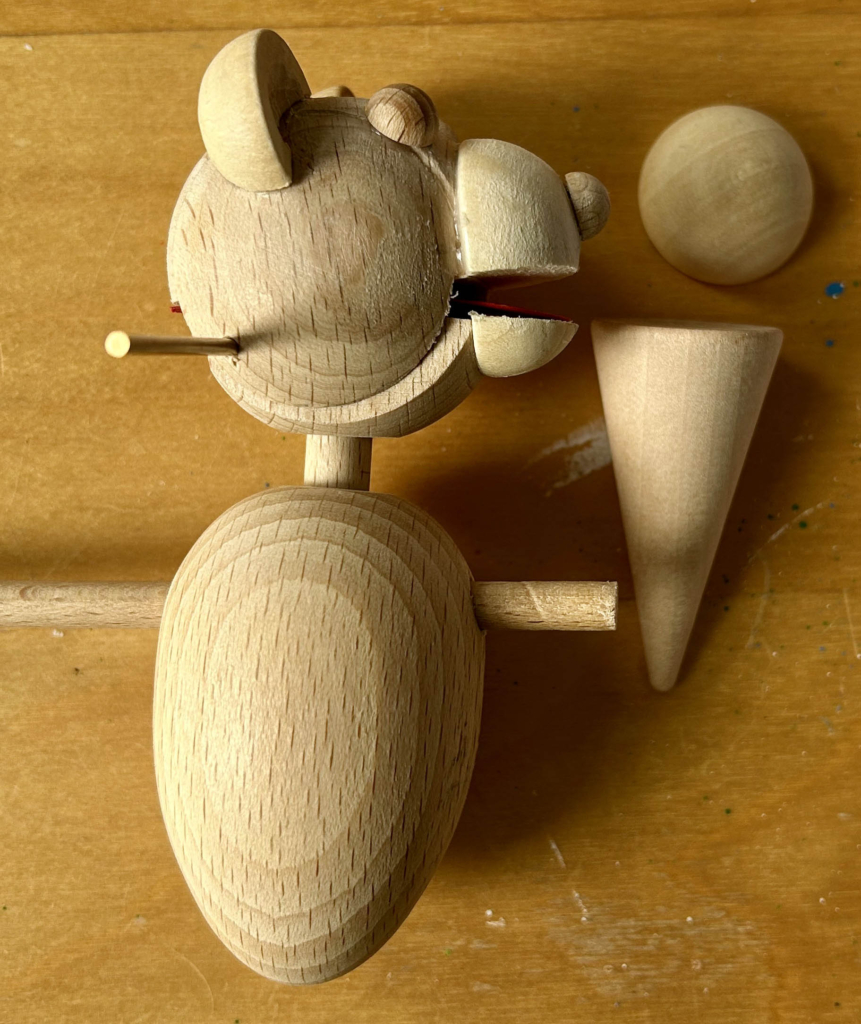
    The Video

    The Berlin Dragonfly

    An unusually warm winter has encouraged a rarely seen species to leave its secret lair next to the pond – the Berlin Dragonfly!

    Link https://www.youtube.com/watch?v=9gJACizfDUo

    Download

    Here are the images compressed for download. https://www.wordwise.de/Dragonfly_Images.zip

  • The Fish School of Ballet

    The Fish School of Ballet

    The Idea

    The way that groups of fish move together has always interested me (flocks of birds too, but that is another story). Occasionally I see underwater nature TV programmes which show how a school of fish move like synchronised swimmers or a group of ballet dancers moving together across a stage. I found one definition of a “school” as a shoal of fish swimming in the same direction to then suddenly all change direction at the same time. My question was – how do they do that? Is it telepathy? Is there a sergeant-major fish who yells “about turn!” So I thought why don’t you make yourself a school of fish and see how you can make it “school”, or dance yourself.

    Inspiration

    Before making anything, I always have a look around hyperspace, to see how others approach the same challenge. It’s boring to simply copy someone else’s work, but seeing what approach they take and how the finished item works out is always an education and often an inspiration. Entering “fish automata” into a search machine, I found quite a few matches. Two impressed me in particular: one with just a nice single fish by Carlos Zapata (https://cabaret.co.uk/fish-2012-by-carlos-zapata/) and another quite complex one with a big school of fish by Matt Smith (https://www.youtube.com/watch?v=CGaj_KlXFqs).

    Approach

    Trying to keep things as simple as possible, I thought maybe I could use a cam to make the fish wiggle. I then decided to let the operator choose in which direction the fish should swim instead of automating a fixed routine of direction changes. Simply turn the crank one way to swim left and turn the crank the other way for the fish to swim right. The operator of the automaton then becomes the choreographer for our fish ballet school.

    Drawings

    I used the Graphic app on my computer to produce scale drawings. This took up most of the time as I kept modifying things as I noticed where bits might bump together, or where gravity might pull parts in the wrong direction. It is hard to follow drawings which you didn’t draw yourself, but together with the photos they should make some sense.

    Front view of base

    For the drawings I used a different colour for each moving part.
    – The yellow part is the crankshaft which is turned by the operator.
    – The red, green and blue parts each carry two fish at the top (not shown).
    – The brown part (the wiggler) holds the stops which limit the movement of the red, green and blue discs.
    – The grey parts are fixed and don’t move.
    As the camshaft is turned, the three yellow wheels drive the red, green and blue discs, turning them until they encounter the stops on the wiggler.

    Top view of parts of base

    The top view follows the same colour scheme but doesn’t show the crankshaft or the box. The grey circles represent wooden hemispheres which act as lengthened bearings for the brass rods, which each hold two fish. I thought these looked like upside down octopus so, to reinforce the effect, I added a 3 mm thick set of arms to each one, which accounts for the odd, grey star shapes. The six small brown circles in the wiggler show the 3 mm dowels which protrude downwards to act as stops, limiting the rotation of each coloured disc.

    Side view of base

    The side view shows the yellow cam responsible for wiggling the fish, four times per rotation. The brown part is hinged at the bottom and a free-running wheel ensures smooth movement as the cam turns. Imagine the cam pushing the wheel and thus tilting the brown part outwards, towards the front of the base. This moves the stops towards the front. The low points on the cam allow the stops to move back towards the rear, encouraged by a spring (not shown).

    The fishy, yellow part to the right is part of the external crank which the operator turns.

    Templates

    One of the advantages of producing drawings is that you can print out and then cut out templates, which speeds up things in the workshop.

    Some parts and their templates

    Base – top

    This is what the underside of the top looks like.

    Three octopus to guide the fish

    The purpose of the hemispheres is to lengthen the bearings (holes) in which the long brass rods sit. The rods must turn easily in the bearings but should stay vertical. Longer bearings keep the rods straighter whilst still allowing them to turn freely.

    Brass rods to hold the fish

    Three brass rods to mount the fish

    Here are the large discs responsible for turning the fish with pieces of dowel protruding from the edge which restrict the amount of turn, when they hit the stops on the wiggler. The long brass rods are carefully fixed, vertically, into the discs using two-component epoxide adhesive.

    The camshaft

    The camshaft

    The camshaft has two identical cams at each end and, between them, there are three drive wheels, each driving one of the discs on the end of a brass rod.

    The wiggler

    The hinged carrier for six stops

    This strange looking thing holds the stops to restrict the rotation of the large discs. It is hinged near the bottom of the base and the spring pulls it against the two identical cams. As the cams turn they move this gently forwards and backwards. The slight movement of the stops causes the large discs to move a little, which in turn make the fish wiggle a little. It is the wiggler.

    The assembled mechanism

    The partially assembled base

    When assembled, the stops on the wiggler are positioned so that they can catch the protruding dowels in the edges of the large discs. For each disc there are two stops. One restricts clockwise movement, the other counterclockwise movement.

    The fish

    Six fish

    I carved the fish from lime wood and added fins made of 3 mm plywood. After cutting each fish into four pieces, I used a fretsaw to cut a slot upwards in each piece, making space for a piece of flexible tape. Some careful gluing later and the fish wiggle in quite a fishy way. Two fish are mounted onto each brass rod using two component epoxy resin adhesive.

    The painted base

    The base before fixing the spring

    Some underwater vegetation builds on the aquatic atmosphere, as does carving the supports to hinge the wiggler as clams. My clams have eyes which makes them a species as yet unknown to science. As the spring is not fixed here, gravity pulls the wiggler away from its intended working position.

    Final assembly & reflections

    Final assembly

    For this project, with an eye on future repairs, I chose to not glue the box together. Instead I used 3 mm dowel to pin the parts together while doing the fine tuning and painting. Once painted, I used brass screws to more permanently hold things together. Making things of wood is great, but wood does react to the moisture levels in the air. This has occasionally caused some of my fully glued creations to jam up, and repair then means having to destroy certain parts and then remake and repaint them.

    Leaving the box without a front or back wall leaves the mechanism clearly visible for the many curious.

    This looks quite complex, but there is not much to it with just a few moving parts. I now even suspect that one cam would probably have been enough to move the wiggler, making it even simpler.

    When my seven-year-old quality control expert tried it out, she played happily with it for quite a long time. It is not really child-proof as the temptation to grab a brightly coloured fish and move it yourself is almost irresistible for small hands. The 2 mm diameter brass rods are fine for adults, but children would need something much more substantial. The fish are also not terribly robust. We will see what time shows. Other makers have used wire rings to join the fish segments together. Maybe that would be a bit sturdier.

    Video

    https://www.youtube.com/watch?v=6NcYk4pT7pw

    Download

    Here are the images compressed for download. https://www.wordwise.de/Fish_archive.zip

  • Undulating Octopus

    Undulating Octopus

    The Idea

    I am currently making a fish automaton, which will appear in a separate article, and I was considering what sort of fish swim around in the sea and what shape and colour they are. A lot of fish have much the same shape, you know, sort of fishy looking, long and sleek with fins and tails. Two exceptions swam into my mind, the first was a seahorse and the second was an octopus. I am sure that I will sometime have fun trying to make a seahorse automaton, but I couldn’t resist pushing the fish to one side and knocking up a simple octopus.

    Fish pushed to one side for an octopus

    The Octopus

    An octopus

    It doesn’t take long to make an octopus as they only have a head and eight arms. I used a wooden egg for the head, sawing the pointy end off to make a flat surface. In this flat surface I then drilled eight holes into which I glued eight pieces of string. Each octopus arm is then made up of 9 wooden beads which I found ready drilled and painted in a hobby shop. I suppose they were intended for children to make a necklace or a wrist band with a bit of elasticated thread. To make a friendly impression, my octopus has a nose and an external mouth with a slightly puzzled expression. I apologise in advance to any biologists who have a better understanding than I do of what is essential for an octopus in its life down in the ocean depths.

    The Mechanism

    As my octopus has eight dangly arms, the simplest movement is to spin it around so that the arms flail outwards. I decided to add a bit of up and down movement to produce some sort of undulation and make the movement what seems to me to be more octopus-like.

    The small box to contain the mechanism

    A small, open box is enough to contain the mechanism driven by a crank.

    Two wooden discs

    We need two wooden discs, one mounted horizontally and the other vertically. You can see that the shaft for the larger disc is mounted off-centre on a 2 mm brass rod. This eccentricity is what is required to produce the up and down movement.

    The basic mechanism

    For each turn of the horizontal shaft its eccentric disc turns once and so pushes the smaller disc up once and allows it to fall down once. The eccentric disc is thus acting as a cam. It could have a more complicated shape to, for example, increase the number of up and down movements per turn. This quite simple mechanism gives us just what we need to make the octopus both spin and move up and down, producing the undulating effect we are after.

    The finished octopus base

    In the finished item you can see that a couple of plastic washers keep the eccentric disc turning smoothly. I have also painted some very small fish around the circumference of the smaller, driven disc. It would be a bad idea to paint the eccentric disc as the abrasion as it drives the other disc would rub the paint off.

    Video

    Youtube link https://www.youtube.com/watch?v=YPYMaLMjkJQ

    Images

    https://www.wordwise.de/Undulating_Octopus_images.zip

  • Wooden Weather

    Wooden Weather

    We have had a lot of weather recently and here is a little more. At least with this version, you won’t get wet feet.

    Inspiration

    A present for Kim

    The other day, a young friend of mine gave me a present, a beautiful picture of a rainbow. This made me wonder whether anyone had tried to make a wooden weather automata. A quick search found one match (https://oldchapelgallery.co.uk/product/wooden-automata-rain-machine/) “Wooden Automata Rain Machine” made by Ian McKay.

    Image from the Old Chapel Gallery

    This suggested using a crankshaft to make the raindrops move up and down and I thought, “I’ll go for that” but, along the way, I decided to embellish the design with a rainbow, a sun, a cloud and ultimately a small bird.

    Making

    A rainbow is a simple geometric exercise and I chose to have 6 colours. As a boy I learned Richard Of York Gave Battle In Vain to name the sequence of seven colours in the rainbow, red, orange, yellow, green, indigo and violet. I have never understood the difference between indigo and violet, so I decided to drop indigo leaving just six colours.

    A rainbow

    The cloud was fun. Cotton wool is often used to suggest clouds but I have a good collection of wooden balls.

    Selection of small wooden balls

    So, with some sanding and gluing, I could make a cartoonish sort of cloud which was just right.

    Making a wooden cloud

    After a bit of painting, I used some 4 mm dowel to glue the cloud firmly to the rainbow. This meant that I could hold the cloud in a fixed attitude and could drill four parallel holes for the raindrops.

    Drilling the cloud to let the raindrops fall

    I then drilled matching holes in the base, as well as a hole up through the rainbow for the 4 mm dowel which holds the sun up in the sky.

    Brass raindrop rods

    For the movement, I used a piece of brass rod and bent it using pliers, sliding on some drilled 4 mm dowel pieces as bearings before adding the next bend. The four bearings are roughly at 0°, 90°, 180° and 270° so that each raindrop seems to move out of phase with the others.

    The crankshaft

    You can see that the crankshaft also turns a wheel at the left. This wheel will friction drive the hemisphere attached to the bottom of the dowel holding the sun.

    The linkages on the crankshaft

    After adding bearings made of drilled pieces of dowel to the bottom of the raindrop rods, I attached linkage rods to the crankshaft before fitting it all together and fixing the ends into the bearings by adding a final bend.

    The finished drive assembly

    To stop the bearings from slipping out of their respective brass loops, I then added a drop of two-component epoxy resin glue to the outside of each bearing.

    Mistake 1 – Moving Holes

    When I did my trial assembly I found that I had made the linkage rods too short and the mechanism jammed. Once I recognised the problem, I had to move the holes in the right hand side and in the internal partition down 10 mm. To move a hole, you fill the old hole with a suitably thin piece of dowel (first making the hole bigger if necessary) and then drill a new hole.

    Mistake 2 – Cloud Too Thin

    Once everything moved smoothly, I found that the rod for the right hand raindrops kept falling out of the cloud. When I made it longer, it then poked out of the top of the cloud on the up stroke. I thought about inflating that end of the cloud by the addition of a new ball, but then decided to add a small bird, calmly flying high up, towards the sun, thus keeping its feet nice and dry.

    A serendipitous bird

    This was then a case of serendipity and not a mistake at all! Isn’t it fun just making things up as you go along!

    The Video

    Wooden Weather video

    URL https://www.youtube.com/watch?v=eH0Ha5dDb-g

    The Images

    https://www.wordwise.de/Wooden_Weather_Archive.zip

  • The Unexpected Visitors

    The Unexpected Visitors

    Our princess had just been to the hairdressers which was so tiring that she settled down in a comfy chair in the garden and drifted off into a deep sleep. Meanwhile a sudden gust of wind in the treetops blew a new family out of the branches of a tree to drift down onto the lawn, tipping everyone out on the way. Well that new hairdo looked just right so it took no time at all to move everyone into this luxurious new abode. 

    And the moral of this story is – be careful where you nod off when you’ve just had your hair done!
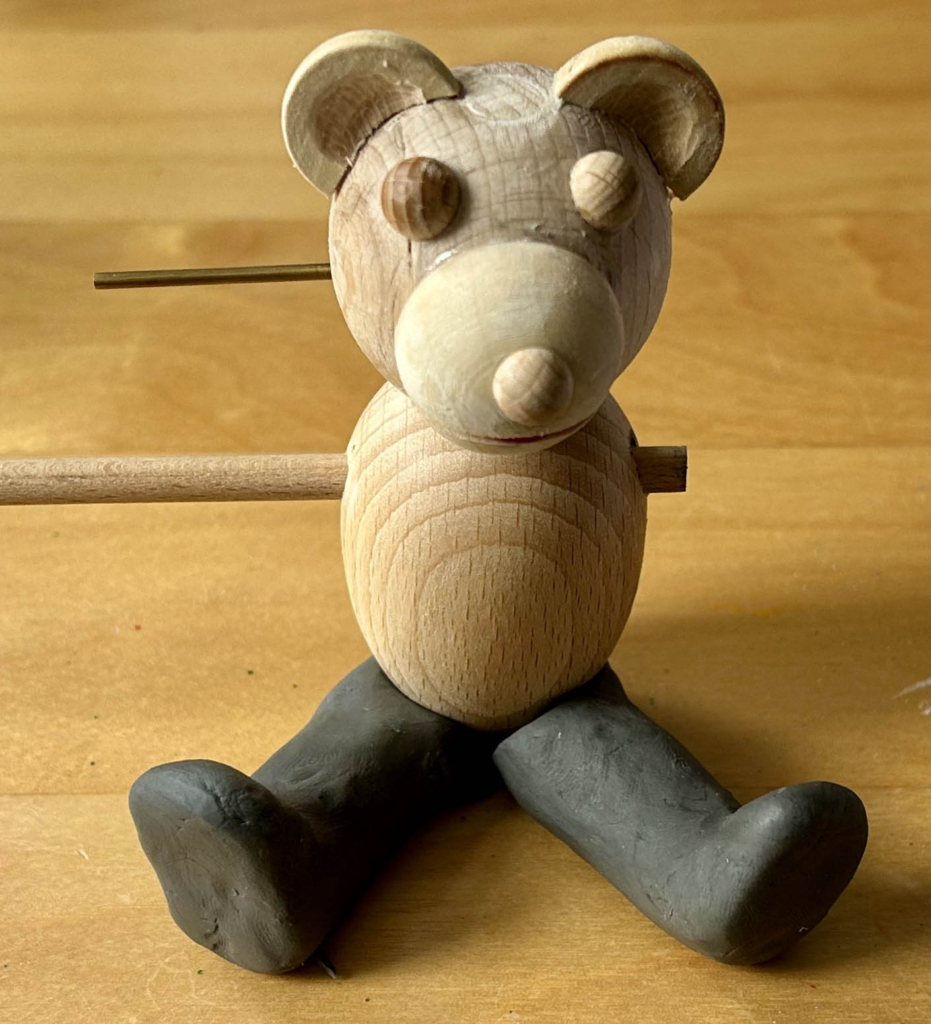
    What was the idea?

    I was sketching a few figures in an idle attempt to move away from my usual style when my wife piped up and said that’s good.

    The initial sketch

    As all dutiful husbands do, I agreed with her and knocked up a maquette in plastercine.

    The plastercine maquette

    Some things changed a bit along the way. Now there are only 3 birds and the girl is now wearing stylish glasses. I took some photos and scaled the size of the printout to match the size of my piece of wood. Cutting out the figures from the printout allowed me to mark up my wood to prepare for cutting and carving.

    The movement

    I decided to make the birds move up and down as the handle is turned. This is the reverse of what goes on in an internal combustion engine for example. Instead of pistons moving up and down to cause some rotation, in this case the rotary movement causes the birds to move up and down, excited by the prospect of ma or pa bird returning with a juicy worm in their beak.

    The unfortunate hostess for this pretty scene can do no more than wait patiently for calm to return, maybe tying a knot in her hanky to remind herself not to fall asleep again in the garden during the nesting season.

    Making

    After marking up the wood, the first thing to do is to drill three holes for the birds to move in while things are still square enough for precision. The birds bodies are basically 10 mm diameter dowel so the holes are 11 mm to allow easy movement up and down.

    Three bird holes

    Then the larger pieces of waste can be removed by sawing. Carving is much harder work than sawing so the more that you can remove like this the better.

    Carved hair ring / nest

    It’s handy to refer to the plastercine maquette every now and again while carving and after a few days things will take on the required shape.

    The required shape

    The base

    The base is a box with a crankshaft.

    Most parts for the base
    The crankshaft with bearings to connect three birds

    The crankshaft has three bearings at approximately 0 degrees, 120 degrees and 240 degrees. If you look from the end along the main shaft, you will see the three bearings (made from a piece of drilled dowel) evenly spaced around the shaft. I just bent a piece of 1.6 mm brass rod with a pair of pliers until it looked about right, fitting the wooden bearings as I went along. Once the rod is bent the bearings cannot be slid on, or off, which is just what we want; three reliable places to connect the birds with no risk of parts slipping out of place and jamming. The internal partitions are there to keep the crankshaft in place so that it can’t slip to the left or right..

    Partially assembled base

    The birds

    Three birds waiting to be connected

    The birds have to be painted before assembly in cheerful, birdy colours.

    Slots cut in bottom end of birds

    After positioning the birds with their cheeky beaks all pointing outwards, they have to be marked so that slots can be cut to fit a brass rod with a loop at the end into each slot. A pin pushed through the eye of each loop holds it in place. This arrangement prevents the birds from twisting around and poking one another with their beaks.

    Birds with their connecting rods

    Note that to align the connecting rods to the wooden bearings on the crankshaft, I had to add a sideways offset to the yellow and green birds’ rods.

    Connecting rods attached to crankshaft bearings

    After checking for easy movement, I used epoxy resin to glue the connecting rods to the wooden bearings on the crankshaft.

    Reflections

    I was amazed to find that with my hand-bent “crankshaft” the movement was very smooth, with little effort required. It is a very compact solution too. I didn’t carve the birds as they are comparatively small and the bright colours certainly catch your attention once they start moving about. Carving the main 12 cm tall figure took quite a bit of work, but I think it was worth it.

    The video

    Link https://youtu.be/cQ8qP7Q0Dos

    Downloadable Images

    https://www.wordwise.de/Animals_images.zip

  • Animals in Orbit

    What was the idea?

    There is a range of small wooden figures widely offered for sale for young families with each figure sitting on a standardised piece of 17 mm diameter dowel. There is then a matching range of bases with 17.5 mm diameter holes into which the figures can be plugged. Apart from the plugging and unplugging, this is a very static affair so I decided to add some movement and open up a whole new world, to boldly go where no turkey has gone before. I also find that the commercially available, mass-produced figures are a bit too simple, restricted as they are by the low price that parents are traditionally willing to pay for them. I like to take a few hours to carve each small figure which presumably makes them commercially unviable, but hey, I make things for fun, not money.

    The movement

    Round base with the crank mechanism

    A 15 cm plywood disc serves as the base. It has four supports for the lid and a central bearing which allows the vertical spindle to turn freely. Turning the crank rotates the drive wheel on which a disc rests which is attached to the vertical spindle. Friction means that when the drive wheel is turned, it causes the disc to turn, rotating the vertical spindle.

    This very simple mechanism is extended by the addition of two wooden cogs. One is glued to the cranked shaft and the other is fixed to a small music box mechanism. This arrangement means that when the handle is cranked the wheel turns and the cogs also turn to produce a merry tune. The music box mechanism uses a ratchet to drive its music drum. Turned the “wrong” way, the ratchet simply clicks harmlessly now and then and no music is produced.

    The vertical spindle

    The vertical spindle is glued to a disc which is friction-driven round and round. The spindle passes freely through the middle of another 15 cm disc above which both a 67 mm hemisphere and sphere are fixed. The hemisphere is used to fix the arms holding the figures and, with a lick of paint, the sphere looks like our planet Earth.

    Five arms

    The five arms are made of 8 mm dowel attached to 40 mm hemispheres with a 17.5 mm hole drilled in the centre. Stretch your imagination a little and these could be flying saucers.

    The Animals

    A peacock
    A squirrel
    A cat
    A polka-dot horse
    A snail (with moustache)
    A zebra

    The Video

    Animals in Orbit – video

    Link https://www.youtube.com/watch?v=tVyCAvw8i4U

    Reflections

    This is a fairly simple carousel with music. The ability to change the passengers makes it more interactive, especially for kids who like to put their own slant on things. I can carve as many figures as I feel like as they can always form an orderly queue to wait for their turn for a ride. Apart from the five flying saucers there is also one prime position right on top of the world.

    Downloadable Images

    https://www.wordwise.de/Animals_images.zip

  • Twirler

    Terry’s a twirler
    An accomplished swirler
    A polished curler
    Magic with the ball
    He never lets it fall
    At all…

    Terry the Twirler

    What was the brief and how did it change?

    I started out with the idea of a dog chasing its tail on a small base. Having made a base with a crank to spin the turntable on the top, I then decided that the dog was a bit boring and that something more interesting was required.

    The poor dog, endlessly chasing its tail

    A few pencil sketches later and I settled on a figure doing some sort of Victorian dance, with its arms diagonal making a more interesting movement as the turntable rotates.

    A drawing, the wire & plastercine maquette, and the carved figure

    Adding long rabbits ears emphasised the movement and a ball precariously perched on the top hand looks as if it might fly away at any moment. I’m not sure exactly what the result is but it was fun to make.

    Making

    Parts for the base

    The parts for the base are mostly made of 3 mm plywood. The finished base is 55 wide x 55 deep x 43 mm high. The 15 mm diameter drive wheel and the 23 mm diameter turntable are made of 8 mm plywood. Using thick wood for the drive wheel increases the surface area in contact with the turntable thus providing more reliable operation.

    Assembling the base 1

    The dowel serving as the axle for the turntable rotates freely in a bearing glued to the bottom of the base. A wider piece of dowel is glued to the axle to prevent it from being completely removed.

    Assembling the base 2

    When these two pieces are glued together, the turntable can turn but cannot fall out.

    Assembling the base 3

    The crank is made from a piece of bent brass rod and this is glued to the drive wheel using 2-component epoxy resin adhesive.

    Assembling the base 4

    When the drive wheel is fitted, it lifts the turntable so that it no longer rests on the top piece of plywood but sits snugly on the drive wheel.

    Assembling the base 5

    After checking that everything moves OK, the final side piece and the top can be glued in place. Two wooden spheres are fitted to the crank handle. The large ball turns freely while the small one is glued in place to prevent the large ball from falling off.

    After carving and painting the figure, it can then be pinned onto the turntable with short pieces of 3 mm dowel and glued in place.

    Final Reflections

    Recently aiming to make smaller pieces, I was pleased that it’s possible to make a comparatively small base with a reliable, crank-operated turntable. Although music boxes often feature a ballerina turning on tip-toe, I feel that just turning a figure without it “doing” anything else means that the figure has to be more interesting.

    Twirler Video

    Video

    Link to video https://youtu.be/wQoWH47zrHs

    Images

    Download the images from here https://www.wordwise.de/Twirler_images.zip

  • Visit to the Musée des Automates, La Rochelle, France

    In 2021, I visited La Rochelle, an attractive seaside town on the Bay of Biscay in France. After a delicious lunch in one of the waterside restaurants, I popped into the Musée des Automates & Modèles Réduits (Museum of Automata and Scale Models – https://museeslarochelle.com) to take a look at their collection.

    This museum opened to the public in 1984, with more than 30 years of work by the museum’s original creator, Michel Gaillard, to build up this collection. In addition to some prestigious antique pieces (for example made by Jouets et Automates Français (JAF), or Decamps …), there are some large animated displays. There are apparently more than 300 moving figures: mostly antique, with some animated window displays and historical scenes. I thought that I would share just a few impressions of what’s on offer.

    Here is part of a reconstruction of the “Montmartre” district of Paris, which is used as a setting for some of the automata from the first part of the 20th century.

    Montmartre street scene
    A butcher’s shop

    One of the shop windows shows a French butcher’s shop, with an automaton which I guess was used for advertising in the days before television took over the job. It reminded me of a modern work by Paul Spooner “Little Reinhold’s Wonderful Sausage Machine”.

    “Groom de service” 1923

    It’s fun to speculate what this piece “Groom de service” made by JAF in 1923 was used for. I imagined it on the counter of a bar serving plates of salted snacks to keep the customers thirsty.

    Le Jouer de Bonneteau

    Of course there was a magician.

    The caption reads “Vauconson réalisant son célèbre automate canard. Réalisation Laurent 13 mouvements”

    This work made me wonder a bit. It’s an automaton showing an automaton-maker at work. Its title loosely translates as “Vauconson making his famous mechanical duck. I took a quick peek in Wikipedia to find an article in French about a digesting or defecating automaton duck, created by Jacques de Vaucanson around 1734.

    More detail of what Vaucoson was working on

    Here is a link to an automated translation of the French Wikipedia article https://translate.google.com/website?tl=en&u=https://fr.m.wikipedia.org/wiki/Canard_de_Vaucanson&sl=fr for those interested in defecating ducks.

    A classic automaton showing a clown balancing on a ladder, made in 1895

    This clown balancing on a ladder together with a pig balancing a ladder on its nose, was made in 1895 by another famous automatist called Leopold Lambert. Follow this link https://mus-col.com/en/the-authors/10280/ for a short biography.

    It was an interesting visit for me even though I know nothing about antique automata. The entrance fee also includes a visit to the adjacent museum which has a collection of model ships and a model railway setup.

    The museum is within walking distance of La Rochelle town centre at 12-14 rue de la Désirée, 17000 La Rochelle

    Other Automata Museums in France

    If you search for “musée des automates”, you will find several matches in France.

    I will certainly be popping in to see what they have to offer, the next time that I am in the vicinity.

    Images

    Download the images from here https://www.wordwise.de/La_Rochelle_Images.zip